
AI Hallucination in Legal Practice: Definition, Sanctions, and Attorney Obligations
A formal glossary entry defining AI hallucination in the legal context — fabricated case citations, distorted holdings, and false procedural information — and explaining the governing legal frameworks (Rule 11, ABA Model Rules, inherent authority), the documented sanctions spectrum, and attorney verification obligations.
Lex Machina Review is an independent risk-tracking and reference resource. Nothing on this site is legal advice, and using it does not create an attorney-client relationship. Every record is reviewed against primary sources but may not reflect the most current status of a matter — always verify directly against the cited court order, rule text, or a licensed attorney before relying on it.
Companion explanation — secondary to the source document above
What Is an AI Hallucination in Legal Practice?
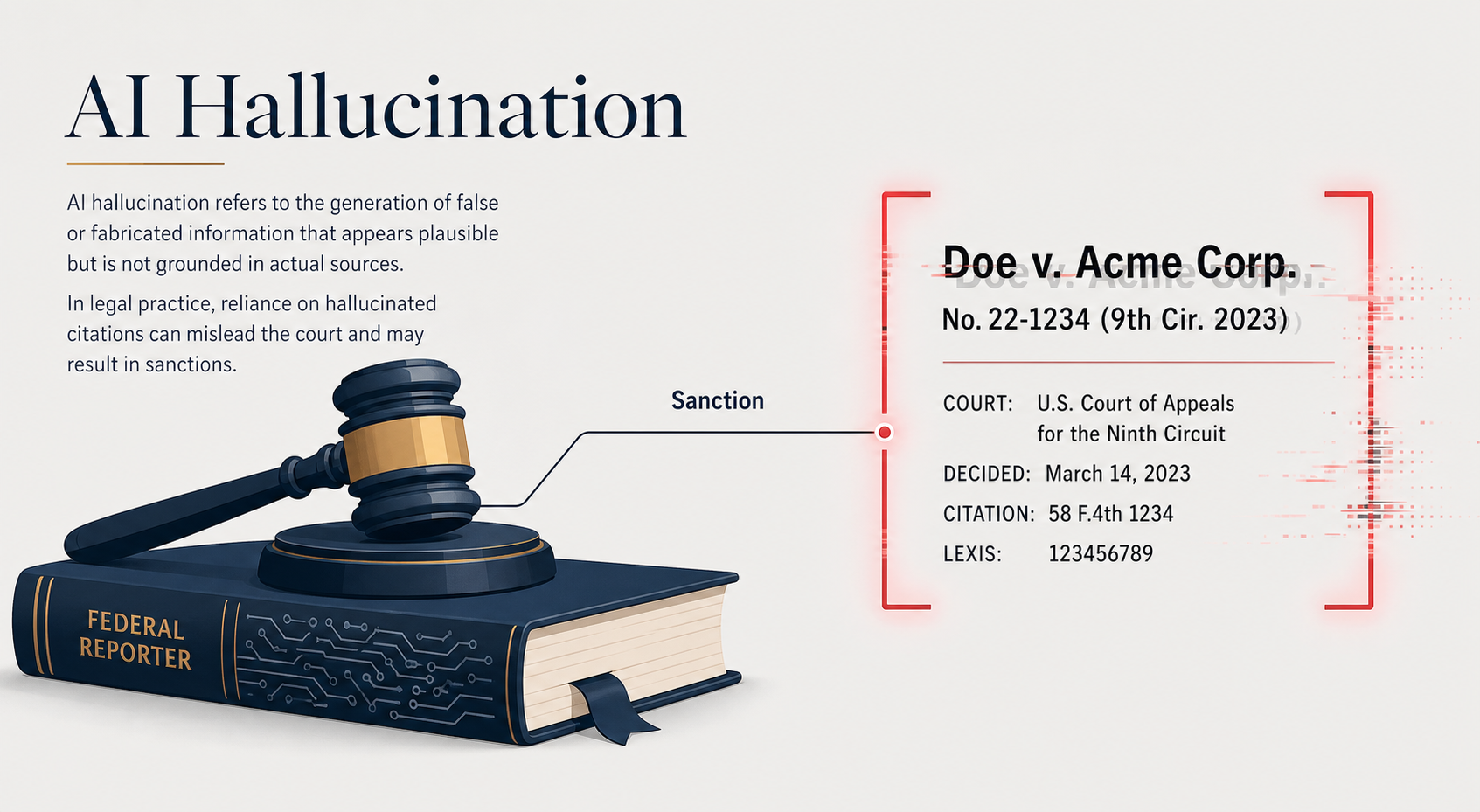
In the legal context, an AI hallucination is the generation by a large language model of fabricated case citations, distorted holdings, invented statutes, or false procedural information that appears authentic but is incorrect. The National Center for State Courts (NCSC) defines it as the generation of "fabricated case citations, distorted holdings, or false procedural information that appears authentic but doesn't exist or is factually incorrect." This is distinct from a general AI hallucination — where a model might describe a non-existent historical event or invent a product feature — because a legal hallucination directly undermines the integrity of the judicial record and the attorney's duty of candor to the tribunal.
The scale of the problem is substantial. The Damien Charlotin AI Hallucination Cases Database tracked 1,598 cases worldwide as of June 9, 2026, where courts found or implied AI hallucinated content. Of those, approximately 1,115 are in U.S. courts. The database breaks down the nature of the hallucinations: 1,334 involve fabricated authorities, 427 involve false quotes, and 653 involve misrepresented holdings. These are not isolated incidents — a Thomson Reuters Westlaw study found 22 different cases between June 30 and August 1, 2025, where courts or opposing parties identified non-existent cases within filings, leading to discipline motions or sanctions.
Why Large Language Models Hallucinate Legal Authorities
Large language models are predictive text generators, not databases. They generate text by statistically predicting the next most likely token based on patterns in their training data. As the NCSC guidance explains, these models "generate text that sounds right rather than text that is right." When asked to produce a legal citation, the model does not retrieve a verified record from a trusted source — it constructs a sequence of characters that resembles a citation it has seen in training. This architecture makes hallucination an inherent feature, not a bug that can be fully eliminated.
The risk is particularly acute in legal research. A 2025 study from Stanford's CodeX Center found that general-purpose LLMs fabricate case citations in approximately 30–45% of legal research responses. Purpose-built legal AI tools that incorporate retrieval-augmented generation (RAG) and are fine-tuned on legal databases show significantly lower hallucination rates, but no system is immune. The attorney's duty of verification remains non-delegable regardless of the tool's claimed accuracy.
Three Categories of Legal Hallucinations
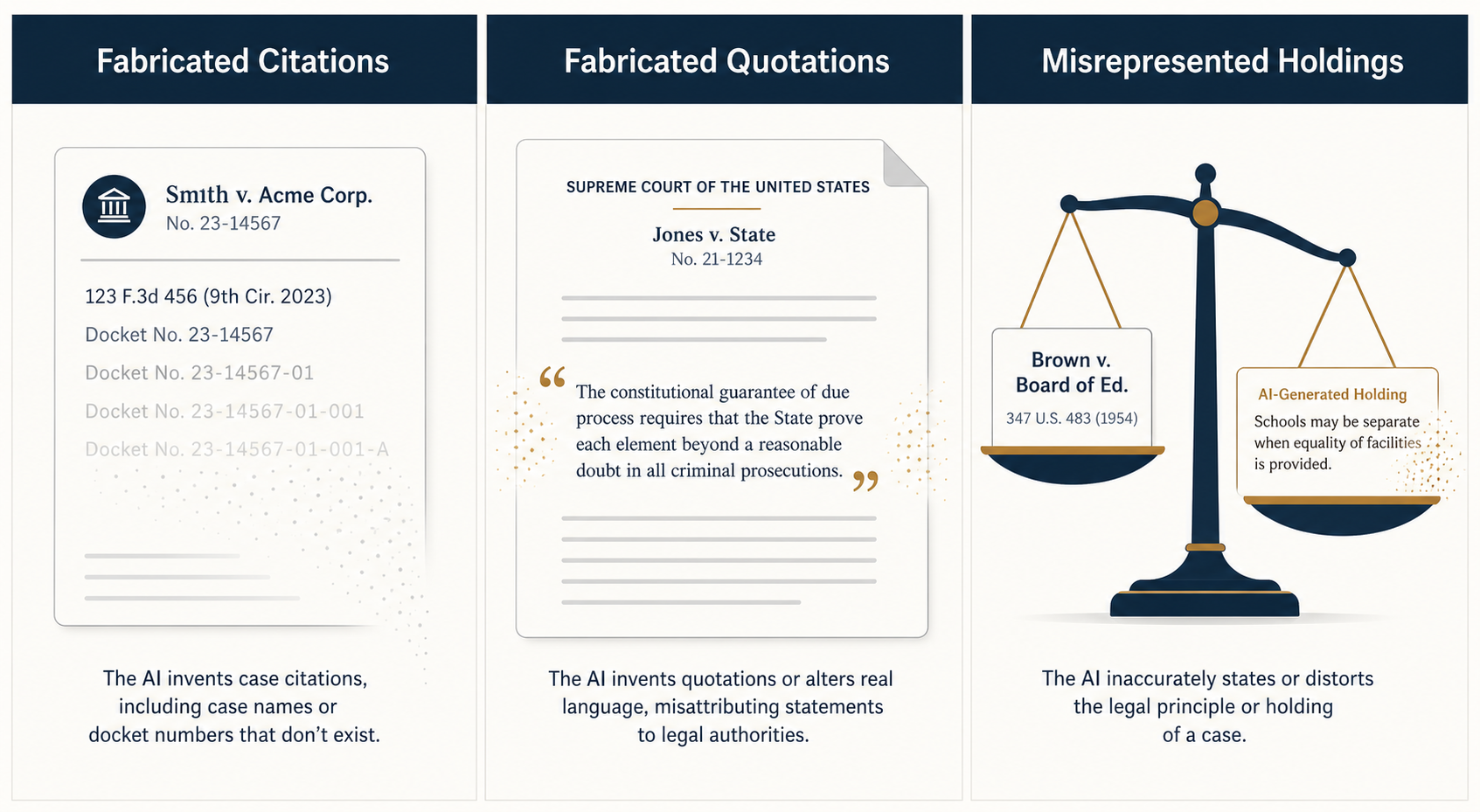
Legal hallucinations fall into three primary categories, each with distinct implications for court filings and professional responsibility. Understanding these categories helps attorneys identify potential errors during verification.
1. Fabricated Citations to Non-Existent Authorities
The most common and most dangerous category: the model invents a case name, docket number, reporter citation, or statute that does not exist. The fabricated citation often looks authentic — it follows proper Bluebook format, includes plausible party names, and cites to a real court. The landmark case in this category is Mata v. Avianca, where an attorney submitted a brief containing six fabricated cases generated by ChatGPT. The court imposed a $5,000 sanction and publicly reprimanded the attorneys. In Johnson v. Dunn (N.D. Ala. July 23, 2025), three experienced litigators were sanctioned after submitting filings with fabricated citations, resulting in public reprimands, disqualification from the case, and referrals to the Alabama State Bar.
2. Fabricated Quotations Attributed to Real Cases
In this category, the model correctly identifies a real case but invents a quotation or holding that does not appear in the opinion. The citation is valid; the attributed language is not. This is particularly insidious because a quick Westlaw or Lexis search confirms the case exists, but the attorney must read the actual opinion to discover the quotation is fabricated. The Sterne Kessler review identifies this as one of three distinct hallucination types, noting cases where "citations to real quotes from real cases fail to support or contradict a proposed legal proposition."
3. Misrepresented Holdings or Distorted Legal Propositions
The model cites a real case and a real quote but misrepresents what the case actually held. The quote may be taken out of context, applied to a different legal question, or reversed on appeal without the model's awareness. This category is the hardest to catch because both the citation and the quotation are authentic — only the legal analysis connecting them is wrong. The NCSC guidance includes "distorted or misrepresented facts, quotations, or holdings" and "unsupported propositions of law" as distinct hallucination types.
Governing Legal Frameworks: Rule 11, Inherent Authority, and Ethics Rules
Courts have uniformly held that AI does not change the attorney's non-delegable duty to verify the accuracy of all representations made to the court. Sanctions for AI-generated hallucinations are imposed under existing legal frameworks, not AI-specific statutes. Three primary sources of authority govern these sanctions.
- FRCP Rule 11(b)(2)-(3): Filing a brief with fabricated citations violates Rule 11(b)(2) (frivolous arguments) and Rule 11(b)(3) (unsupported factual contentions). The court may impose sanctions on the attorney, the law firm, or both. Senior Judge Walter H. Rice (S.D. Ohio) described the violations in one case as "the most egregious violations of Rule 11" he had seen, imposing a collective $7,500 sanction and referring the attorneys to the Ohio Supreme Court's Office of Disciplinary Counsel.
- Inherent Authority (Chambers v. NASCO): Even where Rule 11 may not apply, courts retain inherent authority to sanction bad-faith conduct that abuses the judicial process. The 9th Circuit's June 3, 2026 decision in Lnu v. Blanche relied on inherent authority to impose a $2,500 sanction on each of two attorneys, a six-month suspension from practicing before the court, and a two-year AI disclosure requirement, finding they "violated their duty of candor" by failing to own up to the use of AI.
- ABA Model Rules 1.1, 3.3, and 5.3: ABA Formal Opinion 512 (2024) confirmed that existing professional conduct rules apply to AI-assisted work. Model Rule 1.1 (competence) requires attorneys to understand the technology they use, including its limitations and hallucination risks. Model Rule 3.3 (candor to the tribunal) prohibits knowingly offering false evidence — and ignorance of AI-generated errors does not excuse the violation. Model Rule 5.3 (supervision of nonlawyer assistance) applies to AI tools as a form of nonlawyer assistance, requiring the attorney to make reasonable efforts to ensure the tool's conduct is compatible with the lawyer's professional obligations.
The Sanctions Spectrum: Documented Cases and Monetary Ranges
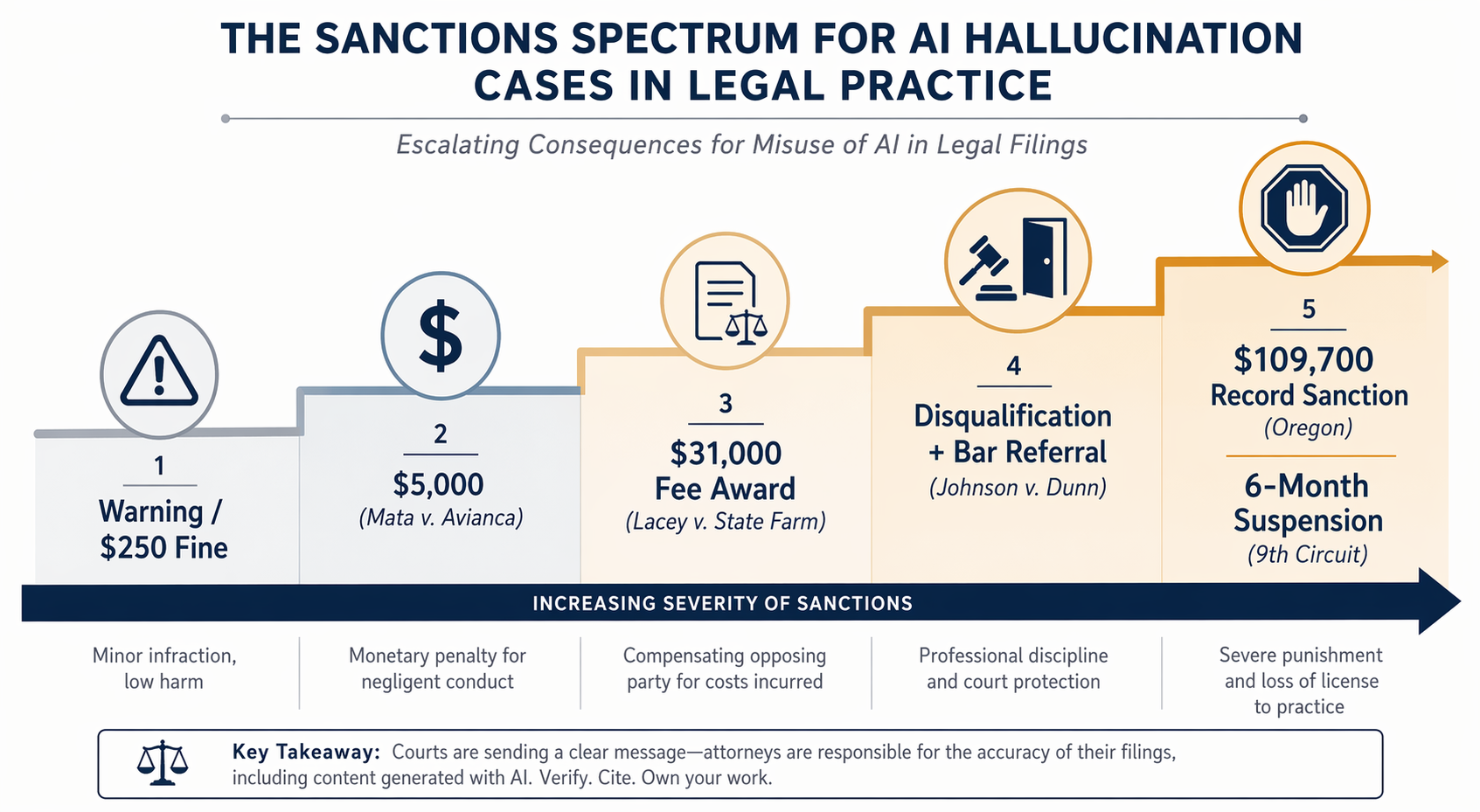
Sanctions for AI-generated hallucinations span a wide spectrum, from nominal fines to practice suspensions and bar referrals. The severity depends on the court's assessment of harm, culpability, remediation, and deterrence. The following table catalogs key documented cases with concrete figures.
| Case / Incident | Court | Sanction Amount | Additional Consequences | Key Factor |
|---|---|---|---|---|
| Mata v. Avianca | S.D.N.Y. | $5,000 | Public reprimand | No remediation; attorney blamed ChatGPT |
| Lacey v. State Farm | C.D. Cal. | $31,000 (fee award) | No individual sanctions on attorneys | Full, fair, sincere admissions of responsibility |
| Johnson v. Dunn | N.D. Ala. | Not specified | Disqualification, bar referral, citation-sharing order | Extreme dereliction; no remediation |
| In re Martin | Bankr. N.D. Ill. | $5,500 | Mandatory AI training | Attorney accepted responsibility |
| Kaur v. Desso | N.D.N.Y. | $1,000 | Mandatory CLE on AI | Moderate remediation |
| Lnu v. Blanche (9th Cir.) | 9th Circuit | $2,500 per attorney | 6-month suspension; 2-year AI disclosure requirement | Lack of candor; 'subtle subterfuge' |
| Oregon record sanction | Federal court (Oregon) | $109,700 | Not specified | Highest documented monetary sanction |
| 6th Circuit collective sanction | 6th Circuit | $30,000 (total) | Case dismissed | Two dozen+ fake citations |
| 5th Circuit sanction | 5th Circuit | $2,500 | None specified | Attorney didn't accept responsibility |
| S.D. Ohio (Judge Rice) | S.D. Ohio | $7,500 (collective) | Contempt finding; bar referral | Most egregious Rule 11 violations |
The pattern is clear: attorneys who promptly admit the error, correct the record, and demonstrate good-faith remediation receive significantly lower sanctions. In Lacey v. State Farm, the court awarded $31,000 in attorney's fees and costs but declined to sanction individual attorneys because "their admissions of responsibility have been full, fair, and sincere." By contrast, in Johnson v. Dunn, where the court found "extreme dereliction of professional responsibility," the sanctions included disqualification, bar referral, and an unusual order requiring each sanctioned attorney to provide the sanctions order to every client, colleague, opposing counsel, and presiding judge in active matters.
Proportionality in Sanctions: The Four-Pillar Framework
Courts are increasingly applying a structured proportionality framework to calibrate sanctions for AI hallucinations. The EDRM four-pillar framework, authored by Hon. Ralph Artigliere (ret.) and Prof. William F. Hamilton, identifies four factors courts weigh when determining sanctions.
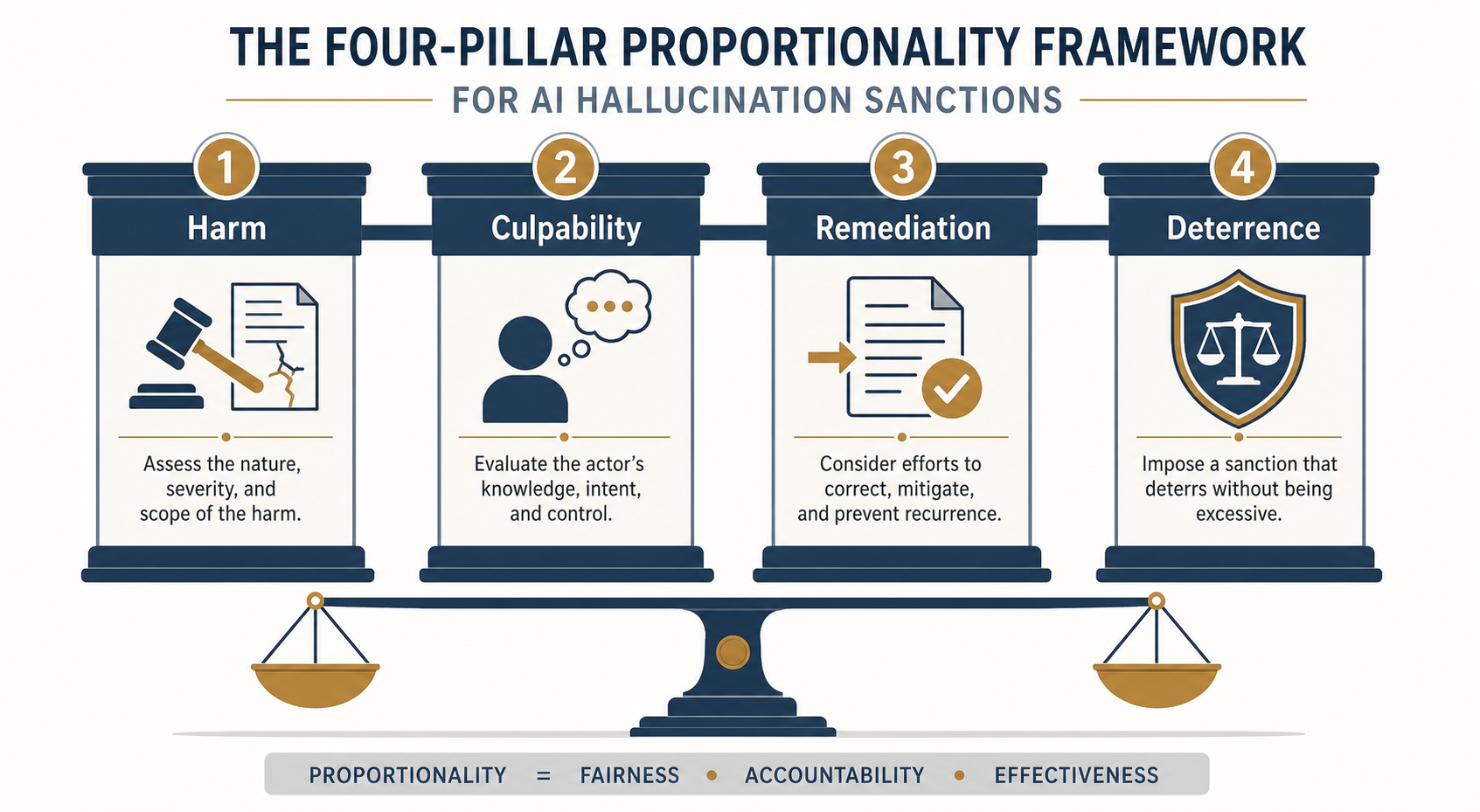
- Harm: What was the impact on the opposing party, the court, or the integrity of the judicial process? Did the fabricated citation affect the outcome of a motion or trial? In Johnson v. Dunn, the harm was substantial — the opposing party had to expend resources to identify and brief the fabricated citations, and the court's trust in the filing attorneys was fundamentally compromised.
- Culpability: Was the attorney negligent, reckless, or intentional in their use of AI? Did they have firm-wide AI policies in place? In Johnson v. Dunn, the court noted that the firm itself was not sanctioned because it had AI policies in place — but the individual attorneys were sanctioned for failing to follow those policies. In the 9th Circuit's Lnu v. Blanche decision, the court found that attorney Sethi engaged in "subtle subterfuge" by correcting a filing containing hallucinated cases without disclosing they were fabricated, elevating culpability.
- Remediation: Did the attorney promptly correct the record, notify the court and opposing counsel, and take steps to prevent recurrence? This is the single most important factor in reducing sanction severity. In Lacey v. State Farm, full and sincere remediation led the court to decline individual sanctions despite awarding $31,000 in fees. In In re Martin, the attorney accepted responsibility and received a $5,500 fine plus mandatory AI training — far less severe than the sanctions in cases where attorneys attempted to conceal the error.
- Deterrence: What level of sanction is necessary to deter this attorney and others from similar conduct? Courts are increasingly using escalating sanctions to send a message. The 9th Circuit's six-month suspension and two-year AI disclosure requirement in Lnu v. Blanche was explicitly designed to deter future misconduct. The $109,700 Oregon record sanction serves a similar deterrent function.
Court-Specific AI Disclosure Rules
A rapidly growing number of courts now require attorneys to disclose their use of AI in filings. As of early 2026, over 40 federal district courts have standing orders on AI use, according to multiple sources. The 9th Circuit's June 2026 decision in Lnu v. Blanche added a new dimension: a two-year order requiring the sanctioned attorneys to disclose in future filings whether generative AI was used and the name of the AI program. The Eastern District of Texas modified Local Rule CV-11(g) to explicitly address AI use in filings.
These disclosure rules vary widely. Some require a simple certification that AI was not used to generate legal analysis; others require detailed disclosure of the specific AI tool, the prompts used, and the verification steps taken. The Ropes & Gray AI Court Order Tracker suggests that 667+ court orders addressing AI for filings and drafting have been issued, though the frequently cited "40+ districts" figure may be an undercount as of June 2026. Proposed Federal Rule of Evidence 707, approved for public comment in June 2025, would subject machine-generated evidence to Daubert-like standards, potentially creating a uniform federal framework.
Verification Obligations and Safe Practice Protocols
The NCSC establishes a clear standard: "never trust, always verify." Every citation generated by an AI tool must be independently verified against a primary legal research database — Westlaw, Lexis, Bloomberg Law, or an official court docket. This is not optional, and it is not delegable to the AI tool itself. The following protocols represent current best practices for avoiding AI hallucination sanctions.
- Verify every citation against a primary source. Do not rely on the AI tool's own verification features. Open the actual case or statute in a trusted legal research platform and confirm the holding, quotation, and citation format match what the AI generated.
- Maintain human-in-the-loop review. At least one licensed attorney who did not use the AI tool should review every filing for citation accuracy before submission. This creates a second line of defense against hallucinated content.
- Implement firm-wide AI use policies. In Johnson v. Dunn, the firm was not sanctioned because it had AI policies in place — but the individual attorneys were. A written policy that specifies permitted tools, verification requirements, and consequences for non-compliance provides both guidance and a liability shield.
- Document verification steps. Maintain a record of which citations were verified, by whom, and on what date. In the event of a hallucination, this documentation demonstrates good-faith compliance with professional responsibility obligations and can significantly reduce sanction severity.
- If you discover a hallucination, correct it immediately. The single most important factor in reducing sanctions is prompt, honest remediation. Notify the court and opposing counsel, file a corrected brief, and explain what happened. Do not attempt to conceal the error or blame the AI tool without taking responsibility.
- Use purpose-built legal AI tools, not general-purpose chatbots. Tools that incorporate RAG and are fine-tuned on legal databases have significantly lower hallucination rates than general-purpose LLMs. However, no tool is immune, and the verification obligation applies regardless of the tool used.
The stakes are high and rising. The Thomson Reuters study found 22 cases with fabricated citations in a single month (July 2025). The NPR report notes that 10 cases from 10 different courts were identified on a single day. The 2025 ABA TechReport found that 79% of lawyers report using AI tools. As adoption accelerates, so will the frequency of hallucination incidents — and the severity of sanctions for attorneys who fail to verify.
Related records
Tool profile
Browse tool evaluations →Governing regulation
Browse the obligations tracker →Preventive workflow
Browse verification workflows →
Report a correction or tip
Spotted an outdated figure, a misstated fact, or a ruling this case record should reflect? Public comments are disabled for this content given the professional cost of a misreported case outcome, penalty amount, or rule text — use the structured correction channel instead.
Report a correction or tip for this record →