
Flagship tracker
Risk Digest
The flagship, near-daily updated database of documented AI hallucination and sanction incidents in legal proceedings worldwide. Each entry is a structured record, not a news article: jurisdiction, court, judge (if named), the AI tool implicated, penalty amount, ruling date, a confirmed-vs-reported status flag, and a link to the primary court order. Serves the 'check risk' and 'track regulation' tasks: a lawyer, risk manager, or journalist scanning for new sanctions, a specific jurisdiction, or a specific tool. Excludes narrative commentary, procedural how-to guidance (belongs in Workflows), and rule text summaries (belongs in Regulation). This group is the site's differentiation engine: freshness and per-record sourcing are the moat, so every record must carry a last-verified timestamp distinct from the ruling date.
Confirmed
A court order or docket entry has been independently verified.
Reported — unverified
Still pending independent verification against a primary source.
 CONFIRMEDUpdatedJurisdictionGermanyCourtFederal Court of Justice (Bundesgerichtshof)ToolNo AI tool namedRuling dateMar 20, 2024
Anwar Raslan's Life Sentence Stands After German Appeal
A verified record of Anwar Raslan's conviction and appeal: the Higher Regional Court of Koblenz sentenced him to life imprisonment for crimes against humanity, and Germany's Federal Court of Justice confirmed the sentence in 2024.
Last verified
 REPORTED — UNVERIFIEDUpdatedJurisdictionUS-FLCourtFlorida First District Court of AppealToolNone documentedRuling dateSep 26, 2025
Donna Adelson's Appeal Is Pending. What Is She Arguing?
Donna Adelson's appeal of her 2025 murder conviction in the Dan Markel case remains pending before Florida's First District Court of Appeal as of late August 2026: the initial brief has been filed, and no answer brief, oral argument, or decision has yet entered the record. This record separates verified case-file facts from reported claims — the three grounds attributed to the brief, the gaps that remain unconfirmed, and the limited basis for any odds estimate.
Last verified
 UNVERIFIEDUpdatedJurisdictionUS FederalCourtHouse Committee on EthicsToolNo AI tool namedRuling dateAug 4, 2026
What's verified in the Max Miller House Ethics probe
Verified status of the House Ethics Committee's investigation into Rep. Max Miller: only the committee's Aug 4, 2026 statement is on the record, disclosing a Rule 18(a) review of category-level domestic-violence and illegal-drug-use allegations. With no record dated after Aug 5, 2026, the current status is unverified — not confirmed ongoing and not dismissed.
Last verified
 REPORTED — UNVERIFIEDUpdatedJurisdictionOhio, United StatesCourtCuyahoga County Common Pleas CourtToolNo AI tool implicatedRuling dateAug 31, 2026
What's the Status of the Miller-Grisham Social Media Order?
Status-verified record of the Aug. 31, 2026 Cuyahoga County Common Pleas hearing that ordered Rep. Max Miller and Stephanie Grisham to remove social media posts after mutual breach claims over their 2023 non-disparagement agreement. It separates what is confirmed from what remains unverified, including the case number and whether the order is still operative as of Sept. 1, 2026.
Last verified
 REPORTED (NON-AI EXCLUSION)UpdatedJurisdictionUS-ArizonaCourtMaricopa County Superior CourtToolNo AI tool namedRuling dateAug 28, 2026
Clayton Echard–Laura Owens Lawsuit Is Not an AI-Risk Case
An exclusion record for the Risk Digest: the Clayton Echard–Laura Owens matter is a paternity and fraud dispute, not an AI-risk incident, and ended with Laura Owens's Aug 28, 2026 guilty plea to four felony counts. The confirmed-non-AI label is an inference from claim scope — the Maricopa County docket remains unverified and no ruling on the available record tested an AI or synthetic-media standard.
Last verified
 REPORTED — UNVERIFIEDUpdatedJurisdictionArizona, United StatesCourtMaricopa County Superior CourtToolNo AI tool namedRuling dateAug 28, 2026
What Laura Owens Actually Alleged Against Clayton Echard
The popular 'coercive abortion' framing of Laura Owens' case against Clayton Echard conflicts with the sourced record, which documents fabricated-pregnancy and paternity fraud. This record separates what the Aug 28, 2026 guilty plea adjudicated from what remains reported or unverified, including the pending Oct 23, 2026 sentencing.
Last verified
 REPORTED — UNVERIFIEDUpdatedJurisdictionMassachusetts, USCourtMassachusetts Trial CourtToolNoneRuling dateAug 28, 2026
Where do the Lindsay Clancy jury deliberations stand now?
A source-linked status record for the Lindsay Clancy jury deliberations: the last verified update (Aug. 28, Day 23) shows the jury ended its second day without a verdict and was excused to resume Monday, Aug. 31 at 9 a.m. ET. No primary source yet documents the Aug. 31 session, so that day's status remains unverified pending the Mass.gov docket.
Last verified
 REPORTED/UNCONFIRMEDUpdatedJurisdictionUS (South Carolina)CourtSupreme Court of the United StatesToolNo AI tool namedRuling dateJun 29, 2026
The SC 26th Amendment Absentee Voting Case Is Watson v. RNC
The implied AI-hallucination or sanction reading of this keyword is unsupported by every captured source: the actual matter is Watson v. Republican National Committee (No. 24-1260), a 26th Amendment merits challenge to South Carolina's 65+ mail-in-vote exception. The AI premise must be treated as reported/unconfirmed, not a documented sanction, until the 24-1260 docket is inspected directly.
Last verified
 REPORTED — UNVERIFIEDUpdatedJurisdictionU.S. Fourth CircuitCourtU.S. Court of Appeals for the Fourth CircuitToolNoneRuling dateJan 1, 2026
Why the SC mail-in voting age ruling is unsettled law
A unanimous Fourth Circuit panel held that South Carolina's over-65-only no-excuse mail-in voting law violates the 26th Amendment, reversing and remanding in Grant v. South Carolina Election Commission. Because the panel explicitly split with the Fifth and Seventh Circuits, and no AI ballot-processing tool is implicated, counsel should treat the ruling as unsettled law rather than a final resolution.
Last verified
 UNVERIFIEDUpdatedJurisdictionOregonCourtMultnomah County (reported)ToolNo AI tool namedRuling dateAug 11, 2026
Which Southwest PDX Discrimination Suit Facts Are Verified?
Structured case record of the racial-discrimination lawsuit over a Black family removed from a Southwest flight at Portland International Airport, separating confirmed facts from unverified ones as of August 31, 2026. With no primary complaint or docket yet located, the page marks case status "unverified" and routes readers to the Multnomah County court-records portal to verify the rest.
Last verified
 REPORTED — UNVERIFIEDUpdatedJurisdictionCalifornia, USCourtLos Angeles Superior CourtToolNo AI tool namedPenaltymore than $150,000Ruling date
Is the $750,000 California Lottery Prize Denial Verified?
A verification record of the reported $750,000 California Lottery prize denial: the suit was dismissed in Los Angeles Superior Court with more than $150,000 in fees awarded, but the exact ruling date, the reported denial ground, and appeal status remain unverified — and no source confirms an AI or automated-validation role.
Last verified
 REPORTED-ONLYUpdatedJurisdictionUnited StatesCourtState courts (South Carolina, California, Florida)ToolNo AI toolRuling dateDec 1, 1991
Are ECT Malpractice Lawsuits Against Psychiatrists Rare?
Only one systematic study measures ECT malpractice claims against psychiatrists: 22 of 1,700 psychiatric claims filed 1984-1990, with four referencing side effects or appropriateness and resolution costs below the psychiatric average. No later study in the record quantifies ECT-specific claim rates, so current 'wave of ECT lawsuits' figures and case mentions are reported-only, not verified incidence data.
Last verified
 REPORTED — UNVERIFIEDUpdatedJurisdictionTurkeyCourtTunceli and Erzurum Chief Public Prosecutor's OfficesToolNone implicatedRuling dateAug 30, 2026
Gülistan Doku Investigation Is Not an AI Sanction Case
The Gülistan Doku investigation is a Turkish criminal probe into a student's disappearance — not a legal-AI sanction or disciplinary matter. This record explains why the case is excluded from the Risk Digest and gives the latest reported status as of August 30, 2026.
Last verified
 REPORTED — UNVERIFIEDUpdatedJurisdictionUS federalCourtEOIR immigration courtToolNo AI tool namedRuling dateJul 22, 2026
Milo Yiannopoulos's Deportation Case Remains Unverified
Every case-specific fact in the Milo Yiannopoulos removal proceedings traces to DHS statements relayed by media — no EOIR case number, immigration judge, hearing date, or order PDF was identified in the reviewed material as of late August 2026. This record flags the case as reported-only and provides the verification steps to run before relying on the deportation coverage.
Last verified
 REPORTED-NOT-CONFIRMEDUpdatedJurisdictionMichigan, USACourtWayne County Circuit CourtToolNo AI tool namedRuling dateAug 10, 2026
What's Confirmed in the Sauce Gardner Contractor Lawsuit?
The Sauce Gardner–Sanborn Construction litigation over the $935,000 Bonita Apartments renovation is real and reciprocal, but only reported, not docket-confirmed as of late August 2026. This record separates verified filing facts (Wayne County Circuit Court, Aug 10, 2026, $500,000 deposit) from open fields such as case numbers, docket status, and Sanborn's counterclaim, and keeps the unrelated New Jersey defamation suit out of scope.
Last verified
 REPORTED — UNVERIFIEDUpdatedJurisdictionUS-CaliforniaCourtNo court record locatedToolNo AI tool implicatedRuling date
Studio City Dog Boarding Death Lawsuit Is Unconfirmed
As of August 30, 2026, the Studio City dog boarding death 'lawsuit' is unconfirmed: current evidence is media reporting that owner Madeleine Fedyk accuses a trainer of negligence after her 2-year-old Bernese Mountain dog Dunkin died of extreme heat within 48 hours of being left for boarding. No docket, case number, court, or filing date was located, and no AI tool is implicated in the matter.
Last verified
 CONFIRMEDUpdatedJurisdictionUS FederalCourtSupreme Court of the United StatesToolNo AI tool implicatedRuling dateAug 24, 2026
Supreme Court’s Mail-In Voting Stay in Trump v. California
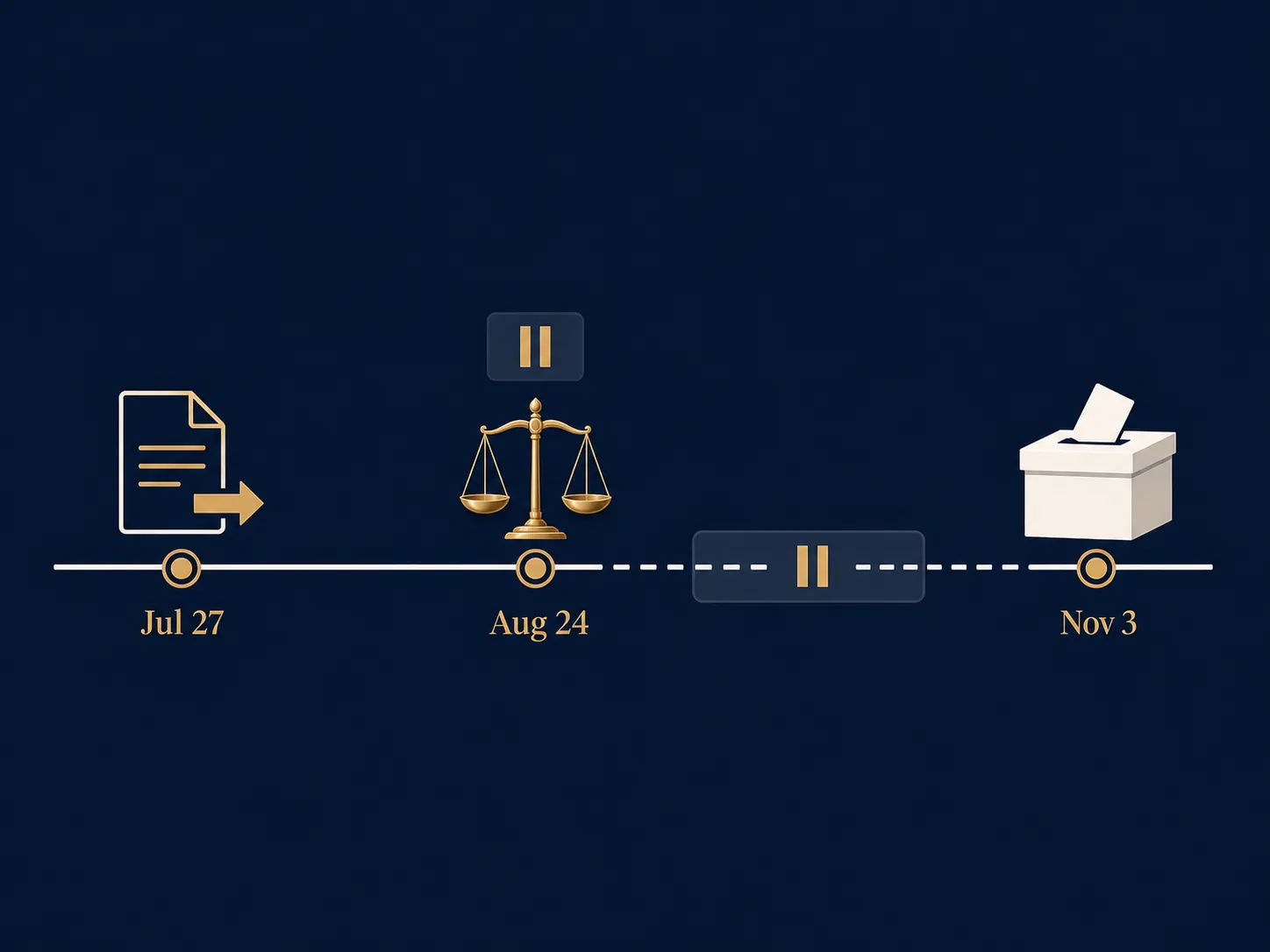
The Supreme Court’s Aug 24, 2026 action in Trump v. California is an emergency stay that lets the administration implement challenged USPS mail-in ballot restrictions before the November 2026 midterms, despite the D. Mass. injunction against them. It is not a merits ruling and leaves the lawfulness of the restrictions undecided.
Last verified
 CONFIRMEDUpdatedJurisdictionUS FederalCourtU.S. Supreme CourtToolNo AI tool namedRuling dateAug 17, 2026
Which Carroll Verdict Did the Supreme Court Reject?
The Supreme Court's Aug. 17, 2026 denial of reconsideration in Trump v. Carroll (docket 25-573) affects only the $5 million defamation verdict; the separate $83.3 million award remained pending at the high court, with payment stayed on a bond of nearly $100 million. The verified docket timeline separates the two judgments and shows why the denial was a procedural refusal, not a merits ruling.
Last verified
 REPORTED — UNVERIFIEDUpdatedJurisdictionUS-MSCourtForrest County Circuit CourtToolNo AI tool namedRuling dateFeb 19, 2026
The Bricen Rivers and Lauren Johansen case timeline
Source-anchored timeline of the Bricen Rivers–Lauren Johansen case, from the July 2024 killing through the July 15, 2026 Harrison County indictment. Reviewed sources show no documented AI-evidence ruling, and the March 3, 2026 trial outcome remains unverified.
Last verified
 REPORTED — UNVERIFIEDUpdatedJurisdictionDistrict of ColumbiaCourtU.S. District Court for the District of Columbia (reported)ToolNone reportedRuling date
What is the DC grand jury investigation of public schools?
Guidance on what is confirmed versus reported in the special grand jury investigation of DC public schools, which reportedly covers attendance-record keeping, truancy, and graduation rates, including at Ballou High School. As of Aug 29, 2026, the probe is reported-only: no DOJ statement, docket, judge, or indictment has been located, and the probe's existence does not establish wrongdoing.
Last verified