
How AI Water Monitoring Creates New Evidence in Legionella Litigation
Continuous AI-powered water monitoring generates timestamped records of temperature, flow, and disinfectant levels, transforming how courts evaluate premises liability in Legionella cases. This article examines how this new evidence class affects breach of duty, constructive notice, and Daubert admissibility for both plaintiffs and defendants.
- Hallucination rate
- Not measured / undisclosed
A Legionella premises case used to begin, evidentially, with a familiar scramble: maintenance binders, recollected flushing routines, contractor invoices, water-treatment reports, and a few test results that may or may not line up with the exposure window. AI water monitoring changes that posture. A building owner, hotel operator, hospital, or landlord may now have a timestamped archive showing temperature, flow, pH, oxidation-reduction potential, and disinfectant-residual readings at frequent intervals, with some systems describing readings as often as every 30 seconds and generating millions of data points per year.[1][2][3]
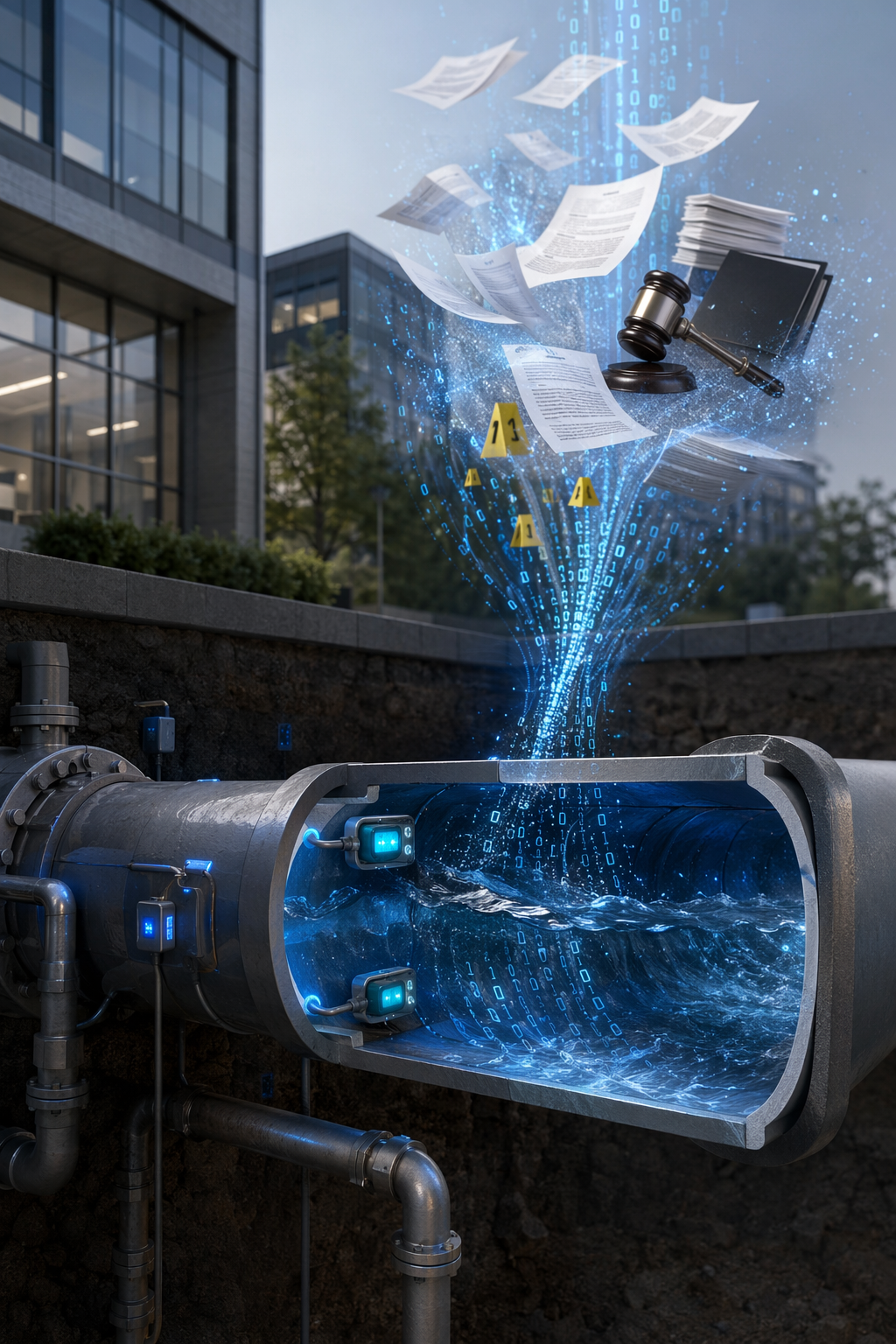
That record does not prove that Legionella bacteria were present. The distinction matters. Continuous monitoring systems generally detect conditions associated with risk: warm water temperatures, low or unstable disinfectant residuals, stagnation, flow irregularities, and related water-quality indicators. In litigation, however, those conditions can still be central. The question often is not whether a sensor diagnosed Legionnaires' disease. It is whether the defendant had a reasonable system for identifying hazardous conditions, whether that system showed warning signs, and whether anyone acted on them.
The stakes are not academic. A 2013 CLM Magazine article discussed Legionnaires' disease premises-liability settlements ranging from $255,000 to $5.2 million, while Pritzker Hageman reports recent recoveries between $1 million and $6.45 million.[4][5] Those numbers should be handled carefully. Confidential settlements leave an incomplete public record, and firm-selected recoveries are not a neutral damages dataset. They do, however, explain why the existence or absence of a machine-made water-system record will attract attention early in discovery.
The New Record Is Not a Maintenance Binder
A maintenance binder shows what someone chose to record. A continuous monitoring archive shows what a sensor captured whether or not a person later found it convenient. That difference is why AI water monitoring for Legionella prevention has become more than a facilities-management topic. It is a discovery topic.
The useful evidence is usually mundane. It is a temperature trace that repeatedly crosses a control limit overnight. It is a low disinfectant residual that persists through a holiday weekend. It is a flow profile suggesting stagnation in a remote branch. It is an alert acknowledged four days late, followed by a corrective-action note that does not identify who performed the work or whether the condition returned.
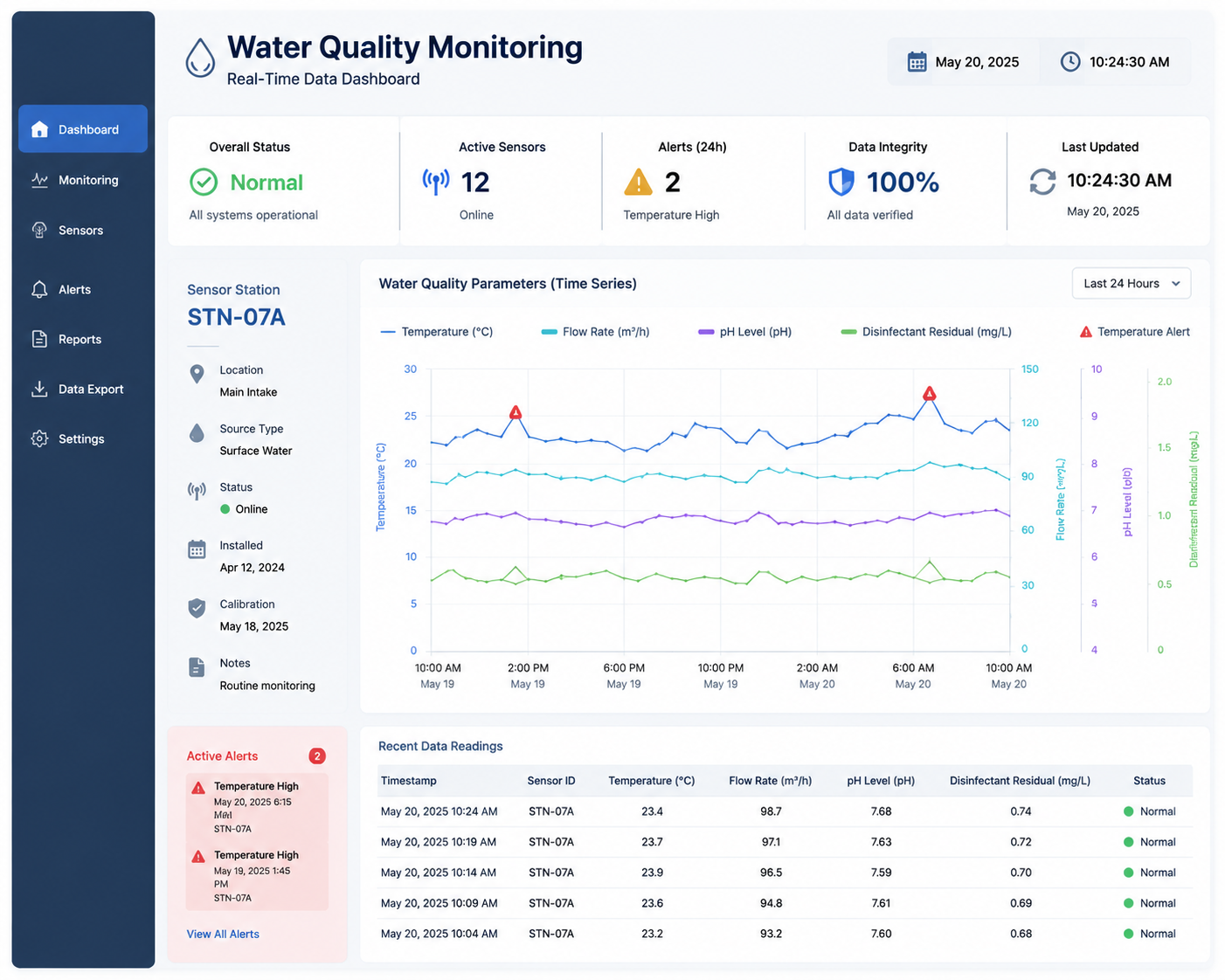
In a conventional record, those gaps can become a credibility contest. A property manager says flushing was routine. A vendor says residuals were generally acceptable. A tenant says the building had recurring hot-water problems. Continuous monitoring does not end the dispute, but it changes the object of the dispute. The parties argue over what the readings mean, whether the sensors were reliable, whether alerts were configured properly, and whether missing data should be treated as ordinary system noise or litigation-significant absence.
How the Same Archive Helps Both Sides
For defendants, the best use of monitoring data is not a polished claim that the property was safe. It is a dated, boring, complete sequence: routine readings within defined control limits, documented review, prompt alert response, and corrective actions that match the building's water management plan. If the plaintiff's theory depends on long-standing neglect, a continuous record can narrow the alleged breach or defeat it.
For plaintiffs, the same archive can be more useful than a witness who vaguely remembers lukewarm water. The data may show recurring excursions before the illness period, alerts that were never escalated, sensor downtime in the precise riser at issue, or repeated corrective entries without durable improvement. Constructive notice becomes easier to plead and prove when the warning signs were not hidden in the pipes but displayed, logged, and retained.
| Record Type | Defense Use | Plaintiff Use |
|---|---|---|
| Temperature history | Shows readings stayed within program limits during the relevant period | Shows recurring warm-water conditions or excursions before exposure |
| Flow or stagnation data | Shows regular movement through monitored lines | Shows low-use branches or prolonged stagnation in areas tied to exposure |
| Disinfectant residual readings | Shows residuals were monitored and corrected when needed | Shows low residuals, unstable residuals, or slow response to alerts |
| Alert logs | Shows timely acknowledgment and escalation | Shows ignored alerts, late acknowledgments, or alert fatigue |
| Corrective-action records | Shows compliance with the water management program | Shows incomplete remediation or recurring conditions after intervention |
| Missing data periods | May be explained by maintenance, outage, or sensor replacement | May support spoliation arguments or challenge claims of continuous diligence |
This is where ASHRAE 188 becomes practical rather than decorative. Envigilance's 2026 compliance guide describes a water management program around elements that include monitoring procedures and corrective-action documentation.[6] In litigation, the point is not to recite the standard. The point is to ask whether the monitoring archive actually fits the program the defendant says it had.
A sensor reading outside a control limit is not automatically negligence. A clean dashboard is not automatically due care. The litigation question is procedural: who received the alert, what the plan required, what was done, whether the action was documented, and whether the condition returned. A well-maintained archive can make that sequence visible. A selective archive can make it suspicious.
The Verizon Example Shows Why Pattern Evidence Matters
The 2022 Verizon matter is useful for one narrower point: systematic water-safety failures across a portfolio can make documentation legally consequential. Partner Engineering and Science described an investigation involving 225 violations across 45 buildings and a New York Attorney General agreement.[7] That does not prove how any later civil case should be tried. It does show why building-level records, portfolio-level practices, and repeat deviations can matter when regulators or plaintiffs look beyond a single handwritten log.
AI Can Also Change Source Investigation
The most concrete public example is not a landlord dashboard but an outbreak-investigation tool. In April 2026, the CDC described TowerScout, a computer-vision AI tool that reduced cooling tower identification from 4 hours to 5 minutes, a 98% reduction, and said the tool had been open-sourced.[8] That is not proof that AI identifies a legal source in any given case. It is proof that AI can compress an investigative step that once consumed scarce public-health time.
For litigators, the procedural consequence is more interesting than the marketing pitch. Faster tower identification may help investigators create a more complete candidate-source list closer to the outbreak period. That can affect subpoenas, site inspections, environmental sampling strategy, and expert opinions about plausible exposure routes. It can also create its own discovery: model outputs, image inputs, confidence thresholds, exclusion criteria, and human review.
Here again, the distinction between measured fact and AI inference should stay visible. A photograph of a building, a geolocated cooling tower, and a timestamped inspection are different evidentiary objects from an algorithmic classification that helped someone decide where to look. The former may be authenticated through ordinary routes. The latter invites questions about training data, error rate, validation, and whether the expert is relying on the model as evidence or merely as an investigative aid.
Measured Conditions Are Easier Than Predictive Scores
Vendors and consultants now describe AI predictive analysis that can identify risk conditions before they develop into more serious problems, and public-facing technical articles discuss AI water monitoring as a prevention tool.[9][10] That may be operationally useful. In court, however, a risk score is not the same thing as a temperature reading.
Raw sensor data has a familiar shape. A calibrated temperature probe recorded a value at a time. A flow sensor registered movement or lack of movement. A disinfectant sensor produced a residual reading. Those records still require foundation, but their evidentiary theory is recognizable: measurement, authentication, maintenance history, and expert interpretation.
AI-generated predictions are harder. A platform may combine temperature, flow, pH, ORP, residual trends, usage patterns, weather, building schedules, or other variables into a risk score. Counsel then needs to know what the score purports to measure. Does it estimate the likelihood of conditions favorable to Legionella growth? Does it predict loss of control under a water management plan? Does it rank assets for maintenance priority? Those are different propositions, and only some may fit the opinion being offered.
This is also where vendor phrasing can become a litigation problem. A system that detects low disinfectant residuals, warm temperatures, and stagnation is not thereby detecting Legionella. If a brochure, dashboard label, or witness slides from risk-condition detection into bacteria detection, opposing counsel will notice. The cleaner testimony is usually narrower: the system measured parameters associated with increased risk, generated alerts under configured thresholds, and preserved records of those events.
Preservation Has to Reach the Platform, Not Just the PDF
A preservation letter that asks only for water management plans and inspection reports may miss the most important evidence. Continuous monitoring data often lives in a vendor platform, a building-management integration, exported spreadsheets, alert emails, mobile-app notifications, and administrative logs. The PDF summary produced after the fact is rarely the whole record.
The preservation demand should be specific enough to stop quiet loss. Relevant categories may include raw sensor readings, alert histories, acknowledgment logs, escalation records, dashboard exports, metadata, user-permission histories, calibration records, sensor replacement records, firmware versions, threshold settings, model-version histories, retention settings, API logs, and records of manual edits or annotations.
Cloud retention is a particular trap. A landlord or hotel may believe it has years of monitoring because the dashboard displays a long trend line, while the platform retains high-resolution readings only for a shorter period or overwrites event-level metadata after export. If litigation is reasonably anticipated, auto-purge settings can turn a technical default into a spoliation fight.
Firmware and calibration histories deserve the same attention. A sensor that drifted out of calibration during the alleged exposure period may still produce a neat graph. A firmware update may change how baselines, thresholds, or derived fields are calculated. A model update may alter risk scoring without changing the underlying measurements. Those facts do not automatically make the data inadmissible, but they affect weight, explanation, and expert reliance.
Daubert Questions Will Not All Look the Same
No published case law identified in the reviewed materials directly resolves how continuous AI or IoT water-monitoring records should be admitted in Legionella premises litigation. That absence should keep both sides modest. Courts already know how to deal with business records, machine records, expert testimony, and scientific reliability challenges. The novelty is the combination: a building system continuously producing technical data, some of it measured, some processed, some interpreted by AI.
The admissibility fight should separate at least three layers. First are raw measurements: temperatures, residuals, flow events, pH, ORP, timestamps, and device identifiers. Second are configured alerts: the platform's conclusion that a threshold was crossed or a condition persisted long enough to notify a user. Third are predictive outputs: risk scores, anomaly detection, prioritization recommendations, or forecasts.
| Evidence Layer | Likely Foundation Questions | Harder Reliability Questions |
|---|---|---|
| Raw sensor readings | Device identity, calibration, timestamp integrity, data export process | Whether drift, placement, or maintenance affected accuracy |
| Configured alerts | Threshold settings, notification routing, acknowledgment history | Whether alert rules matched the water management plan and relevant standard of care |
| AI risk scores or predictions | Model version, inputs, output meaning, user reliance | Validation, error rate, explainability, fit to the disputed legal issue |
A defendant may want the AI score when it shows low risk across the claimed exposure period. A plaintiff may want the same score when it shows repeated warnings before anyone acted. Either way, the party offering the score should expect questions that are less forgiving than questions about a thermometer. What data trained or validated the model? Was it validated for this type of building? Did users understand the output? Was the score relied on in real time, or discovered only after counsel started asking questions?
Expert use adds another layer. An engineer can rely on timestamped water-quality readings to reconstruct system behavior. An epidemiologist may use building-system data alongside exposure history and environmental sampling. But if the expert imports an AI platform's risk conclusion as a scientific conclusion, the reliability of that conclusion becomes part of the opinion. The word "AI" will not carry the foundation by itself.
What This Means for Landlord Liability
Landlord liability for Legionella remains a state-law premises question, not a single national rule. The monitoring data does not create uniform federal liability. It affects the proof of familiar elements: duty, breach, notice, causation, and damages.
On duty, continuous monitoring may matter if the property type, occupancy, water system complexity, or governing standard already supports a duty to manage water risk. On breach, the data may show whether the owner followed its own control limits and response procedures. On notice, timestamps can be blunt: if the system alerted repeatedly before the exposure period, the defendant may have difficulty saying the condition was unknowable. On causation, the data is usually only one piece. It may support or undermine a theory of hazardous conditions, but it does not by itself identify the strain, prove exposure, or connect a particular occupant's illness to a particular fixture.
The defense advantage is real when the archive is complete and disciplined. A landlord that can show stable readings, documented review, timely corrections, and alignment with its water management program has something more persuasive than a witness saying, years later, that the property was well maintained. The plaintiff advantage is equally real when the archive shows alerts without action, recurring excursions, unexplained gaps, or corrective notes that do not match the sensor history.
The hardest cases will be the mixed ones. A building has a monitoring system, but only some risers are instrumented. Alerts were generated, but not all were escalated. A corrective action appears in the log, but the readings remain unstable. A risk score looks alarming, but the raw measurements are ambiguous. Those are not technology questions in any abstract sense. They are record questions: what was captured, what was preserved, what was reliable, and what a qualified expert can fairly infer from it.
The Evidentiary Posture to Expect
Continuous AI water monitoring is shifting Legionella disputes from credibility disputes to record disputes. That is a meaningful change, but not a settled doctrine. The legal system has not yet produced a clear framework for weighing these archives, especially when raw measurements, configured alerts, and predictive models are bundled together in one platform.
The disciplined posture is to treat the data as potentially decisive, preserve it early, separate measured conditions from predictive conclusions, and assume that the first serious admissibility fights will turn less on the word "AI" than on whether the records can be authenticated, explained, and shown to have been reliably maintained.
References
- Advancements in Legionella control: emerging technologies - Aquatrust
- Legionella Prevention in Smart Buildings - Forest Rock
- Continuous Water Quality Monitoring for Legionella - Legionella Control International
- Legionnaires' Disease and Premises Liability - CLM Magazine, 2013
- Determining Liability for a Legionnaires' Disease Outbreak - Pritzker Hageman
- ASHRAE 188 Legionella Compliance: Essential Guide 2026 - Envigilance
- Mitigating Legionella Risk at Your Properties - Partner Engineering and Science
- AI's Role in Stopping Legionnaires' Disease - Centers for Disease Control and Prevention, April 2026
- 7 Ways AI Predictive Analysis Can Reduce Legionella Risk - Legionella Control International
- AI Water Monitoring May Prevent Legionnaires' Disease Outbreaks - Medbound Times
Chronological incident history
No sanction cases have named this tool in the tracked record set to date. This does not imply the tool is safe — see Risk Digest for ongoing monitoring.
← Compare peer toolsReport a correction or tip
Spotted an outdated figure, a misstated fact, or a ruling this tool profile should reflect? Public comments are disabled for this content given the professional cost of a misreported case outcome, penalty amount, or rule text — use the structured correction channel instead.
Report a correction or tip for this record →