
Candidate Qualification Disputes Hinge on State Election Codes
State election codes vary dramatically on standing, official authority, and jurisdiction, determining whether a candidate qualification challenge succeeds or fails. This article maps the fragmented legal landscape that will define the 2026 midterms, drawing on recent legislation, court rulings, and the post-Trump v. Anderson framework.
- Hallucination rate
- Not measured / undisclosed
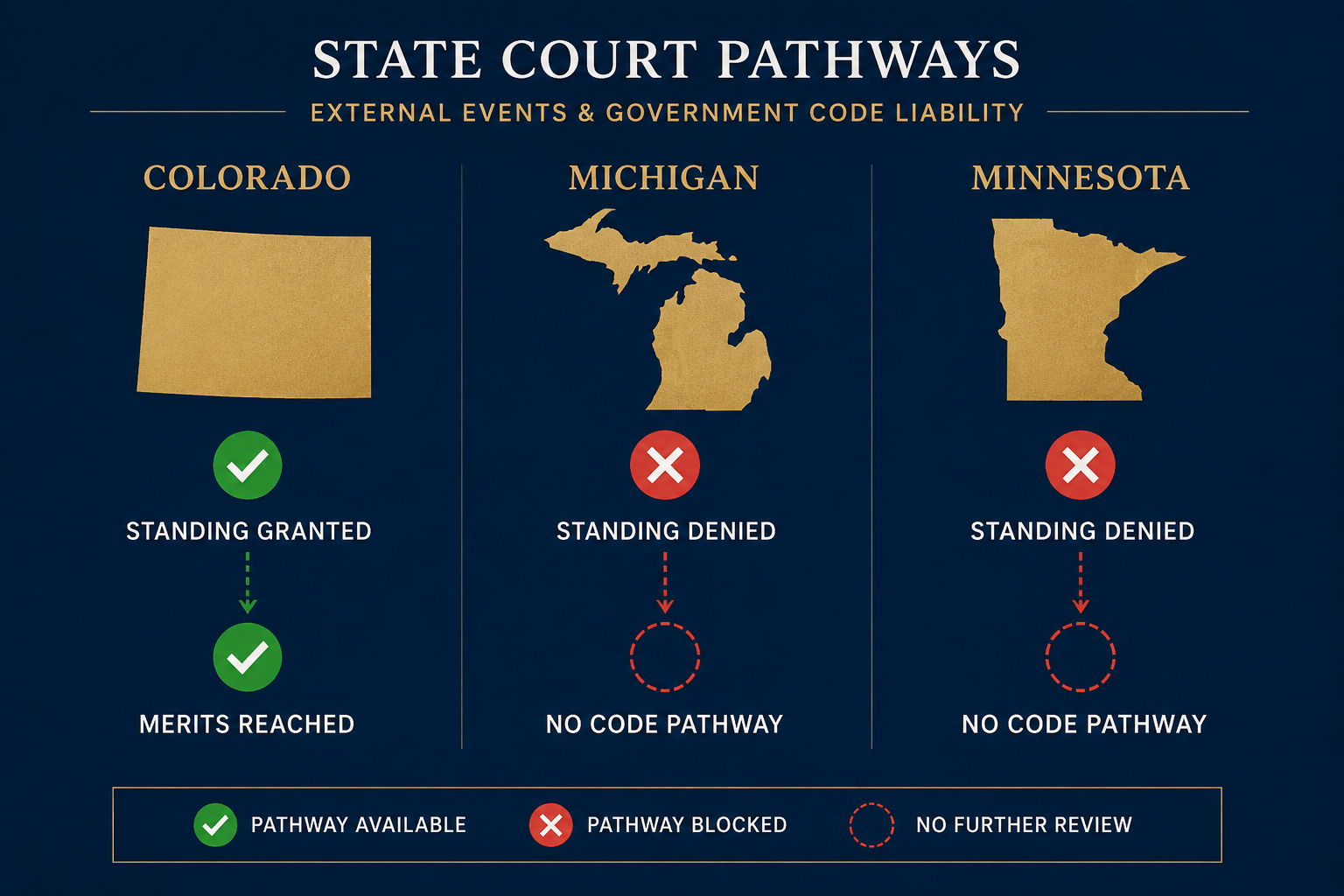
A reader looking for a national rule on candidate eligibility will run into the state code almost immediately. Colorado, Michigan, and Minnesota all saw challenges built around the same broad Section 3 theory in the 2024 cycle. Colorado reached the merits because its election code supplied a voter challenge mechanism for candidate qualifications. Michigan and Minnesota did not move the same way because their laws treated party nomination differently, allowing parties to nominate the candidate of their choice even if later questions remained about eligibility for the office.[1]
That distinction is where the political debate over candidate qualifications turns into a procedural legal problem. The practical question is not simply whether a candidate meets a constitutional qualification. It is whether a particular state gives a particular challenger a forum, a decision-maker, and a review path before ballots are printed.
Trump v. Anderson changed part of that map, but not all of it. The Supreme Court held unanimously that states cannot enforce Section 3 of the Fourteenth Amendment against federal officeholders; that enforcement authority rests with Congress, which has not enacted implementing legislation.[2] For federal offices, that ruling sharply narrows state power. For state offices, however, the state-law architecture still matters, and so does the difference between a court saying “we cannot hear this here” and a court saying “the candidate is qualified.”
This article is a descriptive analysis of the current election-law landscape, not legal advice. Candidate qualification disputes are highly state-specific, and the relevant deadlines, filing rules, and jurisdictional provisions must be checked in the governing code.
Why Colorado Could Reach What Other States Did Not
Colorado is the useful starting point because it shows what a functioning procedural gateway looks like. The state’s election code gave voters a route to challenge a candidate’s qualifications. Once that route existed, the dispute could move through an evidentiary and appellate process, and the court could address the constitutional merits.[1]
Michigan and Minnesota show the opposite problem. Their courts did not need to treat the Section 3 theory as frivolous in order to dismiss the challenges. The decisive point was that state law did not give the challengers the same kind of ballot-access mechanism at that stage. Party nomination and ultimate eligibility for office were handled through a different structure, so the cases did not arrive in a posture that required a merits ruling.[1]
That is the error in many national summaries of candidate qualification litigation. A dismissal in Michigan or Minnesota was not the same legal event as a merits ruling in Colorado. One court may be saying that the challenger used the wrong statutory door. Another may be saying the election official lacked authority. Another may be saying the claim is premature. Those outcomes can all leave the underlying qualification question unresolved.
| State | Procedural feature that mattered | Practical consequence |
|---|---|---|
| Colorado | Election code supplied a voter challenge route for candidate qualifications | Court could reach the merits of the Section 3 challenge |
| Michigan | State law treated party nomination and eligibility through a different structure | Challenge was dismissed without the same merits path |
| Minnesota | State law similarly allowed party nomination to proceed despite eligibility arguments | Challenge did not produce a Colorado-style merits ruling |
The Three Gates: Standing, Authority, and Forum
Candidate qualification disputes usually fail or advance through three statutory gates. The first is standing: who may object. Some states permit an elector, voter, opposing candidate, party official, or another defined actor to initiate a challenge. Others do not create a comparable private route, or create one only for specified defects.
The second gate is official authority. A secretary of state may have ministerial duties only, meaning the office receives filings, checks facial compliance, and prepares ballots without deciding contested constitutional facts. In another state, an election board or designated official may have broader authority to adjudicate objections. The same petition can look like a lawful request in one office and an invitation to exceed statutory power in another.
The third gate is forum. Some disputes begin before an election commission. Some begin in trial court. Some require administrative exhaustion before judicial review. Some belong in a specialized election proceeding with compressed deadlines. The word “exclusive” in a jurisdictional provision can decide more than the facts pleaded in the complaint.
- If the code says “any elector may challenge,” the first fight may be over timing and proof.
- If the code assigns limited ministerial duties to the secretary of state, the first fight may be over official authority.
- If the code gives exclusive jurisdiction to a commission or court, the first fight may be over forum.
- If the code separates party nomination from office eligibility, the first fight may be over whether the challenge is premature.
The 2024 Section 3 litigation made those gates visible. More than 50 challenges were filed across 35 states, and most were dismissed on procedural grounds such as standing, ripeness, or the scope of state official authority rather than on the constitutional merits.[1] That figure is not a scorecard for the theory. It is a map of how many different procedural systems had to process the same national controversy.
Trump v. Anderson Narrows Federal Enforcement, Not Every State-Code Question
After Trump v. Anderson, a state cannot use its own process to enforce Section 3 against a candidate for federal office. That is the easy sentence. The harder sentence is that the decision does not make every candidate qualification dispute a federal nonissue. It does not erase state-law qualifications for state offices. It does not tell every secretary of state what authority the state legislature has conferred. It does not convert procedural dismissals into substantive holdings that a candidate is eligible.[2]
The enforcement gap also remains important. The Supreme Court’s federal-office holding depends in part on congressional enforcement, and Congress has not enacted Section 3 implementing legislation.[2] That does not authorize states to fill the federal-office gap on their own terms after Trump v. Anderson. It does mean lawyers advising on candidate risk cannot stop at the constitutional text. They have to ask whether the office is federal or state, what the state code permits, and whether any separate state-law qualification rule is being invoked.
Older merits questions may still matter when a case survives the procedural gates. In Cawthorn v. Amalfi, the Fourth Circuit rejected the argument that the 1872 Amnesty Act prospectively immunized future insurrectionists from Section 3 disqualification.[3] That point is relevant because it shows that not every qualification case is only about procedure. But procedure decides whether a court ever reaches that kind of question.
The 2026 Midterm Pressure Map
The statutory environment is not static heading into the 2026 midterms. The Brennan Center reported that 32 restrictive voting laws were enacted across 17 states in 2025, tying the highest annual total since it began tracking in 2011; 31 of those 32 laws were in effect for the 2026 midterms.[4]
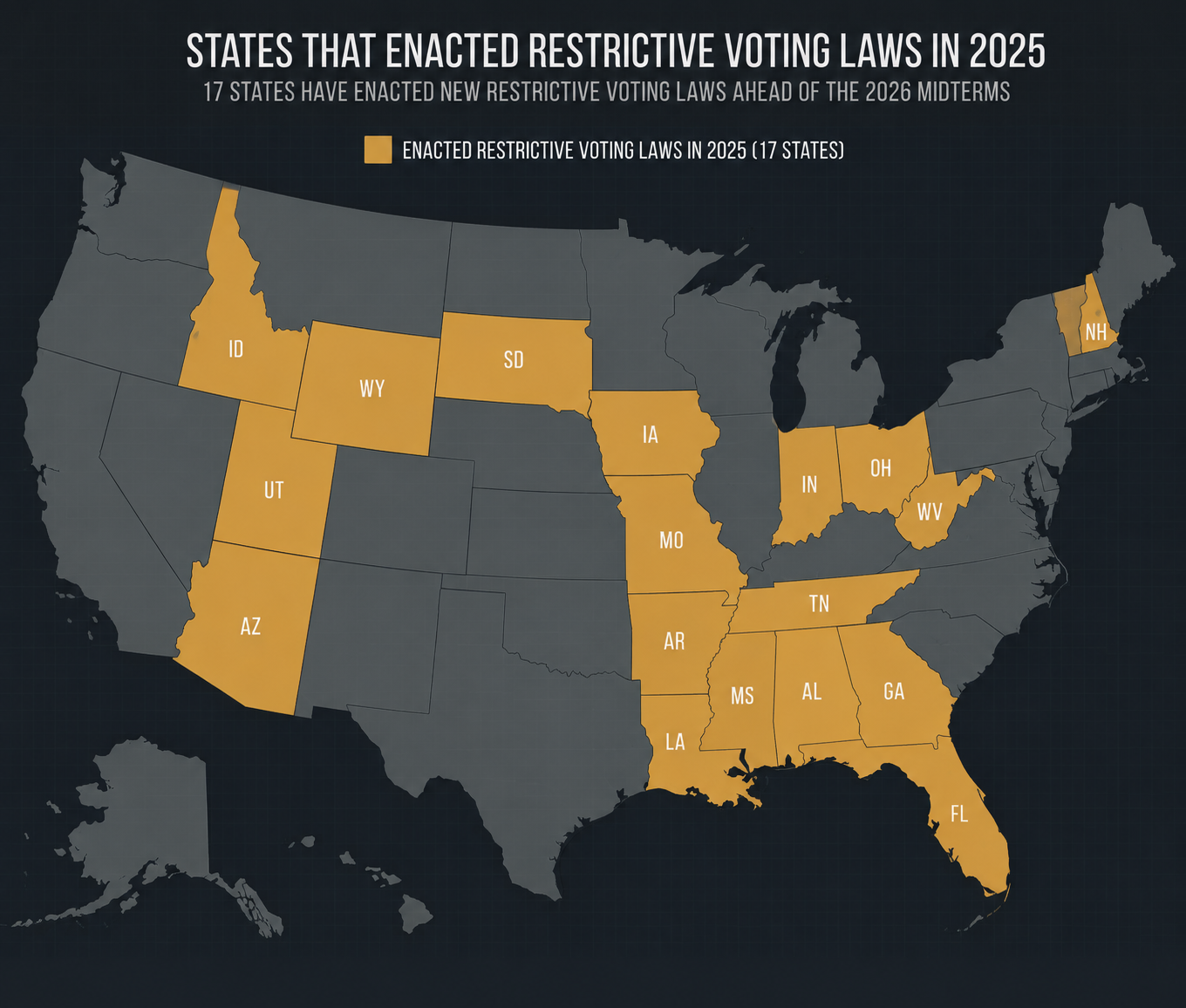
The same Brennan Center roundup identified 8 election interference laws enacted in 7 states in 2025, including measures that gave partisan state officials power over local election administration in Iowa, Kansas, Louisiana, Texas, and Utah.[4] Those laws are not all candidate qualification laws. They matter here because they change the institutional setting in which election disputes are administered, reviewed, or escalated.
Pending legislation adds another layer of uncertainty. As of the Brennan Center’s review, 258 expansive and 187 restrictive carryover bills were pending across 24 and 23 states, respectively, for 2026 legislative sessions.[4] Those numbers should not be used to predict any single candidate challenge. They do show that the code environment practitioners must read in Q3 2026 may differ from the code environment that shaped earlier litigation.
This is where qualification disputes become operationally difficult. Ballot deadlines compress the time available for research, filing, evidentiary development, administrative review, appeal, and ballot printing. A challenge that is legally plausible but filed in the wrong forum can consume the only window in which it could have been corrected. An official who decides a contested qualification issue without statutory authority can create a separate defect. A court that dismisses for ripeness may leave the issue to reappear after voters, parties, or local administrators have already acted.
What Counsel Should Read Before the Constitutional Argument
The legal research sequence should start with the state code, not with the most prominent national case. That is true for challengers, candidates, parties, election officials, and local governments that may be pulled into the dispute.
- Identify the office: federal, statewide state office, legislative office, local office, party office, or nomination position.
- Identify the statutory challenger: elector, voter, candidate, party, official, board, or no private challenger at all.
- Identify the decision-maker: secretary of state, local election official, election board, commission, trial court, or another designated body.
- Identify the timing rule: filing deadline, certification date, ballot-printing deadline, administrative review period, and appeal window.
- Identify the remedy: exclusion from ballot, declaratory judgment, mandamus, injunction, post-election contest, or no available pre-election remedy.
Those questions can produce uncomfortable answers. A state may recognize a qualification requirement but provide no pre-ballot private enforcement path. A secretary of state may believe the objection is serious but lack adjudicatory authority. A court may have jurisdiction only after a final administrative decision. A statute may allow objections to nomination papers but not to the candidate’s underlying constitutional fitness. None of those answers resolves the public argument. They decide whether the legal system will hear it in time.
Fragmentation Is the Rule to Plan Around
The mistake to avoid in 2026 is treating candidate qualification as a single national litigation category with uniform consequences. Trump v. Anderson supplies a controlling federal-office rule for state enforcement of Section 3. It does not supply a complete manual for state-office qualifications, state statutory objections, secretary-of-state authority, or forum allocation.
The Colorado, Michigan, and Minnesota comparison remains the cleaner lesson: similar facts can produce different procedural outcomes because state election codes assign power differently. For the 2026 midterms, the first legal question is not “is the candidate qualified?” It is “does this state provide a path to decide that question at all?”
References
- Unpacking the Legal Challenges to Trump's Ballot Eligibility, State Court Report
- Trump v. Anderson and Enforcement of the Insurrection Clause, LII / Cornell Constitution Annotated
- Historical Context, Current Challenges & Recommendations Regarding the Disqualification Clause, NYC Bar Association
- State Voting Laws Roundup: 2025 in Review, Brennan Center for Justice
Chronological incident history
No sanction cases have named this tool in the tracked record set to date. This does not imply the tool is safe — see Risk Digest for ongoing monitoring.
← Compare peer toolsReport a correction or tip
Spotted an outdated figure, a misstated fact, or a ruling this tool profile should reflect? Public comments are disabled for this content given the professional cost of a misreported case outcome, penalty amount, or rule text — use the structured correction channel instead.
Report a correction or tip for this record →