
How the Iran War Is Testing Constitutional War Powers
A source-cited reference explainer for legal professionals on how the Iran conflict tests the constitutional allocation of war powers between Congress and the president, including the first bicameral passage of a concurrent resolution under the War Powers Resolution and the implications of INS v. Chadha.
- Hallucination rate
- Not measured / undisclosed
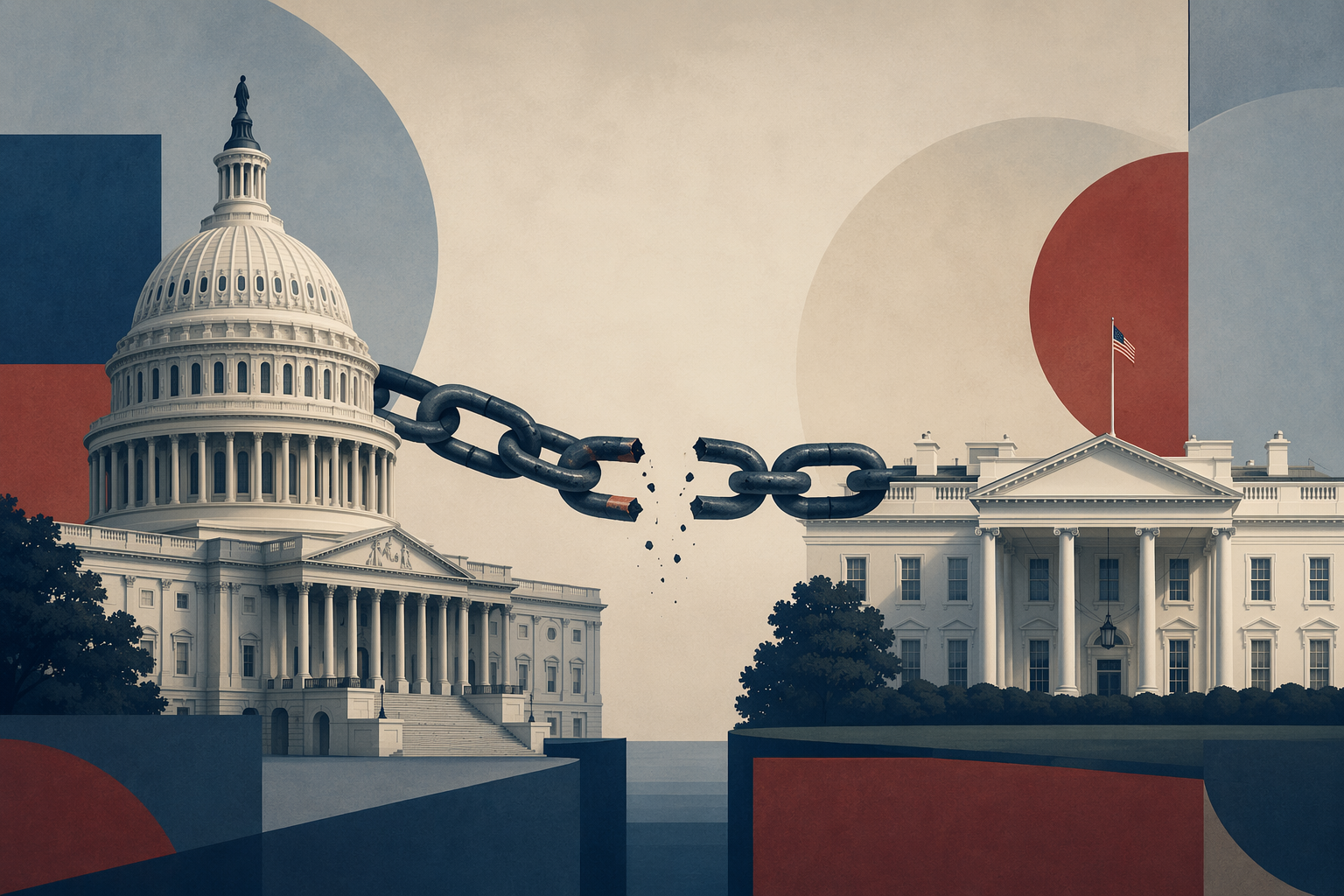
Congress has now done the thing the War Powers Resolution appears to invite it to do: both chambers passed a concurrent resolution, H.Con.Res. 86, directing the president to terminate U.S. military operations against Iran. That passage is historically significant because it is the first bicameral passage of a concurrent resolution under the 1973 statute’s termination mechanism. It is also legally unsatisfying, because the very mechanism Congress used may not be enforceable after INS v. Chadha. The result is the central anomaly of the current constitutional war powers fight over Iran: Congress has spoken in the statutory form Congress wrote, yet that may not legally end the war.[1]
This is a reference explainer as of July 20, 2026, in a fluid conflict. It is not legal advice and not a prediction of how a court would resolve any particular challenge. As of that date, the constitutional and statutory switches that matter are Article I authorization, Article II command, the War Powers Resolution’s 48-hour report and 60-day clock, the meaning of “hostilities,” the possible role of the 2001 AUMF, and the shadow cast by Chadha over Congress’s chosen method of termination.
The constitutional baseline is simple only until operations begin
The Constitution does not put war powers in one place. Congress has the Article I powers to declare war, authorize force, fund or defund military activity, regulate the armed forces, and make rules concerning captures. The president has Article II authority as commander in chief, including operational control over forces once they are deployed. Those clauses do not answer the hardest Iran question by themselves, because modern military action usually begins before anyone obtains a formal declaration of war.
The usual map for that problem remains Justice Jackson’s concurrence in Youngstown. Presidential power is at its “maximum” when the president acts with express or implied congressional authorization; it occupies a “zone of twilight” when Congress has not clearly spoken; and it is at its “lowest ebb” when the president acts against the expressed or implied will of Congress.[2] The Iran conflict matters because it has produced arguments for more than one box at once. The administration points to existing statutory authority and disputed executive power. Congress, through H.Con.Res. 86, has registered opposition. Chadha then interferes with the ordinary lawyerly instinct to ask whether that opposition is legally operative.
The War Powers Resolution was built around notice, time, and termination
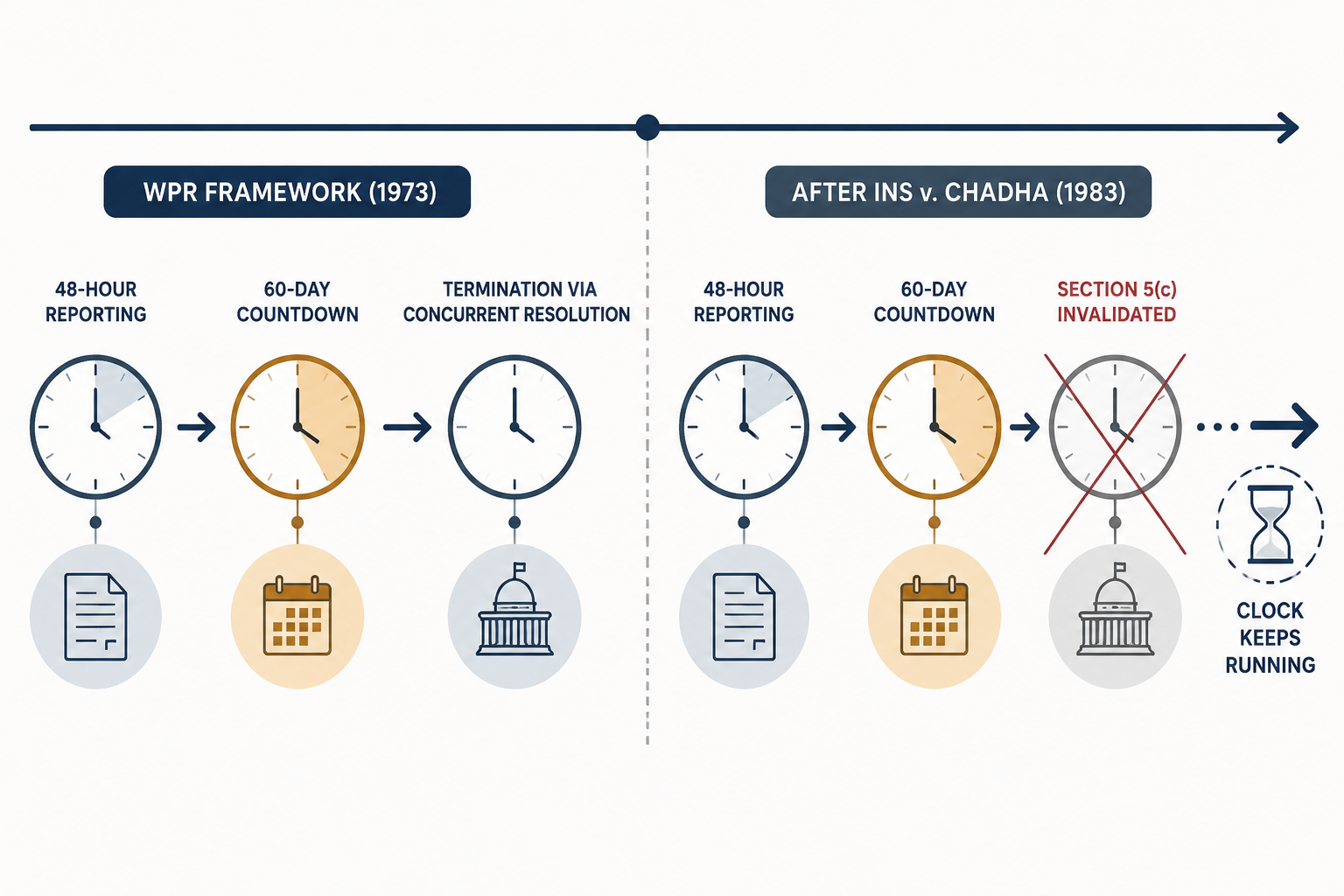
Congress enacted the War Powers Resolution in 1973 to force a decision point after unilateral presidential deployments. Its basic operating design is familiar but worth stating with care. When U.S. armed forces are introduced into hostilities, or into situations where imminent involvement in hostilities is clearly indicated by the circumstances, the president must report to Congress within 48 hours. Unless Congress declares war, enacts specific authorization, extends the period, or is physically unable to meet because of an armed attack, the president must terminate the use of forces within 60 days, with a limited withdrawal period after that.[3]
| WPR component | Why it matters in the Iran conflict |
|---|---|
| 48-hour report | Determines whether the executive branch acknowledges that forces have entered hostilities or imminent hostilities. |
| 60-day clock | Creates the statutory termination deadline if Congress has not authorized the operation. |
| Section 5(c) concurrent resolution | Gives Congress a statutory termination mechanism, but one whose enforceability is disputed after Chadha. |
| “Hostilities” | Controls whether later operations, ceasefire claims, and blockade activity keep the clock running or restart it. |
That design depends on a word the statute does not fully define: “hostilities.” The word cannot be treated as a clerical label. The Brookings Congressional Study Group notes legislative history indicating that Congress intended the term to reach “a state of confrontation in which no shots have been fired,” a formulation that matters directly to the administration’s reported position that an April 7 ceasefire ended hostilities for War Powers Resolution purposes.[3]
If the 60-day clock began with Operation Epic Fury on February 28, then later legal consequences depend on whether hostilities ended, paused, or continued in another form. If the April 7 ceasefire terminated hostilities for statutory purposes, the administration has a route around the original deadline. If subsequent operations or the continuing naval blockade amounted to hostilities, the clock may not have stopped, or it may have restarted. Just Security’s analysis frames the dispute exactly this way: the Iran conflict exposes how much of the WPR’s practical force turns on executive-branch characterization after the fact.[4]
A blockade is not a procedural footnote
The blockade question deserves more than passing treatment because it is where legal vocabulary can do real work. In The Prize Cases, the Supreme Court treated a blockade as a belligerent act. Lawfare’s analysis also points to the Office of Legal Counsel’s own recognition that a blockade is belligerent conduct.[1] That does not mechanically resolve every statutory question, but it makes it difficult to dismiss a continuing blockade as something categorically outside “hostilities” merely because the executive branch prefers a narrower label.
The distinction is not academic housekeeping. If a blockade continues after missiles stop flying, the legal question is not whether a news cycle still looks like war. It is whether U.S. forces remain engaged in conduct that international and domestic war-powers authorities have historically treated as belligerent. For lawyers tracking the WPR clock, that is the difference between a terminated episode and a continuing statutory problem.
H.Con.Res. 86 is the statute working, and possibly not working
Section 5(c) of the War Powers Resolution was Congress’s attempt to preserve a legislative termination tool short of a veto-proof statute. Under the 1973 design, Congress could direct removal of U.S. forces by concurrent resolution, meaning passage by both chambers without presentment to the president. H.Con.Res. 86 therefore matters because Congress did not merely complain, hold hearings, or introduce a symbolic measure. It used the form the WPR itself describes.[1]
The difficulty is INS v. Chadha. In 1983, the Supreme Court invalidated a one-house legislative veto on bicameralism and presentment grounds. The conventional post-Chadha objection to Section 5(c) is straightforward: if Congress is taking action with legal effect, it must use the constitutionally prescribed process, including presentment to the president unless another constitutional provision supplies a different route. A concurrent resolution is not presented. If Chadha’s logic controls, Section 5(c) cannot compel termination by itself.[5]
That is how Chadha may have inverted the WPR’s practical balance. A simple majority can help authorize military action through ordinary legislation if the president signs it. But if Congress wants to terminate an ongoing operation over presidential objection, it may need either enacted legislation that survives presentment or enough votes to override a veto. In ordinary terms, that means Congress may need a two-thirds supermajority to end a war that began without a comparably demanding approval threshold.[5]
The point should not be overstated. The Supreme Court has not squarely held that Chadha invalidates a two-house concurrent resolution in the war powers context. Michael Glennon’s discussion of Chadha emphasizes both the damage the decision did to Congress’s war powers design and the fact that Justice White’s dissent treated war powers as a different and especially sensitive context.[5] That competing view matters because Section 5(c) is not an immigration-housekeeping device accidentally wandering into foreign affairs. It was part of Congress’s post-Vietnam architecture for reclaiming a share of decisions over sustained hostilities.
Even if H.Con.Res. 86 lacks binding legal force, it is not legally meaningless. Under Youngstown, a formal expression of congressional opposition can bear on whether the president is operating with congressional support, in congressional silence, or against Congress’s expressed will. Lawfare’s treatment of the resolution also links this point to Justice Frankfurter’s historical-gloss reasoning: a record of congressional acquiescence is harder to claim when both chambers have taken the unusual step of passing a war powers termination resolution.[1]
The 2001 AUMF is the administration’s most practical statutory route
The administration’s strongest way out of the WPR termination problem is not a broad assertion that Article II permits sustained war with Iran. It is statutory: the 2001 Authorization for Use of Military Force. The 2001 AUMF authorizes force against those nations, organizations, or persons the president determines planned, authorized, committed, or aided the September 11 attacks, or harbored such organizations or persons. Lawfare reports that the 2001 AUMF remains the primary statutory authorization invoked in the Iran conflict, while the 2002 Iraq AUMF was rescinded in late 2025.[6]
The legal effect of that argument depends on fit. If the 2001 AUMF validly authorizes the relevant operations, the president has a plausible Youngstown Category One claim: action supported by congressional authorization. If the connection between the 2001 AUMF and operations against Iran is too attenuated, the statute does not do that work. And if H.Con.Res. 86 is treated as evidence of congressional opposition, even without binding force, the analysis moves away from comfortable authorization and toward Jackson’s lowest-ebb category.
The rescission of the 2002 AUMF also has to be handled cautiously. It narrows the available statutory landscape if accurately reported, but the research record here rests on Lawfare’s account rather than an independently developed legislative history in this article.[6] For present purposes, the important point is not the 2002 AUMF as a stand-alone answer. It is that the administration’s authorization case appears to rest heavily on a 2001 statute whose original target and current application are contested.
Public opposition changes politics, not the constitutional mechanism
Public-opinion polling belongs in the file, but not in the holding. Brookings/Ipsos polling from May 15–21, 2026, and Reuters/Ipsos polling from June 23–24, 2026, were reported as showing majority opposition to the conflict, with different question wording and timing.[3][7] That political context helps explain why members of Congress acted. It does not itself authorize, terminate, or constitutionalize anything.
The same distinction applies to commentary about Congress’s institutional weakness. Reporting after the Iran strikes emphasized that Congress was confronting limited practical power under the War Powers Act framework.[8] That is a useful description of the political moment. The legal question remains more specific: which instrument can bind the president, which instrument merely records congressional opposition, and which disputed authorization moves the case into a different Youngstown category.
What makes Iran a landmark war-powers confrontation
The Iran conflict is not constitutionally important simply because it involves military force without a formal declaration of war. That has been the modern pattern for generations. It is important because several usually separate war-powers problems have converged in one live dispute: a contested WPR clock, a ceasefire claim, a continuing blockade question, an invoked but disputed AUMF, and the first bicameral passage of a concurrent termination resolution under the WPR.
For legal professionals, the cleanest statement is also the most uncomfortable one. Congress has acted in the form the 1973 War Powers Resolution contemplated. That act may still be unable to compel termination because Chadha placed Section 5(c) under constitutional doubt. The administration may still claim statutory authorization through the 2001 AUMF, though that claim depends on a contested fit between the statute and the Iran operations. And the WPR clock may turn on whether “hostilities” includes conduct, such as a blockade, that older case law and executive-branch legal materials have treated as belligerent.
That is why the Iran war is the most significant constitutional war powers confrontation in decades: it shows Congress doing the remedial work the statute assigns to it, while also showing how limited Congress’s enforceable tools may be once sustained military operations are underway.
References
- What Congressional Resolutions Mean for the War in Iran — Lawfare.
- Does the President Need Congress to Approve Military Actions in Iran? — Constitution Center.
- The Iran War and the War Powers Resolution — Brookings Congressional Study Group, July 14, 2026.
- What the Iran War Reveals About the War Powers Resolution and How Congress Can Act — Just Security.
- The Court Gutted Congress's War Power. It's Time to Give It Back. — Just Security.
- Law and the Iran War, After the First 60 Days — Lawfare.
- Does the War Powers Resolution Debate Take on a New Context in the Iran Conflict? — Constitution Center.
- After Iran Strikes, Congress Confronts Its Limited Power Over War — TIME.
Chronological incident history
No sanction cases have named this tool in the tracked record set to date. This does not imply the tool is safe — see Risk Digest for ongoing monitoring.
← Compare peer toolsReport a correction or tip
Spotted an outdated figure, a misstated fact, or a ruling this tool profile should reflect? Public comments are disabled for this content given the professional cost of a misreported case outcome, penalty amount, or rule text — use the structured correction channel instead.
Report a correction or tip for this record →