
Andrew Giuliani's First Amendment defense of Falklands banner fails
Andrew Giuliani argued the First Amendment protects Argentina's Falklands banner at the World Cup, but the Constitution does not apply to private organizations like FIFA. This article explains the state action doctrine, reviews FIFA's 2014 precedent, and shows why the defense is legally flawed.
- Hallucination rate
- Not measured / undisclosed
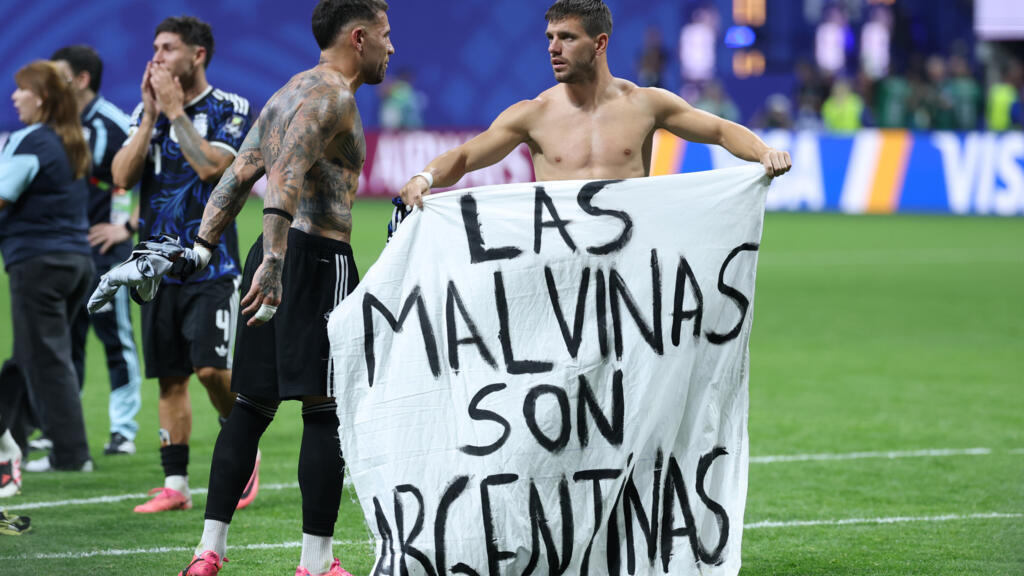
Andrew Giuliani’s First Amendment defense of Argentina’s Falklands banner has an obvious political appeal and a serious legal defect. The reported controversy began after Argentina players displayed a “Las Malvinas son Argentinas” banner following their World Cup semifinal, prompting FIFA scrutiny and a British diplomatic response. Giuliani, speaking from a White House-adjacent World Cup role, reportedly defended the display in free-speech terms and invoked the First Amendment.[1]
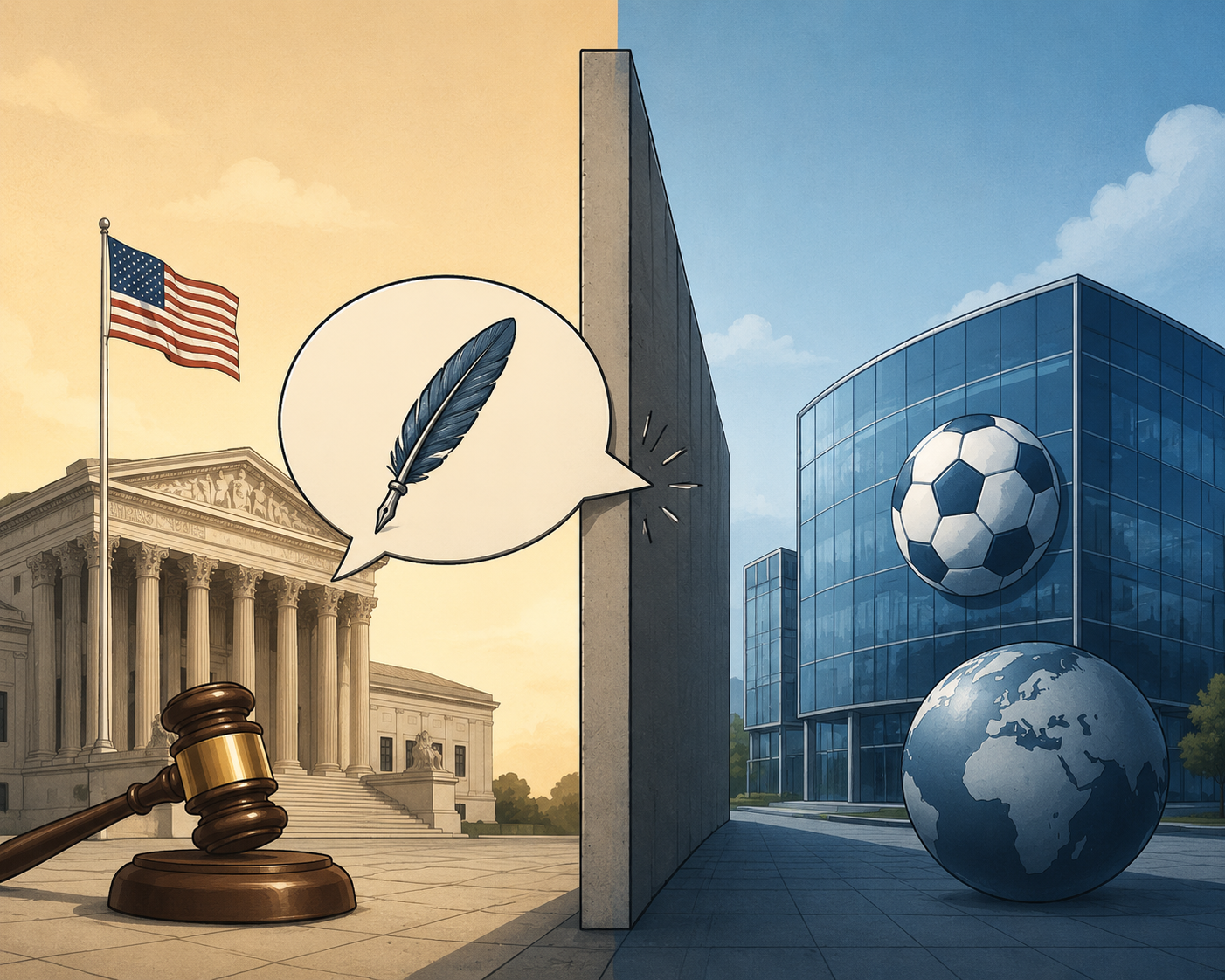
That is where the legal analysis has to slow down. The First Amendment is not a portable guarantee against every consequence that follows political expression. It restrains government actors. FIFA is not the United States government, and a FIFA disciplinary proceeding is not a federal prosecution, state fine, municipal permit denial, or public-school speech restriction. If FIFA disciplines a federation for a political banner, the first constitutional question is not whether the speech is popular, provocative, nationalist, or historically loaded. The first question is who is doing the restricting.
The First Amendment Problem Is State Action
In ordinary U.S. constitutional law, the First Amendment blocks the government from abridging speech. It does not generally compel private associations, employers, platforms, leagues, clubs, or event organizers to host speech they prohibit under their own rules. That distinction is not a technicality added after the fact. It is the gate through which the claim must pass before any familiar free-speech balancing begins.
A government punishment for the Falklands banner would raise one set of questions. If a U.S. city hosting a match tried to fine Argentine players because officials disliked the political message, the constitutional analysis would look very different. If federal officials conditioned visas or security cooperation on a team’s refusal to express a territorial claim, the First Amendment question would not be so easily dismissed. But FIFA enforcing a tournament rule against a participating football association is a different legal act by a different legal actor.
The fact that the 2026 World Cup is being played partly on U.S. soil does not convert FIFA into a U.S. government agency. Nor does a White House task-force official’s view of the controversy make FIFA’s disciplinary machinery governmental. Venue matters for policing, public accommodations, visas, security, labor rules, local permitting, and any number of operational questions. It does not, by itself, make a private international sports body subject to the First Amendment when it enforces its internal competition rules.
That is the category error. The argument treats a constitutional shield against state coercion as though it were a general-purpose objection to private governance. It may work rhetorically. It does not supply a legal defense to FIFA discipline.
FIFA’s Own Legal Position Is the More Relevant Boundary
FIFA’s speech rules are contestable as a matter of sports governance and expressive freedom. They are not automatically unconstitutional under U.S. law merely because a match is played in the United States. FIFA operates as a private association under Swiss law, and academic commentary on the 2026 tournament has already identified the broader tension between FIFA’s restrictions and free-expression norms in host countries.[2]
That broader tension is real. International tournaments are public-facing events. They are staged in cities, use public infrastructure, rely on government security cooperation, and draw political attention precisely because national teams are not ordinary private speakers. FIFA’s rules can therefore collide with expectations formed by domestic constitutional cultures, especially in the United States, where “free speech” often functions as both a legal doctrine and a civic vocabulary.
But collision is not incorporation. A private association can create disciplinary rules that are narrower than what the First Amendment would allow the government to impose. A newspaper can decline an op-ed. A private conference can enforce a code of conduct. A sports federation can restrict on-field political displays if its governing instruments permit that restriction and applicable private-law constraints are satisfied. Those decisions may be criticized, challenged under contract or association law, or debated as bad governance. They do not become First Amendment violations simply because the excluded or punished speech is political.
The 2014 Fine Matters More Than the Slogan
The most important fact is not whether the Falklands banner is tasteful, inflammatory, patriotic, anti-British, or historically justified. The most important fact is that FIFA has already disciplined Argentina over the same message. In 2014, FIFA fined Argentina 30,000 Swiss francs after players posed with a banner reading “Las Malvinas son Argentinas” before a friendly against Slovenia.[3]
That prior sanction gives the 2026 controversy its practical spine. This is not a novel theoretical question about whether FIFA might someday treat a sovereignty claim as political expression covered by its disciplinary rules. FIFA already treated this exact formulation as punishable conduct. A lawyer advising a federation would start there, not with an abstract invocation of American constitutional values.
Precedent inside a private disciplinary system is not precedent in the Article III sense. It does not bind as a Supreme Court holding binds lower courts. Still, it matters. It tells federations what FIFA has considered sanctionable, gives disciplinary bodies a reference point, and narrows the range of plausible surprise. If the same national federation repeats the same political banner at another FIFA event, FIFA does not need to invent a theory from scratch.
That does not mean the outcome of the 2026 investigation is predetermined. FIFA’s inquiry was reported as having been launched on July 16, 2026, and described as standard procedure after the semifinal display.[4] A final decision has not been identified in the materials available for this article. Any discussion of sanctions is therefore precedent-based analysis, not a report of a completed punishment.
Sports Illustrated’s assessment that punishments were likely belongs in that limited frame: it is an analysis of potential disciplinary consequences in light of FIFA practice and the 2014 sanction, not proof that FIFA has already reached a final decision in 2026.[5]
What Giuliani’s Official Role Adds—and What It Does Not
Giuliani’s role is relevant because he was not merely a random television commentator. The State Department identified him in a June 4, 2026 press briefing as Executive Director of the White House Task Force on the FIFA World Cup 2026, speaking about issues including World Cup security and visas.[6] The Athletic’s New York Times coverage also situated the controversy within that tournament and task-force context.[7]

That setting explains why the statement drew legal attention. A White House-linked official invoking the First Amendment in the middle of a FIFA disciplinary controversy can create confusion for teams, organizers, and public officials who must keep separate lines of authority straight. His statement may have been political advocacy, diplomatic signaling, or a public defense of expression. It was not, without more, a legal instruction to FIFA.
Nor does Giuliani’s official-adjacent status make the First Amendment bind FIFA. State action doctrine asks whether the challenged restriction is fairly attributable to the government. The challenged restriction here would be FIFA discipline. Unless the government coerced, compelled, significantly encouraged, or effectively controlled that disciplinary decision, the constitutional claim still runs into the same wall: FIFA is the actor enforcing the rule.
The Diplomatic Stakes Explain the Noise, Not the Doctrine
The Falklands message was never going to remain an internal football matter. BBC News reported the UK response, including Prime Minister Keir Starmer’s statement that “the Falkland Islands definitely are” British.[8] The Guardian described the players’ display and the environment around Argentina’s semifinal celebration, placing the banner inside a moment of national-team triumph rather than a detached political press conference.[9]
Those facts matter because they show why the controversy escalated. A sovereignty claim displayed by a national team at a global event predictably pulls in diplomats, domestic audiences, football authorities, and host-government officials. It also explains why a U.S. official might instinctively reach for the language of free expression.
But diplomatic salience does not change the identity of the disciplinarian. The United Kingdom’s objection, Argentina’s history with the claim, and the symbolic force of the banner all help explain why FIFA would view the display as politically sensitive. They do not turn FIFA’s disciplinary code into U.S. public law.
A Narrow Contrast With the Giuliani Family First Amendment Litigation
There is an unavoidable but easily overplayed comparison to Rudy Giuliani’s own failed First Amendment arguments in defamation litigation. The Conversation has used that litigation to explain why the First Amendment does not protect defamatory falsehoods in the way Giuliani claimed.[10] NPR reported that a jury awarded $148 million to two Georgia election workers after Rudy Giuliani was found liable for defaming them.[11]
The comparison should stay narrow. Rudy Giuliani’s case concerned defamation liability and the limits of constitutional protection for false statements about private individuals involved in election administration. Andrew Giuliani’s reported Falklands-banner defense concerns whether the First Amendment constrains FIFA at all. Both examples involve public appeals to free speech that outrun the governing doctrine, but they fail at different points in the analysis.
Where a Real Challenge Would Have to Look
If Argentina or another federation wanted to contest FIFA discipline, the First Amendment would be an awkward tool. A more serious challenge would have to look to FIFA’s governing documents, disciplinary procedures, Swiss association law, contract principles, arbitration rules, proportionality arguments within the sports-law system, or any host-country legal obligations that actually apply to FIFA’s conduct. Those arguments may be difficult, but at least they would aim at the actor imposing the sanction.
There is also a governance argument worth taking seriously: FIFA’s control of political expression at a national-team tournament sits uneasily beside the fact that national teams are already political symbols. Flags, anthems, territorial identities, state recognition, and diplomatic disputes are not external to international football. They are part of its architecture. Verfassungsblog’s pre-incident analysis is useful for that reason; it frames FIFA’s speech controls as part of a larger free-expression problem at the 2026 World Cup, even though it does not decide the Falklands dispute itself.[2]
That governance critique can coexist with the constitutional point. FIFA may be too restrictive. Its political-expression rules may be unevenly enforced. Its disciplinary process may invite hard questions about neutrality. None of that makes the First Amendment the operative defense to a private FIFA sanction.
The Defense Fails at the Threshold
The legally precise answer is narrower than the public controversy. Giuliani may have been defending political expression. He may have been signaling sympathy for Argentina’s right to make a national claim. He may even have been criticizing FIFA’s instinct to police political messaging. But if the argument is that the First Amendment shields Argentina from FIFA discipline over the Falklands banner, it fails before the merits. FIFA is not the U.S. government.
References
- White House backs Argentina team after Falklands banner at World Cup, The Hill.
- Freedom of Speech at the FIFA World Cup 2026, Verfassungsblog.
- Argentina fined by Fifa for Falklands banner before Slovenia friendly, BBC Sport.
- FIFA to probe Argentina’s Falklands banner display at World Cup semifinal, Al Jazeera, July 16, 2026.
- Argentina Falklands Banner: Likely Punishments, FIFA Investigation, Sports Illustrated.
- Press Briefing with Andrew Giuliani, Executive Director for the White House Task Force on the FIFA World Cup 2026, U.S. Department of State, June 4, 2026.
- White House, Argentina and Falklands World Cup free speech, The Athletic / The New York Times, July 18, 2026.
- Starmer: 'the Falkland Islands definitely are' ours, BBC News.
- White House backs Argentina team over Falklands banner at World Cup semi-final, The Guardian, July 18, 2026.
- Giuliani claims the First Amendment lets him lie: 3 essential reads, The Conversation.
- Giuliani ordered to pay $148 million to Georgia election workers he defamed, NPR, December 15, 2023.
Chronological incident history
No sanction cases have named this tool in the tracked record set to date. This does not imply the tool is safe — see Risk Digest for ongoing monitoring.
← Compare peer toolsReport a correction or tip
Spotted an outdated figure, a misstated fact, or a ruling this tool profile should reflect? Public comments are disabled for this content given the professional cost of a misreported case outcome, penalty amount, or rule text — use the structured correction channel instead.
Report a correction or tip for this record →