
Can the Houthis Lawfully Close the Bab al-Mandeb Strait?
An analysis of whether the Houthis, backed by Iran, can lawfully close the Bab al-Mandeb Strait under international law, concluding that any attempted closure would violate UNCLOS transit passage, the law of naval warfare, UN Security Council resolutions, and IHL prohibitions on attacking civilian vessels.
- Hallucination rate
- Not measured / undisclosed
Reuters reported on July 16, 2026, that Iran had instructed the Houthis to close the Bab al-Mandeb Strait if the United States strikes Iranian power infrastructure, with Islamic Revolutionary Guard Corps representatives in Yemen reportedly controlling the timing decision.[1] That report raises a narrower question than much of the Red Sea debate usually asks. The issue is not whether the Houthis can endanger ships. They have already shown that they can. The legal question is whether a non-state armed group, acting under outside direction, can lawfully close an international strait by declaration, missile fire, mines, or some combination of all three.
On the available law, the answer is no. A Houthi closure of Bab al-Mandeb would not become lawful because it was announced as a blockade, framed as resistance, or aimed at ships with some asserted connection to Israel, the United States, or the United Kingdom. It would run into the transit-passage regime for international straits, the law of naval blockade, Security Council demands that attacks cease, and the separate protections international humanitarian law gives civilian vessels and crews.
The geography puts transit passage at the center
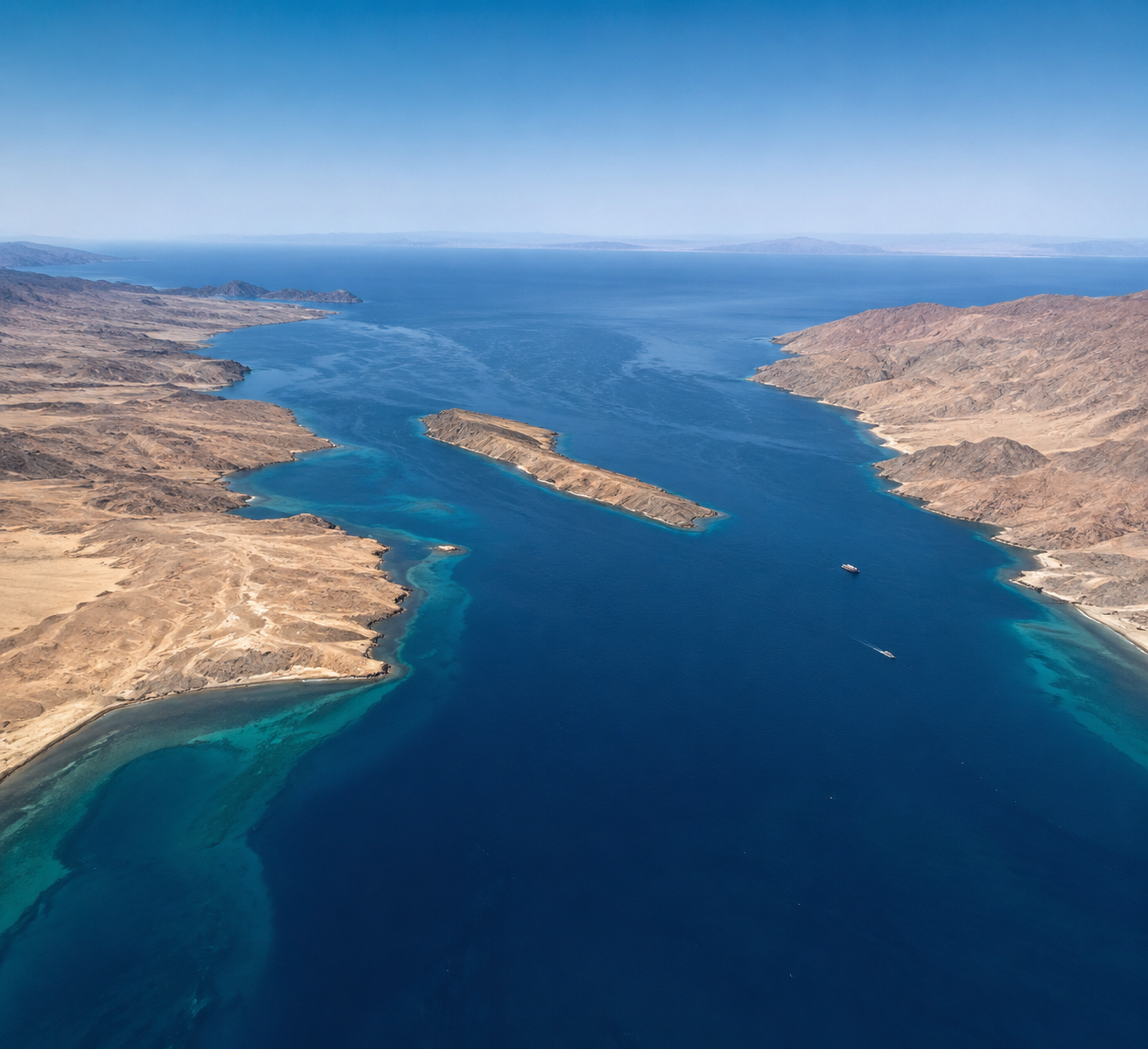
Bab al-Mandeb is not simply a busy sea lane with a political problem attached. It is a narrow strait connecting the Red Sea and the Gulf of Aden. At its narrowest point, between Perim Island and Djibouti, it is about 9.5 nautical miles wide, and the traffic separation scheme crosses Yemeni and Djiboutian territorial seas.[2] That geography matters because the ordinary high-seas freedom of navigation analysis does not do all the work. The passage route lies inside territorial seas, but it is also a strait used for international navigation.
That is the setting in which UNCLOS Articles 37 through 44 become central. The transit-passage regime applies to straits used for international navigation between one part of the high seas or an exclusive economic zone and another part of the high seas or an exclusive economic zone. Coastal states retain important regulatory powers over safety, pollution, fishing, customs, and traffic separation, but they may not hamper transit passage and may not suspend it.
Yemen’s non-ratification of UNCLOS complicates the treaty path, but it does not give the Houthis a hidden power to close the strait. Much of the navigation regime is treated as customary international law, and in any event the Houthis are not a coastal state government exercising ordinary strait-management authority. Even a coastal state does not get to unilaterally suspend transit passage through a qualifying international strait. A non-state armed group firing at merchant ships from or near the Yemeni side has still less claim to do so.
Three closure theories, three legal failures
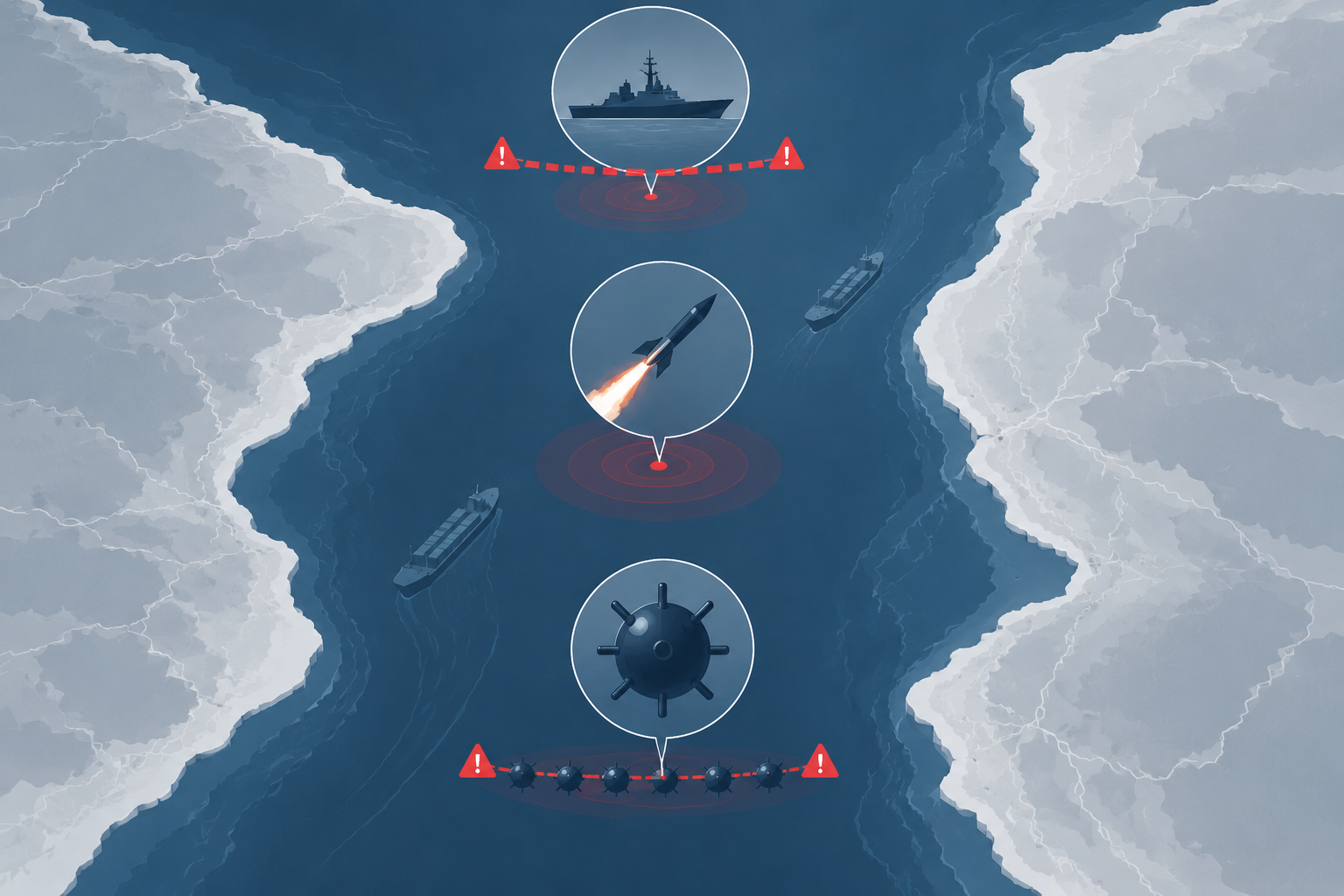
A closure could be attempted in more than one way. The legal analysis changes at the edges depending on whether the Houthis purport to declare a blockade, attack selected merchant vessels, or seed the area with mines and other area-denial weapons. None of those methods supplies the missing authority.
A declared blockade would not satisfy blockade law
Calling a closure a blockade does not make it one. Classical blockade law assumes a belligerent in an armed conflict at sea, a public declaration, effective enforcement, impartial application, and limits on methods and purpose. The San Remo Manual’s blockade provisions, drawing from the older London Declaration tradition, require more than a threat to strike ships that enter a chosen zone. A blockade must be effective, must be applied impartially to vessels of all states, and must not have the sole purpose of starving civilians or denying them objects essential to survival.[3]
The Houthi practice described in available materials points in the opposite direction. Their announced targeting has been selective, tied to asserted Israeli, U.S., or U.K. links rather than an impartial closure applicable to all vessels on equal terms. Their maritime operations have also been episodic and coercive rather than a continuous, effectively maintained cordon. That matters because blockade law is not a vocabulary for any armed group that can make a route more dangerous. It is a regulated belligerent measure with conditions attached.
There is a deeper problem. The San Remo Manual was written for international armed conflicts at sea. The Houthis are a non-state party to a non-international armed conflict in Yemen, and scholars continue to debate how far the naval-warfare framework can be transposed to their maritime attacks. That uncertainty should not be inflated into authority. If the classic blockade rules fit imperfectly, the Houthis do not gain a greater legal power than a state belligerent would have. They are, at most, trying to borrow a legal category whose entry conditions they cannot meet.
This is where the distinction between blockade and maritime quarantine becomes useful. Raul Pedrozo has argued that a maritime quarantine could be used as a peacetime enforcement measure to implement the arms embargo in Security Council Resolution 2216, drawing a contrast with blockade and citing the 1962 Cuban quarantine as precedent.[3] Whether one accepts that proposal or not, it underscores the point. A quarantine aimed at arms flows under an existing embargo is not the same legal animal as a Houthi closure of an international strait to coerce third-state conduct.
Missile attacks on merchant vessels do not become navigation regulation
The second route is not to declare a blockade at all, but to make passage too dangerous. A missile or drone campaign against merchant ships could disrupt traffic without formally claiming to close the strait. That may be operationally effective; it is not a lawful suspension of transit passage.
Merchant vessels are not lawful targets merely because they are commercially useful, nationally registered, insured in a hostile market, or bound for an unfavored port. Under the San Remo framework, merchant vessels are civilian objects unless they make an effective contribution to enemy military action, and they may be attacked only when the legal conditions for loss of protection are met.[4] A cargo vessel’s presence in a strait is not, by itself, an effective contribution to military action.
That point is often lost when armed groups treat ownership chains, beneficial interests, charter arrangements, cargo destination, or nationality as if they were targeting permissions. Those facts may matter to sanctions lawyers, insurers, port authorities, and diplomatic staffs. They do not automatically convert a civilian merchant ship into a military objective. A vessel can be politically symbolic and legally civilian at the same time.
The self-defense question should also be kept distinct. Russell Buchan has argued that Houthi attacks on warships likely meet the Article 51 armed-attack threshold, while attacks on commercial vessels alone likely do not.[5] That analysis constrains the response side; it does not legalize the original attacks on commerce. Commercial shipping cannot be used as a legal measuring stick only when it helps widen the conflict and ignored when civilian protection becomes inconvenient.
Mines and area denial sharpen the same problem
Mining the strait, or using other area-denial systems to make the route unusable, would be a different tactic with the same legal defect. A minefield does not ask whether a ship is making an effective contribution to military action. It threatens vessels by location, timing, and chance. In a strait where the traffic separation scheme passes through territorial seas and transit passage cannot be suspended, indiscriminate area denial is especially hard to square with either navigation law or IHL.
The legal objection is not that mines are always unlawful in every naval conflict. It is that using them to close Bab al-Mandeb to civilian shipping would regulate the strait by hazard rather than law. If the intended result is that civilian crews must either avoid the strait or accept an unreviewed risk of destruction, the method does not become lawful because it is less visibly selective than a missile strike.
| Closure method | Legal defect |
|---|---|
| Declared blockade | Fails the basic blockade requirements of recognized belligerent authority, effectiveness, impartiality, and lawful purpose. |
| Kinetic attacks on merchant vessels | Interferes with transit passage and risks unlawful attacks on civilian objects unless a vessel has lost civilian protection. |
| Mines or area-denial weapons | Creates indiscriminate danger in a strait where transit passage may not be suspended. |
The Security Council has not left a legal opening
The institutional layer points the same way. Security Council Resolution 2826, adopted on July 14, 2026, extended the Secretary-General’s reporting mandate through January 2027, noted that there had been no new incidents in 2026 while threats continued, and preserved the Council’s freedom-of-navigation position regarding Houthi attacks in the Red Sea.[6] The vote was 13 in favor, none against, with China and Russia abstaining.[6]
Those abstentions matter politically, but they do not create legal cover for a Houthi closure. China and Russia objected to the text on grounds including escalation risk and the resolution’s asserted lack of added value.[6] That may signal that a broader enforcement mandate would face serious Council resistance. It does not amount to recognition that the Houthis may close an international strait, attack merchant vessels, or suspend transit passage.
Resolution 2722 in 2024 had already demanded that the Houthis cease attacks on merchant and commercial vessels and affirmed the exercise of navigational rights and freedoms by merchant and commercial vessels in accordance with international law.[6] Resolution 2826 continued that posture rather than replacing it. The Council may be divided over enforcement, escalation, and the proper response by outside navies; it has not endorsed the legal theory that the Houthis can turn Bab al-Mandeb into a discretionary checkpoint.
Commercial stakes explain urgency, not legality
The economic stakes are real, but they should not be allowed to do the legal analysis. Kpler data cited by the Foundation for Defense of Democracies indicated that roughly 7% of global oil output transited Bab al-Mandeb in June 2026.[7] The U.S. Energy Information Administration reported that 4.1 million barrels per day of petroleum crossed the strait in 2024, down from 9.3 million barrels per day in 2023 before Houthi attacks began.[8]
Those figures explain why governments, shipowners, insurers, and ports react quickly to closure threats. They do not make Bab al-Mandeb legally special in the sense the Houthis would need. A strait does not become more closable because more energy passes through it. If anything, the chokepoint function is why the transit-passage regime exists: geography should not let one coastal actor, still less a non-state armed group, hold international navigation hostage.
Piracy is a tempting but incomplete label
There is an understandable impulse to call attacks on merchant ships piracy. The label is rhetorically satisfying and operationally useful because piracy triggers recognized enforcement powers at sea. But UNCLOS Article 101’s “private ends” requirement has long made politically motivated maritime violence difficult to classify as piracy. That is one reason the Security Council has demanded an end to Houthi attacks without treating the situation as a straightforward piracy file.
Avoiding the piracy label does not weaken the legal objection to closure. It simply keeps the categories clean. A politically motivated attack may fall outside piracy and still violate transit-passage protections, Security Council demands, and IHL rules protecting civilian vessels and crews. Legal precision should not be mistaken for leniency.
Civilian crews are not instruments of maritime signaling
The most serious legal exposure does not arise from interference with navigation alone. It arises when civilian ships and crews are used as the medium for coercion. The San Remo framework treats merchant vessels as civilian objects unless they lose protection by making an effective contribution to enemy military action, and it identifies indiscriminate attacks and hostage-taking as war crimes.[4] Human Rights Watch characterized the July 2025 sinkings of MV Magic Seas and MV Eternity C as apparent war crimes, including concerns over civilian harm and hostage-taking.[9]
That is the point at which the closure theory stops being an abstract dispute about straits. A flag state must decide whether its vessel may sail. A master must decide whether a route is survivable. An insurer must decide whether a voyage remains covered. A port operator must decide whether delay, diversion, or refusal is legally and commercially necessary. None of those decisions is improved by pretending that a missile strike on a civilian cargo ship is a form of lawful strait administration.
Iranian direction would not cure the defect. If the Houthis act under Iranian instruction, the attribution and responsibility questions become more serious, not less. Outside direction does not turn a non-state group into a coastal state with authority to suspend transit passage, nor does it turn selective attacks on civilian shipping into a lawful blockade.
What the law leaves standing
There are uncertainties around the edges: Yemen’s non-ratification of UNCLOS, the fit between international naval-warfare manuals and a non-international armed conflict, the contested piracy characterization, and the Security Council’s limited appetite for expanded enforcement. None of them supplies the missing authority to close Bab al-Mandeb.
A Houthi attempt to close the strait would not be a valid suspension of transit passage. It would not be a lawful blockade merely because it was announced as one. It would not be excused by Security Council practice. And where civilian merchant vessels and crews are targeted, it would carry separate IHL consequences rather than being absorbed into a general claim of maritime coercion.
References
- Reuters report on Iran instructing the Houthis to close Bab al-Mandeb if the U.S. strikes Iranian power infrastructure, Reuters, July 16, 2026,
- Maritime Security Threats and the Passage Regime in the Bab el-Mandeb, Norwegian Centre for the Law of the Sea, June 21, 2021,
- Imposing a Maritime Quarantine to Enforce the Houthi Arms Embargo, Lieber Institute,
- San Remo Manual on International Law Applicable to Armed Conflicts at Sea, International Committee of the Red Cross, 1994,
- The Law of Self-Defense and U.S.-U.K. Strikes Against the Houthis, Lieber Institute,
- Security Council Extends Reporting Requirement on Houthi Attacks in Red Sea until January 2027, United Nations, July 14, 2026,
- Kpler data cited by Foundation for Defense of Democracies on Bab al-Mandeb oil transit, Foundation for Defense of Democracies,
- World Oil Transit Chokepoints, U.S. Energy Information Administration,
- Yemen: Houthi Attacks on Ships Apparent War Crimes, Human Rights Watch,
Chronological incident history
No sanction cases have named this tool in the tracked record set to date. This does not imply the tool is safe — see Risk Digest for ongoing monitoring.
← Compare peer toolsReport a correction or tip
Spotted an outdated figure, a misstated fact, or a ruling this tool profile should reflect? Public comments are disabled for this content given the professional cost of a misreported case outcome, penalty amount, or rule text — use the structured correction channel instead.
Report a correction or tip for this record →