
Why AI Death Hoaxes Like Kamar Williams Outrun the Law
The July 2026 disappearance of influencer Kamar Williams created a data void that AI obituary pirates are known to exploit. This article examines why existing defamation, Section 230, and cross-border enforcement remedies are poorly equipped to address AI-generated death hoaxes targeting living people during missing-person events.
- Hallucination rate
- Not measured / undisclosed
For roughly two days in July 2026, the public anxiety around Kamar Williams had a dangerous search shape: obituary, death cause, updates. It had the shape of a question people ask when they fear the worst. It also had the shape of a query that obituary spam networks know how to monetize.
Kamar Williams, the 21-year-old Atlanta influencer known from the 80K Twins, was reported missing on July 14, 2026. His twin brother, Kiyel, posted a public appeal while family and followers waited for verified information. Williams was found safe within about 48 hours. There was no death to explain, no obituary to publish, and no cause of death to investigate.[1]
That clarification matters because the name itself is already noisy. This article concerns the 80K Twins influencer Kamar Williams, who was found safe in July 2026. It does not concern the UK murder convict also named Kamar Williams, who is a different living person. It does not concern Kamar Michael Williams, a Cincinnati man who died in 2021. Treating those records as interchangeable is not a harmless search mistake. It is exactly how a living person gets folded into a machine-readable pile of death notices, court snippets, and recycled grief.
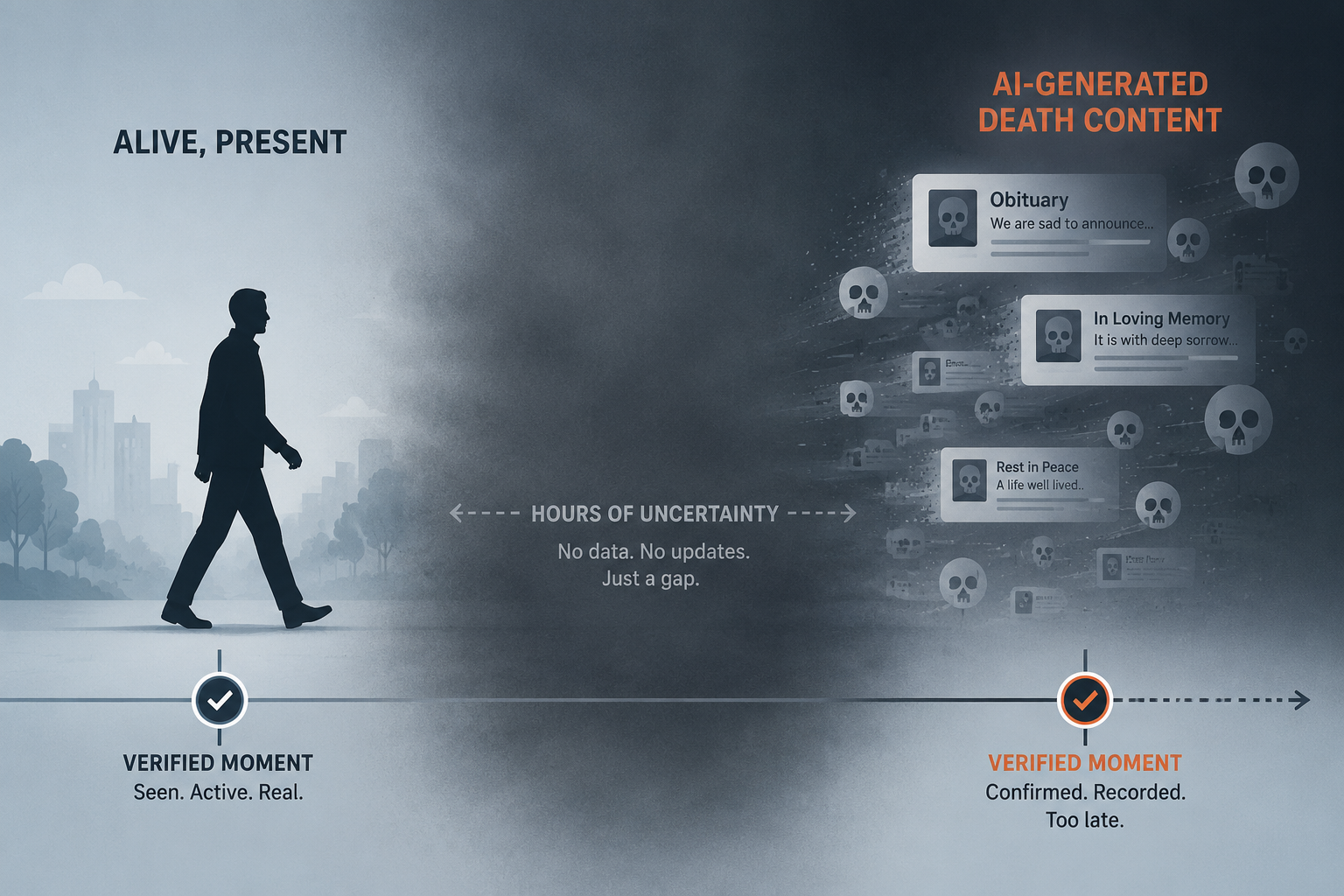
There is also an important evidentiary limit: the available material does not show that AI-generated obituary pages specifically appeared for Williams during the missing-person window. The point is narrower and still serious. His disappearance created the kind of information gap that AI obituary operators have already learned to exploit. When a person is missing, search demand rises before confirmed facts exist. Family posts, local coverage, old biographical scraps, and platform comments become raw material. The machine does not need confirmation. It needs a query with traffic.
The data void is not empty for long
A missing-person case produces a brutal little interval. The family is trying to get attention. Friends are reposting. Local outlets may have one confirmed fact and several unanswered questions. Search engines are being asked for updates faster than anyone can verify them. That is the void.
The online obituary economy already knows how to fill it. CNET’s June 2025 investigation described an industrial pattern of AI obituary piracy: generated death notices, scraped family details, ad-supported pages, and social distribution designed to intercept people searching for grief-related information. NewsGuard tracked 49 unreliable AI news sites in May 2023 and about 1,200 by mid-2025, while Ahrefs data cited in the same investigation found that roughly three out of four web pages created in April 2025 contained AI-generated content.[2]
The investigation’s most useful detail was not the scale alone. It was the ordinariness of the operation. CNET identified a Nigerian operator using the name “Harry John,” running obitsfarewell.com, using ChatGPT to generate all obituary content, and relying on one assistant to distribute links on Facebook. CNET also reported that multiple related domains were registered at Kalkofnsvegur 2 in Reykjavik, Iceland, the same address as the Icelandic Phallological Museum.[2]
That is the legal problem in miniature. The harm is intimate and immediate. The operator may be anonymous, offshore, or both. The hosting and distribution chain may run through companies that did not write the false page. The person targeted may still be trying to prove the basic point that they are alive.
A living person falsely declared dead has real claims
The easiest part of the legal analysis is also the part that should not be minimized. If an AI-generated page falsely states that a living person died, the law is not helpless at the level of theory. A living person can bring claims that are much stronger than claims premised on injury to the reputation of someone already deceased.
Defamation is the obvious starting point. A false statement that a living person is dead is not just incorrect biography. It can damage reputation, interfere with business relationships, alarm employers and sponsors, disrupt family life, and produce an urgent need for public correction. Nikolas Guggenberger, a University of Houston law professor, put the distinction plainly in CNET’s reporting: “You have a very easy defamation case if it's false information about the family that's still alive. It becomes a little harder when you want to build a defamation claim based on a defamation of the deceased themselves.”[2]
Depending on the facts, the same publication could also support intentional infliction of emotional distress, false light or invasion-of-privacy theories, and right-of-publicity claims if a person’s name or likeness is used to draw traffic or advertising revenue. Those claims would turn on state law, the plaintiff’s public status, fault requirements, and the operator’s conduct. But the basic wrong is recognizable: a living person has been converted into monetized death content.
That is why the Williams episode should not be treated as a story about mere confusion in search results. During a missing-person window, a false death notice does not simply misinform strangers. It can force the missing person’s family to do extra remedial work while they are already under pressure: correcting comments, contacting platforms, warning followers, answering calls, and proving that a viral-looking page has no basis. Even after the person is found safe, the false page may remain indexed, screenshotted, syndicated, or scraped into another low-quality site.
The claim is clearer than the defendant
A lawyer can write a complaint against a named obituary pirate. That is not the same thing as finding one, serving one, collecting from one, or forcing one to stop before the page spreads.
The CNET reporting shows why. A content farm can sit behind disposable domains, foreign registration details, social distribution, AI drafting tools, and ad networks. If a family or public figure’s counsel finds one page, there may be mirrors, excerpts, Facebook posts, cached search snippets, and copycat pages already live. Each remedial step consumes time. The false content was cheap to generate; correction is not cheap to perform.
| Legal target | Why it matters | Practical friction |
|---|---|---|
| Original AI obituary operator | Most direct defendant for false content | May be anonymous, offshore, judgment-proof, or difficult to serve |
| Hosting provider or search platform | Controls visibility and access | May invoke intermediary immunity and content-policy processes |
| Social platform accounts distributing links | Drive traffic during the missing-person window | Accounts may be fake, automated, or removed only after spread |
| Ad or monetization intermediaries | Supply the financial incentive | Often several steps removed from the defamatory statement |
This is where legal sufficiency starts to separate from practical remedy. A plaintiff may have a plausible defamation claim and still face a defendant who is hard to identify. A platform may remove one page without admitting liability. A registrar may respond slowly. A search engine may de-index only after a documented request. By then, the generated obituary has already done what it was built to do: capture attention inside the uncertainty window.
Section 230 protects the hosts more often than the person
Section 230 is not a magic shield for the person who created defamatory AI content. The original creator of a false death notice can still face liability. The harder point is that Section 230 can protect platforms that host, display, or distribute third-party content, depending on their role in creating or developing the challenged material.[3]
For the target, that distinction can feel almost perverse. The visible company may be the platform where relatives first saw the hoax, the search engine that surfaced it, or the social network where bot-like pages spread it. But if that company did not materially contribute to the defamatory content, the plaintiff may be pushed back toward the original operator — the party least likely to be reachable quickly.
Platform policy changes help at the margins, but they do not change the liability architecture. Google announced a March 2024 spam policy update aimed at obituary spam, and Meta reported taking down 100 million fake pages in 2024.[4][2] Those figures show that platforms are not unaware of the abuse. They also show why individual victims should not be expected to solve it one takedown form at a time.

AI harm is getting into court, but not on one settled theory
The courts are not ignoring AI-generated harm. A federal judge in Florida rejected Character.AI’s First Amendment defense in a wrongful death suit and allowed the case to proceed, a ruling that signaled at least some judicial willingness to scrutinize claims involving chatbot outputs rather than treating them as categorically protected expression at the threshold.[5]
That ruling matters, but it should not be oversold. A wrongful death claim involving chatbot interaction is not the same claim as a defamation case over an AI-generated obituary page. It does, however, undercut the broadest comfort story that AI output sits outside ordinary accountability just because it is generated. Courts can look at product design, foreseeability, user harm, and the specific role a defendant played.
On the other side is the emerging defense posture that treats AI hallucination as too bizarre to be legally actionable. Gibson Dunn announced in 2025 that it secured dismissal of a defamation claim against OpenAI by arguing, among other things, that the alleged hallucinations were too patently absurd to be defamatory.[6]
That argument may fit some hallucination cases better than others. A chatbot inventing an obviously impossible episode may not carry the same sting as a page formatted like a death notice, optimized for search, distributed on social media, and published during a real missing-person event. In the obituary-spam setting, the problem is not that the falsehood is surreal. The problem is that it is plausible enough to scare people before verification catches up.
The “hallucination” label can hide the business model
Calling a false death notice an AI hallucination can make the harm sound accidental, almost meteorological. That is too clean. In obituary piracy, generated text is often part of a commercial process: detect interest, generate a page, attach ads or traffic incentives, distribute links, and move on. The model benefits from speed and volume. The person falsely declared dead bears the cost of precision.
This matters for legal strategy. If a defendant frames the publication as nonsensical machine output, the plaintiff will want to show context: the page design, headline, metadata, social snippets, monetization, search placement, and timing. A false obituary generated during a verified missing-person search is not received in a vacuum. It lands in a community already primed to fear death.
For public figures and influencers, the commercial dimension is even sharper. Their name is already a traffic asset. A fake obituary does not merely injure feelings. It can interrupt sponsorship discussions, confuse followers, distort analytics, create brand-safety concerns, and force public-facing crisis management. The same visibility that helps locate a missing person can also make the person more attractive to spam operators.
What counsel can realistically do during the first hours
The first legal response is evidence preservation, not theory selection. Screenshots should capture the full page, URL, timestamp, visible ads, author line, domain data, social posts, search snippets, and any claims about cause of death. If the person has been found safe, counsel should preserve the verified update too. The contradiction is the case.
- Document the false statement exactly, including whether it says the person died, implies death, or invents a cause.
- Separate the living target from other people with the same or similar name before sending notices or public corrections.
- Send targeted takedown and de-indexing requests to the platforms that control visibility, even if damages claims will point elsewhere.
- Preserve domain, registrar, hosting, ad-network, and social-distribution evidence before accounts or pages disappear.
- Avoid overstating what is known; a clean correction is more useful than a speculative accusation against every site that repeated the phrase.
That response will not feel satisfying to a family watching a false death notice circulate. It is still the work that makes later remedies possible. The law can recognize the injury, but it often needs the victim to build the record while the operators keep publishing.
The Kamar Williams lesson
The Williams disappearance ended with the fact everyone wanted: he was found safe. That should have closed the loop. Instead, the episode shows why missing-person events now need legal attention even before a specific fake obituary is confirmed. The uncertainty window itself has become exploitable infrastructure.
Existing law gives a living person falsely declared dead real claims. Defamation, emotional distress, privacy, and publicity theories are not imaginary tools. But the remedy still has to travel through Section 230 boundaries, offshore attribution problems, platform processes, generated-content defenses, and the practical fact that AI pages can be created faster than a lawyer can identify the correct defendant.
The useful question is no longer whether AI death hoaxes are real. The documented obituary-piracy market already answers that. The harder question is which combination of platform duties, cross-border enforcement, monetization controls, and liability rules can slow the conversion of a living person into automated death content while there is still time for the correction to matter.
References
- Kamar Williams found safe after being reported missing — The Grio, July 17, 2026
- Digital Grave-Robbing: How AI Is Plundering Online Obituaries — CNET, June 22, 2025
- Section 230 and AI-generated content — NYS Annual Survey of American Law
- Google spam policy update targeting obituary spam — CNN, March 2024
- Florida judge rejects Character.AI First Amendment defense in wrongful death suit — AP News
- Gibson Dunn secures dismissal of defamation claim against OpenAI — Gibson Dunn, 2025
Chronological incident history
No sanction cases have named this tool in the tracked record set to date. This does not imply the tool is safe — see Risk Digest for ongoing monitoring.
← Compare peer toolsReport a correction or tip
Spotted an outdated figure, a misstated fact, or a ruling this tool profile should reflect? Public comments are disabled for this content given the professional cost of a misreported case outcome, penalty amount, or rule text — use the structured correction channel instead.
Report a correction or tip for this record →