
Legal AI in 2026: The Governance Gap Between Individual Adoption and Institutional Readiness
This analysis examines the structural risk created by the 35-point gap between individual AI adoption (69%) and formal firm adoption (34%), drawing on the 8am 2026 Legal Industry Report, ABA Opinion 512, and recent sanction cases to provide a governance framework for law firm leaders.
- Hallucination rate
- Not measured / undisclosed
The Headline Is Good; The Detail Is Not
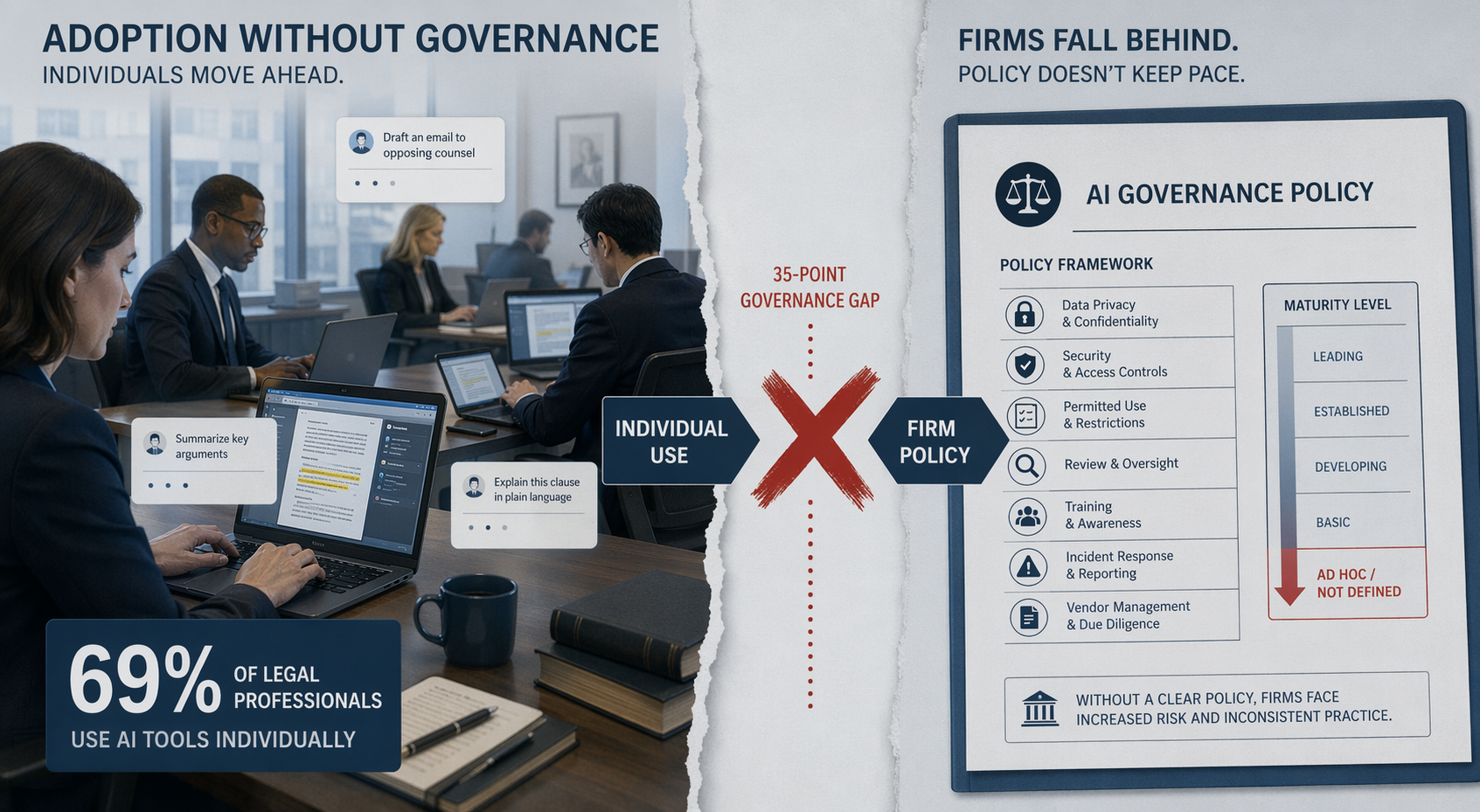
The 8am 2026 Legal Industry Report, based on a survey of more than 1,300 legal professionals conducted in September and October 2025, delivers a headline that the legal technology press has understandably seized on: 69% of legal professionals now use generative AI tools at work. That figure has more than doubled from 31% in 2025. Nearly a third of those users — 28% of all respondents — report using AI daily, and another 31% use it several times a week. Only 19% say they never use AI in their professional capacity.
The productivity story is equally compelling. According to the same survey, 94% of AI users report measurable productivity benefits. Among them, 38% save between one and five hours per week, and 14% save between six and ten hours. The top use cases — drafting correspondence (58%), general research (58%), brainstorming (54%), and summarizing documents (47%) — are core legal tasks that consume billable and non-billable time alike.
But the headline masks a structural problem that managing partners, legal ops directors, and compliance officers cannot afford to ignore. The same report reveals that only 34% of firms have formally adopted legal-specific AI tools. That is a 35-point gap between individual behavior and institutional readiness — and the gap is not closing from the institutional side.
The Governance Gap: Policy and Training Data
The 8am report's governance findings are where the optimism of the adoption headline gives way to genuine concern. When 69% of professionals in a firm are using a technology that the firm has not formally evaluated, adopted, or set rules for, the firm is not managing risk — it is discovering it after the fact.
| Governance Metric | Percentage | Source |
|---|---|---|
| Firms with no AI policy and no plans to create one | 43% | 8am 2026 Legal Industry Report |
| Firms that provide no AI training | 54% | 8am 2026 Legal Industry Report |
| Firms with a written, actively enforced AI policy | 9% | 8am 2026 Legal Industry Report |
| Firms that have implemented general-purpose AI tools | 46% | 8am 2026 Legal Industry Report |
| Firms that have adopted legal-specific AI tools | 34% | 8am 2026 Legal Industry Report |
The 43% figure — firms with no AI policy and no intention of creating one — is particularly striking when set against the 69% individual adoption rate. It means that in nearly half of all law firms, attorneys are using generative AI in client work without any firm-level guidance on what is permitted, what must be disclosed, or how output should be verified. The 54% of firms that provide no AI training compound the problem: even well-intentioned attorneys are left to learn the technology's failure modes on their own, often through trial and error.
Only 9% of firms have a written, actively enforced AI policy. That minority represents the governance vanguard. The remaining 91% operate somewhere on a spectrum from informal verbal guidance to complete policy vacuum. For law firm leaders, the question is not whether their attorneys are using AI — the 69% figure answers that — but whether the firm has any mechanism to ensure that use is competent, confidential, and candid.
Why the Gap Matters: Professional Responsibility Exposure
The governance gap is not an abstract organizational concern. It maps directly onto professional responsibility obligations that every licensed attorney and every law firm must satisfy. The baseline is ABA Formal Opinion 512, issued in July 2024, which identifies six core obligations for lawyers using AI: competence (Model Rule 1.1), confidentiality (Model Rule 1.6), communication with clients (Model Rule 1.4), reasonableness of fees (Model Rule 1.5), candor toward the tribunal (Model Rule 3.3), and supervision of non-lawyer assistants (Model Rule 5.3).
As of February 2026, 47 states have issued formal AI ethics guidance for lawyers, according to a Gunderson Dettmer client alert. The near-universal state-level adoption of AI ethics guidance means that the professional responsibility framework is no longer emerging — it is established. An attorney who uses AI without understanding these obligations cannot claim ignorance as a defense.
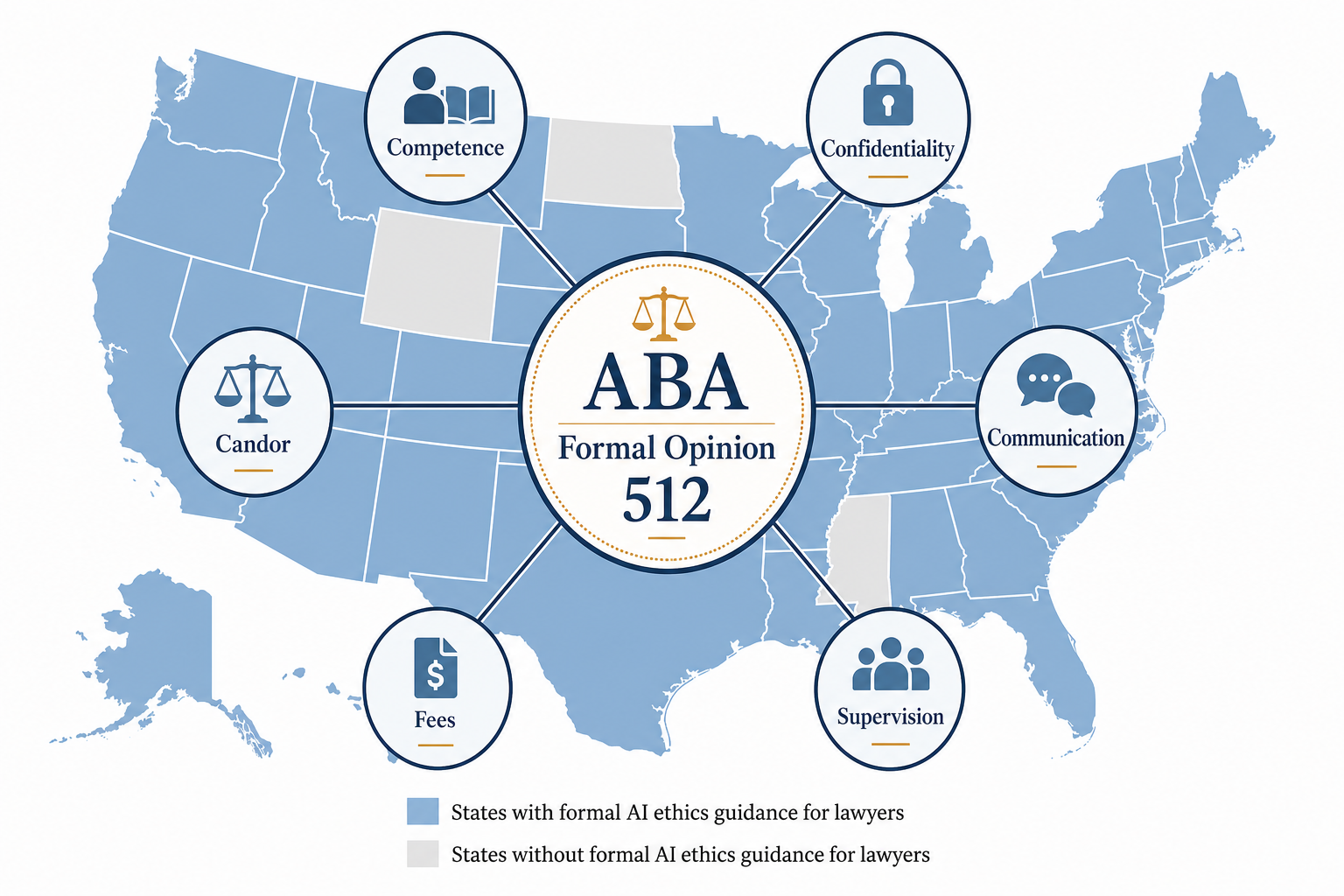
The governance gap creates exposure in every one of these six areas:
- Competence (Rule 1.1): An attorney who uses AI without understanding its capabilities and failure modes — including hallucination rates that vary dramatically by platform — cannot provide competent representation. The 54% of firms that offer no training leave this obligation entirely to the individual attorney.
- Confidentiality (Rule 1.6): Submitting client information to a third-party AI tool without understanding the vendor's data retention policy may constitute a disclosure of confidential information. Only 46% of firms cite data security as a top barrier, but the absence of a policy means no one has evaluated which tools are safe to use with client data.
- Candor (Rule 3.3): The most visible failure mode — AI-generated fake citations — directly violates the duty of candor to the tribunal. Multiple sanction cases have already demonstrated that courts do not accept "the AI made me do it" as a defense.
- Supervision (Rule 5.3): When an AI tool performs tasks that a paralegal or junior associate would traditionally handle, the supervising attorney retains the same duty to verify the output. A firm without a policy has no mechanism to ensure this verification occurs.
Real-World Consequences: Sanction Cases in 2025–2026
The professional responsibility exposure created by the governance gap is not theoretical. The Voibe hallucination analysis documents 1,348 worldwide AI hallucination cases in legal filings as of April 24, 2026, with 915 of those occurring in US courts. The tracker, maintained by Damien Charlotin, is a best-effort compilation and likely undercounts actual incidents — most state trial court decisions are not indexed on Westlaw or Lexis. On a single day — March 31, 2026 — 17 US court decisions noted suspected AI hallucinations.
Two recent incidents illustrate the range of consequences:
| Incident | Date | Details | Outcome |
|---|---|---|---|
| Sullivan & Cromwell self-report | April 18, 2026 | Firm self-reported approximately 28–40 AI hallucinated citations in court filings | Under court review; firm proactively disclosed the issue |
| Lacey v. State Farm | May 6, 2025 | Attorney submitted brief containing AI-generated fake case citations | ~$31,000 in sanctions imposed |
Perhaps the most sobering statistic from the Voibe analysis is that approximately 40% of documented hallucination cases involve licensed lawyers. These are not pro se litigants experimenting with ChatGPT — they are practicing attorneys who used AI in client work without adequate verification. The Sullivan & Cromwell incident is particularly instructive because the firm self-reported the issue rather than waiting for opposing counsel or the court to discover it. That decision may mitigate the sanction, but it does not eliminate the professional embarrassment, the client notification obligation, or the reputational damage.
The pattern across these cases is consistent: an attorney uses a general-purpose AI tool (ChatGPT, Gemini, or Claude) for legal research or drafting, the tool fabricates citations or case holdings, the attorney files the output without independent verification, and the court discovers the error. In every case, the attorney's defense — lack of familiarity with the tool's failure modes — is precisely the gap that firm-level training and policy are designed to close.
Barriers to Firm-Wide Adoption: Data Security, Ethics, and Privilege
The 8am report identifies the top barriers to firm-wide AI adoption, and they map closely to the professional responsibility concerns outlined above:
- Data security (46%): Firms are concerned about submitting client data to third-party AI platforms whose data handling practices may not meet the firm's confidentiality obligations.
- Ethical concerns (42%): Uncertainty about which AI uses are ethically permissible under state bar guidance and ABA Model Rules.
- Privilege concerns (39%): Risk that using AI tools could waive attorney-client privilege or work product protection.
- Lack of trust in results (39%): Concerns about accuracy, hallucination rates, and the reliability of AI-generated legal analysis.
These barriers are often framed as reasons to delay adoption. But the 69% individual adoption rate makes that framing untenable. The barriers are not preventing AI use — they are preventing governed AI use. The data security concern, for example, does not stop an attorney from pasting client facts into a free chatbot. It only stops the firm from evaluating whether that chatbot's data retention policy is compatible with Model Rule 1.6.
The implication is clear: the barriers that firms cite as reasons not to adopt AI are actually arguments for adopting AI governance. A firm that has evaluated tools, selected those with appropriate data handling practices, trained its attorneys on proper use, and established verification protocols has addressed all four of these concerns. A firm that has done none of these things has left each concern unmanaged.
A Practical Governance Framework for Law Firms
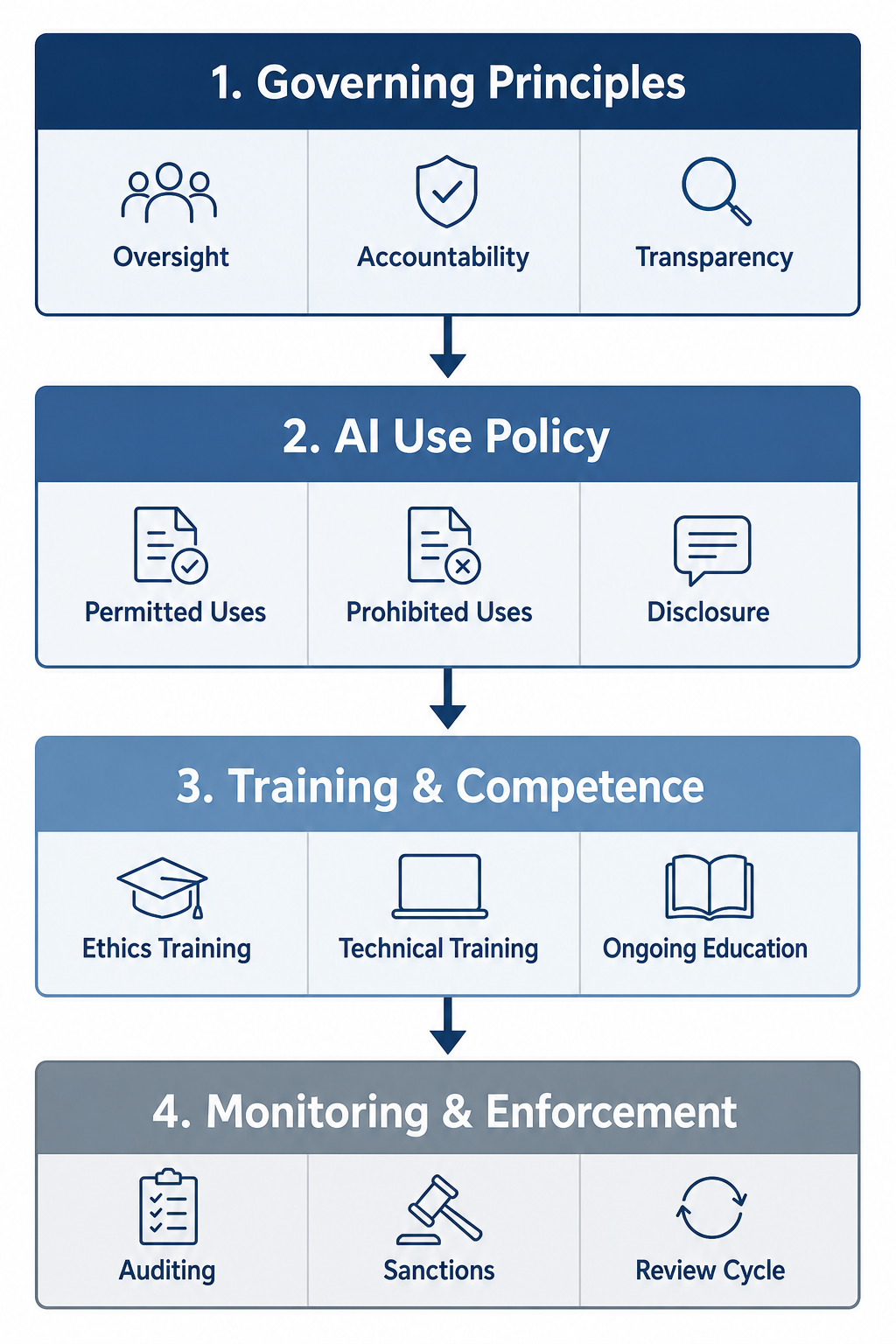
The governance gap is structural, but it is not intractable. The firms that have moved beyond the 9% with actively enforced policies share a common approach: they treat AI governance as a four-tier system rather than a single document. The framework below is drawn from the professional responsibility obligations established by ABA Opinion 512 and the practical experience of firms that have already implemented AI policies.
| Tier | Components | Key Questions |
|---|---|---|
| 1. Governing Principles | Oversight structure, accountability assignment, transparency commitment | Who owns AI governance at the firm? How are decisions escalated? How is AI use disclosed to clients? |
| 2. AI Use Policy | Permitted uses, prohibited uses, disclosure requirements, tool approval process | Which AI tools are approved? What tasks may they perform? When must clients be notified? |
| 3. Training & Competence | Ethics training (ABA obligations), technical training (tool capabilities and limits), ongoing education | How does the firm ensure every attorney understands hallucination risk? How is new attorney onboarding handled? |
| 4. Monitoring & Enforcement | Usage auditing, incident reporting, sanction framework, regular policy review cycle | How does the firm detect unauthorized AI use? What happens when a policy violation occurs? How often is the policy reviewed? |
Each tier depends on the one above it. A use policy without governing principles lacks accountability. Training without a use policy has no curriculum. Monitoring without training punishes behavior that the firm never taught its attorneys to avoid. The firms that have succeeded in AI governance — the 9% — have built all four tiers, even if they started with a minimal viable version of each.
For managing partners and legal ops directors, the 2026 data presents a clear choice. The 69% individual adoption rate is not going to reverse. The 47 states with AI ethics guidance are not going to rescind their opinions. The 1,348 documented hallucination cases are not going to disappear. The only variable the firm controls is whether it will govern the AI use that is already happening within its walls — or continue to discover it after the first sanction arrives.
Chronological incident history
No sanction cases have named this tool in the tracked record set to date. This does not imply the tool is safe — see Risk Digest for ongoing monitoring.
← Compare peer toolsReport a correction or tip
Spotted an outdated figure, a misstated fact, or a ruling this tool profile should reflect? Public comments are disabled for this content given the professional cost of a misreported case outcome, penalty amount, or rule text — use the structured correction channel instead.
Report a correction or tip for this record →