
Why New York City Cannot Arrest Netanyahu Under the ICC Warrant
NYC Mayor Zohran Mamdani has stated his intention to direct NYPD to arrest Israeli PM Benjamin Netanyahu under the ICC warrant if he visits New York. This article examines the four independent legal barriers — US non-membership in the Rome Statute, federal preemption of foreign affairs, head-of-state immunity, and pending federal legislation — that make such enforcement legally impossible.
- Hallucination rate
- Not measured / undisclosed
Zohran Mamdani’s most consequential word was not “Netanyahu,” “ICC,” or even “arrest.” It was “direct.” In a July 18, 2026 interview, Mamdani said he was in an “active conversation with our legal department” about how, as New York City mayor, he would direct the NYPD to arrest Israeli Prime Minister Benjamin Netanyahu if Netanyahu came to New York under the International Criminal Court warrant.[1] That framing puts the legal basis for arresting Netanyahu under an international warrant in exactly the place where it is weakest: not in The Hague, not in a state-party capital, but inside a U.S. municipal chain of command.
The warrant is real. On November 21, 2024, ICC Pre-Trial Chamber I issued arrest warrants for Netanyahu and former Israeli defense minister Yoav Gallant, finding reasonable grounds to believe they bore responsibility for war crimes and crimes against humanity, including starvation as a method of warfare, murder, persecution, and other inhumane acts.[2] Nothing in the municipal-law question requires minimizing that order. The narrower issue is whether the existence of the ICC warrant gives New York City police any lawful channel to execute it against a sitting foreign head of government visiting the United States on official United Nations business.
On the public record now available, it does not. Four legal barriers operate separately: the United States is not bound by the Rome Statute cooperation regime; a city cannot create its own foreign-affairs enforcement policy; head-of-state immunity remains a serious independent obstacle; and pending federal legislation, together with existing executive policy, confirms that the federal government is not moving toward local ICC enforcement.
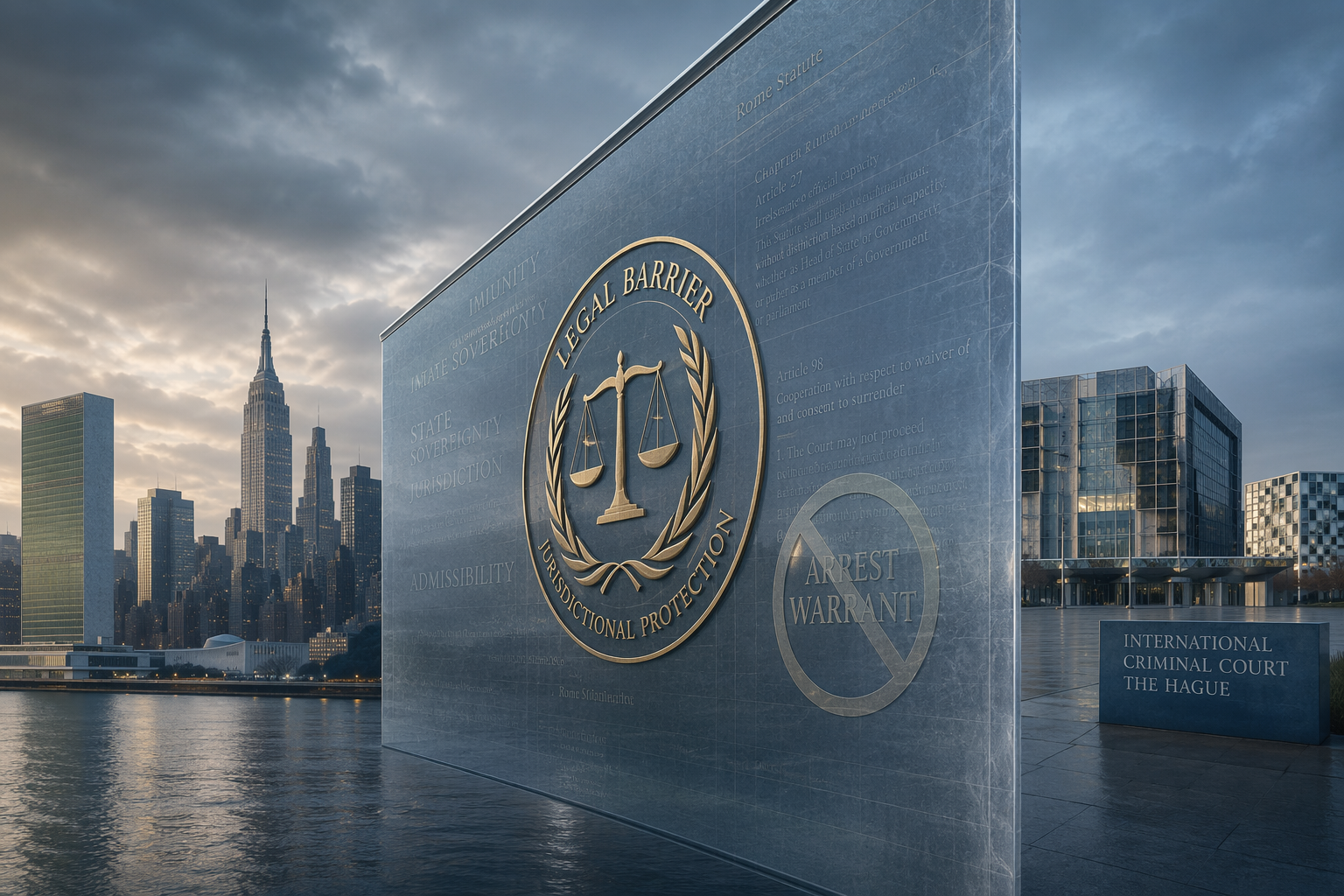
The ICC Warrant Does Not Supply Domestic Arrest Power
The first problem is basic source hierarchy. The Rome Statute creates cooperation duties for states parties. Article 86 says states parties “shall, in accordance with the provisions of this Statute, cooperate fully with the Court in its investigation and prosecution of crimes within the jurisdiction of the Court.”[3] That is a treaty obligation running to states that accepted the treaty. It is not a roving warrant-enforcement code for every police department in the world.
As of the current materials, the Rome Statute has 125 states parties, and the United States is not one of them.[3] That distinction is not clerical. If the United States had ratified the Rome Statute and enacted implementing legislation, the question would move to federal statutory authority, arrest procedures, and the allocation of responsibility among federal and local officers. But without U.S. membership, Article 86 does not bind the United States, and it certainly does not bind New York City as if the city were a treaty actor in its own right.
This is where many public arguments slide too quickly from international criminal accountability to domestic arrest authority. An ICC warrant may be valid within the ICC system and still lack a domestic enforcement mechanism in a non-party state. The court depends on states to arrest suspects; it has no police force of its own. A local police department cannot fill that gap merely by agreeing with the warrant’s moral or legal premise.
The University of Miami International and Comparative Law Review’s analysis of Mamdani’s proposal treats this as the first structural defect: a municipal government cannot convert a non-self-executing international demand into local arrest power when the United States has not undertaken the treaty obligation in the first place.[4] That point does not turn on Netanyahu’s identity. It would apply to any ICC warrant presented to a U.S. city without federal statutory authority.
Hungary Shows the Enforcement Gap, Not a New York Solution
The enforcement gap is visible even among Rome Statute members. In April 2025, Netanyahu visited Hungary, a state party at the time, and Hungary did not arrest him. Hungary also announced its withdrawal from the Rome Statute. ICC Pre-Trial Chamber I later found that Hungary had failed to comply with its cooperation obligations and referred the matter to the Assembly of States Parties.[5]
That episode matters here for a limited reason. It shows that even when the ICC is dealing with a treaty party, its remedy for noncompliance is institutional referral, not a self-executing arrest operation. The broader state-level compliance crisis is covered in ICC Arrest Warrants for Israeli Leaders: The Compliance Crisis. For New York, the point is narrower and sharper: if the ICC’s remedy against a noncomplying state party is referral, it is hard to see how a non-party state’s municipality acquires direct enforcement authority by inference.
A City Cannot Run Its Own Foreign-Affairs Enforcement Policy
The second barrier is constitutional. Arresting a sitting foreign prime minister under an ICC warrant during a U.N.-related visit would not be an ordinary local arrest dressed up with international vocabulary. It would be a direct act toward a foreign sovereign’s head of government, in response to an international tribunal whose jurisdiction the United States has not accepted. That is foreign affairs territory.
U.S. doctrine has long treated foreign affairs as an area where state and local initiatives can be displaced even without a direct conflict with a specific federal statute. In Zschernig v. Miller, the Supreme Court invalidated an Oregon probate law because of its “great potential for disruption or embarrassment” in foreign relations and because it produced state-level judgments about foreign governments.[6] Later cases have refined the field, but the underlying warning remains: local governments do not get to make their own foreign policy through enforcement choices.
That principle is especially hard to avoid when the proposed act is not symbolic procurement policy or a pension-screening rule, but a physical arrest. NYPD officers act under municipal command, but New York City is not sovereign in foreign relations. It cannot decide that the United States will, for practical purposes, cooperate with the ICC in a specific case after the federal government has declined to become a Rome Statute party.
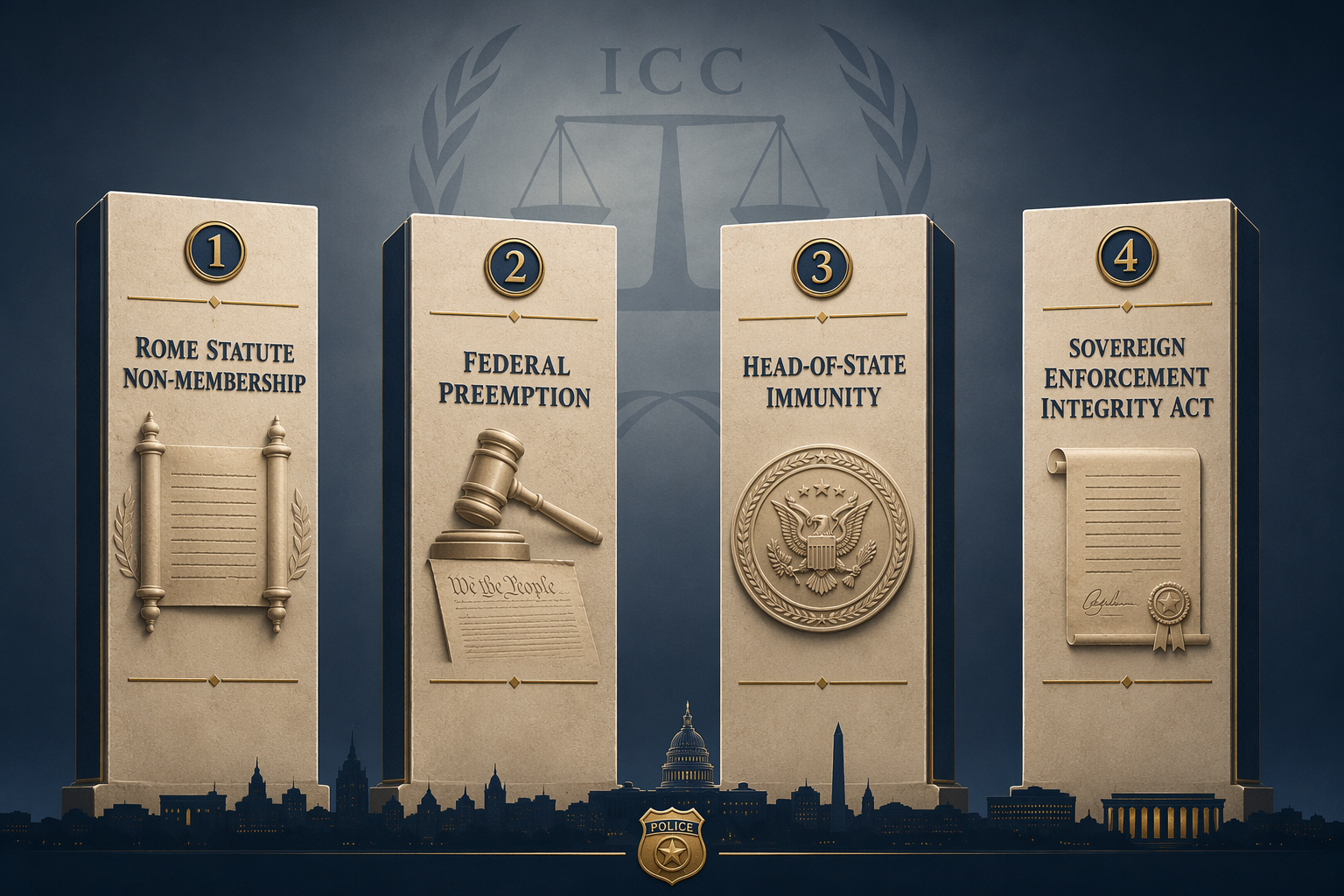
The Miami analysis places Mamdani’s proposal inside this preemption problem: municipal ICC enforcement would intrude on a federal domain and attempt to operationalize a foreign-affairs position the national government has not adopted.[4] The point is not that cities must be silent about international crimes. Mayors, councils, and residents can condemn, advocate, divest, protest, or lobby Congress. “Direct NYPD to arrest” is a different verb. It asks a local police department to take custody of a foreign head of government for surrender to an international court. That is not a municipal competence.
Head-of-State Immunity Is a Separate Obstacle
Even if the Rome Statute and preemption problems were put to one side, immunity would still have to be confronted. Netanyahu is not a former official or a private visitor. The stated scenario concerns a sitting prime minister coming to New York on official United Nations General Assembly business. Under customary international law and U.S. practice, sitting heads of state and certain high-ranking officials receive immunity from the jurisdiction of foreign domestic courts while in office.
The Rome Statute itself does not erase that problem for non-party states. Article 27 removes official-capacity immunity before the ICC for persons subject to the court’s jurisdiction. But Article 98(1) instructs the Court not to proceed with a request for surrender or assistance that would require the requested state to act inconsistently with its obligations regarding state or diplomatic immunity of a third state, unless the Court can first obtain cooperation for waiver of that immunity.[3] The legal dispute over Articles 27 and 98 is substantial, but the non-party-state scenario is exactly where Article 98 does the most work.[7]
France and Hungary have invoked immunity concerns in response to the Netanyahu warrant, illustrating that this is not an academic footnote invented for U.S. municipal law.[7][5] Their positions do not settle every Article 27 and Article 98 dispute, and ICC chambers have taken robust views of cooperation duties in other contexts. But for New York City, the relevant question is more constrained: may municipal police disregard head-of-state immunity and arrest a sitting foreign leader without a federal instruction to do so? The public materials do not identify a credible path to yes.
In U.S. practice, immunity determinations for foreign officials are not usually left to local police desks or municipal law departments. They are bound up with recognition, diplomatic status, and executive-branch foreign-affairs judgments. That makes immunity both a substantive barrier and an institutional one. The official who would need to decide whether immunity has been waived or displaced is not the mayor.
Universal Jurisdiction Does Not Cure the Municipal Defect
The strongest public objection is usually framed through universal jurisdiction. If some crimes are of concern to all humanity, the argument goes, why should a local arrest be treated as impossible when a suspect is physically present? Eichmann and Pinochet are the familiar reference points, and the argument has circulated in commentary defending the possibility of local action against Netanyahu.[8]
The difficulty is not that universal jurisdiction is unserious. It is that it answers a different question. Universal jurisdiction can explain why a state may prescribe or adjudicate certain grave offenses under specified conditions. It does not by itself authorize a U.S. municipal police department to execute an ICC warrant against a sitting foreign head of government in the absence of federal implementing law, over foreign-affairs preemption, and around immunity.
Eichmann involved Israel’s prosecution after abduction from Argentina; Pinochet involved extradition litigation in the United Kingdom concerning a former head of state. Neither supplies a New York City arrest power. They may illuminate international criminal accountability, but they do not convert the NYPD into an ICC enforcement arm.
Federal Signals Cut Against Local ICC Enforcement
The pending Sovereign Enforcement Integrity Act, H.R. 5411, should be kept in its proper place. Representative Elise Stefanik announced the bill in September 2025 as a response to Mamdani’s stated plan, and the bill would expressly prohibit state and local officials from enforcing ICC warrants in the United States.[9] The available materials do not confirm that it has been enacted as of July 19, 2026, so it should not be treated as current controlling law.
Still, introduced legislation can be legally relevant without being binding. H.R. 5411 shows that Congress has understood the municipal-enforcement theory as a concrete federalism problem and has considered making the prohibition explicit. It is not the foundation for rejecting Mamdani’s plan; the Rome Statute, preemption, and immunity issues already do that work. The bill confirms the direction of federal resistance.
Executive policy points the same way. Executive Order 14203, issued in February 2025, authorized sanctions related to ICC actions against the United States and its allies, reflecting a federal posture hostile to ICC proceedings of this kind.[10] One can criticize that policy on legal or moral grounds, but a mayor cannot treat it as an invitation for local cooperation with the Court. If anything, it sharpens the preemption problem.
| Barrier | What It Blocks | Why It Matters for NYPD |
|---|---|---|
| U.S. non-membership in the Rome Statute | Treaty-based cooperation duty | Article 86 binds states parties, not U.S. municipalities |
| Foreign-affairs preemption | Local creation of an ICC enforcement posture | A city cannot decide U.S. cooperation policy toward an international tribunal |
| Head-of-state immunity | Domestic arrest of a sitting foreign leader | Immunity questions belong to federal foreign-affairs practice, not municipal command |
| Federal legislative and executive posture | Any claim of supportive federal environment | H.R. 5411 and Executive Order 14203 point against local ICC enforcement |
What the Legal Department Caveat Can and Cannot Do
Mamdani’s reference to an “active conversation with our legal department” deserves a narrow reading.[1] It means the city’s internal analysis has not been publicly disclosed. It does not mean the barriers disappear, and it does not provide an affirmative source of arrest authority. Municipal lawyers can advise on city powers, police procedure, liability exposure, and coordination with other governments. They cannot make the United States a Rome Statute party, waive foreign sovereign immunity, or transfer foreign-affairs authority from Washington to City Hall.
The question is therefore not whether a mayor may have a view about the ICC warrant. The question is whether a mayor may order municipal police to enforce it. On the disclosed materials, every route closes before NYPD reaches an arrest: no Rome Statute obligation binds the United States; no city has independent foreign-affairs enforcement power; no clean path avoids head-of-state immunity; and no federal policy currently supports local execution of ICC warrants against a U.S. ally’s sitting head of government.
References
- Mamdani Says He Is in Active Conversation With Legal Department on Netanyahu ICC Warrant, The New York Times, July 18, 2026.
- Situation in the State of Palestine: ICC Pre-Trial Chamber I Rejects the State of Israel’s Challenges to Jurisdiction and Issues Warrants of Arrest for Benjamin Netanyahu and Yoav Gallant, International Criminal Court, November 21, 2024.
- Rome Statute of the International Criminal Court, International Criminal Court.
- Local Threats, Global Warrants: Mamdani, the ICC, and Constitutional Boundaries, University of Miami International and Comparative Law Review.
- ICC Judges Find Hungary Failed to Comply With Request to Arrest and Surrender Benjamin Netanyahu, International Criminal Court, 2025.
- Zschernig v. Miller, 389 U.S. 429, Supreme Court of the United States, 1968.
- The Interplay Between Articles 27 and 98 of the Rome Statute, EJIL: Talk!.
- Universal Jurisdiction and the ICC Warrant for Netanyahu, Middle East Monitor, December 2025.
- Stefanik Introduces Sovereign Enforcement Integrity Act, Office of Representative Elise Stefanik, September 2025.
- Executive Order 14203, Federal Register, February 2025.
Chronological incident history
No sanction cases have named this tool in the tracked record set to date. This does not imply the tool is safe — see Risk Digest for ongoing monitoring.
← Compare peer toolsReport a correction or tip
Spotted an outdated figure, a misstated fact, or a ruling this tool profile should reflect? Public comments are disabled for this content given the professional cost of a misreported case outcome, penalty amount, or rule text — use the structured correction channel instead.
Report a correction or tip for this record →