
What the D.C. Circuit's Navarro Contempt Ruling Actually Held
The D.C. Circuit's July 2026 ruling in United States v. Navarro establishes that a former White House aide cannot avoid a contempt conviction by unilaterally claiming executive privilege without appearing and asserting it on a question-by-question basis. The decision closes a door that the Supreme Court's presidential immunity ruling had arguably opened for executive-branch witnesses.
- Hallucination rate
- Not measured / undisclosed
The useful starting point for legal analysis of Peter Navarro’s contempt sentence is not the four-month sentence. It is the holding. On July 21, 2026, the D.C. Circuit affirmed Peter Navarro’s two-count contempt conviction and held that executive privilege, even if it had been validly invoked, “would not have excused” his categorical failure to comply with the House Jan. 6 committee’s subpoena.[1]
That distinction matters because the decision is narrower, and more durable, than the usual shorthand. The panel did not hold that executive privilege can never protect communications involving a former White House aide. It held that a witness cannot convert an unproven privilege claim into permission to skip the subpoena process altogether.
Navarro’s legal problem was not merely that he said the words “executive privilege.” It was that he treated those words as a complete substitute for appearance, engagement, record-making, and question-by-question assertion. The D.C. Circuit rejected that substitution.
The Holding Turns On Nonappearance, Not On Abolishing Privilege
The D.C. Circuit’s opinion, written by Judge Patricia Millett for a panel that also included Judges Cornelia Pillard and J. Michelle Childs, affirmed Navarro’s conviction on both contempt counts.[1] The operative move was procedural. The subpoena required testimony and documents. Navarro did not appear. He did not negotiate the subpoena’s scope. He did not create a record of specific questions met by specific objections. He instead refused compliance in full.
That posture left the court with a clean problem: whether a former presidential adviser can unilaterally decide that a congressional subpoena is void as to him because he believes executive privilege applies. The answer was no. A privilege claim may affect particular testimony or documents, but it does not erase the duty to respond to the subpoena process.
The small fact that carries unusual weight is Navarro’s reported response to the February 2022 subpoena: within about three minutes, before reviewing the subpoena’s scope, he emailed, “Yes. No counsel. Executive privilege.”[2] That was not a developed privilege log, an instruction from the President specifying protected subject matter, or a negotiated objection. It was a categorical position announced before the particulars mattered.
A court deciding a contempt appeal is not obliged to repair that record after the fact. Once Navarro chose total noncompliance, the case was no longer an abstract separation-of-powers seminar. It became a contempt case about whether the subpoena mechanism can function when the recipient self-certifies that he need not show up.
What Compliance Required
The practical rule is not difficult, but it is unforgiving. A witness who believes executive privilege may apply must still treat the subpoena as a legal command. That ordinarily means appearing, engaging with the committee where appropriate, preserving objections, and asserting privilege in response to particular questions or document demands.
| Required posture | What it protects | What Navarro did instead |
|---|---|---|
| Appear or otherwise engage with the subpoena process | The witness’s ability to make objections on a record | Refused to appear |
| Identify specific privileged areas | The distinction between protected and unprotected information | Asserted privilege categorically |
| Preserve privilege question by question | Judicial review of actual disputes | Offered no question-specific record |
| Show presidential authorization where derivative executive privilege is claimed | The legitimacy of the privilege invocation | Failed to prove an actual invocation by Trump |
This is where the appellate decision has its day-to-day force for government and white-collar lawyers. The court did not require a witness to surrender every objection by walking into the hearing room. It required the witness to use the hearing-room process, or an equivalent record-building process, to separate real privilege disputes from blanket defiance.
That sequencing is not a technicality. Executive privilege is often derivative when asserted by an aide. The aide is not protecting a personal entitlement in the way a client invokes attorney-client privilege. The claim depends on presidential interests and, in this case, required proof that former President Donald Trump had actually authorized the invocation. The panel found that Navarro had not made that showing.[1]
The point is also institutional. If a subpoena recipient may stay home on the strength of an unverified privilege assertion, Congress loses the ability to test scope, relevance, waiver, authorization, and accommodation. The subpoena then becomes optional for precisely the witnesses most likely to possess contested executive-branch information.
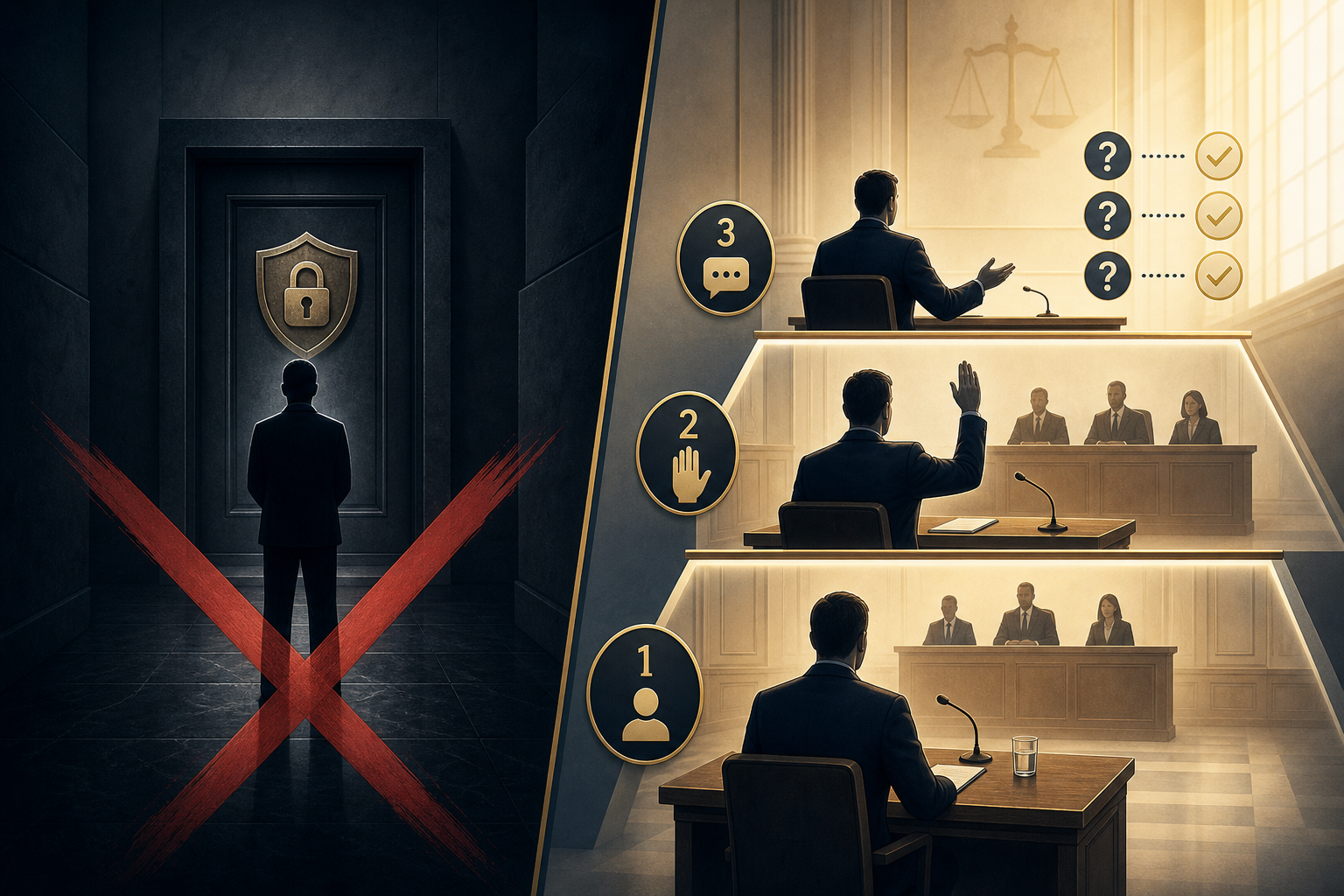
The Three-Minute Email Was Not A Privilege Record
Navarro publicly connected his refusal to Trump’s directive to assert executive privilege, and the committee’s interest in him was not incidental. He had been described as central to the “Green Bay Sweep” plan to delay certification of the 2020 election, and the Jan. 6 committee subpoenaed him in February 2022.[1] But the legal sufficiency of his defense did not turn on the political salience of the investigation. It turned on proof.
A witness claiming derivative executive privilege needs more than a statement that the former president wanted privilege asserted. He needs a record that permits a court to determine whether the privilege was actually invoked, by whom, over what subjects, and with what effect. Navarro’s three-minute email did not do that work.[2]
Nor did categorical refusal give the committee a chance to narrow the dispute. Some questions might have implicated presidential communications. Others might not have. Some document requests might have raised colorable privilege claims. Others might have sought materials outside any protected channel. By refusing to appear at all, Navarro prevented those distinctions from being made in the ordinary way.
The appellate court’s reasoning therefore treats procedure as substance. A privilege not asserted with discipline can fail not because the underlying doctrine is imaginary, but because the witness never placed a justiciable privilege dispute before the court.
Trump v. United States Did Not Supply Derivative Immunity
The most consequential part of the ruling is the panel’s treatment of Trump v. United States. Navarro argued that the Supreme Court’s presidential immunity decision changed the analysis for executive-branch witnesses. The D.C. Circuit drew the line at the President. The immunity recognized for presidential acts did not extend to senior aides asserting derivative executive privilege.[1][2]
That matters because Trump v. United States created a plausible opening for witnesses to argue that criminal process touching presidential decision-making must be handled differently. The D.C. Circuit’s answer was not to deny that presidential immunity doctrine has force. It was to refuse the additional step Navarro needed: converting presidential immunity into aide immunity, and then converting aide immunity into a defense to total subpoena noncompliance.
Those are distinct moves. A President may have immunity for certain official acts. A senior adviser may have information connected to those acts. A congressional subpoena may seek testimony touching that information. None of that automatically gives the adviser a personal right to disregard the subpoena. The panel’s refusal to collapse those categories is the opinion’s central contribution to the post-Trump immunity landscape.
The result is a meaningful but limited precedent. The court did not decide every future privilege fight involving former White House personnel. It decided that the Supreme Court’s presidential immunity ruling does not excuse a senior aide’s unilateral, categorical nonappearance before Congress.
DOJ’s Reversal Did Not Control The Appeal
The Department of Justice’s mid-appeal reversal is institutionally striking, but it is not the holding. On August 29, 2025, DOJ told the D.C. Circuit that it “is no longer taking the same position as the prior administration in this case” and declined to continue defending Navarro’s conviction.[2]
The internal rationale for that reversal has not been publicly documented in the materials available here. That leaves room to describe the procedural fact, but not to supply motives. What can be said is narrower and more important: the court appointed amicus to defend the judgment, heard the appeal, and unanimously affirmed.[1][2]
That sequence keeps the precedent from resting on DOJ’s litigation preference at any particular moment. The executive branch may change its view of how aggressively to defend a contempt conviction. The court still has an Article III judgment before it, a record, and legal arguments to resolve.
For lawyers reading the case forward, this is one of the more important features of the affirmance. The panel did not avoid the merits because the prosecution’s position shifted. Nor did it treat DOJ’s withdrawal as a confession that the conviction was legally infirm. It resolved the privilege and immunity arguments through adversarial presentation supplied by appointed amicus.
The Sentence Now Matters Mostly As Posture
Navarro’s sentence was concrete, but by July 2026 it no longer determined the practical stakes of the appeal. Judge Amit Mehta sentenced him on January 25, 2024, to four months in prison and a $9,500 fine.[3] Navarro reported to prison on March 19, 2024, served approximately 90 days, and was released early.[4]
That timing makes the D.C. Circuit decision precedential rather than liberty-determinative. The question was not whether Navarro would avoid custody. He had already served the custodial portion. The question was whether the conviction would stand and what rule would govern future witnesses who claim executive privilege in response to congressional subpoenas.
The Bannon comparison is useful only if kept short. Steve Bannon also received a four-month sentence for contempt of Congress, but his factual posture was different because he had left the White House in 2017 and was a private citizen during the subpoena period.[3] That made his executive privilege claim weaker on its face. Still, the two cases share the same core defect: neither proved a valid presidential invocation sufficient to justify the refusal, and neither treated privilege as something to be preserved through compliance with process.
Why A Dormant Enforcement Tool Matters Here
Criminal contempt of Congress under 2 U.S.C. §§ 192 and 194 is an old tool, but modern prosecutions have been rare. Before the Jan. 6 committee cases, contempt referrals often died inside executive-branch charging discretion rather than producing trials and appellate opinions. Lawfare’s analysis of the Navarro, Meadows, and Scavino charging decisions describes how DOJ’s treatment of recent contempt referrals turned on prosecutorial judgments as much as formal congressional referral.[5]
That background explains why Navarro’s case carries weight beyond his sentence. A rarely used statute produces little appellate law. Once the D.C. Circuit affirms a conviction in a case involving a former senior White House adviser, an asserted presidential privilege, and a post-Trump immunity argument, the opinion becomes a procedural map for future disputes in the circuit.
The map is not an invitation to Congress to steamroll all executive-branch objections. It is a warning that the witness must preserve those objections in a legally cognizable way. The subpoena process has room for accommodation and privilege assertion. It has much less room for a witness to announce the conclusion and refuse to participate in the steps that would test it.
The Precedent Lawyers Have To Use
For government lawyers, the decision strengthens the enforceability of subpoenas where a witness attempts to invoke executive privilege without presidential authorization and without appearing. For white-collar lawyers, it narrows the room for advising categorical noncompliance by former executive-branch officials. For constitutional lawyers, it marks a boundary around Trump v. United States: presidential immunity remains presidential.
The ruling also fits with the news account of the affirmance without being reducible to it. Readers who need the basic chronology can start with the related overview, Peter Navarro’s contempt conviction appeal upheld by D.C. Circuit. The legal consequence is the harder point: once a subpoena recipient refuses to appear at all, later invocations of executive privilege arrive on a damaged record.
That is the apparent loophole the D.C. Circuit closed. A former aide may still preserve executive privilege. He may still force disputes over particular testimony or documents. But he may not combine derivative privilege, presidential-immunity rhetoric, and blanket nonappearance into a complete defense to contempt of Congress.
References
- Peter Navarro’s contempt conviction appeal upheld by D.C. Circuit, AP News, July 21, 2026
- DC Circuit likely to reject Peter Navarro’s contempt appeal on broad executive privilege theory, Courthouse News Service, Dec. 18, 2025
- Peter Navarro sentenced to 4 months in prison for contempt of Congress, NPR, Jan. 25, 2024
- Former Trump adviser Peter Navarro reports to prison after Supreme Court rejects bid to remain free, CNN, Mar. 19, 2024
- Dissecting the Justice Department’s Prosecutorial Decisions in Navarro, Meadows and Scavino, Lawfare
Chronological incident history
No sanction cases have named this tool in the tracked record set to date. This does not imply the tool is safe — see Risk Digest for ongoing monitoring.
← Compare peer toolsReport a correction or tip
Spotted an outdated figure, a misstated fact, or a ruling this tool profile should reflect? Public comments are disabled for this content given the professional cost of a misreported case outcome, penalty amount, or rule text — use the structured correction channel instead.
Report a correction or tip for this record →