
What New York's Data Center Moratorium Means for AI Development
New York's data center moratorium creates overlapping regulatory tracks under Executive Order No. 62 and pending legislation S10642. This article breaks down the key provisions, timelines, and compliance risks for legal professionals advising on data center projects or AI compute infrastructure in the state.
- Hallucination rate
- Not measured / undisclosed
The practical mismatch is not that New York announced a single clean ban. It is that there are now two tracks to read at once: Executive Order No. 62 is already in force for new state permitting on covered data center projects at 50 MW or more, while S10642 would lower the trigger to 20 MW but remains pending as of July 19, 2026. That gap matters on day one, because a project can be outside the current EO and still be inside the bill that may follow it, which changes how counsel frames diligence, financing, and change-in-law risk. [1]
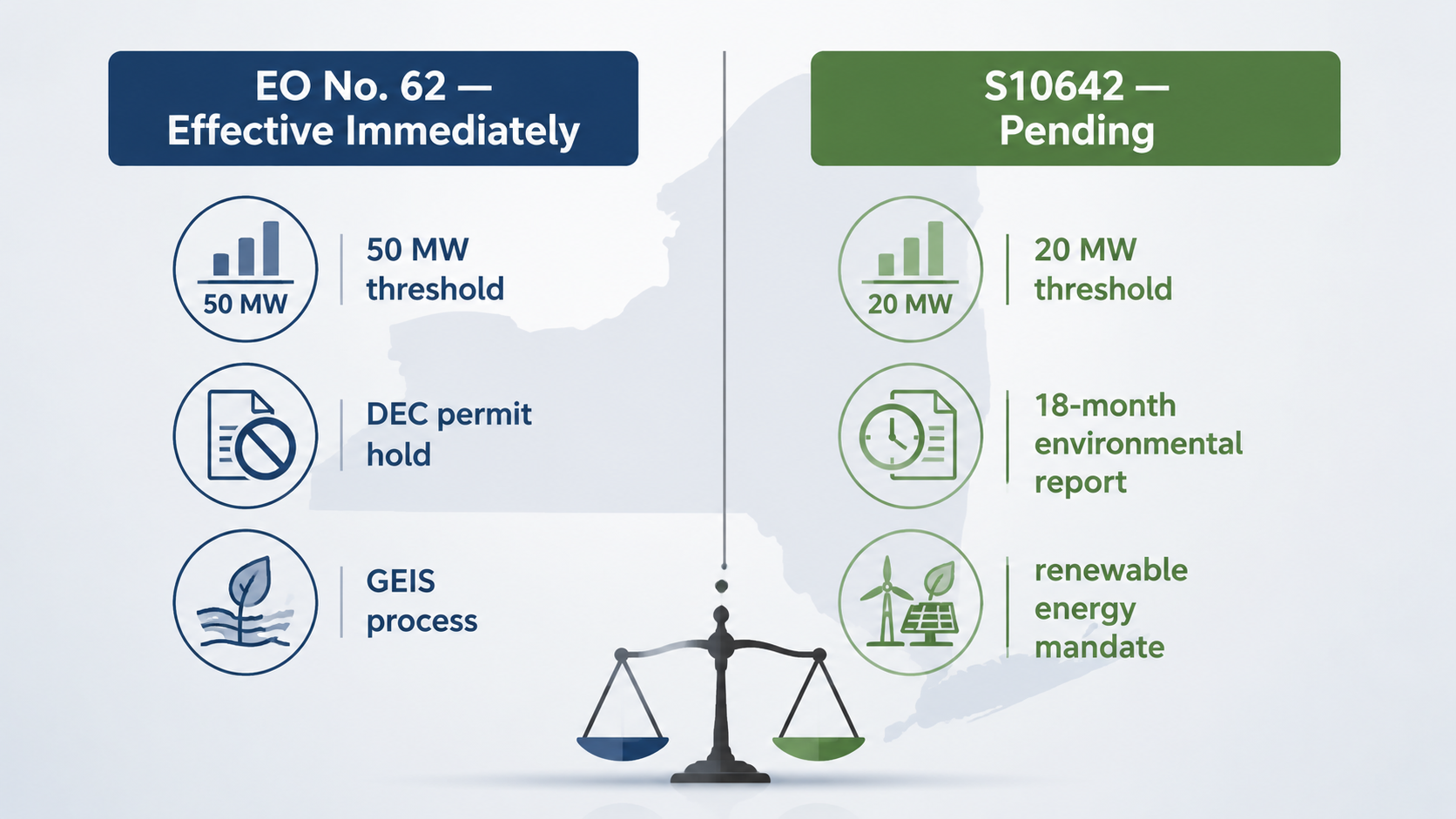
Two Tracks, Two Thresholds
Read the framework as a split screen rather than a single rule.
| Track | Status | Trigger | Main mechanics |
|---|---|---|---|
| Executive Order No. 62 | Effective now | 50 MW or more | Holds new DEC permits for covered facilities while the state works through a generic environmental impact statement (GEIS), a Community Investment Framework, interconnection review, and water-withdrawal review. [1] |
| S10642 / Responsible Data Center Development Act | Passed legislature on June 4, 2026; awaiting governor action as of July 19, 2026 | 20 MW or more | Would extend scrutiny to smaller projects and add an 18-month environmental impact report, renewable-energy targets reaching 90% by 2040, prevailing-wage and domestic-sourcing rules, host community benefits, and separate utility rate classification by 2030. [1] |
The carve-outs matter as much as the threshold. EO No. 62 exempts manufacturing, research, education, and medical care facilities, and it does not change local permits; projects already deemed complete are outside the pause. Those distinctions decide whether a site is actually frozen or only waiting on one layer of state review. [1]
- Is the project above 50 MW today, or only exposed if S10642 becomes law?
- Has the project already been deemed complete?
- Does an exemption fit the use case?
- Which approvals are state, and which remain local?
- Do the data center and power contracts need change-in-law or delay language?
Why Albany Moved
The queue data show why this became a permitting issue, not just an announcement. AP reported that proposed data center load in New York had climbed to nearly 12 GW by May 2026, up from about 1 GW in 2022, with proposals rising from 6 projects to 48. [2] That does not mean every request would have been built. It does mean the state was no longer dealing with a handful of isolated projects.
That scale matters because it ties AI compute demand to power-system planning. For counsel, the useful point is not that load is growing in the abstract; it is that load growth now triggers a permitting and interconnection response that can change project timing, capital structure, and site selection.
The Cost Allocation Question
The bigger legal shift is who pays. The Grid Acceleration Fund, the beneficiary-pays approach to interconnection, and the bill's separate utility rate classification by 2030 all point in the same direction: larger data center facilities may have to internalize more of the grid-upgrade and system-cost burden instead of spreading it broadly across ratepayers. [1] For contracts, that is where the moratorium starts to look less like a pause and more like a cost-allocation shift.
That changes the diligence questions faster than the politics do. A board memo now has to ask who funds interconnection upgrades, how utility classification might affect operating economics, whether a host-community package is part of the baseline deal, and whether a delay in state approval shifts money from the developer to the customer or the rate base.
What The Pending Bill Would Add
Because S10642 is still awaiting governor action, it should sit in a separate branch of the risk model rather than be treated as current law. If signed, it would extend scrutiny down to 20 MW, add the 18-month environmental impact report, and turn the renewable, labor, and sourcing rules into transaction assumptions rather than background policy. Until then, the bill is a planning variable, not an existing obligation. [1]
Public Opinion Is Context, Not Coverage
Public opinion helps explain the pressure, but it does not answer the compliance question. Siena's June 2026 poll found 46% support and 21% opposition, but that survey predates the EO and measures sentiment toward the idea more than the implementation burden now in front of counsel. [3] The broader political argument can keep moving; the permit file still needs a threshold, an exemption analysis, a queue position, and a cost-allocation read.
So the defensible read as of Q3 2026 is not that New York has banned AI infrastructure or that it has settled the issue. It has created an unstable two-track environment in which the first questions are regulatory, not rhetorical: threshold, exemption, permit layer, queue status, cost allocation, and change-in-law. Until the EO process runs and the pending bill is resolved, counsel should treat New York data center capacity as a permitting and interconnection problem with financing consequences, not as a settled policy backdrop.
References
- Executive Order No. 62, Governor's Office, July 14, 2026
- New York data center queue growth coverage, AP News
- New York's data center moratorium coverage, CNBC, July 14, 2026
Chronological incident history
No sanction cases have named this tool in the tracked record set to date. This does not imply the tool is safe — see Risk Digest for ongoing monitoring.
← Compare peer toolsReport a correction or tip
Spotted an outdated figure, a misstated fact, or a ruling this tool profile should reflect? Public comments are disabled for this content given the professional cost of a misreported case outcome, penalty amount, or rule text — use the structured correction channel instead.
Report a correction or tip for this record →