
Slotkin's AI Guardrails Ignore the SAVE Act's Election Risks
The SAVE Act's documentary proof-of-citizenship mandate and the federal expansion of AI-driven SAVE database voter checks each have documented, demographically skewed error rates that compound disenfranchisement risk for the same eligible voters. Slotkin's AI Guardrails Act codifies restrictions on military AI but does not extend to election administration, leaving a gap this article analyzes.
- Hallucination rate
- Not measured / undisclosed
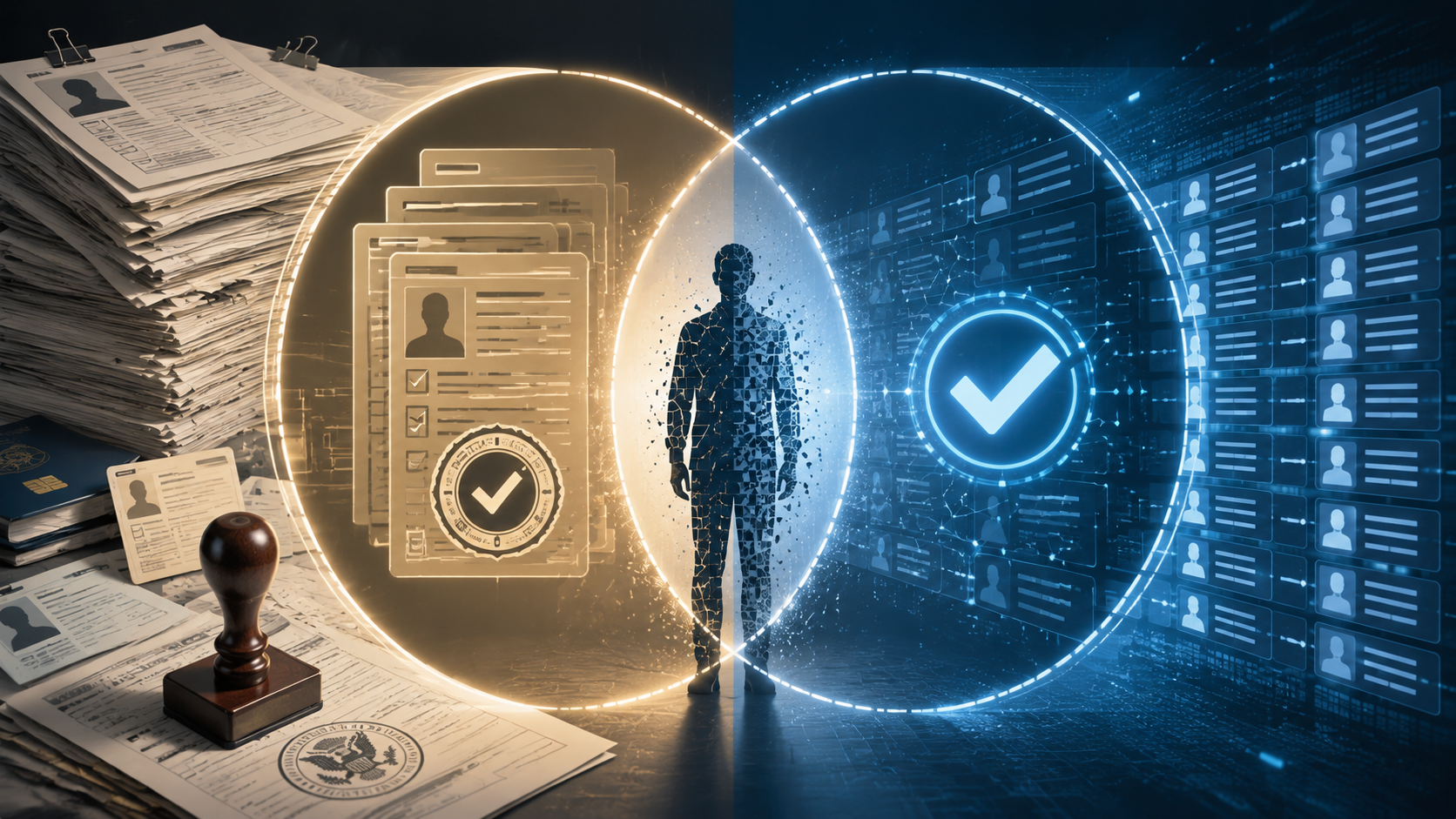
The acronym problem is not a footnote. The SAVE Act, also called the Safeguard American Voter Eligibility Act or SAVE America Act in some coverage, is a congressional proposal to require documentary proof of U.S. citizenship for voter registration. The DHS SAVE database, short for Systematic Alien Verification for Entitlements, is a federal immigration-status verification tool now being used or proposed for voter-list checks. They are different regimes. The legislative problem begins where those two regimes meet: one asks voters to produce documents; the other asks election officials to trust database matching that can be wrong.
That distinction matters because election administration does not experience these systems separately. A voter who lacks ready access to a citizenship document may also be the voter whose naturalization record, married name, address history, or database match creates a second flag. A county clerk does not get a clean philosophical debate about “election integrity.” The clerk gets a list, a deadline, a statutory threat, a voter on the phone, and often no reliable way to know whether the federal data is stale, incomplete, or simply matched to the wrong person.
The Same Voter Can Be Caught Twice
The most useful number in this debate is not a poll result or a partisan estimate. It is the Bipartisan Policy Center’s 2026 finding that roughly 12% of registered voters, about 28.4 million people, lack ready access to the citizenship documents the SAVE Act would require. The same analysis found registered Democrats and Republicans roughly equally likely to have the required documentation, while Republicans relied more heavily on birth certificates, a form of proof that can be fragile when names, custody of records, or access to vital-records offices become the issue.[1]
That finding does not prove that every voter without ready documents would be disenfranchised. It does show the scale of the administrative contact Congress would create before anyone even reaches the database-check layer. A proof-of-citizenship law does not merely ask whether a voter is a citizen. It asks whether the voter can produce the right record, in the right name, at the right time, through a process the election office can accept.
The second track is already producing warning lights. ProPublica and The Texas Tribune reported in February 2026 that the DHS SAVE tool had mistakenly flagged eligible citizens as noncitizens across at least 29 Texas counties, with error rates exceeding 14% in some jurisdictions. The reporting also found that DHS had to correct information provided to at least five states after the tool misidentified eligible voters.[2]
Those are not abstract “AI risk” hypotheticals. They are official-looking mismatches entering a voter-list process. Once that happens, the burden shifts. Someone has to review the record, send notice, answer calls, receive documents, update the file, stop a mistaken cancellation, or restore a registration. If the law treats the screen as a gate rather than a lead, the eligible voter becomes the error-correction mechanism.
For readers who need the broader statutory terrain, the NVRA and HAVA framework is better handled in a dedicated treatment such as How Federal Law Governs Voter Roll Non-Citizen Checks. The point here is narrower: proof-of-citizenship mandates and federal database checks can converge on overlapping populations, and the available evidence does not support treating either track as a clean yes-or-no citizenship determination.
Where the Compounding Risk Lands
A single imperfect screen can be managed if the statute builds in notice, human review, cure, appeal, and a real remedy before removal. The harder problem is administrative stacking: a document rule with known access gaps, followed by a database tool with documented misidentification risk, followed by election-office deadlines that punish delay more reliably than they punish over-inclusion.
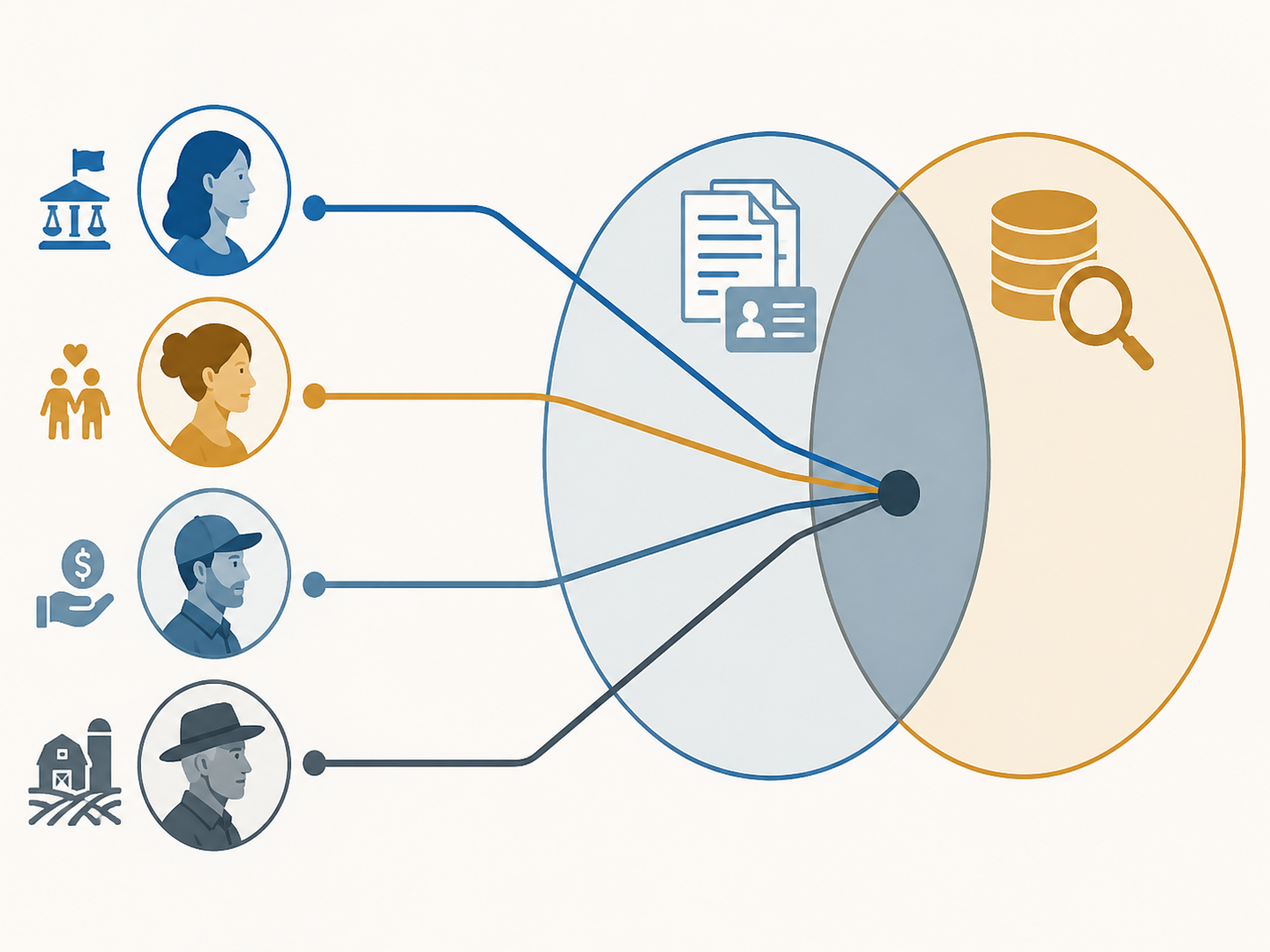
Naturalized citizens sit directly in the overlap. The documentary track may require a naturalization certificate, passport, or other proof that is not always nearby, current, or affordable to replace. The database track adds a second exposure: immigration-status records can lag behind a person’s actual citizenship status, and the February 2026 Texas reporting showed eligible citizens being flagged as noncitizens through the SAVE tool.[2] For a naturalized voter, the question is not simply whether the government knows they are a citizen. It is whether the election-facing system knows it in time, under the voter’s current name and identifying information, before a registration deadline or purge process moves.
Married women face a different version of the same trap. Documentary proof can depend on a birth certificate in one surname, a current registration in another, and a marriage record that may not be in the voter’s possession. A database match can then treat the same name change as uncertainty rather than as an ordinary life event. The issue is not that every married woman lacks proof. It is that a document rule and a name-matching rule can both punish the same discrepancy.
That is where the artificial-intelligence literature matters. Brennan Center research on AI in election administration describes name-matching systems used in voter-roll maintenance that vary in accuracy across racial and ethnic groups, including higher false-positive rates for Asian names and higher likelihood of inaccurate purges affecting Hispanic and Black voters. The same Brennan Center work also discusses AI signature-matching software, including Parascript systems used in more than 29 counties across eight states, with reported controlled-condition accuracy ranging from 74% to 96% and worse performance for young, elderly, disabled, and nonwhite voters.[3]
The Michigan Law Review’s 2023 discussion of algorithmic elections supplies the mechanism, not a claim about the 2026 SAVE rollout. Automated name matching and signature verification do not fail randomly; they can reproduce disparities when the data, model assumptions, or review procedures are uneven.[4] That is enough to make the election-law question concrete. If a voter’s name, signature, or status history is more likely to be treated as a mismatch, a second verification screen does not merely add work. It adds correlated work.
Low-income voters absorb the cure burden most harshly. A person may be eligible, properly registered, and fully able to attest to citizenship, yet still lack ready access to a passport, birth certificate, naturalization certificate, replacement fee, printer, scanner, weekday transportation, or time off work. The BPC figure captures “ready access,” which is the right administrative measure. A document that exists somewhere in a state archive or federal file is not the same as a document a voter can produce before a deadline.[1]
Rural voters face the same problem through geography and office capacity. A cure process that assumes nearby offices, frequent mail reliability, broadband access, or quick replacement records will sort voters by logistics, not citizenship. A small county office may also be asked to interpret federal database returns without specialized immigration expertise. When an official screen creates a false flag, the local election worker is often the person left to explain a federal system they did not design.
| Voter group | Documentary proof risk | Database or AI-matching risk |
|---|---|---|
| Naturalized citizens | Citizenship proof may be unavailable, outdated in presentation, or difficult to replace quickly. | Status records or identifiers can lag or mismatch, producing noncitizen flags that require correction. |
| Married women | Birth, marriage, and current registration records may not align under one name. | Name-matching systems can treat ordinary name changes as uncertainty. |
| Low-income voters | Replacement records, travel, fees, and time off work make cure harder. | False flags impose document-gathering and response costs on the voter. |
| Rural voters | Distance from records offices and limited service access slow document production. | County offices may have limited capacity to investigate federal database errors before deadlines. |
None of this requires assuming bad faith by every official who supports documentary proof or database screening. The problem is statutory design. A careful verification law would specify the trigger for review, the permitted data source, the confidence threshold, the human reviewer, the notice content, the cure period, the appeal path, and the remedy if the government is wrong. A law that leaves those details to overworked administrators invites discretion at exactly the point where Congress claims it is eliminating discretion.
The SAVE Act Debate Is Larger Than One Provision
The American Progress overview of the SAVE Act describes the proposal’s documentary proof-of-citizenship requirement and related operational effects on voter registration, including mail and online registration complications.[5] Brookings likewise treats the measure as a voting-restriction bill rather than as a narrow administrative update.[6] Those characterizations are useful, but they can also flatten the implementation problem into a familiar partisan exchange.
The partisan story is less tidy than the slogans suggest. BPC’s 2026 analysis found registered Democrats and Republicans roughly equally likely to have required documentation, while noting Republican voters’ heavier reliance on birth certificates.[1] A birth certificate is often treated in political debate as the simplest possible citizenship proof. In administration, it is often where the complications begin: changed names, inaccessible records, amendments, custody issues, and mismatch between the birth record and current registration.
Elissa Slotkin has addressed the electoral stakes in blunt partisan terms. In a Fox News interview, she said the SAVE America Act would make it harder for Democrats to win elections.[7] That statement matters because it shows she understands the political consequence of the bill. It does not answer the narrower legislative question: whether her AI and election-security portfolio addresses the automated verification risks that a SAVE Act environment would intensify.
For provision-by-provision background, readers can turn to What the SAVE America Act Does to Voter ID and Mail Voting, Why the SAVE Act keeps failing despite GOP control, and What’s the SAVE Act’s legal timeline from 2025 to 2026? The harder gap is not a missing explainer. It is the absence of a matching governance standard for automated election systems when Congress is simultaneously expanding citizenship-verification demands.
Slotkin’s AI Guardrails Stop at the Pentagon Door
Slotkin’s AI Guardrails Act, announced on March 17, 2026, is not a trivial bill. It would codify three Department of Defense AI prohibitions involving autonomous lethal force, domestic surveillance, and nuclear weapons launch authority.[8] Those are high-consequence areas, and the bill’s premise is sound: some uses of automated systems are too dangerous to leave to agency preference, vendor assurance, or after-the-fact oversight.

But the bill is a defense bill. It does not cover AI-generated election disinformation, automated voter purges, database-driven citizenship checks, name matching, or signature verification. That is not a hidden defect; it is the bill’s scope. The analytic problem is that Slotkin’s most explicit AI legislation recognizes catastrophic state action in military contexts while leaving election-administration AI outside the frame.
Her Protect Our Polls Act, unveiled June 18, 2026, also addresses a real election concern: the presence of military or armed federal law-enforcement personnel at polling places.[9] Physical intimidation at the polls deserves statutory attention. Still, that bill does not address AI-generated disinformation, automated voter purges, algorithmic signature verification, or federal database use in voter-list maintenance.[9]
The contrast is sharpest with the FAIR Elections Act from Senators Jeff Merkley and Alex Padilla. The 2026 proposal targets AI-generated election disinformation, bars federal use of SAVE-type databases for voter purges, and creates a private right of action for voters wrongly removed from the rolls. Slotkin is not listed as a cosponsor in the research materials for that bill.[10]
That comparison should not be overstated. Slotkin’s office has not claimed that the AI Guardrails Act solves election AI governance, and there is no evidence in the research materials that she personally caused the SAVE Act’s documentation gap or the DHS database errors. The criticism is legislative selectivity. Congress can identify unacceptable AI delegation when weapons, surveillance, and nuclear launch authority are involved. It has been much less explicit when automated systems help decide whether an eligible voter remains registered, receives a ballot, or must prove a negative.
| Bill or proposal | What it addresses | What it leaves unresolved for SAVE-related election administration |
|---|---|---|
| Slotkin AI Guardrails Act | DOD AI prohibitions involving lethal force, domestic surveillance, and nuclear launch authority. | No election AI provisions for voter-list matching, signature verification, database checks, or election disinformation. |
| Slotkin Protect Our Polls Act | Military and armed federal law-enforcement presence at polling places. | No automated purge, SAVE database, or AI-generated disinformation framework. |
| FAIR Elections Act | AI-generated election disinformation, federal SAVE-type database use for purges, and a private right of action for wrongly removed voters. | Offers the clearest election-AI contrast in the research materials; Slotkin is not identified as a cosponsor. |
What a Serious Election-AI Standard Would Have to Answer
The minimum governance questions are not exotic. They are the same questions election lawyers ask whenever a voter may lose registration status, ballot access, or ballot counting because of an official determination.
- What statutory event permits a database or algorithmic check?
- Which data source is authoritative, and what happens when federal, state, and local records conflict?
- What match confidence is required before a voter is flagged?
- Who conducts human review, and what training or documentation must support that review?
- What notice must the voter receive, in what language and format, and how much time is available to cure?
- What remedy restores the voter before an election if the government’s system was wrong?
The Brennan Center has separately documented that states are already enacting SAVE Act-style proof-of-citizenship policies, which means the federal debate is not waiting for a single national switch to flip.[11] State and local offices are already building processes around documentary proof, list maintenance, and federal verification signals. If those processes are not designed around error correction, the burden will surface as individual disputes that look isolated only because the system makes each voter fight alone.
The February 2026 reporting on DHS SAVE errors should be treated as a live implementation warning, not as final nationwide measurement. The investigation covers errors known through that reporting window; newer data may exist, and the expansion of database use is ongoing.[2] But the legal lesson does not depend on proving a final national error rate. A system that can produce official false noncitizen flags at county scale needs statutory guardrails before it is tied to removal, rejection, or documentary cure burdens.
That is why the SAVE Act’s AI implications for legislation are not confined to whether Congress adopts one bill title or another. The issue is whether federal law treats automated election-administration tools as consequential state action. If an AI or database-assisted process is only used to generate a lead, the statute should say so. If it can trigger notice, challenge, cancellation, ballot rejection, or referral, the statute should say exactly what procedural rights attach before harm occurs.
Slotkin has legislated against high-consequence military AI. Her current portfolio, as reflected in the AI Guardrails Act and Protect Our Polls Act, does not yet address the election-administration AI risks that the SAVE Act environment makes urgent. If Congress treats AI risk as real when weapons, surveillance, and nuclear systems are involved, it needs an equally explicit standard when automated systems can help decide whether eligible voters remain on the rolls.
References
- Do Documentary Proof of Citizenship Requirements Disadvantage One Party More Than the Other?, Bipartisan Policy Center, 2026.
- SAVE voter citizenship tool mistakes and confusion, The Texas Tribune and ProPublica, February 13, 2026.
- Safeguards for Using Artificial Intelligence in Election Administration, Brennan Center for Justice.
- Algorithmic Elections, Michigan Law Review, 2023.
- The SAVE Act: Overview and Facts, Center for American Progress.
- The SAVE Act: An Attempt to Restrict Voting Rights, Brookings.
- Elissa Slotkin says SAVE America Act would make it hard for Democrat to win elections, Fox News.
- Slotkin Legislation Puts Common Sense Guardrails on DOD AI Use Around Lethal Force, Spying on Americans, and Nuclear Weapons, Office of Senator Elissa Slotkin, March 17, 2026.
- Protect Our Polls: Sen. Slotkin unveils legislation targeting Election Day security, WILX, June 19, 2026.
- Merkley, Padilla Lead Effort to Fight Back Against Voter Suppression and Misuse of Artificial Intelligence in U.S. Elections, Office of Senator Jeff Merkley, 2026.
- States Are Already Enacting Harmful SAVE Act Policies Requiring Proof, Brennan Center for Justice.
Chronological incident history
No sanction cases have named this tool in the tracked record set to date. This does not imply the tool is safe — see Risk Digest for ongoing monitoring.
← Compare peer toolsReport a correction or tip
Spotted an outdated figure, a misstated fact, or a ruling this tool profile should reflect? Public comments are disabled for this content given the professional cost of a misreported case outcome, penalty amount, or rule text — use the structured correction channel instead.
Report a correction or tip for this record →