
Taylor Farms Lettuce Recall Lawsuits Expose FDA Transparency Gap
The CDC and FDA closed the 2024–2025 E. coli outbreak investigation without publicly naming Taylor Farms, forcing victims to identify the supplier through litigation. This analysis examines how that regulatory silence shifts attribution costs to private parties and what it means for the parallel 2026 Cyclospora outbreak.
- Hallucination rate
- Not measured / undisclosed
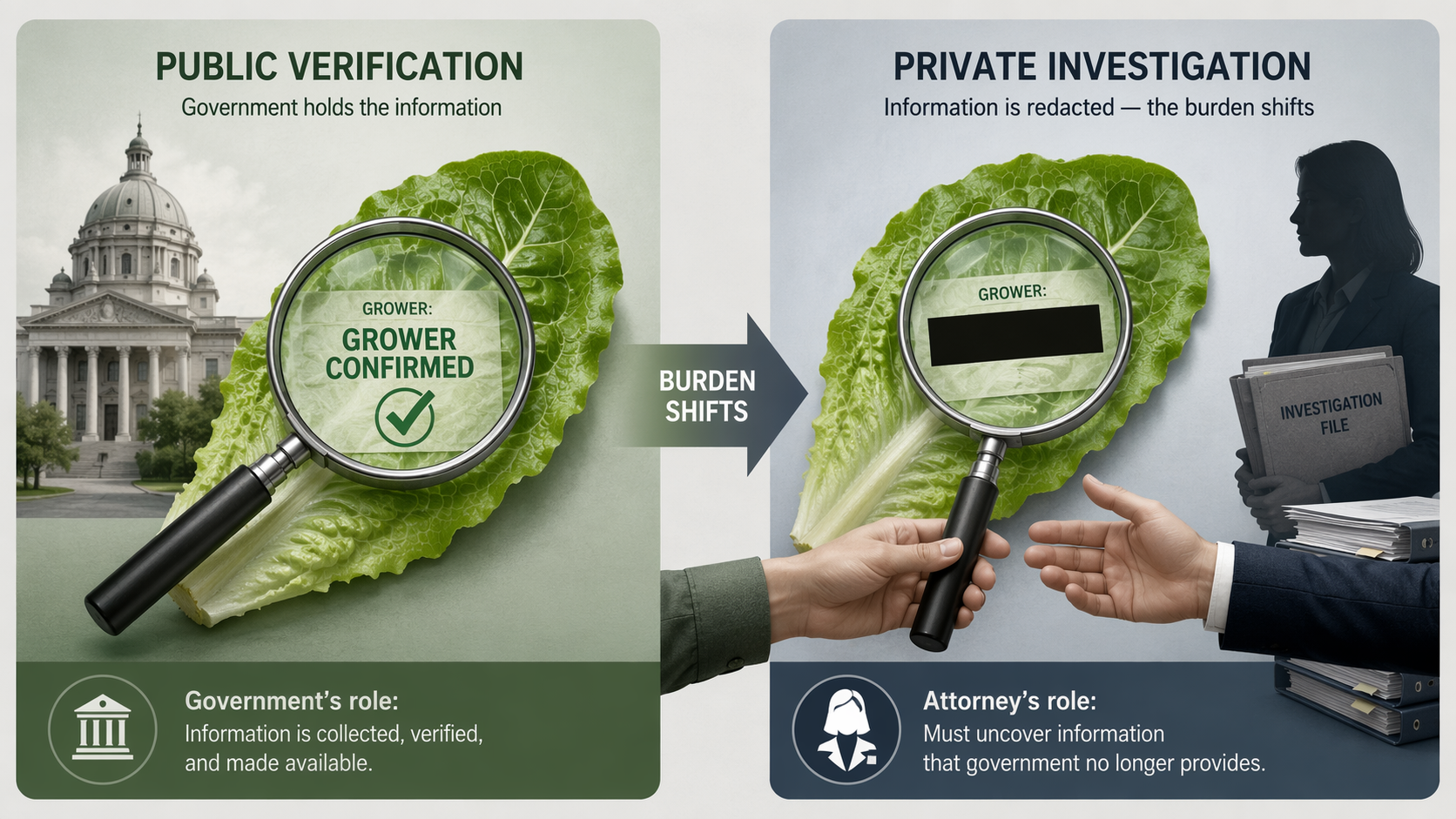
The Taylor Farms lettuce recall lawsuit story starts with a closure notice. On January 15, 2025, the CDC and FDA ended the 2024-2025 E. coli O157:H7 romaine investigation after confirming romaine lettuce from Taylor Farms as the vehicle in an outbreak that sickened 89 people, hospitalized 36, caused seven kidney-failure cases, and was linked to one death, but they did not publicly name Taylor Farms in the closure. That left the source confirmed inside the agency record and absent from the public statement, so victims and counsel had to reconstruct attribution themselves from purchase records, lab matches, and shipping records instead of starting with an official name. [1]

How The Closure Framed The Problem
The FDA's defense of that choice was narrow and practical: if contaminated lettuce is already off the market, there may be no actionable advice left for consumers. That is a real policy position, and it makes sense if the only public-health question is whether people can still avoid the product. It is much less complete if the question is who now has to prove what happened, who pays for that proof, and how long it takes before a family can even name the company tied to the outbreak. Once the agency stops at 'no consumer advice needed,' the work of attribution moves into discovery, where invoices, meal records, and sequencing data become the substitute for public notice. [1][2]
What Private Counsel Had To Rebuild
That is what Marler Clark said it did in the romaine litigation. The firm reported that it obtained invoices from a St. Louis caterer and used whole-genome sequencing matching evidence to independently confirm Taylor Farms as the source before filing multiple federal lawsuits in April 2025. In practical terms, the lawyers performed the notification function the agencies withheld: they turned a closed investigation into a named defendant, and they did it with the kind of proof that usually belongs in a case file, not a public closure memo. [2]
The criticism followed the same line from different angles. Bill Marler called the non-naming decision a failure of the agencies' public-health mandate, Jerold Mande said it deprives consumers and industry of the information they need to make informed food choices, and Darin Detwiler warned that people cannot really plan for likelihood and severity when the source is confirmed but not publicly identified. Marler also pointed to HHS layoffs of roughly 20,000 employees as one factor that may have weakened outbreak transparency, though that is best read as a contributing context rather than a complete explanation. [3][4]
The 2026 Cyclospora Pattern Repeats
The same structure appeared again in July 2026, this time in the Cyclospora outbreak tied to iceberg lettuce. The CDC's July 16 advisory named Taco Bell, but not Taylor Farms as the grower; FDA then confirmed that Taylor Farms lettuce was contaminated on July 18 through import surveillance and a voluntary recall of iceberg lettuce from central Mexico, including Marketside products at Walmart in 15 or more states and food-service products in 27 states with use-by dates through August 3, 2026. Marler Clark filed the first federal lawsuit on July 16, Ron Simon & Associates filed another the next day, and more suits quickly followed. [5][6][7][8]
The case counts underline why the timing matters. Michigan alone reported more than 5,002 cases and 102 hospitalizations as of July 17, while CDC's confirmed figure of 1,644 cases across five states lagged because the agency stopped proactive Cyclospora tracking in July 2025; nationwide estimates exceeded 7,000 cases across 34 states. When the public count trails the real one and the grower name is still moving through reporters, agencies, and lawyers, the burden of attribution does not disappear. It lands on the victims, who need a defendant to investigate, and on the lawyers, who have to build the record before deadlines run. [5]
References
- Taylor Farms named as romaine grower behind deadly outbreak of E. coli infections, Food Safety News, April 2025. Source
- Marler Clark files multiple E. coli Lawsuits against Taylor Farms, PRNewswire, April 2025. Source
- The Cyclospora Outbreak Now Has Two Names on It - Taylor Farms and Taco Bell. Both Have Been Here Before and So Have I, Marler Blog. Source
- Salinas produce supplier accused of causing E. coli outbreak, Los Angeles Times, April 24, 2025. Source
- Taco Bell Hit With Federal Lawsuits Over Cyclosporiasis Infections, Forbes, July 17, 2026. Source
- Investigation of 5-State Outbreak of Cyclospora Illnesses: Iceberg Lettuce, FDA, July 2026. Source
- FDA confirms that Taylor Farms lettuce is contaminated with parasite behind massive outbreak, Food Safety News, July 2026. Source
- Ron Simon & Associates Files First Cyclospora Lawsuit Against Taco Bell and Taylor Farms, PRNewswire, July 2026. Source
Chronological incident history
No sanction cases have named this tool in the tracked record set to date. This does not imply the tool is safe — see Risk Digest for ongoing monitoring.
← Compare peer toolsReport a correction or tip
Spotted an outdated figure, a misstated fact, or a ruling this tool profile should reflect? Public comments are disabled for this content given the professional cost of a misreported case outcome, penalty amount, or rule text — use the structured correction channel instead.
Report a correction or tip for this record →