
Who Qualifies for a Trump Account? A 2026 Legal Analysis
A legal analysis of Trump Account eligibility requirements under IRC §530A, covering the statutory criteria, authorized-individual ordering hierarchy, contribution caps, and unresolved regulatory gaps for practitioners advising families and financial institutions.
- Hallucination rate
- Not measured / undisclosed
The first Trump Account eligibility question in July 2026 is not whether the child has wages. That is the unusual part of the design: unlike a traditional IRA, the child does not need earned income before an account can be opened or funded under the new child IRA structure described in the government’s launch materials and policy explainers.[1][2] The harder question is whether the child, the election, and the adult acting for the child fit the account-opening rules that Treasury and the IRS have so far chosen to write.
As of Q3 2026, the answer can be mapped, but not completed. The March 2026 proposed regulations address how to open initial Trump Accounts, including the election process and authorized-individual ordering rules; they do not yet supply the full operational regime for contributions, distributions, reporting, Roth rollover mechanics, or ABLE coordination.[1] That leaves practitioners with a usable eligibility framework and a conspicuously unfinished administration framework.

The Launch-Period Eligibility Map
For a child to qualify in the practical sense, four things have to line up. The child must be within the statutory child class. A valid election must be made. The person making that election must be authorized under the ordering hierarchy. The account must be opened within the proposed regulatory framework, with a responsible party designated for administration.[1][2]
| Eligibility element | Launch-period legal significance |
|---|---|
| Child status | The child must be under age 18 at the close of the taxable year and have a valid Social Security number issued before the election date. |
| Election | An affirmative election is required, using Form 4547 or the Treasury electronic portal described in the proposed account-opening framework. |
| Authorized individual | The adult making the election must fit the priority hierarchy and make the required representation under penalties of perjury. |
| Responsible party | A responsible party must be identified for account administration; that role is related to, but not always identical with, the person who first had authority to elect. |
| Regulatory posture | The March 2026 rules are proposed, not final, and reserve major funding and distribution mechanics for future guidance. |
That sequence matters because it prevents the common but loose formulation that every child simply “gets” a Trump Account. The statute and proposed regulations create a pathway, not an automatic account for every minor. A child may be eligible, but someone still has to make the election in the proper capacity and within the account-opening process Treasury has described.[1]
Who the Child Must Be
The basic child-side requirements are straightforward enough to state and easy enough to misapply. The child must be under 18 at year-end, and the child must have a valid Social Security number issued before the date of the election.[1][2] In practice, that timing rule should push advisers away from informal assurances such as “the number is coming” or “the family has applied.” For account-opening purposes, the relevant question is whether the valid SSN exists before the election is made.
The absence of an earned-income requirement is the feature that separates Trump Accounts from the IRA habits most tax advisers bring to the table. A toddler with no wages can be within the Trump Account structure if the other requirements are satisfied. That does not make the account unconstrained; it means the constraint has moved from compensation-based eligibility to election authority, contribution limits, investment rules, and unresolved transfer-tax treatment.[1][2]
There is also a narrower pilot-program benefit. Federal materials describe a $1,000 pilot-program contribution for eligible U.S. citizen children born from 2025 through 2028.[2] That pilot contribution should not be blurred into the general account-opening rule. A child can be within the broader Trump Account regime without necessarily being in the pilot birth cohort, and the pilot contribution does not answer the later questions about family gifts, employer contributions, or investment administration.
The Election Is a Legal Act, Not a Signup Preference
Treasury and the IRS framed the initial account-opening process around an affirmative election. The proposed regulations describe use of Form 4547 or a Treasury electronic portal, and IRS public guidance describes the proposed rules as addressing how to open initial Trump Accounts.[1] For professional advisers, that makes the election file worth preserving. The election is the hinge between a child who appears eligible and an account that has actually entered the statutory system.
The conservative practice point is simple: keep the child’s identifying information, the date the SSN was issued or otherwise verified for election purposes, the election method, the adult’s asserted authority, and the responsible-party designation together. Family structures change. Guardianships change. Parents separate. Grandparents fund accounts they do not administer. The government’s account-opening rules anticipate adult authority; they do not eliminate the evidentiary need to show why the person who acted had priority when the election was made.
The Authorized-Individual Hierarchy
The proposed regulations’ most important practical contribution is the ordering hierarchy for the person who may make the election. The hierarchy runs from the pilot-program elector, to the child’s legal guardian, to a parent, to an adult sibling, and then to a grandparent.[1] The adult is not merely checking a box; the person must make a representation under penalties of perjury that the person is authorized to act under the applicable ordering rule.[1]
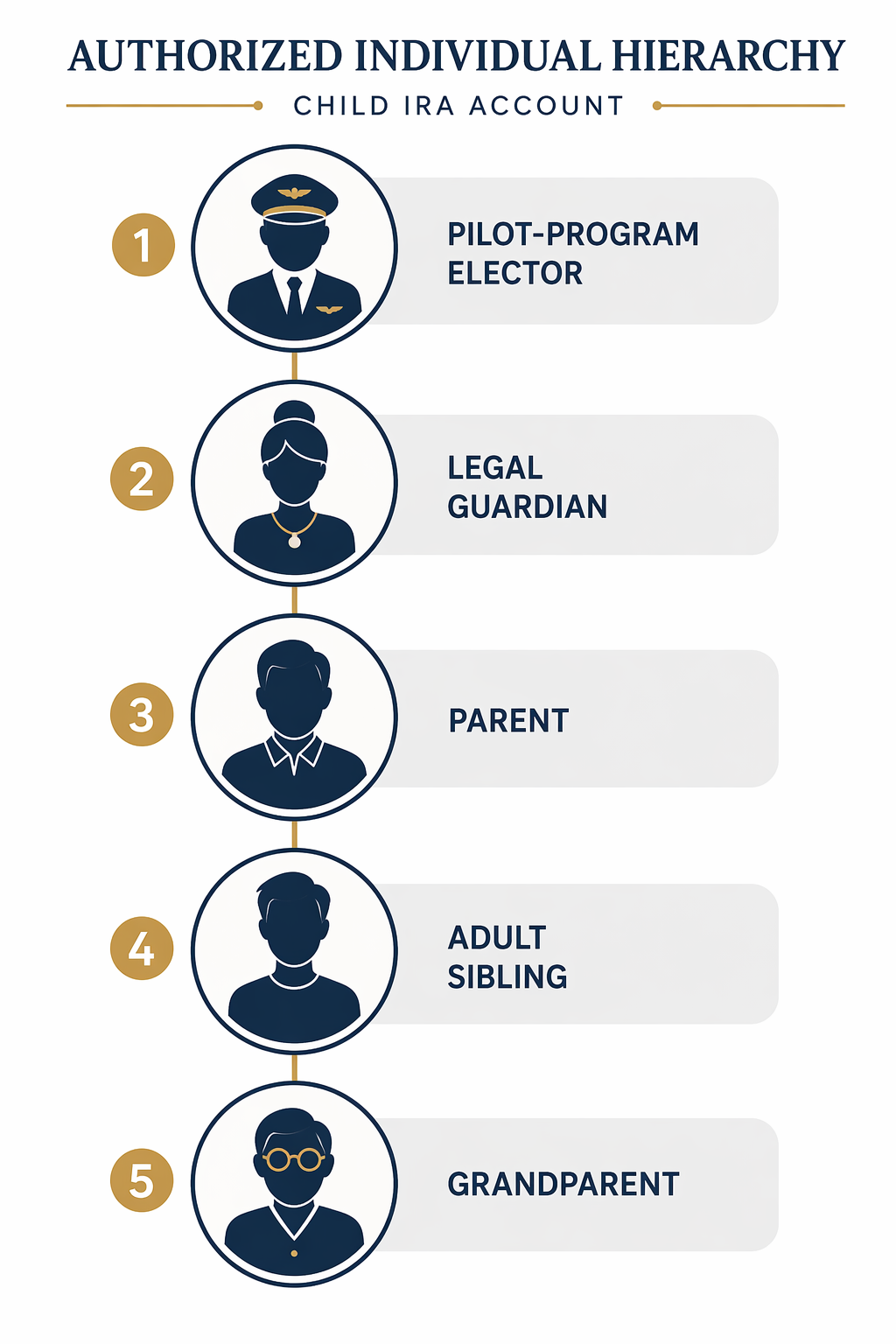
| Priority level | Authorized individual |
|---|---|
| 1 | Pilot-program elector |
| 2 | Legal guardian |
| 3 | Parent |
| 4 | Adult sibling |
| 5 | Grandparent |
This ordering rule is not ceremonial. If a legal guardian has priority, a lower-priority relative should not assume that family relationship alone supplies election authority. If a parent is available and authorized, an adult sibling or grandparent should not be treated as an equivalent signer merely because that person intends to contribute funds. The hierarchy separates affection, funding capacity, and legal authority.
The perjury representation also changes institutional risk. A custodian or trustee may not be expected to litigate family authority at account opening, but it will still need intake procedures that capture the representation the regulations require. A financial institution that treats the hierarchy as a marketing questionnaire rather than an ordering rule is inviting avoidable account-file defects.
Responsible Party Designation
The responsible-party designation is where eligibility starts to become administration. The proposed account-opening framework contemplates identifying a responsible party for the account.[1] That person’s role should be documented with the same care as the election authority, especially where the adult who opens the account is not the person expected to monitor contributions, receive notices, or interact with the financial institution over time.
Practitioners should resist compressing the hierarchy and the responsible-party function into one casual label such as “account adult.” The hierarchy answers who may make the election. The responsible-party designation answers who will stand in the administrative channel after the account exists. Those roles may overlap in many ordinary families, but the distinction becomes important in guardianships, blended families, and accounts funded by relatives who do not have first-priority election authority.
Contribution Limits Are Clearer Than Contribution Planning
The headline contribution numbers are relatively easy to recite. The standard annual contribution cap is $5,000, and employer contributions are separately addressed through an employer-side ceiling of $2,500 under IRC §128, as described in available explainers and professional summaries.[2] Those numbers are not the same as a complete funding rulebook.
For employers, the Department of Labor added an important boundary in June 2026. DOL Technical Release 2026-02 states that Trump Accounts and certain employer Trump Account programs generally are not ERISA-covered pension plans if five non-ERISA conditions are satisfied.[3] That is useful comfort for benefits counsel, but it is not a tax-compliance answer for every contribution design. An employer program can be outside ERISA pension-plan treatment and still need careful review under the tax rules that govern amounts, recipients, payroll administration, and reporting.
Financial institutions received a narrower securities-law accommodation. SEC staff no-action relief, as summarized by Sidley, addressed Form CRS issues for Trump Account trustees in May 2026.[4] That kind of relief helps institutions stand up account products, but it should not be read as a substantive tax ruling on eligibility, contributions, distributions, or family transfer planning.
Investment Restrictions: Simple Menu, Real Compliance Consequences
Trump Accounts are not open-ended brokerage accounts. The available guidance describes investment restrictions limiting assets to broad U.S. equity index funds, with a 0.1% expense cap and no leverage.[2] That restriction is easy to underplay in consumer discussions because it sounds like a product-design choice. For account providers, it is a compliance screen. For advisers, it is a reason not to describe the account as a flexible child investment account.
The restriction also complicates projections. Any long-term balance estimate depends on market-return assumptions, fees, contribution timing, and statutory access rules that are not all finalized. Large projected balances may be useful illustrations if carefully attributed, but they should not become a substitute for eligibility analysis or a representation about what a particular child will receive.
The Gift-Tax Safe Harbor Is the Practical Turn
The most treacherous launch-period issue is not the age test. It is the interaction between Trump Account contributions and the gift-tax filing system. Rev. Proc. 2026-25 provides filing relief for individual donors whose total annual gifts to a beneficiary stay under $19,000 and who do not otherwise file Form 709.[5] That is helpful, but it is a conditional safe harbor, not a blanket exclusion for Trump Account gifts.
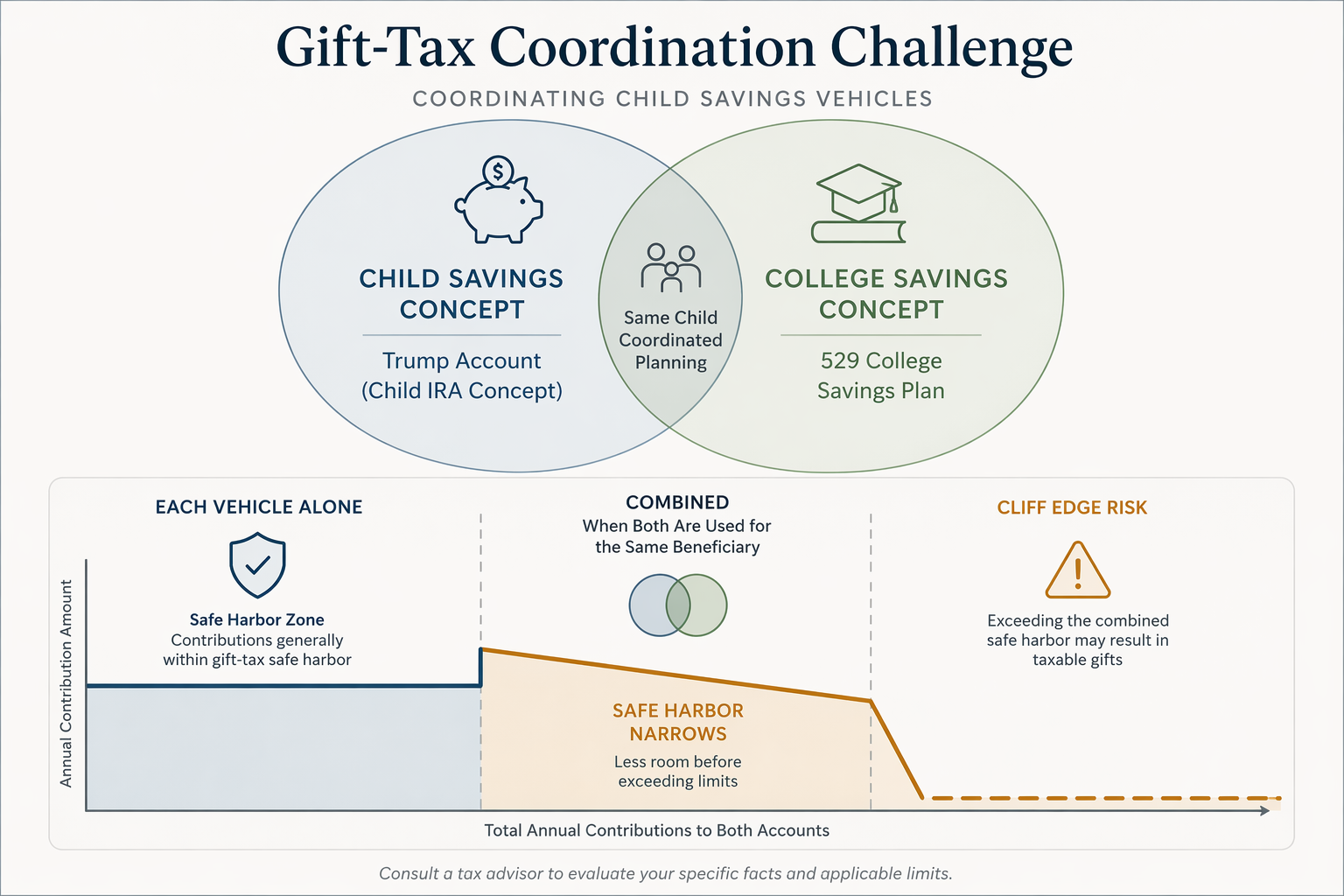
The cliff is easy to miss. If a donor stays within the safe harbor’s conditions, the filing burden is reduced. If the donor exceeds the threshold or has another reason to file Form 709, the relief may no longer protect the Trump Account contribution from reporting treatment. Professional commentary has emphasized that exceeding the threshold by even a small amount can move Trump Account contributions into reportable future-interest-gift territory.[6][7]
Families already using 529 plans are the obvious pressure point. A grandparent may view a Trump Account contribution as a modest add-on to the year’s education savings. The transfer-tax system may view the year’s gifts to the same beneficiary in the aggregate. For a broader comparison of the two vehicles, the related analysis of Trump Accounts vs. 529 Plans is the more natural place to compare savings objectives; here, the legal point is narrower. Coordinated funding can push a donor out of administrative relief even when each gift looked modest in isolation.
ACTEC’s comments on Notice 2025-68 pressed for guidance on gift and generation-skipping transfer tax treatment of Trump Account contributions.[8] That professional concern is well placed. The statutory contribution cap tells families how much can go into the account. It does not by itself tell donors whether the transfer is a present interest, how annual exclusion analysis applies in every circumstance, or how to coordinate Trump Account funding with 529 contributions, outright gifts, custodial transfers, and GST-sensitive planning.
The safest advisory posture is to treat Rev. Proc. 2026-25 as a filing-relief rule with conditions, not as a universal gift-tax clearance certificate. If the same donor is making other annual gifts to the child, front-loading a 529 plan, filing Form 709 for another reason, or working within a GST plan, the Trump Account contribution belongs in the same transfer-tax review rather than in a separate “small account” bucket.
What the March 2026 Proposed Regulations Do Not Yet Resolve
The March 2026 proposed regulations are important because they make account opening administrable. They are also limited. IRS materials describe them as proposed regulations on how to open initial Trump Accounts, and the comment period closed on May 8, 2026.[1] Final regulations had not been published as of the launch-period posture described in the available sources.
- Contribution mechanics: Additional operational rules are still needed for how contributions will be made, accepted, corrected, and reported.
- Distributions: The launch-period account-opening guidance does not supply a complete distribution regime.
- Reporting obligations: Practitioners still need clearer rules for trustees, contributors, employers, responsible parties, and taxpayers.
- Roth rollover treatment: Current guidance leaves Roth rollover treatment unresolved, so advisers should avoid assuming IRA rules simply carry over.
- ABLE coordination: Rollover and coordination rules involving ABLE accounts remain pending.
- State tax treatment: State-level conformity and decoupling questions require separate jurisdictional analysis.
Groom Law Group’s first-round guidance overview similarly treats the early guidance as an opening installment rather than a complete implementation manual.[9] That is the right frame. The proposed regulations are enough to tell a practitioner how to begin analyzing whether the right person can open an account for the right child. They are not enough to answer every downstream tax, reporting, and product-administration question that will follow once money starts moving.
Institutional Intake Should Follow the Hierarchy, Not the Marketing Copy
Financial institutions do not need to resolve every open tax issue before designing an account-opening file, but they do need to respect the pieces that Treasury has already put in place. Intake should identify the child, confirm the SSN timing, capture the election method, determine the highest-priority authorized individual available, obtain the perjury representation, and record the responsible party.
That file discipline matters more because several large financial institutions had not finalized Trump Account products or fee structures as of the July 4, 2026 launch period described in the available sources. Product availability will change faster than the statute. Account files should be built around legal requirements that remain traceable when forms, portals, custodial agreements, and provider disclosures are revised.
A Bounded 2026 Eligibility Conclusion
The Trump Accounts eligibility requirements in 2026 can be stated with reasonable confidence at the account-opening level. Look first to the child’s age and SSN timing. Then verify the election. Then apply the authorized-individual hierarchy in order. Then document the responsible-party designation and the perjury representation. Only after that does it make sense to discuss funding strategy, employer involvement, investment restrictions, or family transfer-tax planning.
The larger legal judgment is more cautious. IRC §530A creates a real child IRA structure that removes the earned-income barrier, but the regulatory framework remains fragmented. Until final and supplemental guidance fills in contributions, distributions, reporting, Roth rollovers, ABLE coordination, state tax treatment, and 529 gift-tax coordination, launch-period advice should be documented as provisional and source-dependent.
References
- Treasury, IRS issue proposed regulations on how to open initial Trump Accounts, Internal Revenue Service.
- What to Know About Trump Accounts, Bipartisan Policy Center.
- Technical Release 2026-02, U.S. Department of Labor, June 17, 2026.
- U.S. SEC Staff Grants Narrow Form CRS No-Action Relief for Trump Accounts, Sidley Austin, May 2026.
- Rev. Proc. 2026-25, Internal Revenue Service, June 29, 2026.
- The Trump Account Gift Tax Question Nobody Has Answered Yet, Savant Wealth Management.
- Expert warns of gift tax cliff for Trump Account donors, Thomson Reuters.
- ACTEC Comments in Response to Notice 2025-68 Concerning the Gift and Generation-Skipping Transfer Tax Treatment of Trump Account Contributions, The American College of Trust and Estate Counsel.
- Trump Accounts Get First Round of Guidance, Groom Law Group.
Chronological incident history
No sanction cases have named this tool in the tracked record set to date. This does not imply the tool is safe — see Risk Digest for ongoing monitoring.
← Compare peer toolsReport a correction or tip
Spotted an outdated figure, a misstated fact, or a ruling this tool profile should reflect? Public comments are disabled for this content given the professional cost of a misreported case outcome, penalty amount, or rule text — use the structured correction channel instead.
Report a correction or tip for this record →