
Courts reject Trump’s election executive orders on constitutional grounds
A source-cited analysis of the two Trump election executive orders, the federal court rulings that have blocked their core provisions, and the separation-of-powers principles driving a consistent judicial response across multiple jurisdictions.
- Hallucination rate
- Not measured / undisclosed
The legal problem with the Trump election integrity documents is not that a president may never speak to election administration. Presidents supervise executive agencies, and agencies sometimes have real election-adjacent duties. The problem courts keep identifying is narrower and more consequential: an executive order cannot give the president, the Election Assistance Commission, the U.S. Postal Service, the Department of Homeland Security, or the Justice Department election powers that the Constitution assigns to Congress and the states.
That distinction explains the pattern now visible across the litigation over EO 14248, issued in March 2025, and the later March 2026 citizenship verification order. Courts have not merely objected to election-security rhetoric. They have blocked core provisions where the administration tried to convert that rhetoric into binding federal commands over voter registration, mail voting, state election records, or ballot-counting practices without a clear congressional delegation.
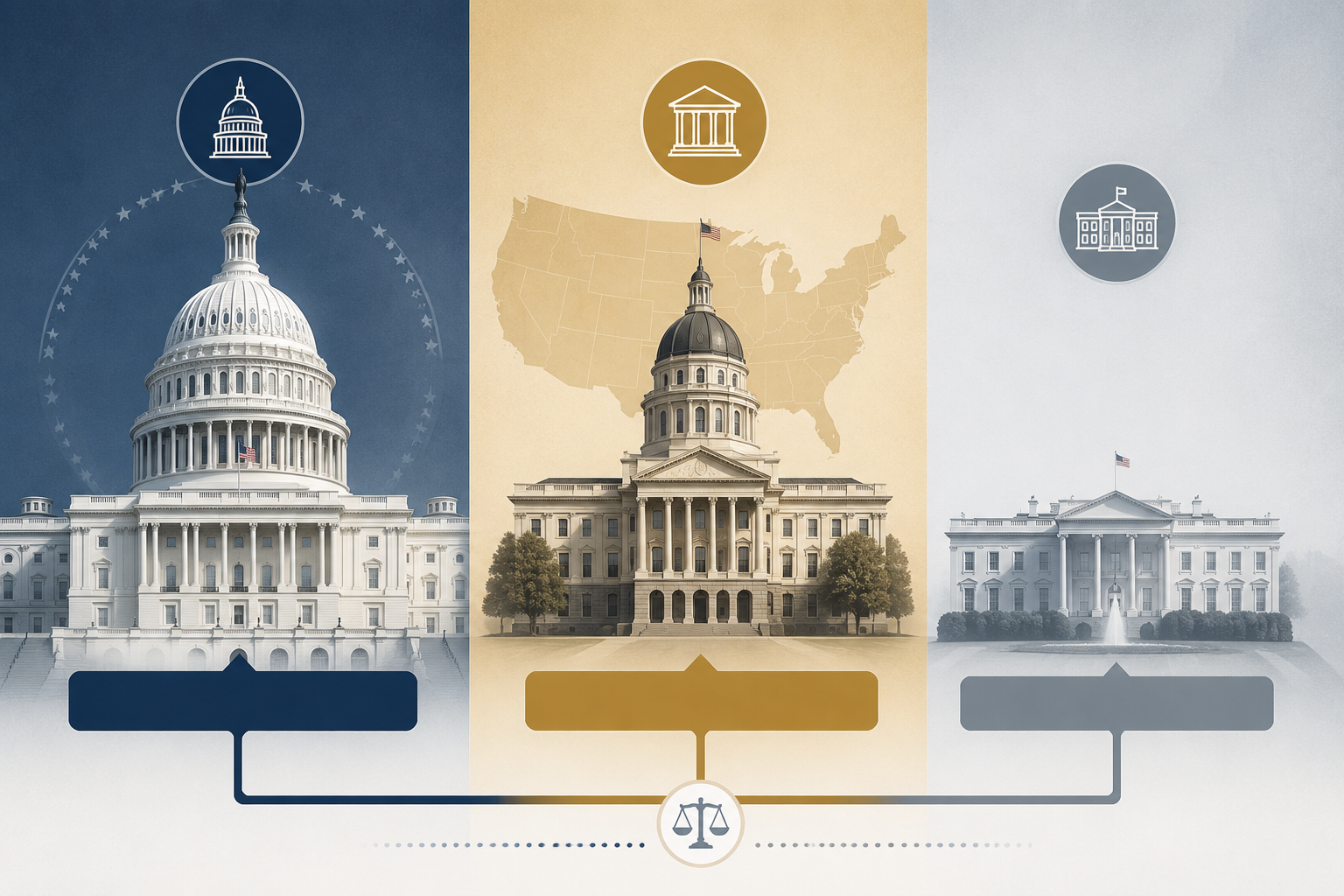
The Two Orders And Their Current Legal Posture
EO 14248 is the broader order. It attempted, among other things, to require documentary proof of citizenship on the federal voter registration form, direct agencies to share data for election enforcement, pressure states over ballot-counting deadlines, and impose new conditions around election systems and federal funding. The Brennan Center’s provision-by-provision tracker is useful because it does not treat the order as one undifferentiated political event; it separates what each section tried to do from what courts have actually blocked or left unresolved.[1]
The March 2026 citizenship verification order was narrower in subject but no less ambitious in claimed power. Campaign Legal Center describes its challenge as directed at another voting order that sought to impose citizenship-verification requirements and alter election administration through executive action rather than legislation.[2]
| Executive action | What it attempted to do | Core provisions blocked or contested | Posture to watch |
|---|---|---|---|
| EO 14248, March 2025 | Directed federal agencies and election-related bodies toward new registration, data-sharing, mail-ballot, and ballot-counting policies. | The documentary proof-of-citizenship requirement on the federal form, commonly described by challengers as a “show your papers” requirement, has been permanently enjoined in D.D.C.; other provisions have been blocked or challenged in separate cases.[1] | Appeals and related cases remain important; not every provision has the same procedural posture.[1] |
| Citizenship verification order, March 2026 | Sought to use federal executive authority to impose additional citizenship-verification and mail-voting controls. | Judge Allison Burroughs Talwani blocked USPS mail-ballot provisions in June 2026, holding that Congress had not delegated control of mail-in voting to USPS.[3] | Further appellate review could test whether the same separation-of-powers reasoning holds across circuits. |
The Constitutional Objection Is Repeating Across Courts
The recurring judicial answer has been separation of powers, not administrative tidiness. The Constitution gives states the initial role in setting the times, places, and manner of federal elections, subject to congressional alteration. It does not give the president a free-standing supervisory power over how states register voters, receive mail ballots, or count ballots in federal elections.
That is why the rulings matter even when they arise from different plaintiffs, statutes, and procedural vehicles. A temporary block against a mail-ballot provision is not identical to a permanent injunction against a voter-registration requirement. But when different courts keep asking the same question — where did Congress give the executive branch this authority? — and keep finding the answer missing, the pattern becomes legally significant.
The D.D.C. permanent injunction against the proof-of-citizenship requirement is the cleanest example from EO 14248. The enjoined provision sought to require documentary citizenship proof on the federal voter registration form. The legal defect was not that citizenship is irrelevant to voting eligibility; it was that the president cannot rewrite the federal registration form by executive order when Congress has assigned that machinery elsewhere.[1]
The same constitutional allocation appears in the California v. Trump and Washington v. Trump strands identified in the tracker. Those cases did not need to use identical language or resolve every election-law question to reinforce the central point: election administration authority runs through the Constitution’s state-and-Congress framework, not through unilateral presidential instruction.[1]
Judge Talwani’s USPS Ruling Supplies The Doctrinal Hinge
The June 25, 2026 ruling by Judge Allison Burroughs Talwani deserves more than a passing citation because it captures the issue in one sentence. In blocking the March 2026 order’s USPS mail-ballot provisions, she wrote that “no law enacted by Congress delegates authority to control mail-in voting to USPS.”[3]
That sentence does a great deal of work. It does not deny that USPS handles mail. It does not deny that mailed ballots depend on postal operations. It says that handling the mail is not the same thing as possessing congressional authority to control mail-in voting. The missing link is delegation.
For election officials, that difference is not academic. If USPS could be ordered to impose new voting conditions because ballots travel through the mail, then a logistics agency would become a federal election regulator without Congress saying so. Talwani’s ruling blocks that move at the threshold: agency proximity to elections is not agency authority over elections.
The posture also matters. This was not a Supreme Court merits ruling, and it should not be written as the final word on every mail-ballot dispute. But as a district court ruling issued months before the 2026 midterms, it tells states and election administrators that the challenged USPS provisions cannot simply be treated as operative federal law while litigation proceeds.[3]
What The Litigation Looks Like From The Regulated Side
The institutional burden falls first on state election administrators, registration organizations, local officials, postal officials, and voters who cannot wait for a final judgment before preparing for an election. A blocked provision still consumes time. A partially blocked order still requires lawyers to decide what remains operative. A pending appeal still hangs over forms, deadlines, public guidance, and training.
The League of Women Voters litigation illustrates that burden from the civic-organization side. The ACLU’s case page identifies the challenge to EO 14248 as brought on behalf of voting-rights organizations against provisions they argue would interfere with voter registration and election administration.[4]
The Campaign Legal Center challenge to the March 2026 order performs a similar function for the later executive action. It frames the order as another attempt to impose citizenship-verification rules through presidential command rather than through the constitutional channels for federal election legislation.[2]
These plaintiffs are not just asking courts to referee a symbolic fight between branches. They are asking whether federal agencies may alter the practical rules for registering voters, receiving ballots, and verifying eligibility before an election cycle already in motion.
The DOJ Voter-File Demands Fit The Same Pattern
The Justice Department’s voter-file demand campaign is a related strand, not the same lawsuit. According to FactCheck.org’s review of Trump’s July 16 election-security speech, DOJ sought voter files from 48 states, and all 9 courts that had ruled on the issue rejected the department’s position.[5]
That number should be read carefully. It does not mean every possible DOJ demand has reached final judgment, and it does not prove every state-file request would fail under every legal theory. It does show that, as of the reported rulings, courts were not accepting the administration’s claimed authority to obtain state voter data on the terms DOJ advanced.[5]
Placed beside the EO litigation, the voter-file losses sharpen the same question: when the executive branch invokes election integrity, what statute authorizes the demand, and what constitutional actor was empowered to impose it? Courts have been willing to ask that question before allowing federal agencies to convert state election infrastructure into federally directed compliance systems.
Political Claims Are Not The Legal Record
The administration’s public defense of these orders has leaned on election security, noncitizen voting, voter-roll accuracy, and mail-ballot concerns. Those themes may have political force. They do not answer the threshold legal question.
FactCheck.org’s analysis of the July 16 speech is useful for separating factual claims from the litigation record. It reviewed Trump’s assertions about election security and the administration’s related actions, including the DOJ voter-file campaign.[5] But the court rulings do not turn on whether a speech line polled well or whether a broad concern is rhetorically familiar. They turn on delegated authority, statutory fit, and the constitutional allocation of election power.
That is also why fraud rhetoric can distract from the operative issue. A president may identify a policy problem and still lack authority to impose the chosen remedy. Congress can legislate in the elections field where the Constitution permits it. States retain primary administrative responsibility unless Congress validly displaces them. The president’s role depends on law already enacted, not on the urgency with which the White House describes the problem.
Several Moving Pieces Remain Unsettled
The current record should not be overstated. District courts have repeatedly rejected the administration’s asserted unilateral control over election administration, but district court rulings are not the endpoint. Appeals remain pending, and the possibility of circuit disagreement matters precisely because election rules must be administered on a calendar, not in the abstract.
Other unresolved materials sit near the same legal terrain. The Congressional Research Service legal sidebar would be useful if accessible, but it should not be treated as part of the cited analysis without review. The SAVE Act’s status was reported as House-passed and stalled in the Senate as of April 2026, but that legislative posture would need to be verified before relying on it in a live publication. White House-released documents mentioned in third-party reporting should likewise be separated from independently verified court records.
Watson v. RNC is another watch item rather than a basis for broad conclusions here. As of July 2026, the case concerning mail-ballot receipt grace periods was pending before the Supreme Court. A ruling there could affect the broader election-law environment, but it is not itself a ruling validating the executive orders at issue in this article.
Where The Boundary Stands In Q3 2026
The most careful description is also the most important one: courts have not rejected every election-integrity policy a president might support. They have rejected central provisions of these Trump election orders where the administration asserted control over federal election administration without a sufficient constitutional or statutory source.
Across EO 14248, the March 2026 citizenship verification order, the USPS mail-ballot ruling, the D.D.C. injunction against the proof-of-citizenship requirement, and the DOJ voter-file demand losses, the same structural objection keeps reappearing. The presidency may execute election laws Congress has validly enacted. It may not become Congress, the states, or both.
As of Q3 2026, that boundary has held in multiple district courts and across multiple provisions. Its durability before or after the midterms will depend on appeals, any circuit split that develops, and whether the Supreme Court decides to take up one or more of these disputes.
References
- Status of Trump’s 2025 Anti-Voting Executive Order, Brennan Center for Justice
- Campaign Legal Center Sues Trump Administration Over Another Unconstitutional Voting Executive Order, Campaign Legal Center
- Trump election overhaul mail voting executive order blocked by Judge Talwani, Votebeat, June 25, 2026
- League of Women Voters Education Fund v. Trump, ACLU
- FactChecking Trump’s Election Security Speech, FactCheck.org, July 2026
Chronological incident history
No sanction cases have named this tool in the tracked record set to date. This does not imply the tool is safe — see Risk Digest for ongoing monitoring.
← Compare peer toolsReport a correction or tip
Spotted an outdated figure, a misstated fact, or a ruling this tool profile should reflect? Public comments are disabled for this content given the professional cost of a misreported case outcome, penalty amount, or rule text — use the structured correction channel instead.
Report a correction or tip for this record →