
US-Israeli strikes on Iran failed the UN Charter self-defense test
An analysis of why the self-defense justification advanced by the United States for the February 2026 strikes on Iran fails legal scrutiny under the UN Charter, drawing on official documents, intelligence assessments, and the consensus of over 100 international law experts who concluded the strikes violated Article 2(4).
- Hallucination rate
- Not measured / undisclosed
The legal case for the February 28, 2026 US-Israeli strikes on Iran begins, or should begin, with the document the United States sent to the UN Security Council on March 10. That Article 51 letter is the formal attempt to move the strikes from Article 2(4)’s prohibition on the use of force into the Charter’s narrow self-defense exception. It does not do so. Its most consequential move is not a flourish about Iranian misconduct, nor even its invocation of nuclear danger. It is the claim that the United States acted in self-defense in the context of an “ongoing armed conflict” with Iran and its associated threats, a phrase that tries to make decades of hostility perform the work that Article 51 assigns to an armed attack or an imminent one.[1]
This is a backward-looking jus ad bellum analysis of the initiation of force on February 28, current as of Q3 2026. It does not resolve every question created by the wider and still-moving conflict, including renewed hostilities after the July 7 ceasefire breakdown. It also does not assess targeting, civilian harm, proportionality in attack, or other jus in bello questions; those belong to a separate inquiry, including the companion analysis of whether the Iran critical infrastructure strikes were lawful under international humanitarian law. Nor does it decide the domestic US constitutional question under Article I, Article II, or the War Powers Resolution. The narrower question here is the one the March 10 letter itself put before the Security Council: did the strikes satisfy Article 51?
The Charter Rule Comes Before The Target’s Character
Iran’s record does not need softening to analyze the legality of force against it. Its regional conduct, domestic repression, and prior confrontations with the United States and Israel are part of the political setting. But the Charter system was not designed to make the lawfulness of force depend on whether the target state is sympathetic. Article 2(4) prohibits the threat or use of force against another state’s territorial integrity or political independence. Article 51 preserves an inherent right of individual or collective self-defense only if an armed attack occurs, with the contested but widely discussed possibility of anticipatory self-defense where an armed attack is truly imminent.[2]
That structure matters because it places the burden on the state using force. A state may condemn Iran’s conduct, sanction it, seek Security Council action, interdict unlawful transfers where a separate legal basis exists, defend itself against actual attacks, or assist an ally within the limits of collective self-defense. What it may not do is assemble old grievances, regional suspicion, and speculative future risk into a substitute for the Charter predicates.
The United States did not claim that the Security Council had authorized the February 28 strikes. It therefore had to fit the operation within self-defense. The difficulty is that each gate in the analysis is closed: no preceding armed attack by Iran justified the initiation of force on February 28; the public evidence cited here does not establish an imminent Iranian armed attack; and preventive disarmament is not an accepted independent exception to Article 2(4).
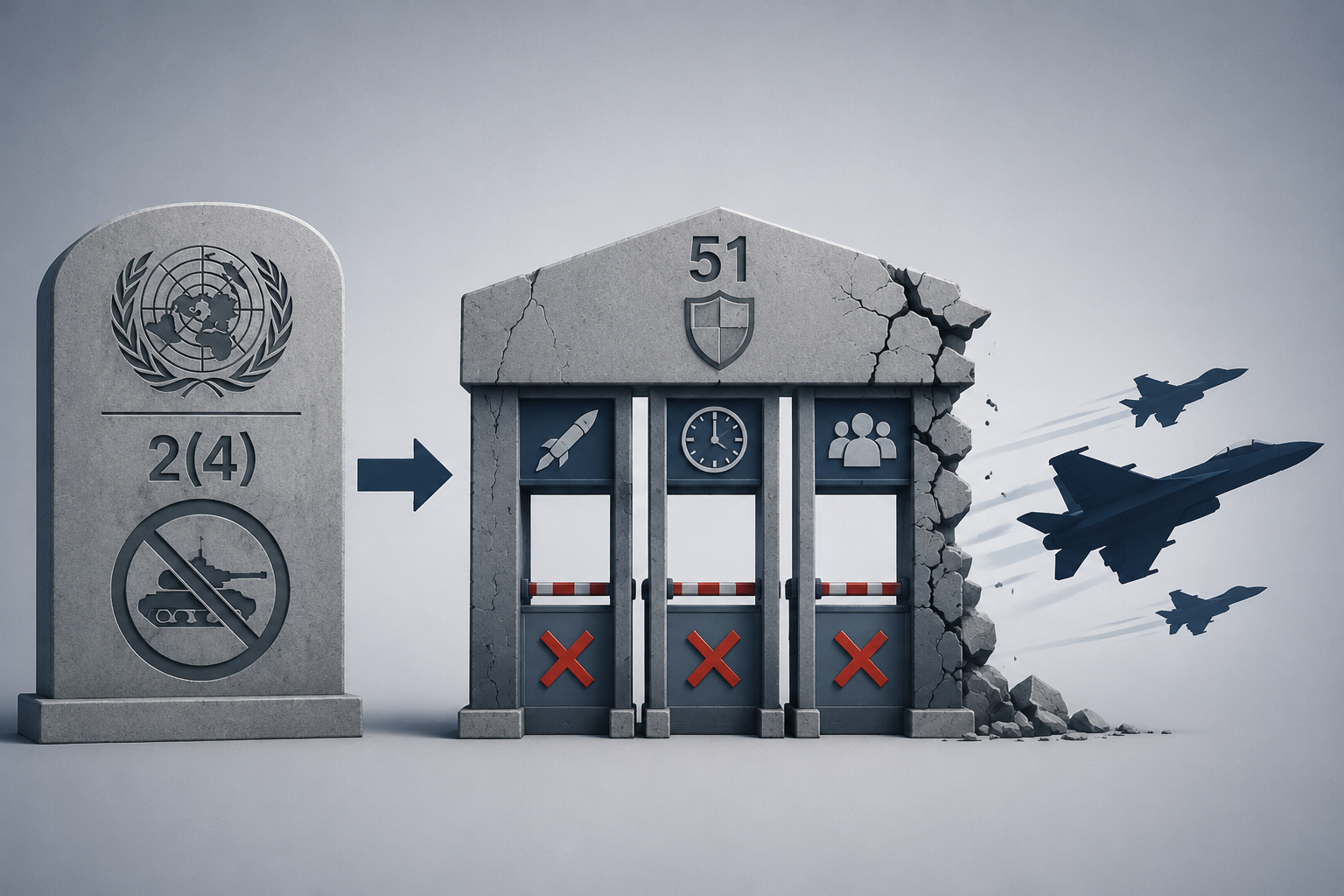
What The March 10 Letter Had To Prove
An Article 51 notification is not a ceremonial filing. It is the state’s legal account of why force already used was within the Charter. The March 10 letter therefore had to do more than show that Iran was dangerous, hostile, or noncompliant with nonproliferation expectations. It had to identify the armed attack to which the United States and Israel were responding, or the imminent armed attack they were entitled to forestall.
The letter instead stretched the frame backward and outward. It invoked a long arc of Iranian hostility, including grievances dating to the 1979 hostage crisis, and treated that history as part of a continuing conflict environment relevant to self-defense.[1] History can explain why officials distrust Iran. It cannot by itself establish the legal trigger for using force in 2026. The longer the chain of events becomes, the more important it is to ask which link is doing the legal work.
The phrase “ongoing armed conflict” is especially troublesome. In ordinary legal usage, armed conflict is often a jus in bello category: it helps determine whether international humanitarian law applies to conduct during hostilities. Article 51 asks a different question: whether the resort to force is justified against another state. A state cannot turn the existence of hostilities in a broad regional theater into a standing license to strike wherever it perceives a strategic threat. The category error is not academic; it lowers the threshold from “armed attack” to “hostile relationship.”
Nor does collective self-defense solve the problem unless the underlying conditions are met. Collective self-defense of Israel would still require an armed attack against Israel attributable to Iran, a request or consent from Israel, and force that is necessary and proportionate to repel that attack. A general desire to weaken Iran’s future military or nuclear capacity is not collective self-defense. It is preventive force by another name.
The Missing Armed Attack
The cleanest Article 51 case begins with an armed attack. The March 10 letter did not identify a discrete Iranian armed attack immediately preceding February 28 that the strikes were necessary to repel.[1] That absence is decisive unless the United States can carry the heavier burden of showing imminence.
Past attacks, proxy activity, and hostile statements can matter to attribution, necessity, and proportionality once an armed attack is established. They do not erase the need for the trigger. If a prior pattern alone were enough, Article 51 would become cumulative: every unresolved grievance would remain legally live, waiting to be reactivated when a state found the strategic moment favorable.
This is where commentary on the legal implications of the US-Iran strikes often becomes imprecise. The fact that Iran has been involved in regional confrontation does not answer whether Iran committed an armed attack justifying these strikes at this time. The Charter inquiry is temporal as well as substantive. It asks not only whether the target state is dangerous, but whether the legal conditions for force existed when force was used.
Imminence Is Not A Label For Strategic Anxiety
The harder version of the US argument is anticipatory self-defense. It has a recognizable shape: if Iran was approaching an irreversible nuclear weapons capability, and if waiting would have made defense impossible, then February 28 could be framed as the last practical moment to act. This is the “last window of opportunity” theory of imminence. It is not frivolous as rhetoric. It is weak as law on the record available here.
The first problem is evidentiary. The Director of National Intelligence assessment cited here concluded that Iran was not pursuing a nuclear weapon and posed no imminent threat.[1] The reported resignation of the National Counterterrorism Center director in protest further undercut the administration’s account of urgency.[1] The IAEA position described in the public materials was that Iran’s program remained monitored and below the weapons threshold.[1] These points do not prove Iran was benign. They do make it very difficult to characterize the strikes as a response to an imminent armed attack.
The second problem is doctrinal. Imminence cannot mean merely that a threat may mature someday, or that the target state is trying to improve its future bargaining position. If the test becomes “act now because later may be harder,” the self-defense exception collapses into preventive war. That is precisely the move the Charter order was meant to resist.
There is a real debate in legal scholarship over whether imminence should be understood more flexibly for modern threats, including weapons programs and nontraditional attack planning. But even a flexible view requires more than a generalized fear that a state may eventually acquire a more dangerous capability. It requires a concrete threat of armed attack, not simply a closing strategic window. The United States’ evidence, as reflected in the public record summarized above, points away from that conclusion rather than toward it.
| Article 51 requirement | What the February 28 justification needed | What the cited record shows |
|---|---|---|
| Armed attack | A prior or ongoing Iranian armed attack legally triggering self-defense | The March 10 letter did not identify a discrete preceding Iranian armed attack justifying the strikes |
| Imminent armed attack | Evidence that an Iranian attack was concrete and impending | DNI, NCTC, and IAEA-related materials described in the record undercut imminence |
| Security Council authorization | A Council mandate permitting force | No Security Council authorization was claimed |
| Necessity and proportionality | Force limited to repelling the armed attack | The preventive-disarmament rationale does not fit that function |
Preventive Disarmament Is The Theory The Letter Could Not Admit
Once the armed-attack and imminence claims are stripped down, the remaining rationale looks like preventive disarmament: using force to degrade a state’s capacity before it can become more dangerous. That may be attractive to planners facing uncertainty. It may even be defended in policy terms by officials who believe the risk of inaction is intolerable. But it is not a settled exception to Article 2(4).
The difference between preemption and prevention is not semantic. Preemption, in the strongest possible case, responds to an attack that is imminent. Prevention responds to a feared future balance of power. Article 51 is built around the former, not the latter. The March 10 letter’s reliance on a broad history of Iranian hostility and a disputed account of nuclear urgency pushed the argument into the preventive category while continuing to use the vocabulary of self-defense.[1]
This is why the “ongoing armed conflict” formulation matters so much. It tries to avoid naming prevention by placing the strikes inside an already existing legal atmosphere. But legal atmosphere is not a Charter exception. If the United States and Israel could lawfully strike Iran on this theory, other states could cite their own unresolved conflicts, old attacks, and intelligence fears to justify force against rivals before an attack materializes.
The Institutional Reaction Confirmed The Weakness, But Did Not Create It
Expert reaction is not itself law. A letter signed by scholars does not make a strike unlawful. But concentrated rejection by lawyers and institutions can reveal whether a state’s theory is operating within a plausible zone of legal disagreement or pressing against the architecture of the rule.
More than 100 international law experts warned that the US strikes on Iran violated the UN Charter.[3] Their conclusion tracked the same basic defects: no qualifying armed attack, no lawful preventive-war exception, and no Security Council authorization. Allen Weiner’s Stanford analysis likewise treated the international-law and constitutional questions as distinct, while identifying serious problems with the international self-defense theory.[4]
The broader institutional response moved in the same direction. Associated Press reporting described the US and Israeli attacks as placing further strain on international law and quoted American Society of International Law president Sean Murphy warning against loosening the Charter’s limits on force.[5] The International Bar Association’s analysis of the Israel-US-Iran conflict also emphasized the centrality of the UN Charter framework and the limits on unilateral resort to force.[6]
UN Secretary-General António Guterres condemned the strikes and stated that they violated the UN Charter.[5] That statement does not replace the Article 51 analysis, but it matters because the Secretary-General’s objection went to the same institutional concern: unilateral force justified by a theory too broad to preserve the prohibition it purports to respect.
Even allied conduct appeared constrained. The Guardian reported that the United Kingdom limited intelligence sharing for operational use against Iran, a practical signal that close security relationships did not translate into full acceptance of the legal theory for the strikes.[7] Such caution is not a judicial ruling, but it is relevant evidence of how thin the self-defense claim looked even among states with strong incentives to avoid a public rupture with Washington.
What This Does Not Decide
A finding that the February 28 initiation of force violated Article 2(4) does not answer every legal question in the conflict. Later Iranian, Israeli, or US uses of force require their own jus ad bellum analysis, especially after renewed hostilities. Nor does this conclusion determine whether particular attacks complied with distinction, proportionality, precautions, or the special rules governing civilian objects and dual-use infrastructure. Human Rights Watch’s laws-of-war Q&A separates those humanitarian-law questions from the law governing resort to force, as it should.[2]
It also does not produce an easy accountability pathway in The Hague. The United States, Israel, and Iran are not parties to the Rome Statute. ICC jurisdiction over aggression or war crimes would therefore face serious limits absent a Security Council referral, and a referral would be politically blocked by the United States. That jurisdictional reality should not be confused with legality. Conduct can violate the Charter even when no international criminal forum is realistically available.
The domestic US constitutional question is similarly adjacent rather than identical. Whether the President had authority under US law to initiate or join the strikes is a separate inquiry from whether the strikes complied with the UN Charter. A use of force can be domestically authorized and internationally unlawful, or internationally justified and domestically contested. Collapsing those questions usually serves advocacy better than analysis.
Readers who want a wider map of the imminence debate can compare this analysis with the broader overview of Iran attack legal implications under the UN Charter. The point here is narrower: the US letter’s own theory failed the Charter test it invoked.
The Legal Implication Is A Boundary Problem
The immediate legal implication is straightforward. Because the February 28 strikes were a use of force against Iran, and because they were not authorized by the Security Council or justified by a valid Article 51 claim, they violated Article 2(4) of the UN Charter. The conclusion does not depend on treating Iran as innocent. It depends on refusing to let the badness of a target replace the legal predicates for force.
The larger implication is more corrosive. If historical grievances dating back decades, disputed nuclear fears, generalized proxy conflict, and an elastic “ongoing armed conflict” theory can be combined into self-defense, Article 51 stops functioning as an exception. It becomes a drafting device for preventive war. That is the legal boundary the February 28 strikes crossed, and it is the boundary the Charter system will have to police long after the operational details of this strike package have faded.
References
- An Unserious Justification for an Unnecessary War: Assessing the U.S. 'Article 51' Letter, Just Security
- Questions and Answers: US, Israel, Iran, and the Laws of War, Human Rights Watch, April 8, 2026
- Over 100 International Law Experts Warn: U.S. Strikes on Iran Violate UN Charter, Just Security
- Stanford's Allen Weiner on the Constitutional and International Law Questions Raised by the Iran Attack, Stanford Law School, March 3, 2026
- US and Israeli attacks on Iran put further strain on international law, AP
- The Israel-US-Iran conflict, International Bar Association
- What is the legality of the US and Israeli attacks on Iran?, The Guardian, March 2, 2026
Chronological incident history
No sanction cases have named this tool in the tracked record set to date. This does not imply the tool is safe — see Risk Digest for ongoing monitoring.
← Compare peer toolsReport a correction or tip
Spotted an outdated figure, a misstated fact, or a ruling this tool profile should reflect? Public comments are disabled for this content given the professional cost of a misreported case outcome, penalty amount, or rule text — use the structured correction channel instead.
Report a correction or tip for this record →