
1st Circuit Blocks Trump's Mail-In Voting Order: The Constitutional Reasoning
- Authority
- 1st Circuit Court of Appeals
- Rule type
- standing order
- Jurisdiction scope
- US federal
- Effective date
- Jul 25, 2026
- Source text
- Read primary rule text ↗
Federal government must not implement DHS voter-list compilation, USPS mail-ballot restrictions, or DOJ prosecution threats against state election officials.
The injunction remains in place, but the merits are not over
On July 25, 2026, the 1st Circuit, by a 2–1 vote, declined to lift Judge Indira Talwani’s June 25 injunction blocking key parts of the March 31 executive order on mail-in voting. The underlying appeal remains pending. That posture matters: this is a stay-stage appellate ruling, not a final merits judgment, and it should be cited that way. It is still a consequential Regulation & Ethics ruling because the court’s reasoning is about institutional authority—what the president may direct, what Congress has assigned to states, and what a federal agency may do only when statute lets it do it—not simply about election policy. Reuters, AP, Democracy Docket, and Election Law Blog quote or summarize the 20-page opinion; the docket text should be checked before treating any quoted language as pin-cite-ready in a brief or client memorandum.[1][2][3][4]

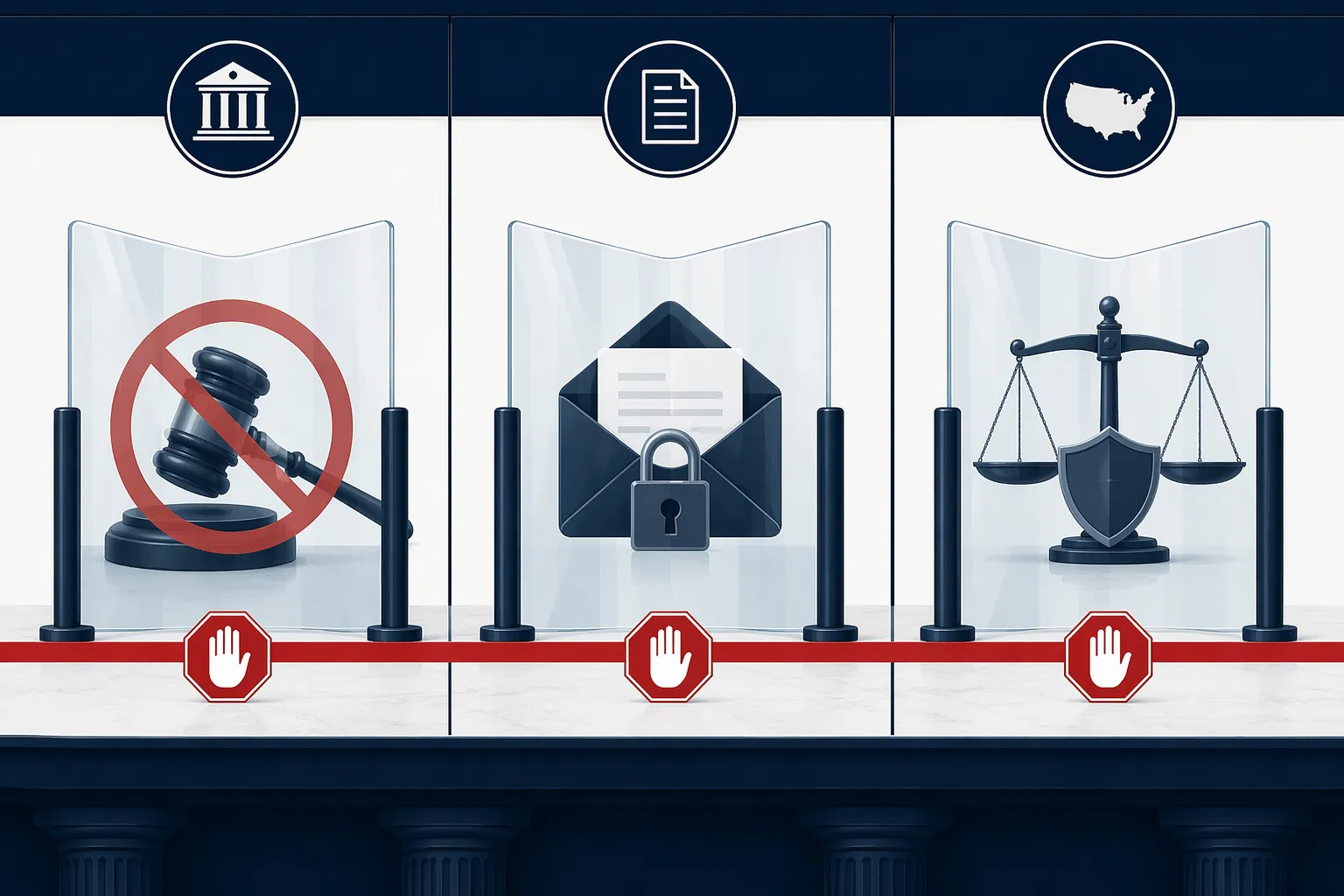
The operative point is narrow but important: the 1st Circuit left in place an injunction against three distinct federal moves. They should not be collapsed into one “mail voting” issue. Each rests on a different claimed source of federal power, and each failed for a different institutional reason.
Available reports identify the blocked provisions as: a DHS-directed citizenship or voter-eligibility list compilation effort; USPS restrictions tied to mail-ballot delivery and preapproved lists; and DOJ pressure threatening prosecution of state election officials who did not comply.[2][3]
| Blocked provision | Federal actor | Why the distinction matters |
|---|---|---|
| Compilation of voter-eligibility or citizenship-related lists | DHS, directed by the president | The court treated election administration as assigned to states and Congress under the Elections Clause, not as a freestanding Article II project. |
| Mail-ballot restrictions tied to USPS delivery | USPS, under executive-order direction | The president’s instruction could not create statutory authority for USPS to issue binding mail-in voting rules. |
| Threats of criminal prosecution against state election officials | DOJ and federal enforcement officials | The coercion theory turned the case from ordinary preemption into Tenth Amendment commandeering. |
Article II was not enough to enter the Elections Clause field
The majority’s most reusable move is its insistence on starting with the Constitution’s assignment of election-administration authority. Article I, Section 4 gives state legislatures the initial role in prescribing the “Times, Places and Manner” of congressional elections, subject to alteration by Congress. The 1st Circuit’s framing, as quoted by Election Law Blog, was that the order “plainly affects the Plaintiff States’ sovereign power to create and enforce a legal code for elections.”[4]
That sentence does more work than a generic federalism objection. It identifies the thing being invaded: not merely a state preference, not a state program funded by federal dollars, but the state’s sovereign power to make and enforce the legal code governing elections, in a field where the Constitution names states and Congress rather than the president. If Congress had enacted a statutory mechanism requiring a particular eligibility-verification process, the analysis would begin somewhere else. If the president were enforcing an existing federal election statute through a properly authorized agency, Article II would have something concrete to execute. The problem here, as the court saw it, was presidential direction itself being used to build federal involvement in state election administration.
Judge Talwani’s district court ruling had already framed the DHS portion in those terms, finding that the president “lacked any authority to direct DHS to compile voter eligibility lists.”[3] The appellate court’s refusal to lift the injunction preserved that boundary at the emergency stage. It did not need to hold that the federal government can never collect citizenship-related information or never share lawful data with election officials. The narrower point is enough: an executive order cannot convert Article II supervision of the executive branch into a new presidential power to reorganize how states determine voter eligibility.
The government’s ripeness argument also ran into the practical shape of the order. Reuters reports that the court rejected the contention that the challenge was premature because the order “lays out a clear set of rapidly approaching deadlines” against the backdrop of September primaries and November midterms.[1] That matters for state officials because election administration is not a switch flipped on Election Day. Registration systems, ballot-design deadlines, mail-processing instructions, training, vendor dependencies, and public notices all accumulate before voters see anything. A state official threatened with federal consequences for administering state law cannot always wait for the final federal enforcement letter before seeking relief.
USPS could not be turned into an election regulator by executive order
The USPS portion is more agency-law than election-law, and that is why it should not be treated as a mere mail-ballot policy dispute. Judge Talwani found that USPS had “no statutory authorization to adopt any binding regulations on mail-in voting.”[3] Votebeat’s coverage of the litigation likewise places the USPS issue in the context of the administration’s effort to allow mail-voting restrictions for the 2026 election.[5]
That reasoning is straightforward but easy to understate. USPS has operational responsibilities over the mail. It does not follow that USPS has authority to impose binding election-administration conditions on states merely because ballots travel through the mail. A delivery function is not the same as a rulemaking function over ballot validity, ballot timing, or state election codes. The president also cannot cure that defect by instructing USPS to act. An agency’s statutory boundary does not expand because the White House coordinates the policy goal.
The separate July 2 D.D.C. ruling involving the NAACP consent-decree material is useful context, but only context. Votebeat and Democracy Docket summarize that proceeding as part of the same broader fight over postal-service implementation and mail-voting restrictions, but the full opinion was not part of the reviewed source set here.[5][3] The safer use of that material is not to claim a national merits rule from D.D.C.; it is to observe that the USPS provisions have generated parallel judicial concern about whether postal operations can be leveraged into election-rulemaking.
The prosecution threat is the part most likely to travel outside election law
The DOJ-threat component is the most important part of the ruling for lawyers working outside voting disputes. The majority’s federalism analysis did not depend only on a formal label—“commandeering”—attached after the fact. It focused on how threats operate on real officials who have calendars, statutory duties, professional exposure, and criminal-risk asymmetry.
Democracy Docket quotes the court’s statement that “people do not lightly disregard public officers’ thinly veiled threats to institute criminal proceedings against them.”[3] That is a practical account of coercion. A state election official does not have to be physically seized or formally deputized before federal pressure changes the administration of state law. If the federal government tells an official that continuing to follow state procedures may invite criminal prosecution, the official is being pushed to administer a different legal regime—one not enacted by the state and not supplied by Congress.
This is why the coercion analysis has a life beyond mail-in voting. State-administered systems often sit next to federal enforcement authority: licensing, public health, education administration, procurement, environmental permitting, benefits programs, and professional regulation. The opinion’s logic suggests a boundary line for executive orders that attempt to redirect those systems by pairing policy instructions with enforcement warnings. The harder question in later cases will be whether the federal threat is tied to a valid federal statute or is being used to substitute presidential preference for legally assigned state authority.
The sympathy here naturally falls on the official ordered to administer one sovereign’s code while another sovereign signals prosecution for noncompliance. That is not an argument against federal enforcement. It is an argument about the source of law. When Congress has made conduct criminal, DOJ may enforce that statute within constitutional limits. When the executive order supplies the operative pressure and the constitutional assignment points elsewhere, the threat becomes part of the separation-of-powers problem rather than an ordinary enforcement backdrop.
Judge Dunlap’s dissent and the emergency posture limit how far the ruling can be carried
Judge Dunlap, a Trump appointee, dissented from the 2–1 ruling.[1] That dissent should be read as more than a notation in the vote line. In an emergency application to the Supreme Court, the government will not need to prove final entitlement to judgment in the way it would after a full merits appeal. It can press stay factors, timing, irreparable harm, federal implementation interests, and disagreement with the majority’s account of ripeness and authority. The dissent gives the government a judicially authored path for that request, even if the public summaries do not permit a detailed reconstruction of every argument.
The broader emergency-docket environment also counsels care. Ballotpedia recorded 38 emergency applications involving Trump-administration cases at the Supreme Court as of July 21, 2026.[6] That number is useful litigation context, not a prediction. It does not mean this case will necessarily reach the Court, and it does not say how the Court would treat this injunction if asked to intervene. It does show why lawyers should write about this ruling in stay-posture terms rather than as if the 1st Circuit has already supplied the final national rule.
The affected footprint is still significant. Election Law Blog’s summary identifies the dispute as involving 23 states.[4] But the number of jurisdictions should not distract from the narrower legal instrument the court used. The opinion did not require a broad theory of voter access, partisan motive, or election fraud. It was enough that the order directed federal actors into a domain the Constitution assigns elsewhere, attempted to use USPS without statutory authorization, and threatened state officials in a way the majority viewed as coercive.
The framework practitioners can carry forward
The ruling is most useful as a sequence of questions for executive-order review. First, identify the legal domain being changed. If the Constitution assigns that domain to states and Congress, Article II should not be treated as a default substitute for missing statutory authority. Second, identify the federal actor being used. If an agency is operationally adjacent to the regulated activity, ask whether Congress actually gave it rulemaking or enforcement power over that subject. Third, identify the pressure mechanism. If state officials are being told that continued adherence to state law may expose them to prosecution, the Tenth Amendment issue is not ornamental.
That framework will matter in any state-administered domain where the presidency tries to coordinate multiple federal levers at once. A hypothetical executive order might direct a data-holding agency to build eligibility lists, instruct a service-delivery agency to condition access on compliance, and have DOJ warn state officials about enforcement exposure. The 1st Circuit’s reasoning supplies a way to separate those moves instead of treating the order as one indivisible policy package.
The durable lesson is not that federal election statutes are powerless, or that federal agencies can never touch election-adjacent activity, or that DOJ threats are always unconstitutional. The lesson is more disciplined: executive orders do not become election law, agency law, or criminal-enforcement authority merely because they are coordinated through the presidency. Until the merits appeal is resolved, that lesson remains procedurally provisional. It is still a strong boundary marker.
References
- US appeals court rules Trump cannot implement mail-in voting order, Reuters, July 25, 2026
- US appeals court upholds halt to Trump's executive order to create voter list, AP News
- Trump's anti-mail voting order gets blocked again, this time by federal appeals court, Democracy Docket
- Appeals court rejects Trump bid to curb mail-in voting in 23 states, Election Law Blog
- Trump administration asks federal judge to allow mail voting restrictions for 2026 election, Votebeat, July 2, 2026
- Supreme Court interim orders involving the Trump administration, 2025-2026, Ballotpedia
Operationalizing workflow
No workflow has been explicitly linked to this obligation yet. See Workflows generally.
Illustrative cases
No illustrative case is currently tracked for this obligation. See Risk Digest for documented incidents generally.
← Back to RegulationReport a correction or tip
Spotted an outdated figure, a misstated fact, or a ruling this regulation entry should reflect? Public comments are disabled for this content given the professional cost of a misreported case outcome, penalty amount, or rule text — use the structured correction channel instead.
Report a correction or tip for this record →