
The Legal Case Against Trump's 2026 Forced Labor Tariffs
- Authority
- U.S. Trade Representative
- Rule type
- regulation
- Jurisdiction scope
- US federal
- Effective date
- Jul 24, 2026
- Source text
- Read primary rule text ↗
Importers must pay 10% or 12.5% tariffs on imports from 60 economies under Section 301 forced labor action.
The Trump forced labor tariffs of 2026 are no longer a paper exercise. They took effect at 12:01 a.m. on July 24, one day after USTR issued its final action under Section 301 and a little more than four months after the Supreme Court invalidated the administration's earlier IEEPA tariff theory.[1] As of today, no complaint has been filed in the Court of International Trade. That leaves importers, litigators, and in-house counsel in the awkward interval between operative duties and judicial testing.
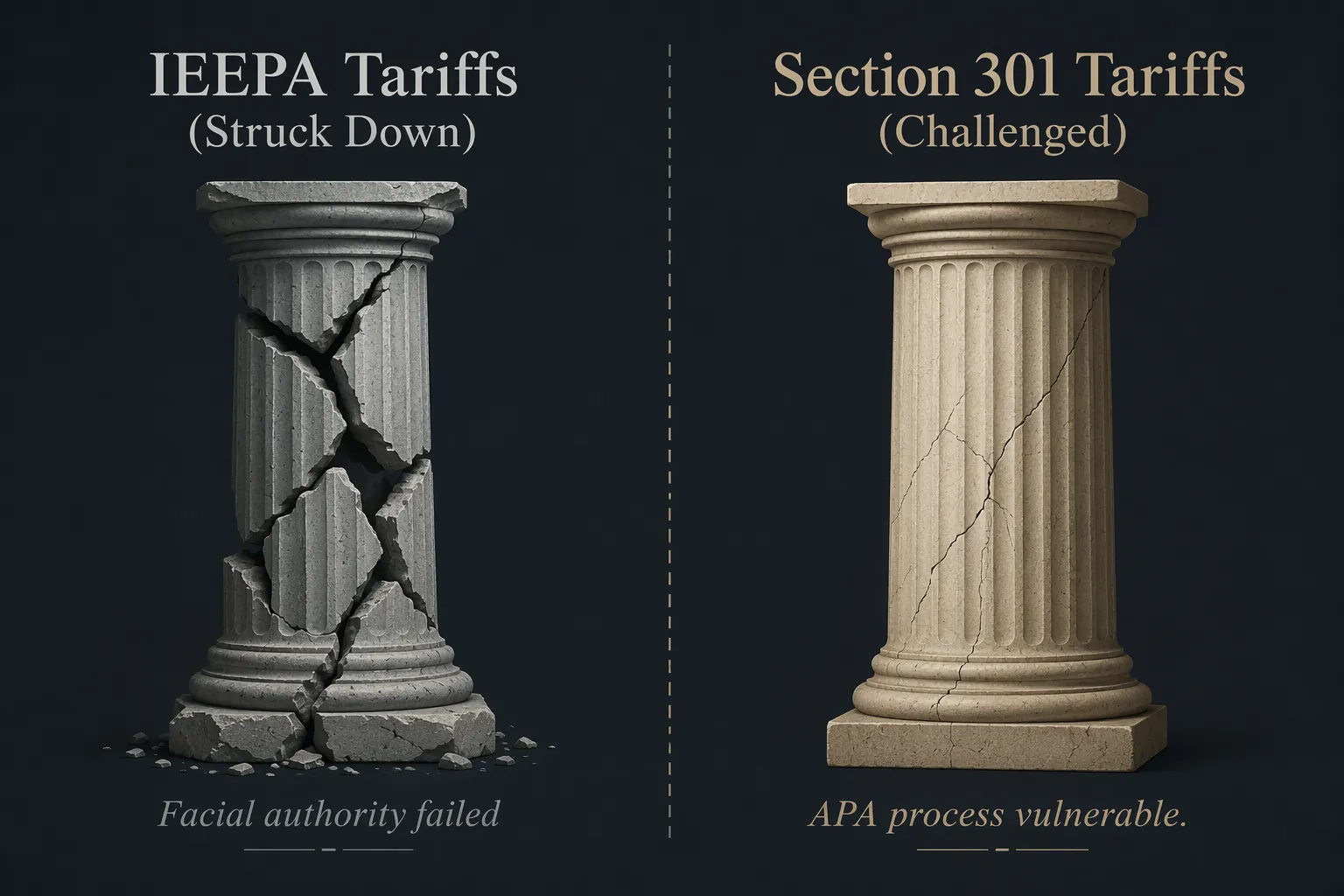
The first legal implication is straightforward but easy to understate: these tariffs are harder to attack on facial statutory authority than the IEEPA tariffs were. Section 301 actually authorizes trade retaliation, including duties. IEEPA had to be stretched into that role, and the Supreme Court rejected the stretch on February 20, 2026.[2] But a better statutory hook does not settle the administrative-law question. It only moves the likely fight from whether the President had tariff authority at all to whether USTR explained, supported, and tailored this particular tariff action.
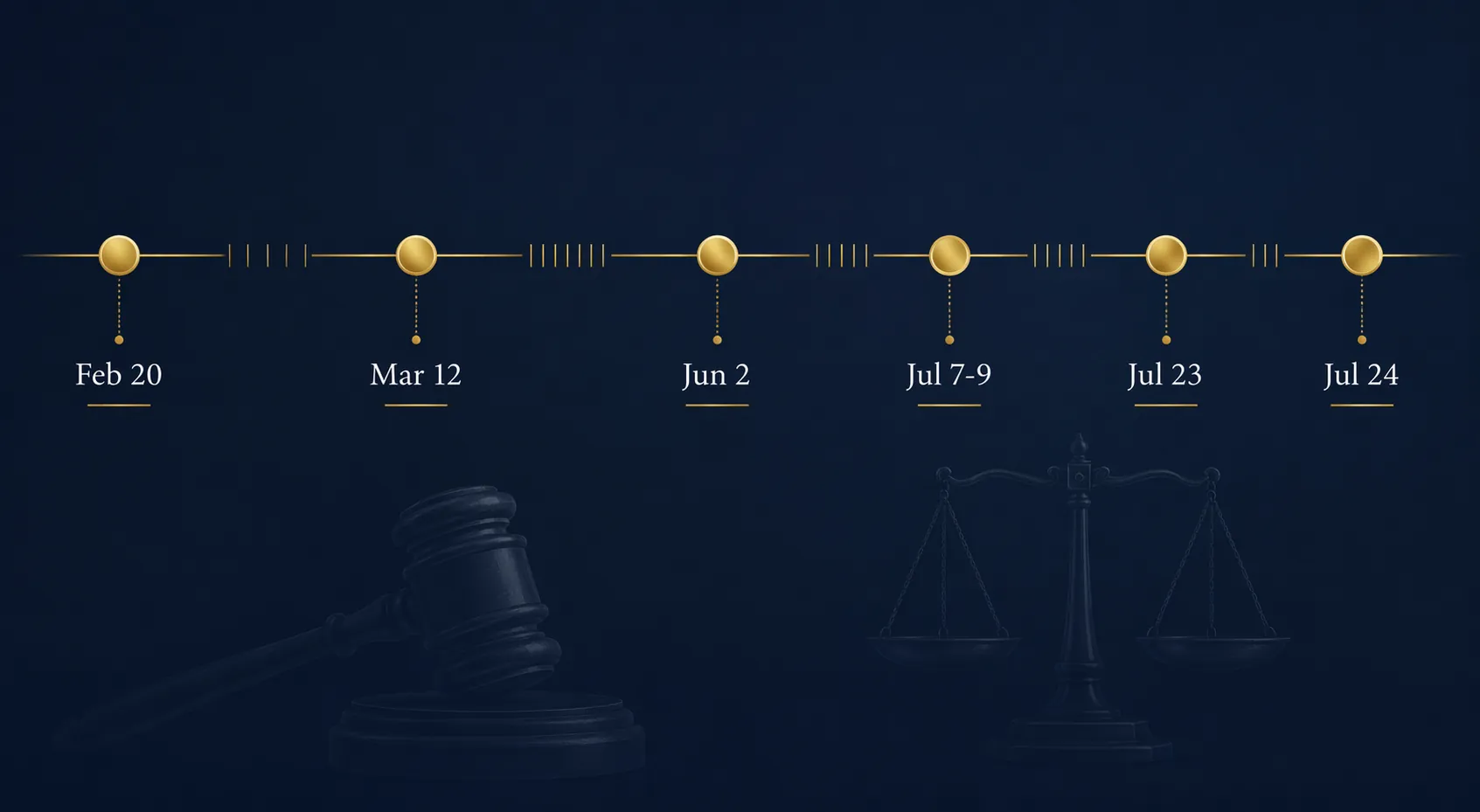
The Calendar Is Part of the Case
The administration moved quickly after the IEEPA defeat. The Supreme Court decision came on February 20. The administration then used a Section 122 bridge tariff, which the Court of International Trade promptly invalidated; that appeal remains pending. On March 12, USTR initiated Section 301 investigations. On June 2, it issued findings. Hearings ran from July 7 through July 9. The final action issued July 23, with an effective date of July 24.[1][2]
| Date | Event | Why it matters legally |
|---|---|---|
| Feb. 20, 2026 | Supreme Court invalidates IEEPA tariff theory | Removes the administration's broad emergency-power route |
| After Feb. 20, 2026 | Section 122 bridge tariff is adopted and then invalidated by CIT | Shows the search for a replacement tariff authority remained unsettled |
| Mar. 12, 2026 | USTR initiates Section 301 investigations | Starts the record for the forced labor tariff action |
| June 2, 2026 | USTR issues findings | Frames the statutory theory and claimed burden on U.S. commerce |
| July 7-9, 2026 | USTR holds hearings | Builds procedural record for APA review |
| July 23-24, 2026 | Final action issued and tariffs take effect | Turns legal risk into an immediate importer compliance problem |
That sequence does not prove unlawfulness. Section 301 investigations need not move at the pace preferred by disappointed importers. But the compressed calendar matters because the government is asking one record to support an unusually broad remedy: tariffs on 60 economies covering roughly 99% of U.S. import volume, with only two rate tiers, 10% and 12.5%.[1] The larger the remedy, the more pressure falls on the explanation connecting the legal violation, the injury to U.S. commerce, and the chosen response.
Why Section 301 Is a Stronger Hook Than IEEPA
A complaint that treats the 2026 Section 301 tariffs as a replay of the IEEPA tariffs will likely waste its best pages. IEEPA was vulnerable because the statute did not clearly confer the kind of tariff power the administration claimed. Section 301, by contrast, directs USTR to respond to certain foreign acts, policies, or practices and gives the agency trade remedies that include duties. Courts have traditionally given substantial deference to Section 301 determinations characterized as exercises of administrative and trade-policy discretion.[2]
The government also has a record to point to. USTR received about 1,518 written comments, heard roughly 60 witnesses, and consulted with 46 economies before issuing the final action.[1] Those numbers do not immunize the action from APA review. They do, however, make a clean procedural-opportunity challenge less attractive than it would be if the agency had skipped notice, hearings, or consultations altogether.
That is why the more serious challenge is likely to sound less like, "Section 301 cannot do tariffs," and more like, "USTR has not reasonably explained why this record supports this theory and this remedy." The distinction matters. A facial power challenge asks a court to say the agency could not act. An arbitrary-and-capricious challenge asks whether the agency connected the relevant facts to the action it chose.
The Novel Theory Carries the Load
The tariff action rests on a theory that is more ambitious than ordinary forced labor enforcement. USTR is not merely targeting specific shipments alleged to contain forced labor inputs. It is treating a foreign government's failure to prohibit forced labor imports as an "unreasonable" practice under Section 301, then treating the resulting competitive displacement as a burden on U.S. commerce.[3]
That framing does real work for the administration. It lets USTR locate the offending practice abroad, even when the immediate enforcement question would ordinarily be handled at the border under forced labor import rules. It also lets the agency describe harm to U.S. commerce without proving that every covered importer, product line, or country-specific supply chain contains forced labor. The legal vulnerability is the same feature from another angle: the theory expands the bridge between foreign government omission and U.S. commercial injury.
Desiree LeClerq has identified the cleanest tension for potential challengers. To show harm to domestic producers, USTR benefits from arguing that forced labor goods still enter or affect the U.S. market. To justify placing responsibility on foreign governments rather than relying on U.S. border enforcement, USTR also emphasizes the effectiveness of CBP enforcement. Those positions are not logically impossible to reconcile, but they are vulnerable to pressure if the final action does not explain where domestic enforcement ends, where foreign government failure begins, and how the chosen tariff levels respond to that gap.[3]
A plaintiff would not need to show that forced labor enforcement is unimportant, or that Congress lacks concern about forced labor in supply chains. The better pleading theory would be narrower: USTR selected an unprecedented collective tariff remedy without adequately explaining the causal chain from specific foreign omissions to a generalized burden on U.S. commerce.
Breadth Creates a Remedy-Fit Problem
The breadth of the action is likely to do more litigation work than the revenue estimate. The tariffs are projected to raise about $970 billion over 10 years, but a large revenue number by itself does not make a trade remedy unlawful.[4] The harder question is why 60 economies, roughly 99% of import volume, and two blunt tariff tiers are a reasoned response to the particular practices USTR found.[1]
Section 301 remedies do not have to be surgical. Still, APA review asks whether the agency considered important aspects of the problem and avoided unexplained inconsistencies. A two-tier structure invites several lines of attack: why economies with different laws, enforcement capacities, trade profiles, and exposure to forced labor risk are grouped together; why the distinction between 10% and 12.5% captures legally relevant differences; and why the tariffs apply without importer-level relief for companies that maintain robust forced labor due diligence programs.
That last point is not just a business complaint. It marks a structural difference between this action and shipment-specific forced labor enforcement. Under UFLPA and Section 307-style border enforcement, a company may at least try to contest detention or exclusion with supply-chain evidence. The Section 301 tariff applies at the economy-rate level. A clean importer, if such a showing could be made, still pays the rate. USTR may answer that Section 301 is aimed at foreign government practices, not importer culpability. The question for CIT review would be whether the agency explained why that collective remedy fits the record it built.
The China Section 301 Precedent Helps the Government, But Only So Far
The government will not enter a Section 301 lawsuit empty-handed. The China Section 301 litigation remains the closest practical precedent. In that litigation, the Court of International Trade required a fuller explanation, the Federal Circuit sustained the challenged action, and the Supreme Court denied certiorari on June 15, 2026.[5] That sequence is useful to USTR because it confirms that courts can be reluctant to second-guess trade determinations once the agency supplies an adequate explanation.
But the China precedent is not a universal solvent. The 2026 forced labor tariffs are broader, rest on a different theory of "unreasonable" conduct, and impose a collective remedy across dozens of economies rather than focusing on one country investigation. The cert denial leaves the Federal Circuit ruling in place; it does not decide whether USTR can convert foreign failure to prohibit forced labor imports into a near-global two-tier tariff schedule.
For challengers, the lesson from the China litigation is also mixed. It warns against relying on broad claims that courts should reweigh trade policy. It also shows that explanation matters. The CIT's insistence on fuller reasoning in that case gives plaintiffs a map for attacking gaps without asking the court to become a trade negotiator.
What a CIT Complaint Would Likely Test
No filed complaint means the litigation theories remain prospective. Based on the action now in effect, a serious CIT challenge would probably concentrate on four issues rather than on a single headline claim.
- Statutory classification: whether failure by foreign governments to prohibit forced labor imports can reasonably be classified as an "unreasonable" practice under Section 301.
- Causation and burden: whether USTR adequately connected foreign government omissions to competitive displacement and burden on U.S. commerce.
- Remedy fit: whether a 60-economy tariff schedule with only two rates is reasonably tailored to the record.
- Reasoned decision-making: whether USTR responded to important comments and reconciled its reliance on both continuing forced labor market effects and effective CBP enforcement.
- Procedural speed: whether the accelerated investigation left meaningful opportunity for participation and produced a record capable of supporting the final action.
The strongest version of that complaint would not deny that forced labor can distort trade. It would ask whether this agency record supports this broad remedy. Courts are more likely to engage that question than a generalized objection to tariff policy.
The government response is equally visible. USTR will point to express Section 301 authority, a substantial administrative record, witness testimony, written comments, consultations, and the deferential posture courts have taken toward trade retaliation. It will argue that foreign government import policies can shift competitive conditions in the U.S. market even when U.S. border officials are actively enforcing forced labor laws. It will also argue that Section 301 remedies operate at the level of foreign practices, not importer innocence.
WTO Review Is Not the Practical Check
There is a WTO shadow over any broad Section 301 action, but it is not likely to be the near-term forum that matters most to affected companies. Historically, Section 301 measures could be challenged through WTO dispute settlement. The appellate body remains non-functional because of the U.S. blockade on judge appointments, weakening the multilateral check that might otherwise discipline unilateral tariff actions.[6]
That institutional fact pushes practical attention back to domestic litigation. For importers paying the new rates today, the question is not whether another government eventually brings a WTO case. It is whether a CIT plaintiff can obtain review of USTR's reasoning, and whether that review produces remand, vacatur, refunds, or only a more carefully written agency explanation.
Refund Expectations Should Stay Modest for Now
The IEEPA refund experience is a caution against assuming that a legal win quickly becomes cash recovery. After the IEEPA tariffs, about $166 billion had been collected, roughly $85 billion in refund claims had been processed, and only about $21 billion had been paid out.[2] Those figures come from a different statutory defeat, not from the Section 301 action now in effect. They are still relevant for counseling because they show the administrative drag between invalidation, claim processing, and payment.
If a Section 301 plaintiff ultimately prevails, the remedy will matter as much as the merits. A remand without vacatur would preserve duties while USTR supplies additional explanation. Vacatur could raise refund questions, but the mechanics would depend on the court's order, liquidation status, protest posture, and any appeal. For now, counsel should separate two questions that executives often merge: whether the tariffs are vulnerable and whether paid duties are likely to return soon.
The Legal Risk as of July 24
The better assessment is neither confidence nor panic. The Section 301 forced labor tariffs are legally more durable than the IEEPA tariffs because Congress gave USTR an actual tariff tool. That makes a facial authority challenge harder and gives the government a serious defense from the first page of any complaint.
They are also not legally settled. Their distinctive vulnerabilities sit in the administrative record: the novel "unreasonable practice" theory, the competitive-displacement theory of burden on U.S. commerce, the tension between claimed continuing market harm and effective CBP enforcement, the compressed investigation schedule, and the fit between a broad two-tier remedy and the country-specific practices USTR says it found.
That is where the first serious CIT challenge is likely to live. Not in a replay of the IEEPA fight, and not in a free-form objection to tariffs as policy, but in APA reasoned decision-making, remedy fit, and whether USTR's forced-labor causation theory remains coherent under judicial review.
References
- USTR Section 301 forced labor tariff final action and report, Office of the United States Trade Representative, July 23, 2026, link
- Goulder analysis of tariff litigation and refund exposure, Forbes/Tax Notes, 2026, link
- The Section 301 Forced Labor Import Ban Report, International Economic Law and Policy Blog, June 2026, link
- USA Today report on July 23, 2026 forced labor tariffs and revenue estimate, USA Today, July 23, 2026, link
- Orrick analysis of China Section 301 litigation and June 15, 2026 certiorari denial, Orrick, June 2026, link
- Governments Make Their Case, International Economic Law and Policy Blog, July 2026, link
Operationalizing workflow
No workflow has been explicitly linked to this obligation yet. See Workflows generally.
Illustrative cases
No illustrative case is currently tracked for this obligation. See Risk Digest for documented incidents generally.
← Back to RegulationReport a correction or tip
Spotted an outdated figure, a misstated fact, or a ruling this regulation entry should reflect? Public comments are disabled for this content given the professional cost of a misreported case outcome, penalty amount, or rule text — use the structured correction channel instead.
Report a correction or tip for this record →