
What the 2027 COLA Increase Means for Attorney Fee Caps
- Authority
- Social Security Administration (SSA)
- Rule type
- regulation
- Jurisdiction scope
- US federal
- Effective date
- Jan 1, 2027
- Source text
- Read primary rule text ↗
Fee agreements must reference the SSA-approved dollar cap applicable on the date of favorable decision, not an estimated future cap.
A September 2026 fee agreement can produce two different attorney-fee outcomes without a single word of the agreement changing. If SSA issues the favorable decision before the next COLA-linked fee cap becomes effective, the representative remains under the current $9,200 cap. If the same favorable decision arrives after the effective date, the higher 2027 cap may apply. The awkward part is that the lawyer may know the higher number is coming before the case is decided, but knowledge of a coming cap is not the same thing as an operative cap.
That is the practical center of the 2027 Social Security COLA legal question for fee agreements. Current public estimates put the 2027 COLA in roughly the 3.6% to 3.8% range, which would move a $9,200 cap to approximately $9,531 to $9,550 if applied directly to the current cap. The official COLA announcement is expected in October 2026, so those figures remain estimates, not governing law.

The extra few hundred dollars is not trivial, but it is not the main compliance problem. The real problem is a moving ceiling tied to a favorable-decision date that the representative does not control. A firm can sign the agreement, file the case, track the COLA announcement, and still be wrong if the agreement treats a projected future amount as though SSA has already made it effective.
The cap changed from occasional jumps to an annual mechanism
SSA’s representative-fee cap used to change in large, infrequent steps: $6,000 in 2009, $7,200 in 2022, and then $9,200 effective November 2024. In March 2024, SSA announced that it would raise the cap to $9,200 and then evaluate future cap increases annually based on cost-of-living adjustments, rather than waiting years between revisions.[1]
That shift matters because the cap is no longer just a number buried in old forms and office templates. It is now part of an annual benefits-administration cycle. SSA’s own fee-agreement framework still requires the agreement to meet agency conditions, including the percentage limit on past-due benefits and the applicable dollar cap for direct approval.[2]
The 2027 cycle is still early in that new regime. As of July 2026, the official 2027 COLA has not been announced, and the way firms calendar, draft around, and audit the transition is still becoming habit. That is precisely when template language tends to lag behind the rule it is supposed to follow.
The agreement date is not the date that does the most work
A contingent fee agreement in an SSA benefits matter normally points to a percentage of past-due benefits, subject to SSA approval and the statutory cap structure. The familiar shorthand is 25% of past-due benefits, capped at the agency’s approved dollar limit. The dangerous shortcut is assuming that the date the client signs the agreement fixes the dollar cap.
For transition purposes, the key operational event is the favorable decision. If the decision issues while the $9,200 cap is still the applicable cap, the representative should not draft or bill as though an anticipated $9,500-range cap already governs. If the decision issues after SSA implements the COLA-linked increase, the higher cap may be available under the same fee agreement, assuming the agreement otherwise satisfies SSA’s requirements.
| Same September 2026 agreement | Favorable decision timing | Likely cap result |
|---|---|---|
| Agreement signed before the official 2027 COLA is effective | Decision issued before the new cap takes effect | Current $9,200 cap controls |
| Agreement signed before the official 2027 COLA is effective | Decision issued after the new cap takes effect | COLA-adjusted cap may apply |
This is the mismatch that creates drafting risk. From the lawyer’s point of view, the work may be identical. From the client’s point of view, the representation may have begun on the same date. From the agency’s point of view, the cap turns on whether the favorable decision falls on one side of the effective-date line or the other.
That makes fixed-number drafting unattractive during the transition. A clause that says the representative may receive 25% of past-due benefits “up to $9,550” before SSA has announced and implemented that number can overstate what the representative may collect if the favorable decision arrives too early. The agreement may have been written in anticipation of the correct policy direction and still be wrong for the actual decision date.
The projected 2027 increase is modest in dollars, but not in administration
A 3.6% COLA applied to $9,200 produces about $9,531. A 3.8% COLA produces about $9,550. The spread between those projections is small enough that it should not change a firm’s business model by itself. It is large enough, however, to expose whether the firm’s templates, intake scripts, and fee-audit process are tied to the correct legal event.
The temptation in late 2026 will be to treat the cap as functionally known once the official COLA announcement is public. That is still too loose. The operative question is not merely whether the COLA percentage has been announced. It is whether SSA has made the representative-fee cap adjustment effective for the favorable decision at issue.
For firms that rely on centralized forms, the period between announcement and implementation deserves its own calendar entry. The issue is not only what number appears in the template. It is whether case managers, hearing representatives, and accounting staff all understand that pending cases may be split across two caps depending on decision timing.
Which cases actually feel the cap change
The cap does not affect every case the same way. It only matters after the percentage calculation and the amount of past-due benefits are known. For the current $9,200 cap, $36,800 in past-due benefits is the point at which 25% equals $9,200. A higher cap moves that break point upward.
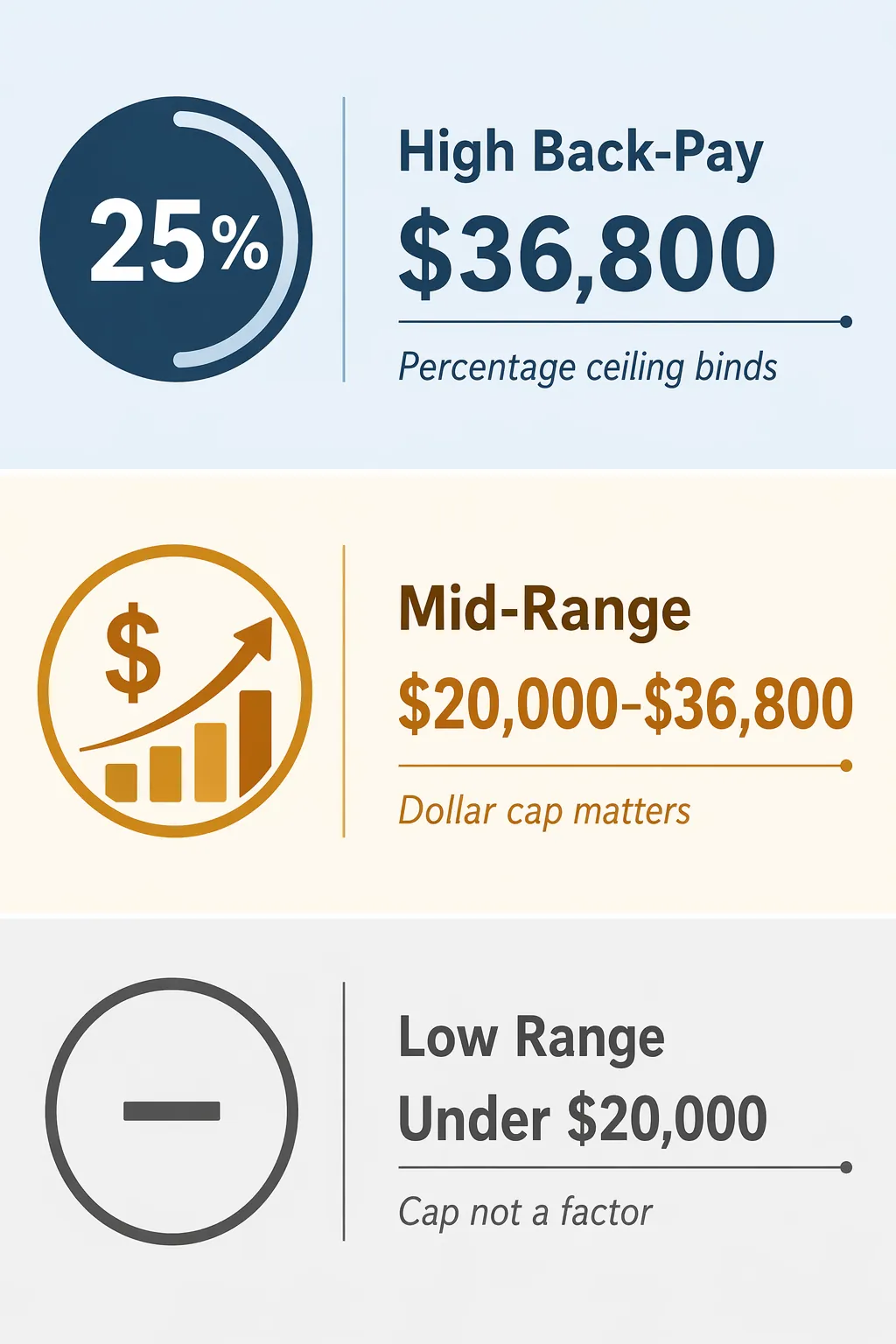
| Case economics | What usually limits the fee | Why the 2027 cap matters |
|---|---|---|
| High back-pay cases above the current $36,800 break point | The dollar cap prevents collection of the full 25% | The COLA-linked cap may add a few hundred dollars, but it does not remove the cap |
| Cases near the break point | Small timing and benefit-amount differences can determine whether the cap is reached | These are the cases most likely to expose template language that names the wrong cap |
| Lower back-pay cases well below the break point | The 25% calculation is below the dollar cap | The cap increase may have little practical effect on the approved fee |
The middle category deserves the most attention because it is where expectation and administration can diverge. If a case is far above the break point, everyone knows the dollar cap is doing real work. If a case is far below it, the percentage calculation keeps the fee below either cap. Near the line, a modest COLA-linked increase can change whether the representative expects to reach the maximum, and the decision date determines which maximum is even available.
That is also where client communications can become imprecise. A client does not need a lecture on the CPI-W or the annual COLA cycle. The client does need a fee agreement that does not imply the representative can collect a future dollar amount before SSA has made that amount applicable to the case.
Drafting should follow the applicable cap, not a predicted cap
The safest drafting approach is usually not to guess the future number. It is to state the percentage limit and incorporate the applicable SSA-approved dollar cap as of the favorable-decision date or other governing agency event, while preserving the 25% ceiling. That approach lets the agreement move with the agency rule without pretending that an estimate has already become effective.
A transition-period agreement should avoid three avoidable errors. First, it should not hard-code an estimated 2027 amount as though it were final. Second, it should not omit the lower current cap if a favorable decision could issue before the new cap is effective. Third, it should not describe the cap as depending only on when representation began or when the agreement was signed.
This does not require every agreement to become a mini-treatise on SSA fee approval. Over-explaining can create its own ambiguity. The point is narrower: the agreement should make the fee contingent on SSA approval, the 25% past-due-benefits ceiling, and the dollar cap legally applicable when the agency evaluates the fee under the favorable decision.
- Use the current $9,200 cap for matters decided before any COLA-linked 2027 cap becomes effective.
- Refer to the SSA-approved cap applicable to the favorable decision rather than naming an estimated future dollar amount.
- Keep the 25% past-due-benefits ceiling visible in the agreement and in internal fee-review workflows.
- Calendar the official October 2026 COLA announcement separately from the fee-cap effective date.
- Audit pending late-2026 cases before fee petitions or fee authorizations are processed.
Practitioner commentary has already treated the higher cap as operationally meaningful, especially for representatives whose fees have been compressed by the prior cap increases arriving only after long intervals. That commentary is useful as a signal of office-level impact, but it does not change the legal sequence: projected COLA, official announcement, agency implementation, favorable decision, then fee approval.
The narrow compliance point
The 2027 COLA is likely to lift SSA’s attorney-fee cap into the mid-$9,500 range, but the number is not final until the official process is complete. A firm that writes late-2026 agreements around the estimate rather than the governing cap risks asking for more than SSA will approve if the favorable decision arrives before the new cap is effective.
Until SSA announces and implements the 2027 figure, fee agreements should incorporate the applicable SSA-approved cap as of the favorable-decision date, preserve the 25% ceiling, and avoid stating a fixed future cap as though the projected COLA were already legally effective.
References
- Social Security to Raise the Representative Fee Cap to Help with Claiming Benefits, Social Security Administration, March 29, 2024.
- Fee Agreements, Social Security Administration.
Operationalizing workflow
No workflow has been explicitly linked to this obligation yet. See Workflows generally.
Illustrative cases
No illustrative case is currently tracked for this obligation. See Risk Digest for documented incidents generally.
← Back to RegulationReport a correction or tip
Spotted an outdated figure, a misstated fact, or a ruling this regulation entry should reflect? Public comments are disabled for this content given the professional cost of a misreported case outcome, penalty amount, or rule text — use the structured correction channel instead.
Report a correction or tip for this record →