
24 states sue USPS over mail-in ballot rule
- Authority
- United States Postal Service
- Rule type
- regulation
- Jurisdiction scope
- US federal
- Source text
- Read primary rule text ↗
USPS final rule DMM 705.24 governs handling of ballot mail for federal elections.

Last verified: Aug. 27, 2026 (UTC). Legal reviewer: not identified in the available record. This case record is informational and is not legal advice.
| Record item | Status as of Aug. 26–27, 2026 |
|---|---|
| Case | California et al. v. United States Postal Service |
| Plaintiffs | California and 23 other states |
| Filed | Aug. 26, 2026 |
| Court | U.S. District Court for the District of Massachusetts |
| Assigned judge | Judge Indira Talwani |
| Challenged rule | USPS final rule, “Ballot Mail for Federal Elections,” DMM 705.24 |
| Immediate posture | The complaint opened the first direct merits challenge to the finalized rule |
| Implementation status | No order identified as of Aug. 26 that barred USPS from applying the rule before the Nov. 3 midterm election |
The filing itself did not suspend the USPS rule. The operative status turned on the orders that had previously restricted implementation and on USPS’s stated condition that it would proceed only after obtaining relief from both injunctions. By Aug. 26, the Supreme Court had stayed one injunction, and Judge Talwani had vacated the other. That is why the lawsuit and the implementation question must be reported separately.
What the states filed
California and 23 other states filed the complaint on Aug. 26, 2026, in the District of Massachusetts. Judge Indira Talwani was assigned to the case. The available record describes the filing as the first direct merits challenge to the finalized “Ballot Mail for Federal Elections” rule, codified by USPS in Domestic Mail Manual provision 705.24.
The available record identifies the plaintiffs as a 24-state coalition but does not reproduce the complete caption or the complaint’s full count-by-count text. The states challenge the final federal postal rule itself, rather than merely seeking review of a proposed regulation or the executive order that prompted the rulemaking.
The procedural chain matters more than the headline
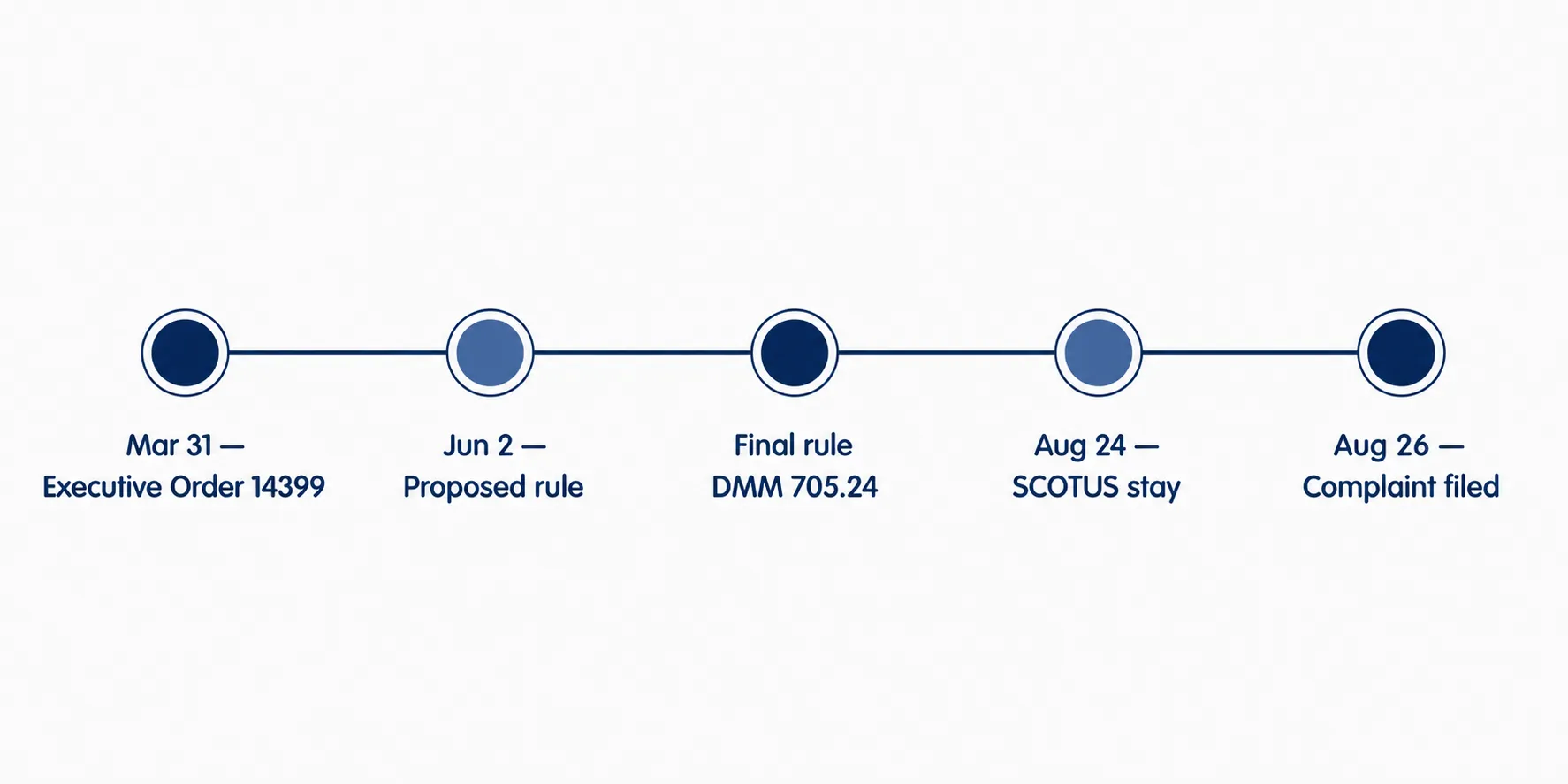
The sequence began with Executive Order 14399, signed on March 31, 2026. USPS published the proposed rule on June 2, 2026, at 91 Federal Register 32915, and later issued the final “Ballot Mail for Federal Elections” rule in DMM 705.24.
Earlier litigation produced two injunctions affecting implementation. The Supreme Court’s Aug. 24, 2026, per curiam order in Trump v. California, No. 26A124, stayed one of those injunctions. The Court’s action was framed around ripeness rather than a final merits determination of the rule’s legality. A stay changes the immediate effect of an order; it does not decide whether the challenged regulation ultimately survives review.
On Aug. 26, Judge Talwani vacated the other earlier injunction. The two developments are practically linked because USPS had conditioned implementation on obtaining relief from both prior injunctions. Reading only the new complaint would miss that implementation posture; reading only the Supreme Court order would miss the separate district-court action needed to clear the second obstacle.
The chronology also explains the states’ litigation posture. After the Supreme Court treated the earlier dispute as not yet ripe for the relief sought there, the Aug. 26 complaint placed the finalized rule’s legality directly before the district court. That makes this a merits challenge to the completed rule, not a holding that the states have already prevailed on any constitutional or administrative-law claim.
What DMM 705.24 establishes—and what the complaint does not establish
DMM 705.24 is the operative USPS rule identified in the available record. Its formal title is “Ballot Mail for Federal Elections.” The final rule supplies the text USPS seeks to apply, while the complaint supplies the states’ allegations about why that rule should be set aside or otherwise limited.
The available record does not include the complete text of DMM 705.24 or the complaint’s detailed description of each mailing requirement. It would therefore overstate the record to list unverified operational details about envelope markings, acceptance, processing, delivery, or ballot deadlines. Counsel relying on those mechanics should consult the finalized DMM provision and the filed complaint directly rather than treating a case summary as a substitute for either document.
The same caution applies to the pleaded claims. The complaint may advance constitutional, statutory, and administrative-law theories, but an allegation is not a judicial finding. As of the last verified check, no merits judgment had established that DMM 705.24 was unlawful, and no identified order had permanently invalidated the rule.
Does an order currently stop USPS from applying the rule?
As of Aug. 26—and on the last verified docket check on Aug. 27—the answer supported by the available record is no. No order was then identified as barring USPS from applying the finalized rule before the Nov. 3, 2026, midterm election.
That answer is about immediate enforceability, not ultimate validity. The complaint starts a new merits proceeding. It does not itself function as a temporary restraining order, preliminary injunction, vacatur, or stay. The Supreme Court’s Aug. 24 stay and Judge Talwani’s Aug. 26 vacatur addressed the prior injunctions; they did not adjudicate the new complaint’s claims.
The posture could change quickly. A later request for emergency relief, a district-court TRO or preliminary-injunction ruling, or an appellate order would require a fresh docket check and a new time-specific status statement. “No order identified as of Aug. 27” should not be shortened to “the rule cannot be challenged” or expanded to “the rule has been upheld.”
Operationalizing workflow
No workflow has been explicitly linked to this obligation yet. See Workflows generally.
Illustrative cases
No illustrative case is currently tracked for this obligation. See Risk Digest for documented incidents generally.
← Back to RegulationReport a correction or tip
Spotted an outdated figure, a misstated fact, or a ruling this regulation entry should reflect? Public comments are disabled for this content given the professional cost of a misreported case outcome, penalty amount, or rule text — use the structured correction channel instead.
Report a correction or tip for this record →