
5G core session hijacking and carrier breach clocks
- Authority
- FCC; SEC; state legislatures
- Rule type
- regulation
- Jurisdiction scope
- US federal; US state
- Source text
- Read primary rule text ↗
Covered carriers must notify FCC, FBI, and Secret Service within 7 business days and customers within 30 days of reasonable breach determination; state and SEC Form 8-K clocks may also run.
Last verified: August 2, 2026. This article is legal-risk analysis for compliance planning, not legal advice.

The July 31, 2026 disclosure from NTU iTrue is not legally important merely because it counted 84 previously unknown 4G and 5G core-network flaws. It matters because the researchers reported session hijacking confirmed on real-world commercial 5G cores, moving the legal question from a lab-risk discussion into breach-clock preparation for carriers, MVNOs, and some private 5G operators.
The study record is substantial but still bounded: 84 previously unknown flaws across seven open-source cellular cores, 83 confirmed flaws, and 81 CVE assignments, as reported in the research paper and contemporaneous coverage.[1][2] The specific commercial record that should be handled carefully is CVE-2026-8233, listed by NVD for Dotouch XproUPF 2.0.0-release-088aa7c4 in the UPF component. NVD currently shows enrichment as “Not Scheduled,” while the CVSS 3.1 base score of 4.6, Medium, is attributed to the CNA VulDB rather than treated as a universal legal severity score.[3]
That score is useful only up to a point. A medium technical rating does not answer whether an exploited session exposed customer location, destination, amount-of-use, account, or billing-linked information. For a telecom privacy officer, that is the harder question: not “how dramatic is the CVE,” but “what data was accessible, when could we reasonably determine that, and which notice clock started?”
Why session hijacking changes the legal conversation
A 5G core session is not just a technical object. In a carrier environment, session handling can intersect with information that Section 222 treats as customer proprietary network information, or CPNI. The statutory definition includes information relating to the quantity, technical configuration, type, destination, location, and amount of use of a telecommunications service, when made available to the carrier solely by virtue of the carrier-customer relationship; it also includes information contained in customer bills.[4]
That is why session hijacking is a different compliance fact pattern from a generic vulnerability scan finding. If an attacker can take over or observe a live telecommunications session in a way that reveals where a subscriber is, what network resources the subscriber is using, where the session is directed, or usage quantities tied to the account, the legal analysis can cross into Section 222 territory. The vulnerability itself is not the breach. The realized access, use, or disclosure of protected information is what starts to matter.
The same distinction matters for vendors and enterprise 5G deployments. A core vendor may face contractual, product, support, and disclosure obligations without itself being the customer-facing telecommunications carrier. A private 5G operator may or may not sit in the same regulatory posture as a common carrier, depending on the service model and customers served. But if the operator holds subscriber-linked usage, location, or account data, counsel still has to map the incident against state privacy and breach laws, contract clauses, sector obligations, and, for public companies, securities disclosure duties.
The FCC clock starts from a determination, not from the headline
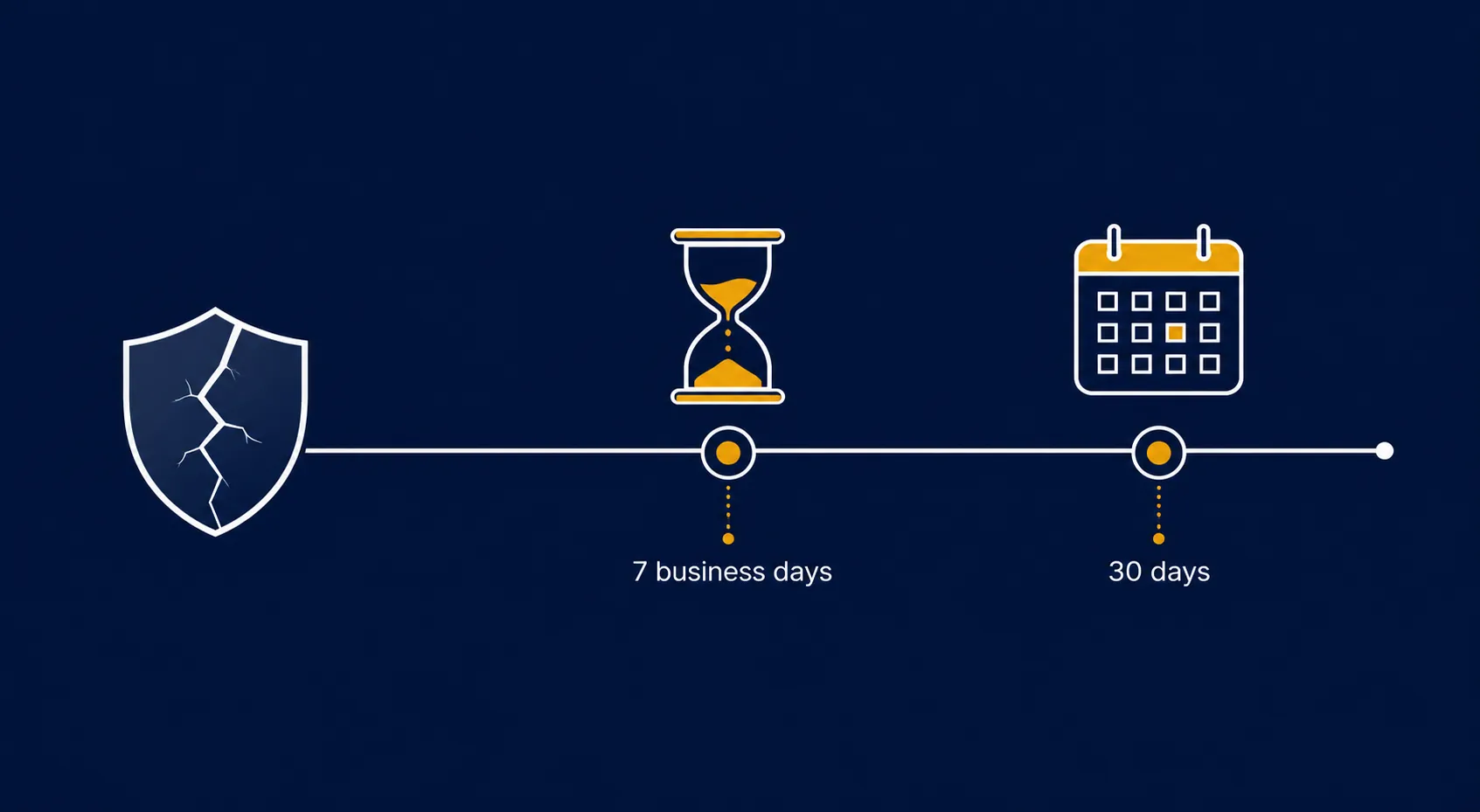
The FCC’s updated data-breach notification rules are built around a “reasonable determination” of breach. Under the FCC’s Data Breach Order materials, covered telecommunications carriers must notify the FCC, FBI, and U.S. Secret Service no later than seven business days after a reasonable determination of a breach, and must notify affected customers without unreasonable delay and no later than 30 days after that reasonable determination.[5]
| Event or decision point | Compliance consequence to prepare for |
|---|---|
| Vulnerability disclosed | Begin technical triage, asset mapping, vendor inquiry, and privilege-aware incident review; disclosure alone is not a breach finding. |
| Evidence of exploitation or unauthorized access appears | Preserve logs, determine affected systems, identify customer-linked data fields, and separate confirmed facts from hypotheses. |
| Reasonable determination of breach | Potential FCC agency notice within seven business days and customer notice no later than 30 days for covered carriers. |
| Materiality determination by a public issuer | Potential Form 8-K Item 1.05 filing within four business days. |
| State-law personal information identified | Parallel state notification analysis based on resident location, data elements, timing rules, and regulator-notice requirements. |
The “reasonable determination” hinge is not clerical. It is the moment when technical uncertainty becomes a legal timing problem. A carrier may know on day one that a disclosed UPF-related weakness exists somewhere in its environment. It may need more time to determine whether the weakness was exploitable in production, whether exploitation occurred, whether session data was exposed, and whether that data was CPNI or other covered personal information. The legal risk is not that every open CVE automatically starts a notice period; it is that a company without a documented decision path may be unable to explain when its determination became reasonable.
The 2023 FCC order also broadened the breach-notification frame by addressing harm and inadvertent access, so a carrier should not assume that only malicious exfiltration creates notice exposure.[5] That point is especially relevant in core-network incidents, where logs may first show abnormal session behavior before counsel can say whether a third party retained, used, or further disclosed the information.
A practical investigation should therefore answer a narrow set of questions early:
- Was the affected component present in a production, lab, roaming, enterprise, or vendor-managed environment?
- Could the weakness allow a third party to observe, redirect, assume, or manipulate a subscriber session?
- Which data fields were reachable: location, destination, amount of use, technical configuration, identifiers, billing information, credentials, or account records?
- Are those fields CPNI, state-law personal information, customer account data, or all three?
- When did the evidence become sufficient for a reasonable breach determination, and who approved that determination?
Those questions should be owned jointly. Network engineering can say what was technically accessible; privacy and regulatory counsel must decide whether the access maps to CPNI or another covered category; incident-response leadership must preserve the record showing why the company did or did not start the clock on a given date.
State notices run beside the FCC analysis
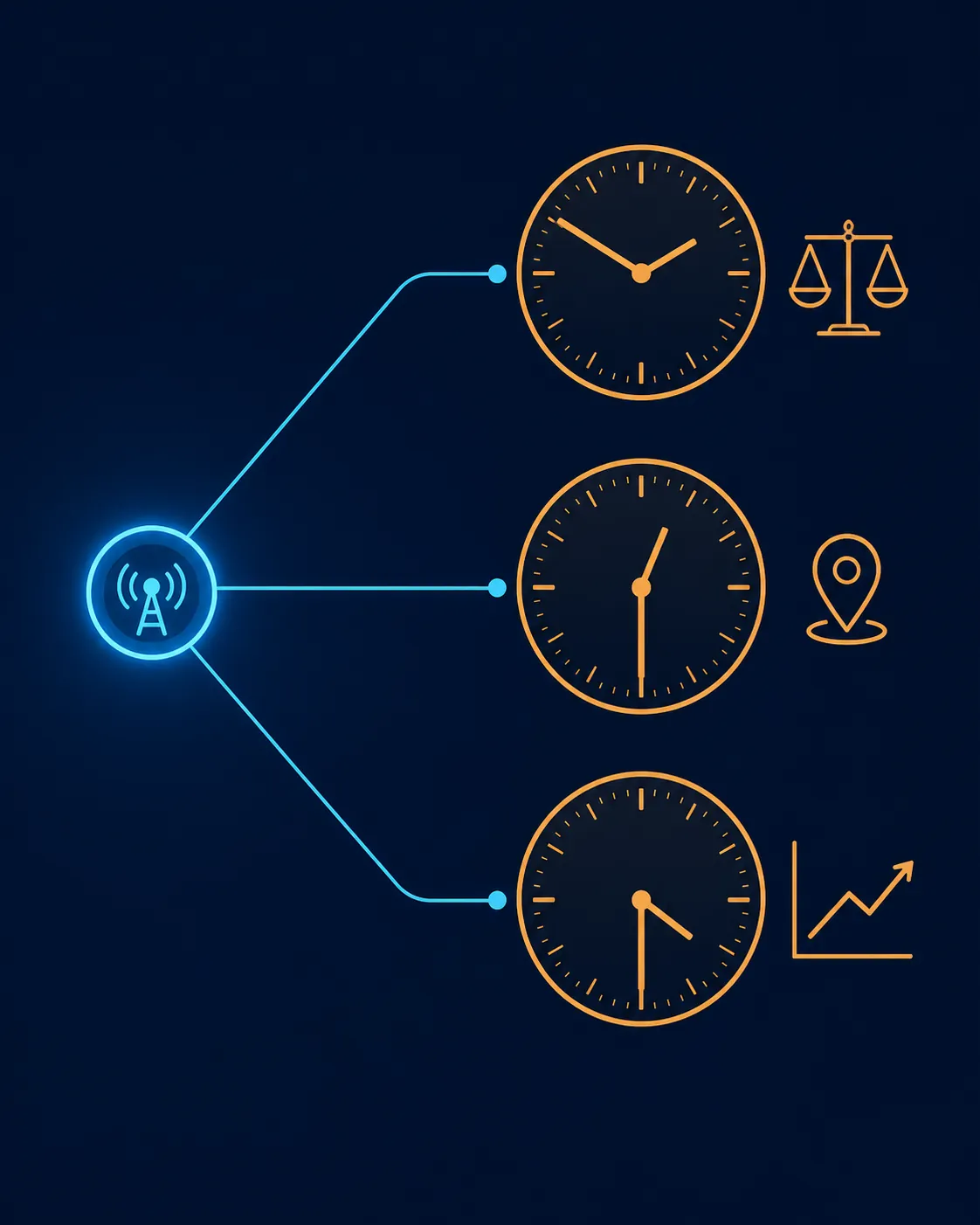
The FCC analysis does not absorb the state-law analysis. All 50 states maintain security-breach notification laws, and those laws create a parallel architecture of triggers, deadlines, regulator notices, consumer notices, and content requirements.[6] A carrier that focuses only on the FCC’s seven-business-day and 30-day windows may still miss state deadlines tied to resident location or specific data elements.
The mapping is not automatic. CPNI and state-law personal information are overlapping categories, not synonyms. A session-hijacking event that exposes destination or amount-of-use information may be central under Section 222 but may require separate analysis under a state statute’s definition of personal information. If the same event also exposes account credentials, customer account numbers, authentication data, or billing records, the state-notice question becomes more direct.
The more useful preparation is not a 50-state appendix written after the incident. It is an intake grid that routes the same technical facts into each notice regime: affected residents, data fields, encryption status where relevant, acquisition or access standard, law-enforcement delay process, attorney-general notice, consumer-reporting-agency notice, and customer communication content. The same sequencing issue appears in other incident records; the site’s analysis of the Fairlife ransomware notification cascade is a useful analogue for how federal and state timing judgments can diverge, though it is not a telecom precedent.
Public carriers also have a securities-disclosure lane
For public carriers and public companies operating material private 5G infrastructure, SEC Form 8-K Item 1.05 adds a separate clock. The SEC’s cybersecurity disclosure rule requires a registrant to disclose a material cybersecurity incident within four business days after determining that the incident is material.[7]
That timing point is often misunderstood. The four-business-day period runs from the materiality determination, not necessarily from the first alert, the first vulnerability report, or the first vendor bulletin. But a company cannot preserve flexibility by avoiding the determination. In a session-hijacking scenario, materiality analysis may need input from network operations, privacy counsel, litigation counsel, customer-impact teams, finance, investor relations, and senior management.
The Item 1.05 question is not limited to whether CPNI was accessed. It asks whether the cybersecurity incident is material to investors. A carrier might consider the number and type of affected customers, service disruption, regulatory exposure, likely remediation cost, litigation risk, contractual consequences, and reputational impact. The site’s coverage of Fairlife’s July 16, 2026 Form 8-K disclosure is useful for notification sequencing by analogy, but it should not be treated as authority for telecom-specific CPNI duties: Fairlife ransomware risk digest.
What the July disclosure does and does not prove
The reported commercial-core facts should be kept exactly as reported. The Hacker News described Dotouch as having remediated the issue, while an unnamed major carrier was still remediating at disclosure.[2] That does not identify a breached carrier, establish customer harm, or prove that any U.S. customer CPNI was exposed. It does, however, give carrier counsel a concrete reason to ask whether comparable components, configurations, or session paths exist in their own environments.
It is also not helpful to convert the 84-flaw count into a single legal conclusion. Some flaws may be lab-bound, some may be patched, some may affect open-source cores, and some may matter mainly to vendors. The legally important subset is narrower: weaknesses that could be exploited in a covered operator’s environment and could expose CPNI, state-law personal information, or information material to investors.
The CVE-2026-8233 record illustrates the same discipline. A CVSS 3.1 base score of 4.6 Medium, attributed by NVD to the CNA VulDB, is not a clean proxy for privacy consequence.[3] A technical severity score may account for exploitability and direct technical impact; it does not decide whether a hijacked session revealed location, destination, usage, or billing-linked information protected by statute.
The rescinded FCC security mandate is not a notice safe harbor
The FCC’s November 2025 action can easily be misread. FCC-25-81, adopted November 20, 2025, rescinded the CALEA-based affirmative cybersecurity mandate for telecommunications carriers.[8] Coverage at the time described the agency as eliminating telecom cybersecurity requirements tied to that mandate.[9]
That rescission does not erase Section 222. It does not make CPNI unprotected. It does not, by itself, eliminate the FCC breach-notification architecture adopted in the Data Breach Order. The compliance distinction is straightforward but important: an affirmative duty-to-secure rule and a breach-notification duty answer different questions. One asks what security program the carrier had to maintain; the other asks what must happen after protected customer information has been compromised or reasonably determined to have been breached.
There is also a text-management problem. Practitioners should be careful with CFR snapshots while the 2023 Data Breach Order, the rescission order, and ongoing litigation are being reconciled. A stale codified section can be worse than no citation if it leads an incident team to apply a removed customer-notice waiting period or miss the current agency-notice structure. For present planning, the safer anchor is the FCC order record and current counsel review, not an unverified copy-and-paste from a code database.
The Sixth Circuit posture is live, not settled
The appellate posture around the FCC breach rules is also moving. On July 31, 2026, the Sixth Circuit granted en banc rehearing in Ohio Telecom v. FCC, vacating the prior panel decision, with oral argument scheduled for October 21, 2026.[10] The vacated panel decision should not be cited as controlling law.
For incident planning, that uncertainty cuts against both extremes. It is too aggressive to pretend the litigation does not exist. It is also too casual to freeze notification readiness until the en banc court speaks. A carrier facing a live session-hijacking investigation still needs a defensible path for deciding whether the FCC, state, customer, law-enforcement, and securities-disclosure tracks have been triggered.
The decision path carriers should have ready
A useful breach-clock playbook for this class of vulnerability does not begin with public relations language. It begins with ownership of the legal trigger.
- Inventory exposure. Identify whether the affected core component, comparable UPF function, vendor build, open-source core, testbed, roaming path, or managed-service environment is present.
- Preserve session evidence. Collect logs, packet/session metadata, authentication records, orchestration records, vendor tickets, and remediation timestamps before ordinary retention cycles erase the record.
- Classify reachable data. Separate CPNI, state-law personal information, credentials, billing data, business-confidential data, and purely technical telemetry.
- Document the reasonable-determination analysis. Record what was known, who reviewed it, what remained unknown, and why the company did or did not conclude that a breach had occurred on a particular date.
- Run parallel notice checks. FCC, state, contractual, customer, law-enforcement, and SEC analyses should proceed in parallel rather than sequentially.
- Keep vendor facts and carrier duties separate. A remediated vendor issue does not answer whether the carrier had exposure, and a carrier notice duty does not automatically make the vendor the notifying party.
For MVNOs, the hardest part may be evidence access. If the host carrier or core vendor holds the relevant logs, the MVNO still may be the customer-facing entity receiving the complaint, regulator inquiry, or contractual demand. The MVNO’s incident plan should specify how quickly it can obtain session-impact facts, what the host must provide, and who makes the customer-notice decision if facts remain incomplete.
For private 5G operators, the first question is regulatory posture. A manufacturer, port operator, hospital system, campus, or utility running private 5G may not be in the same FCC carrier category as a nationwide mobile provider. That does not end the analysis. Employee, patient, customer, contractor, device, location, and authentication data can still route the incident into state breach law, sector privacy rules, contracts, and public-company disclosure controls.
The July 2026 disclosure therefore should not be treated as proof of a breach. It should be treated as a dated trigger for readiness. The affirmative FCC security mandate was rescinded, codified text remains unsettled, and the Sixth Circuit rehearing leaves the breach-rule fight unresolved. Yet a realized session-hijacking event can still force a demanding notice analysis if it exposes CPNI or covered personal information. The carrier that is prepared will be able to say when it knew enough, what information was implicated, and which FCC, state, customer, and SEC clocks did or did not begin to run.
References
- “ANGER: A Bundle of 84 Attacks on Cellular Core Networks,” arXiv.
- “Researchers Report 84 Flaws in 4G and 5G Core Networks, Exposing Telecoms to Attacks,” The Hacker News, July 31, 2026.
- “CVE-2026-8233 Detail,” National Vulnerability Database.
- “47 U.S. Code § 222 - Privacy of customer information,” Legal Information Institute, Cornell Law School.
- “FCC Adopts Updated Data Breach Notification Rules to Protect Consumers,” Federal Communications Commission.
- “Security Breach Notification Laws,” National Conference of State Legislatures.
- “Cybersecurity Risk Management, Strategy, Governance, and Incident Disclosure,” U.S. Securities and Exchange Commission, July 26, 2023.
- “FCC Corrects Course, Outlines Improved Cybersecurity Measures,” Federal Communications Commission, November 20, 2025.
- “FCC eliminates telecom cybersecurity requirements,” Cybersecurity Dive.
- “Sixth Circuit to Rehear Case on FCC Data Breach Rules Case,” Broadband Breakfast.
Operationalizing workflow
No workflow has been explicitly linked to this obligation yet. See Workflows generally.
Illustrative cases
No illustrative case is currently tracked for this obligation. See Risk Digest for documented incidents generally.
← Back to RegulationReport a correction or tip
Spotted an outdated figure, a misstated fact, or a ruling this regulation entry should reflect? Public comments are disabled for this content given the professional cost of a misreported case outcome, penalty amount, or rule text — use the structured correction channel instead.
Report a correction or tip for this record →