
How Abolishing ICE Would Redistribute 400 Federal Statutes
- Authority
- U.S. Congress
- Rule type
- statute
- Jurisdiction scope
- US federal
- Source text
- Read primary rule text ↗
Zeroing ICE’s FY2026 annual appropriations would not zero out the statutes ICE enforces. Nor would a bill titled the Abolish ICE Act, standing alone, make immigration, customs, sanctions, trafficking, child-exploitation, money-laundering, counter-proliferation, war-crimes, or Lacey Act authorities disappear. Congress can defund an agency. Congress can terminate funded operations. Congress can also leave behind a dense body of enforceable law unless it specifies where every relevant function goes.
That distinction matters now because the debate has moved from movement language into legislative text and appropriations facts. On April 30, 2026, Detention Watch Network described the DHS funding bill as zeroing out ICE annual appropriations for the first time.[1] H.R. 7123, introduced on January 15, 2026, in the 119th Congress by Representative Shri Thanedar and referred to the Committees on the Judiciary, Ways and Means, and Homeland Security, would terminate ICE’s funded operations.[2] Those are not the same legal instrument. They create different transition questions. But both force the same practitioner-facing inquiry: when the agency currently exercising an authority is defunded, terminated, or structurally replaced, who can still act under the statute?
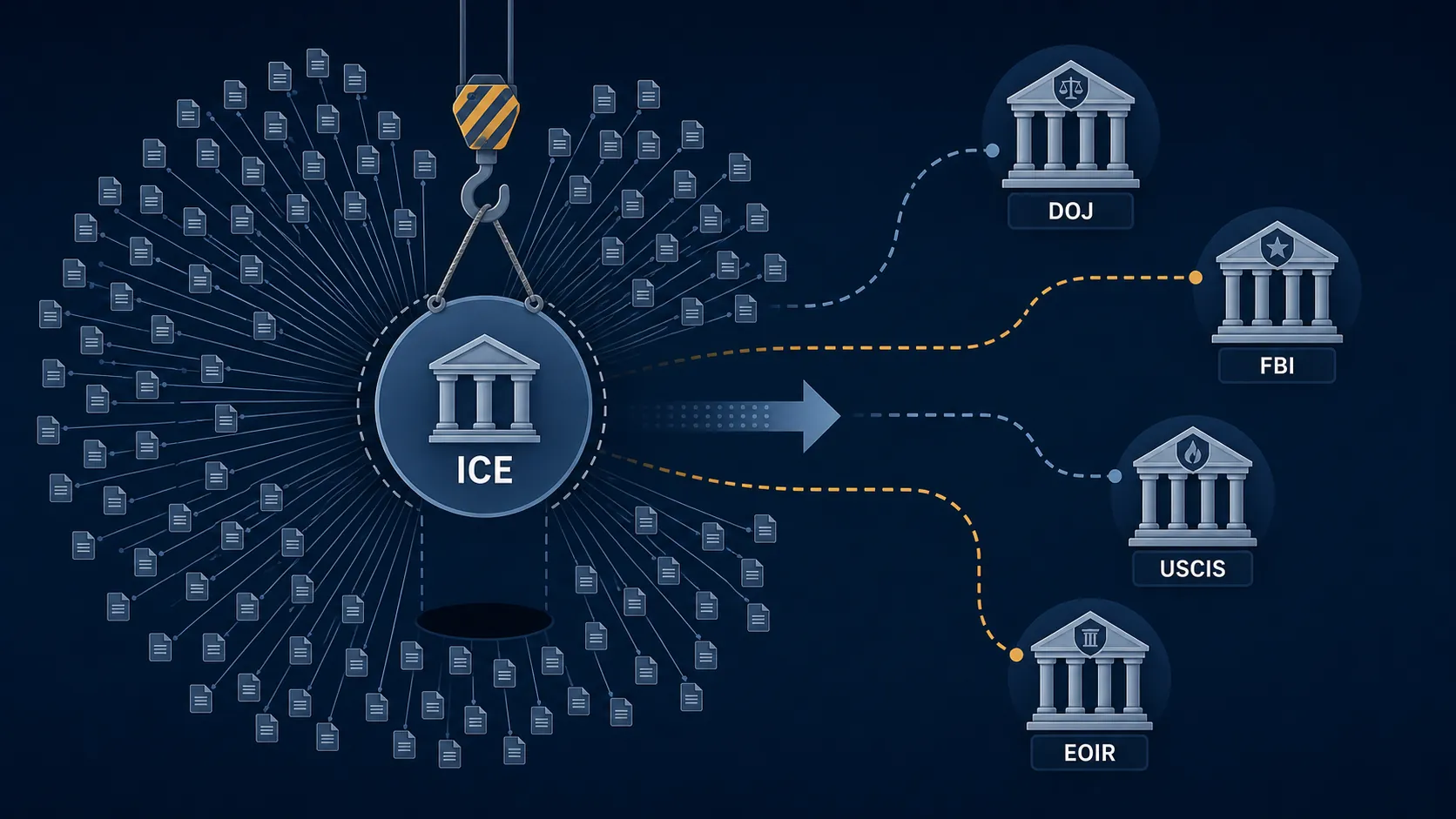
The statutes do not vanish with the agency name
ICE’s own public materials say the agency enforces more than 400 federal statutes, and Cornell Law School’s Wex entry similarly describes ICE as enforcing more than 400 statutes.[3][4] The exact count should be treated with care. The figure is not, on the materials available here, an independently audited statutory table. It is still enough to defeat the common shortcut that treats ICE abolition as though it were only a change in removal operations.
The more useful way to read the 400-plus figure is as a routing problem. Some provisions authorize investigation. Some support detention or seizure. Some involve charging decisions or referrals. Some are civil, some criminal, and some sit close to immigration status without being reducible to removal. A statutory cross-reference to the Secretary of Homeland Security, the Attorney General, an immigration officer, a customs officer, or a named bureau may answer the successor question differently. The practical legal consequence is that the question “Is ICE gone?” rarely resolves the client question by itself.
That is why the legal implications have to be narrowed before they can be useful. The first question is not moral, electoral, or administrative branding. It is whether Congress has separated four things that public debate often collapses: appropriations, authorization, delegated enforcement authority, and agency succession.
| Legal instrument | What it can do | What it does not necessarily do |
|---|---|---|
| Appropriations restriction or zero funding | Limit or eliminate funds available for an agency’s annual operations | Repeal the underlying statutes the agency has been enforcing |
| Authorizing statute | Create, terminate, transfer, or redesign agency functions | Resolve every downstream substitution issue unless drafted to do so |
| Agency guidance | Tell staff, regulated parties, and litigants how the government reads a transition | Override statutory text or bind courts beyond its lawful scope |
| Court substitution or litigation position | Move a case forward after a government reorganization | Settle all future jurisdictional or merits questions |
A defunded agency can become practically unable to perform a function before Congress has repealed or transferred the relevant authority. A terminated component can leave cases, investigations, subpoenas, warrants, notices, detainers, civil demands, and records in transit. If the successor language is broad, counsel may spend months arguing over whether the new actor inherited only personnel and files or also interpretive authority, enforcement priorities, and litigation posture.
The 400-plus-statute footprint is not one kind of law
ICE’s public list of “laws you didn’t know ICE enforces” reaches well beyond removal. It identifies work connected to child exploitation, human trafficking, money laundering, counter-proliferation, war crimes, and the Lacey Act, among other areas.[3] Cornell’s summary likewise frames ICE as a federal law-enforcement agency with a broad statutory portfolio, not merely a deportation office.[4]
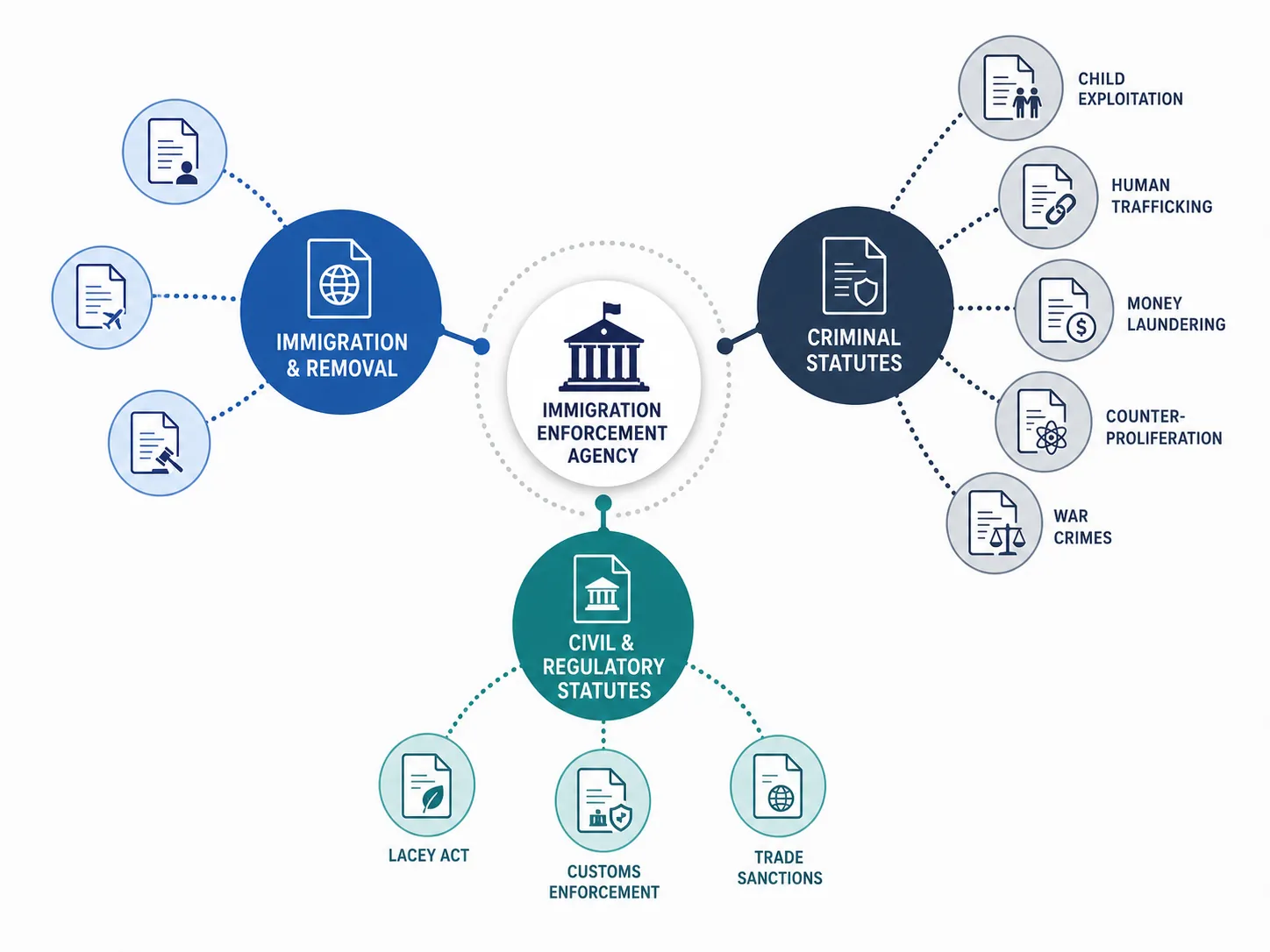
For a lawyer tracking exposure, that breadth changes the abolition analysis. A company with customs, trade, supply-chain, sanctions, or forced-labor risk does not get an all-clear because the agency acronym changes. A removal-defense lawyer cannot assume the government’s authority evaporates if a successor official appears. A civil-rights plaintiff challenging detention practices has to identify the right defendant, the right capacity, and the right source of continuing authority. A knowledge-management attorney cannot responsibly circulate a one-line alert saying “ICE abolished” without mapping the statutes, pending matters, and successor officials that matter to the firm’s work.
The more precise question is which functions attach to which statutory hooks. Some authorities may be naturally reassigned to DOJ components because they are criminal-enforcement functions. Some may move toward FBI investigation channels. Some immigration-benefits or service-adjacent functions may sit more naturally with USCIS. Some adjudicatory or removal-case consequences may involve EOIR, which is housed in DOJ rather than DHS. Some border, customs, or port-of-entry functions may implicate other DHS components. The research materials support the need for reassignment; they do not support a claim that any particular statute has already been finally assigned to one successor.
That uncertainty is not a drafting nuisance. It can alter who signs a notice, who may execute a warrant, who maintains a database, who responds to a subpoena, who appears in court, who issues interpretive guidance, and who has custody of records. In regulated settings, those mechanics can be the difference between a live compliance obligation and a contested demand. In litigation, they can shape jurisdiction, standing, mootness, substitution, exhaustion, and remedies.
The INS precedent shows reassignment, not disappearance
The closest modern analogue is not an agency simply walking off the stage. It is the abolition of the Immigration and Naturalization Service through the Homeland Security Act of 2002 and the redistribution of its functions among the newly configured homeland-security architecture, including ICE, CBP, and USCIS.[5][6] That precedent is useful because it shows Congress can dissolve a familiar immigration agency and rehouse its functions. It is also limited because the functions were preserved and redistributed; the precedent does not prove that a future ICE abolition would be seamless, automatic, or legally identical.
The INS example is best understood as a warning against superficial abolition analysis. Congress can abolish a named institution while retaining much of the state power associated with it. The old organization chart ceases to control, but the statutes, personnel, files, litigation, regulations, and institutional habits need somewhere to land. If the landing instructions are incomplete, agencies and courts have to infer the route from transfer provisions, saving clauses, organic statutes, appropriations riders, reorganization plans, and later guidance.
That process can create at least four categories of friction. First, a successor agency may inherit authority but not staffing capacity. Second, a successor may inherit cases but not the same enforcement culture or priorities. Third, a statute may name an official or component in a way that requires technical amendment rather than informal reassignment. Fourth, pending litigation may have to proceed while parties contest whether the substituted defendant has the same legal position as the prior one.
Where functions could land
The plausible successor map is not a single transfer arrow. A post-ICE architecture would likely split functions by legal character, and the split itself would become a source of legal work.
| Function now associated with ICE | Likely successor question | Practitioner risk |
|---|---|---|
| Criminal investigations tied to trafficking, exploitation, financial crime, counter-proliferation, or war crimes | Whether DOJ, FBI, or another federal law-enforcement component receives authority, files, personnel, and investigative continuity | Challenge to warrants, subpoenas, referrals, evidence custody, and investigative authority |
| Immigration enforcement and removal-related operations | Whether authority remains in DHS, moves toward DOJ-linked adjudication channels, or is divided between service, custody, and litigation functions | Confusion over respondents, detention authority, notices, court appearances, and administrative exhaustion |
| Civil and regulatory enforcement touching customs, trade, supply chains, or environmental statutes | Whether DHS components, DOJ, or specialized regulators inherit monitoring and enforcement roles | Compliance uncertainty for regulated entities and difficulty identifying the agency with interpretive control |
| Records, databases, and pending matters | Which successor controls records, privacy obligations, FOIA processing, and litigation holds | Misserved requests, delayed production, preservation disputes, and contested official-capacity defendants |
DOJ is the obvious candidate for many criminal-enforcement consequences, but “DOJ” is not itself an operational answer. The relevant issue is whether a function goes to prosecutors, investigators, civil litigators, EOIR-facing structures, or a newly designated unit. If FBI receives more investigative responsibility, counsel will need to know whether prior ICE-originated investigative steps remain valid, whether interagency referrals are documented, and whether continuity rules are stated in transition guidance.
USCIS presents a different kind of question. It is a benefits and services agency, not a simple substitute for a police component. Moving service-adjacent immigration functions toward USCIS might reduce some enforcement overlap, but it would also require careful separation of application processing, fraud review, information sharing, and adverse-action pathways. A benefits agency can still make decisions with enforcement consequences if Congress and DHS leave those pathways intact.
EOIR, meanwhile, matters because removal proceedings are adjudicatory and already sit within DOJ. If ICE functions are dismantled, litigators will watch who files or maintains charges, who appears for the government, who moves to substitute parties, and whether pending cases are continued, administratively closed, dismissed, or simply relabeled. None of those outcomes should be assumed from the word “abolish.” They depend on transition text, docket management, and litigation positions.
The hardest problems are procedural before they are philosophical
The public argument often asks whether a dedicated immigration-police agency should exist. The procedural question is narrower and more immediate: what happens on the morning a deadline runs, a subpoena is due, a detained person seeks relief, or a company receives a demand from an office whose future is unresolved?
Jurisdictional confusion is one foreseeable consequence. If a statute authorizes action by an “immigration officer” or a DHS official, a successor designation may be enough for some purposes and contestable for others. If a complaint names an ICE official in an official capacity, the government may seek substitution. If the plaintiff’s theory depends on a policy formerly attributed to ICE, the successor may argue the policy has been rescinded, transferred, or materially changed. That does not end the claim automatically, but it changes the litigation posture.
Compliance monitoring can become equally awkward. A regulated party may need to preserve records for one agency while responding to another. A prior settlement, deferred-action arrangement, consent order, or informal compliance understanding may refer to ICE personnel or ICE offices. Unless transition materials expressly carry those obligations forward, counsel will have to determine whether performance is still due, to whom it is due, and whether a missed communication creates exposure.
Investigation continuity is the place where legal and operational questions meet. A criminal or civil investigation may have been opened under ICE authority, worked by agents later moved to another component, and prosecuted or enforced by an office that reads the transfer statute differently from the target. The first disputes may not look like grand constitutional clashes. They may look like motions to suppress, motions to dismiss, discovery fights, FOIA delays, privilege disputes, or challenges to administrative subpoenas.
Markowitz offers a design answer, not controlling law
Professor Peter L. Markowitz’s Yale Law Journal essay, “Abolish ICE . . . and Then What?,” is useful because it treats abolition as an institutional-design problem rather than a slogan. The essay proposes a four-pillar post-ICE framework: optimal enforcement scaling, mandatory compliance assistance, proportional scalable fines, and minimizing coercive state power.[6] That framework directly addresses the common objection that ending ICE would leave no enforcement architecture at all.
But a law-review architecture is not enacted law. It does not itself transfer a statutory function, substitute a defendant, fund a successor office, or amend a cross-reference. Its value for practitioners is diagnostic. It shows that a post-ICE system could be designed around smaller, more compliance-oriented, less coercive mechanisms. It also shows how much drafting Congress would have to do if it wanted abolition to mean more than starving or renaming an existing enforcement apparatus.
The Oxford Human Rights Hub’s abolition-oriented commentary belongs in that same limited lane: it supplies a normative human-rights critique of immigration enforcement, but it does not answer the statutory-successor question by itself.[7] For counsel, the normative case may explain why a bill exists. It does not identify who inherits subpoena authority under a given statute.
What counsel should track before the abolition question is resolved
Waiting for a final up-or-down answer on H.R. 7123 is too late for organizations with live matters. The useful monitoring file is not a prediction sheet. It is a successor-authority tracker.
- Agency-successor language: Track whether bills, amendments, committee reports, or manager’s statements assign specific functions to DOJ, FBI, USCIS, EOIR, CBP, another DHS component, or a newly created office.
- Appropriations riders: Separate a funding cutoff from a substantive repeal. A rider may stop money without resolving pending investigations, records custody, detention authority, or litigation substitutions.
- Saving clauses and transition provisions: Look for language preserving existing regulations, orders, suits, personnel actions, contracts, databases, and administrative proceedings.
- Court substitutions: Watch how DOJ handles pending cases involving ICE officials, including whether substitutions are routine, contested, or paired with mootness arguments.
- Guidance and delegation orders: Collect DHS and DOJ materials identifying who may sign, detain, investigate, appear, issue demands, or maintain records after any funding or structural change.
- Statutory carveouts: Identify areas Congress expressly excludes from transfer, pauses, repeals, or assigns to a different enforcement model.
In-house counsel should build that tracker around actual exposure, not around the agency’s public controversy. A multinational importer, a university, a platform company, a labor contractor, a nonprofit shelter, and a criminal-defense client will not need the same map. The relevant statutes, records, agency contacts, and litigation risks differ.
Litigators should preserve objections without assuming abolition supplies a merits win. If a successor official appears, the first questions are authority, capacity, continuity, and remedy. Did Congress transfer the function? Did the agency validly delegate it? Did the government preserve the challenged policy? Does the plaintiff need to amend? Does the defendant claim the case is moot? Does the administrative record still exist in usable form?
Risk and knowledge-management teams should avoid a single global label. “ICE defunded,” “ICE terminated,” “ICE functions transferred,” and “ICE enforcement policy rescinded” are different entries. The difference will matter when a partner asks whether a deadline still runs, whether a subpoena still needs a response, whether a compliance protocol still applies, or whether a case caption needs revision.
The legal implication is redistribution
ICE abolition would be legally significant even if Congress tried to make it administratively simple. The agency sits across too many statutory routes for abolition to operate as a clean erasure. The more than 400-statute claim should not be inflated into false precision, but it should be taken seriously enough to change the question. The statutes remain the load-bearing structure.
For practitioners, the immediate task is not to decide whether a post-ICE system would be better. It is to watch where authority is sent, where it is left ambiguous, and where the government acts before the crosswalk is clean.
References
- Press release, Detention Watch Network, April 30, 2026.
- H.R.7123 - Abolish ICE Act, GovInfo.gov, January 15, 2026.
- Top 10 laws you didn't know ICE enforces, ICE.gov.
- Immigration and Customs Enforcement (ICE), Cornell Law School Legal Information Institute Wex.
- The Abolish ICE Movement Explained, Brennan Center for Justice.
- Abolish ICE . . . and Then What?, Yale Law Journal.
- Oxford Human Rights Hub, Oxford Human Rights Hub.
Operationalizing workflow
No workflow has been explicitly linked to this obligation yet. See Workflows generally.
Illustrative cases
No illustrative case is currently tracked for this obligation. See Risk Digest for documented incidents generally.
← Back to RegulationReport a correction or tip
Spotted an outdated figure, a misstated fact, or a ruling this regulation entry should reflect? Public comments are disabled for this content given the professional cost of a misreported case outcome, penalty amount, or rule text — use the structured correction channel instead.
Report a correction or tip for this record →