
Can the President Fire Election Commissioners After Slaughter?
- Authority
- U.S. Supreme Court
- Rule type
- statute
- Jurisdiction scope
- US federal
- Effective date
- Jun 29, 2026
- Source text
- Read primary rule text ↗
For anyone tracking the legal implications of presidential firings of election commissioners in 2026, the issue now starts with a vacant dais, not with a law-school argument about independent agencies. On July 9, President Trump fired EAC Commissioners Hicks and Hovland and accepted Commissioner McCormick’s resignation the same day; the fourth seat had already been vacant since Palmer’s departure in April. The result, as reported by Votebeat, is an EAC with zero commissioners and therefore no commission body available to act.[1]
This is a regulation-and-ethics analysis, not legal advice. It is current as verified on July 27, 2026, which matters because the EAC firings were only 18 days old at verification and a complaint by Hicks, Hovland, or another plaintiff could change the posture quickly.[1]

The immediate legal problem is unusually concrete. The EAC is not merely short of a quorum or facing ordinary partisan deadlock. It has no commissioners. That makes the removal question operational before it becomes theoretical: who can approve agency action, who can defend an institutional position, who can sign off on contested administrative moves, and what happens to state officials or vendors waiting on a commission that cannot lawfully do commission work?
What Slaughter decided, and what it deliberately left open
The Supreme Court’s June 29 decision in Trump v. Slaughter gives the administration its strongest argument. In a 6-3 decision by Chief Justice Roberts, the Court overruled Humphrey’s Executor as applied to Federal Trade Commission commissioners, held that FTC commissioners exercise executive power, and allowed the president to remove them at will.[2]
That holding is not soft. It rejects the old assumption that a multimember expert commission with fixed terms and for-cause removal protection automatically sits outside presidential control. If election commissioners are treated the same way FTC commissioners were treated in Slaughter, a lawsuit challenging the EAC firings begins uphill.
But Slaughter also contains the sentence litigators will now live inside. The Court expressly declined to “define the bounds of what such power entails” and reserved questions involving non-Article III courts, the Tax Court, and the Federal Reserve.[2] That reservation is not a holding for election commissions. It is a door left unlatched.
The companion decision, Trump v. Cook, prevents Slaughter from becoming a clean one-rule-fits-all removal case. In Cook, the Court preserved Federal Reserve independence in a 5-4 ruling based on what the Court treated as “a special arrangement sanctioned by history.”[3] The reasoning matters because it is historical rather than structural. The Federal Reserve was not saved simply because it is important, expert, multimember, or economically sensitive. It was saved because the Court saw a historically grounded arrangement that justified different treatment.
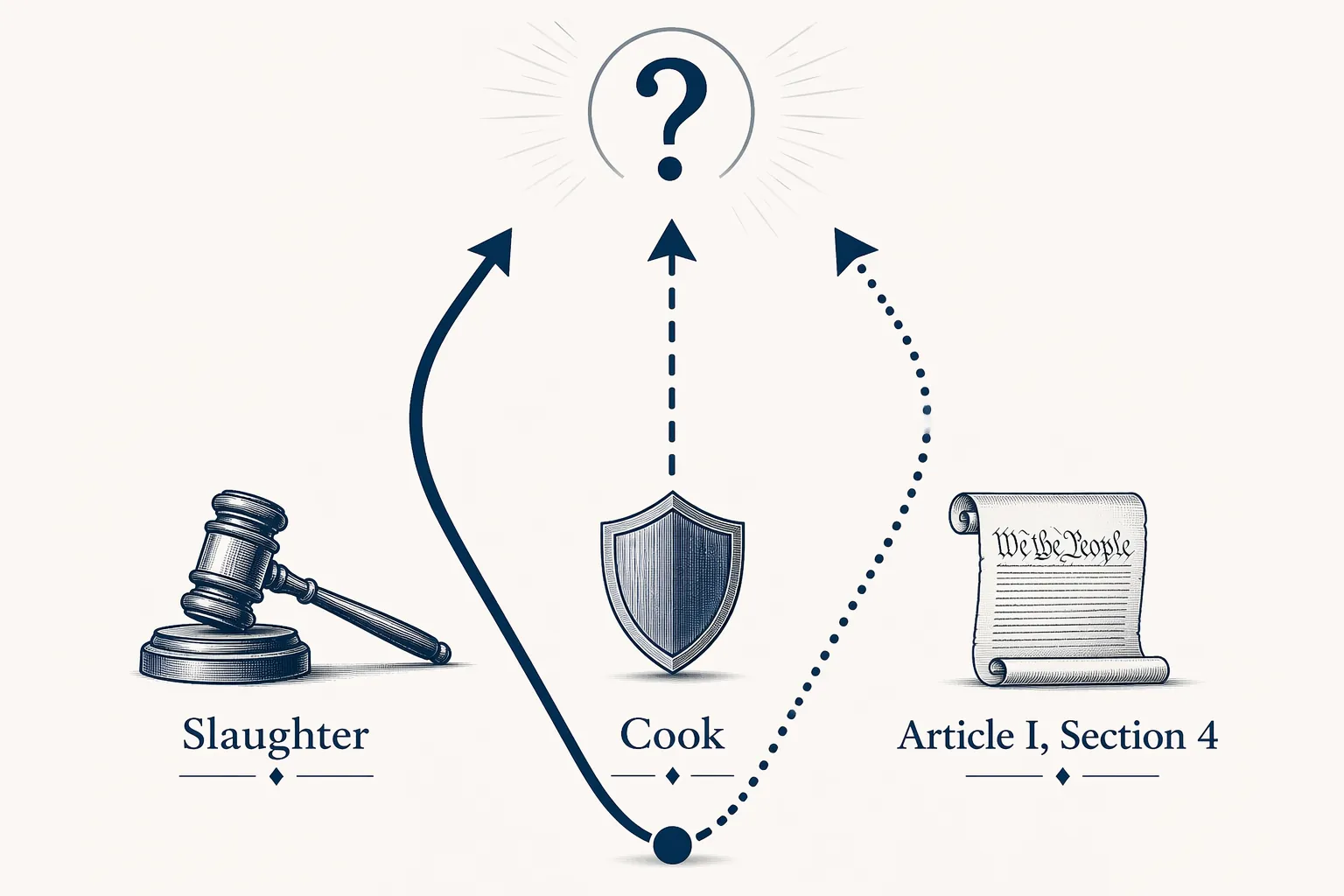
| Path | What it would mean for EAC and FEC removals | Current problem |
|---|---|---|
| Slaughter applies | Election commissioners exercise executive power and may be removed at will. | Slaughter did not decide election-commission removals. |
| Cook exception applies | Bipartisan election commissions are protected by a historically accepted independence model. | The EAC and FEC have shorter and different histories than the Federal Reserve. |
| Article I, Section 4 supplies a separate rule | Election regulation may be different because the Constitution assigns federal-election regulation to Congress and the states. | Courts have used this theory against presidential direction of election administration, but not yet against commissioner removals. |
Election commissions do not fit neatly into either box
The EAC and FEC are not miniature Federal Reserves. They are also not simply the FTC with ballots attached. Their best claim to different treatment comes from design: Congress built both around bipartisan balance, fixed terms, and removal limits because federal election administration and campaign-finance enforcement are especially vulnerable to partisan capture.
The EAC, created under the Help America Vote Act of 2002, has four commissioners, no more than two from the same political party, fixed terms, and for-cause removal protection.[1] The FEC, created under the Federal Election Campaign Act framework in 1974, has six commissioners, no more than three from one party, six-year staggered terms, and for-cause removal protection.[4]
Those features give fired commissioners something more specific than a generalized plea for agency independence. They can say Congress did not merely create expert administrators. It created election bodies whose legitimacy depends on the president not being able to replace opposing-party commissioners at will during an election cycle.
That is a serious argument, but not a settled one. Rick Hasen put the point with useful restraint after the EAC firings: “It’s an open question about the EAC and the FEC. The question has not been tested as to whether political entities created with bipartisan balance might be subject to another exception.”[5] For litigation planning, that is the correct baseline. There is no controlling election-commission exception waiting to be cited.
The Slaughter-applies argument is stronger than its critics want it to be
A government defendant defending the EAC firings will not need to pretend that election administration is unimportant. The argument is simpler: commissioners who administer federal statutes, approve agency policy, supervise agency staff, and participate in binding government action exercise executive power. Slaughter says officers exercising executive power are removable at will unless a recognized exception applies.[2]
That argument has force because Slaughter did not turn on whether the FTC’s mission was partisan or nonpartisan, technical or political, old or new. The Court looked at the nature of the power being exercised. If a court frames the EAC and FEC question at that level of generality, party-balance requirements may be treated as congressional preferences about appointment and agency design, not as constitutionally enforceable limits on presidential removal.
The administration would also press the remedial consequences. If courts treat every bipartisan commission as a candidate for a new exception, Slaughter’s rule becomes unstable almost immediately. The government can argue that Cook already identifies the kind of historically exceptional institution that qualifies, and that election commissions lack the Federal Reserve’s historical footing.[3]
The Cook-style argument depends on history, but not only on age
The fired commissioners’ best Cook-style argument is not that the EAC has existed as long as the Federal Reserve. It has not. The better argument is that election commissions belong to a distinct post-Watergate and post-2000 settlement: Congress responded to election legitimacy crises by creating bipartisan bodies deliberately insulated from single-party presidential control.
For the FEC, the point is especially direct. The agency’s structure reflects Congress’s judgment after Watergate that campaign-finance enforcement should not be run by the president’s political allies alone. For the EAC, Congress acted after the 2000 election disputes and built a federal election-administration commission with partisan balance and protected tenure. These are not accidental bureaucratic choices. They are safeguards aimed at the credibility of federal election rules.
The weakness is obvious enough to matter in a complaint. Cook’s carve-out rests on historical practice, and the Federal Reserve has a different institutional lineage. The EAC dates to 2002; the modern FEC framework dates to 1974. A court may conclude that this is too recent, too statute-specific, or too unlike the Fed to justify a constitutional exception to Slaughter.
Article I, Section 4 is the route Slaughter did not answer
The most interesting argument is not that election commissions are independent agencies in the familiar Humphrey’s Executor sense. After Slaughter, that label has lost much of its force. The more targeted argument begins with Article I, Section 4: the Constitution assigns regulation of the times, places, and manner of congressional elections to state legislatures, subject to congressional alteration. It does not assign that power to the president.
That theory already has live litigation value. Multiple federal courts blocked Trump’s March 2025 executive order directing the EAC to add a proof-of-citizenship requirement to the federal voter registration form, concluding that “the Constitution vests none of these powers in the President.”[6] Those rulings did not decide whether the president can remove EAC commissioners. They did, however, establish that presidential control over election administration is not just another administrative-law question.
A removal plaintiff would likely use those decisions to argue that Slaughter’s executive-power logic cannot simply be imported into election administration. The FTC regulates commerce through executive enforcement. The EAC and FEC operate in a constitutional field where Congress and the states have textually specified roles. If removal power lets the president empty or repopulate the election bodies Congress designed to check partisan control, the Article I assignment may be undermined in practice.
That is a live argument, not a winning holding. The executive-order cases concerned presidential direction of agency action, including the federal voter registration form. Removal is different. A court could say Article I limits what the president may command election officials to do, while Slaughter controls whether he may remove officers who exercise executive functions. The plaintiff’s task would be to connect removal to the Article I injury without turning every personnel dispute into an elections-clause case.
Weintraub is a warning marker, not precedent
The FEC version of this dispute nearly arrived first. In February 2025, Trump attempted to fire Democratic FEC Commissioner Ellen Weintraub. Campaign Legal Center described the attempt as illegal, and Weintraub retained counsel, but she did not file suit.[4]
That matters because lawyers will be tempted to overuse the episode. It shows the administration’s theory was not limited to the EAC. It does not provide a judicial ruling on whether FEC commissioners may be removed at will. No court tested the statutory for-cause protection, the bipartisan-commission theory, or the Article I argument in that posture.
Kobach answers less than a commissionless EAC needs answered
Kobach v. EAC is useful mostly because it shows how awkward EAC authority can become when the commission itself cannot act. In 2014, the Tenth Circuit dealt with EAC action involving the federal voter registration form and implicitly accepted that the agency’s executive director could issue a final agency action under court order.[7]
That implicit acceptance is not enough to solve the current problem. It was not a removal case. It did not decide whether staff may operate an agency indefinitely without commissioners. It did not bind every circuit to treat commissionless EAC action as valid. It may help defend a narrow staff action taken under a specific legal obligation; it does not make an empty commission whole.
The first complaint will be about power, but also about capacity
The cleanest plaintiff is a fired commissioner who wants the office back. Hicks or Hovland could allege a direct removal injury, seek declaratory and injunctive relief, and ask a court to decide whether statutory tenure protection survives Slaughter. That case would put the constitutional question in its most direct form.
Other plaintiffs would face a more complicated route. A state election official, voting-system vendor, or regulated party may be able to identify practical harm from an EAC unable to act, or from an attempted action by officials whose authority is disputed. But those cases would immediately raise standing, ripeness, causation, and remedy questions. A vendor waiting on a stalled approval process is not in the same position as a commissioner removed from office.
The remedial question will be just as important as the merits. A court could reinstate commissioners, enjoin recognition of the removals, block a specific EAC action taken after the firings, or decline relief if it finds the plaintiff’s injury too indirect. If the White House attempts to direct the commissionless EAC to amend the federal voter registration form, Hasen has already flagged that as likely “high profile and very important litigation.”[5]
Agency staff are left in the least comfortable position. They must keep election machinery legally functional without pretending the commission exists. State officials and vendors, meanwhile, have to decide whether to treat EAC silence as delay, incapacity, or a signal that any attempted action may be challenged later. That is where Slaughter’s abstraction becomes a filing deadline, a certification question, or a contract risk.
What can be said now
The safest current answer is narrow. Slaughter gives the president a serious argument that EAC and FEC commissioners exercise executive power and may be removed at will. Cook gives fired commissioners a serious but uncertain argument that some historically protected institutions remain outside that rule. The bipartisan election-commission model gives them a more tailored structural argument. Article I, Section 4 gives them a path that is not merely a reheated defense of independent agencies.
None of those paths has yet produced a holding on presidential removal of EAC or FEC commissioners. Weintraub did not sue. Kobach was not a removal case. The executive-order injunctions involved presidential direction of election administration, not the firing of commissioners. Slaughter itself reserved boundaries instead of mapping them.
Justice Sotomayor’s Slaughter dissent warned that the decision “reshapes our Government” and “elevates” the president “above his once-coequal branches.”[8] That is the separation-of-powers weather system moving behind the EAC dispute. The litigable question is smaller and more immediate: after Slaughter and Cook, can the president empty bipartisan election commissions at will? As of July 27, 2026, no court has answered it.
References
- Trump fires all Election Assistance Commission members, leaving agency unable to act — Votebeat — July 9, 2026
- Supreme Court cements Trump's power over independent agencies — NPR — June 29, 2026
- Trump v. Cook — Supreme Court of the United States — June 29, 2026
- Trump Illegally Attempts to Fire Federal Election Commission Chair Ellen Weintraub — Campaign Legal Center — February 2025
- BREAKING: Trump fires all Election Assistance Commission members — Election Law Blog — July 10, 2026
- Consequences of EAC firings — Democracy Docket — July 2026
- Kobach v. U.S. Election Assistance Commission — U.S. Court of Appeals for the Tenth Circuit — 2014
- Trump v. Slaughter, dissenting opinion — Supreme Court of the United States — June 29, 2026
Operationalizing workflow
No workflow has been explicitly linked to this obligation yet. See Workflows generally.
Illustrative cases
No illustrative case is currently tracked for this obligation. See Risk Digest for documented incidents generally.
← Back to RegulationReport a correction or tip
Spotted an outdated figure, a misstated fact, or a ruling this regulation entry should reflect? Public comments are disabled for this content given the professional cost of a misreported case outcome, penalty amount, or rule text — use the structured correction channel instead.
Report a correction or tip for this record →