
Agrivoltaics land-use law is now a state-by-state patchwork
- Authority
- Congress, IRS, USDA, state legislatures and agencies
- Rule type
- Statute/regulation
- Jurisdiction scope
- US federal and state
- Source text
- Read primary rule text ↗
Confirm federal incentive status, then satisfy applicable state and local agrivoltaics land-use, tax, and permit requirements.
The first diligence question for agrivoltaics land use laws and permits is no longer whether a farmland solar proposal can be described as “dual use.” It is whether the project still has a federal subsidy route at all, and if not, which state or county rule now supplies the operative permission, tax treatment, or program eligibility. As of Q3 2026, that question turns on a dated record: the One Big Beautiful Bill Act was signed on July 4, 2025; the IRS then issued FS-2025-05 on August 21, 2025; and USDA announced in August 2025 that it would not fund solar panels on productive farmland.[1][2][3]
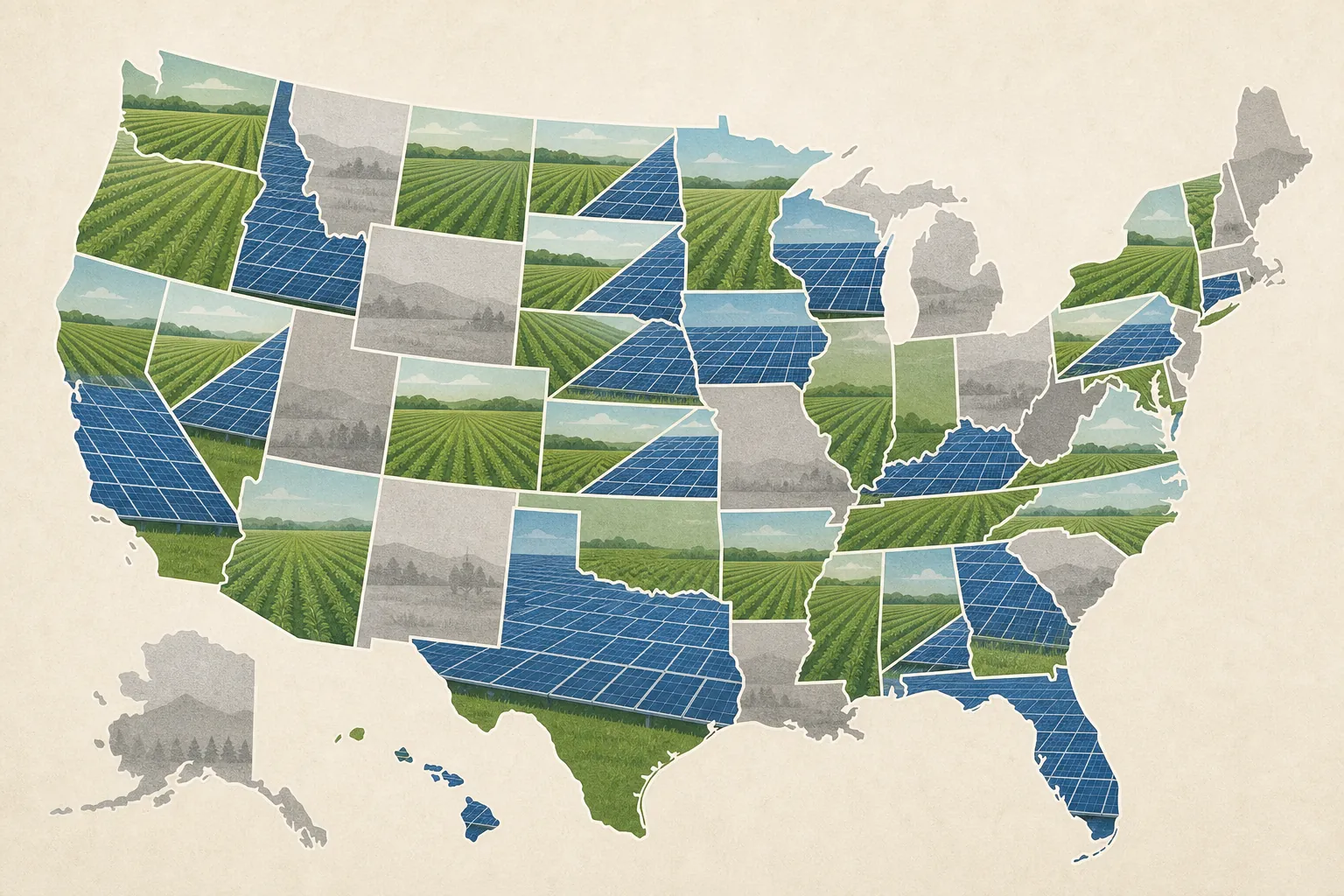
That sequence matters because a land-use lawyer cannot clear a 2026 farmland-solar deal by repeating an old incentive assumption and then treating zoning, agricultural assessment, and state pilot rules as afterthoughts. The federal materials do not say that every agrivoltaic project is illegal. They say the old shortcut is gone or materially narrowed, and the remaining path must be built from state statutes, local siting ordinances, tax classification rules, and any program-specific conditions.
The federal record is narrower than the shorthand
The cleanest place to start is the IRS FAQ, because it separates provisions that are often collapsed in conversation. FS-2025-05 states that the residential clean energy credit under section 25D terminates for expenditures made after December 31, 2025. It also identifies accelerated terminations or changes affecting sections 25C, 25E, 30C, 30D, 45L, 45W, and 179D.[2] Those provisions are not interchangeable. A residential rooftop credit, a commercial charging credit, a vehicle credit, and a building-efficiency deduction do not answer the same legal question for a developer-controlled solar array on agricultural land.
That is why the phrase “the 30% ITC ended” is a poor diligence note. It may be a useful warning that the pre-2025 federal incentive environment should not be assumed, and secondary policy digests have used that kind of shorthand when describing the federal pullback.[4] But it is not a substitute for identifying the taxpayer, the project type, the credit being claimed, the placed-in-service or expenditure date, and the transition rule, if any. In a farmland transaction, the answer may differ for a landowner, a developer, a tax-equity investor, a residential customer, or a public entity trying to use a grant or loan program.
USDA’s August 2025 position adds a separate constraint. The Department said it would no longer fund solar panels on productive farmland.[3] That is not a zoning ban, and it does not by itself amend a county ordinance. It does, however, remove a federal funding lane that had mattered to some rural-energy proposals. For counsel, the practical point is simple: if the parcel is productive agricultural land, federal program eligibility must be checked before anyone assumes that a dual-use design can be financed through USDA-backed support.
A compact 2025-2026 state tracker
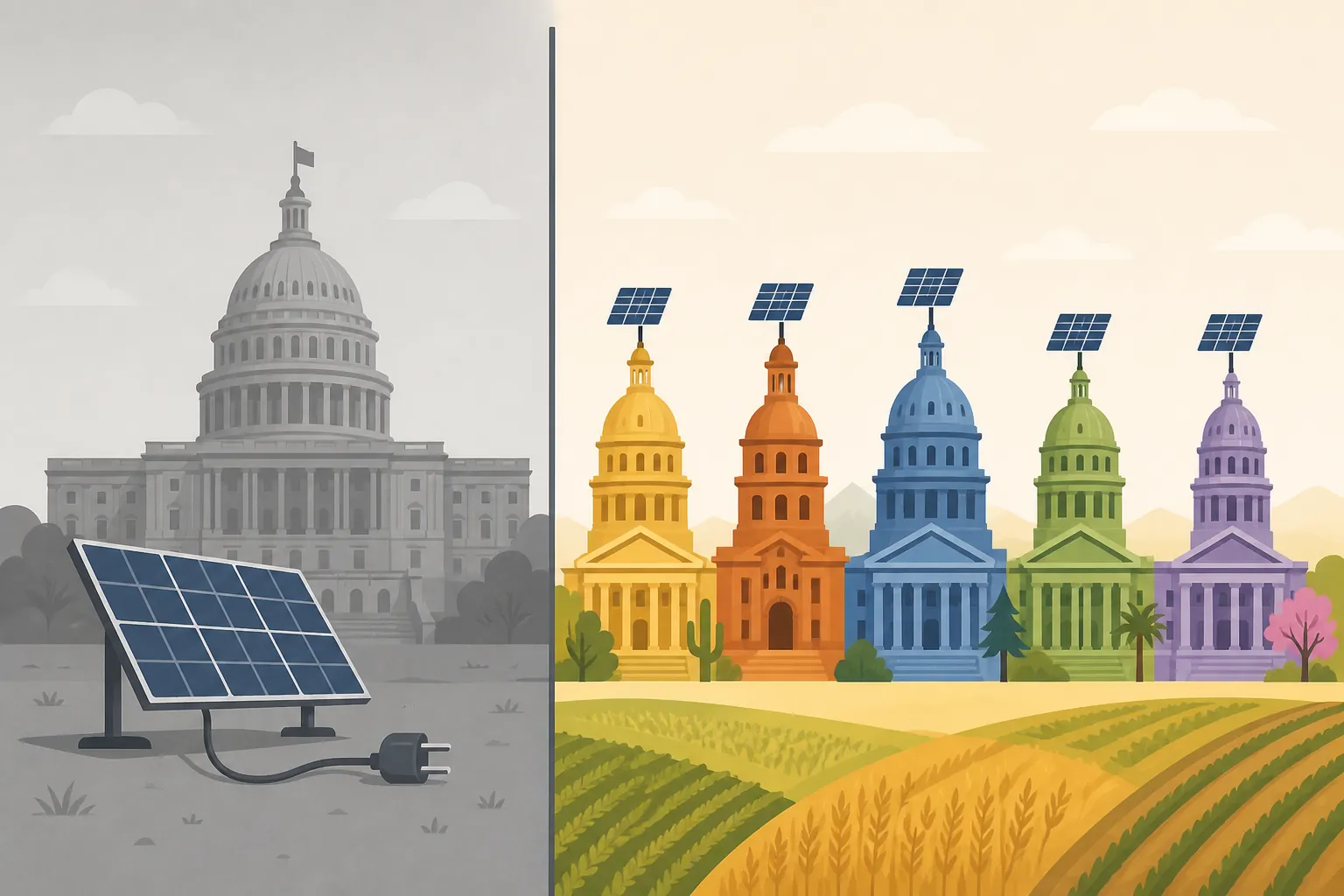
The state responses do not share a single legal form. Some create definitions. Some protect tax treatment. Some run pilots. Some revise siting authority. One did not pass at all. That difference is not cosmetic; it changes the document set a lawyer must read before giving a permit or land-status opinion.
| Jurisdiction | Legal lever | What counsel should treat as the operative question |
|---|---|---|
| New Jersey | Dual-use solar pilot and 65 MW solicitation | Whether the project fits the state pilot or solicitation terms, and whether the agricultural use is real enough to satisfy program and land-use review.[5] |
| Virginia | 2026 statutory definition | Whether the project fits the enacted definition before relying on the term “agrivoltaics” in zoning, siting, or tax discussions.[6] |
| Washington | SB 5445 | Whether the enacted bill changes tax or land-status treatment for agricultural land with solar equipment, rather than simply endorsing dual use as policy.[7] |
| Nevada | AB479 | Whether the project falls within the state’s specific statutory treatment for agrivoltaic or farmland-solar development, instead of importing another state’s pilot model.[8] |
| Maryland | RECA and SB 683 materials | Whether state renewable-energy siting authority, local zoning, and farmland conditions interact in a way that changes the county-level approval path.[9][10] |
| New York | S10011 did not pass | Whether the cited authority is enacted law; a failed bill is a watch item, not a clearance basis.[11] |
New Jersey shows what a state-created path looks like
New Jersey is the useful example because it does more than announce support for agrivoltaics. Its dual-use structure gives the project team a state-administered path, and the 65 MW solicitation supplies a concrete capacity frame.[5] That is a different legal posture from a general statutory definition. The lawyer is not merely asking whether the panels and crops can physically coexist; the lawyer is asking whether the project can qualify inside a capped program with its own eligibility terms, application materials, and agency review.
For a New Jersey parcel, the clearance memo should therefore separate at least four questions. First, does the project fit the pilot’s dual-use requirements? Second, does the proposed system fall within the solicitation’s capacity and timing constraints? Third, does the continued agricultural use support whatever farmland, assessment, or local land-use position the applicant intends to take? Fourth, what remains for the municipality or county to approve even after state-program eligibility is established?
The last question is the one that often gets lost. A state pilot can create a path to incentives or program participation without erasing building permits, stormwater review, fire access, decommissioning conditions, agricultural district rules, or local site-plan procedures. A capped solicitation also creates its own risk: a project that is technically agrivoltaic may still miss the program window or fail to rank inside the available capacity.
Definitions, tax treatment, and siting overlays do different work
Virginia’s 2026 move is principally important because a statutory definition changes the starting vocabulary.[6] Without an enacted definition, “agrivoltaics” can be an engineering description, a marketing label, or a planning-board promise. Once the legislature defines the term, counsel can test the project against legal elements. That still does not mean the definition grants a permit. It means the applicant has a statutory threshold to satisfy before invoking the label in a land-use or policy setting.
Washington’s SB 5445 should be read through the lens of land status and tax treatment.[7] The hard question in many agricultural-solar deals is not whether the panels generate electricity, but whether the land keeps, loses, or modifies its agricultural classification once the array is installed. That issue affects underwriting, lease economics, rollback-tax exposure, and the landowner’s willingness to sign. If a state answers that question by statute, the answer belongs in the first round of diligence, not in a post-closing tax memo.
Nevada’s AB479 belongs in the same tracker, but not in the same box.[8] The point is not that Nevada copied New Jersey or Virginia. The point is that Nevada supplied its own statutory treatment for the subject, and a project relying on Nevada law has to be cleared under that text. A multistate developer may want a single agrivoltaic lease form; the permits will not cooperate unless the form is adjustable by jurisdiction.
Maryland raises a different problem: state renewable-energy siting authority and local land-use control can meet in the same parcel file. RECA and SB 683 materials belong in the diligence packet because they affect how counsel reads the state-local boundary for renewable-energy approvals, including projects that touch farmland or county siting limits.[9][10] In that setting, community or farmland-preservation concerns matter legally only when they appear as a statutory factor, a siting condition, a funding bar, a local ordinance, or an evidentiary finding that the reviewing body must make.
New York S10011 is the cautionary entry. It did not pass.[11] A bill that failed may be useful for legislative monitoring, client alerts, or risk forecasting, but it is not current authority for a permit application, tax position, or zoning opinion. If a project memo cites a proposed agrivoltaics bill, the bill-status check is not clerical; it is the difference between law and aspiration.
The clearance file now has to prove the agricultural side of the dual use
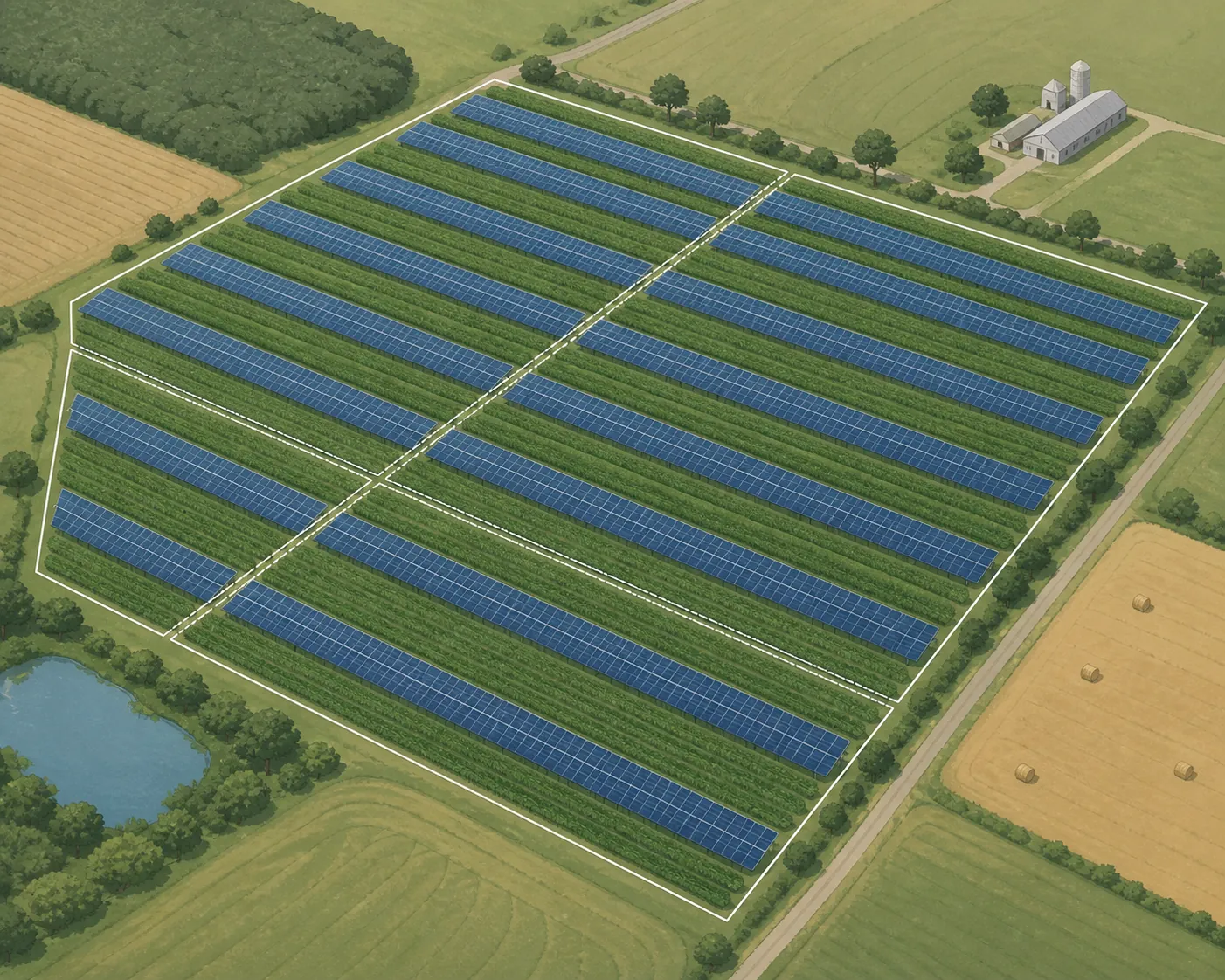
Agrivoltaics is usually described as combining agricultural production and solar generation on the same land. For permitting purposes, that description is only useful if it is translated into proof. The county planner may need a site plan. The tax assessor may need to know whether agricultural use continues at a level recognized by state law. The state pilot administrator may need program-specific agricultural evidence. A lender may need to know whether losing farmland assessment changes the project economics.
The weak file is the one that treats farming as scenery around an energy facility. The stronger file identifies the crop, grazing, or other agricultural activity; explains how the solar layout affects access, equipment, irrigation, drainage, and maintenance; and ties that evidence to the statute or ordinance that matters in the jurisdiction. The legal risk is not that every agrivoltaic project must look the same. It is that the applicant may claim dual use without satisfying the particular legal test that gives the claim consequence.
Questions to run before clearing a farmland-solar deal
A 2026 agrivoltaics diligence checklist should begin with federal status, but it should not end there. The operative questions now move quickly into state and local law:
- Which federal credit or program is the client actually relying on, and is the claimant the landowner, project company, homeowner, public entity, or another taxpayer?
- Do the relevant expenditure, construction, application, or placed-in-service dates fall before or after the federal termination or acceleration dates identified by IRS guidance?
- Is the parcel productive farmland for purposes of USDA’s August 2025 funding bar, and is any USDA-backed support part of the capital stack?
- Does the state have an enacted agrivoltaics definition, or is the project relying on a policy statement, bill draft, agency guidance, or local practice?
- If there is a pilot or solicitation, is the project inside the cap, application period, size limits, agricultural-use requirements, and agency review process?
- Will installing panels change agricultural assessment, open-space valuation, rollback-tax exposure, conservation restrictions, or other land-status treatment?
- Which approvals remain local: conditional use, site plan, building permit, electrical permit, stormwater, fire access, road use, glare, fencing, landscaping, and decommissioning?
- Has every cited bill been checked for enactment, effective date, codification, and amendments?
Those questions are deliberately unglamorous. They are also where the project will be approved, delayed, repriced, or killed. The 2025-2026 federal pullback did not end agrivoltaics, but it made project viability depend on jurisdiction-by-jurisdiction land-use law. Any claimed uniform permit path is legally unsafe.
References
- Public Law 119-21, One Big Beautiful Bill Act, Congress.gov, July 4, 2025.
- FS-2025-05, Internal Revenue Service, August 21, 2025.
- USDA Announces It Will Not Fund Solar Panels on Productive Farmland, U.S. Department of Agriculture, August 2025.
- The Use and Potential of Agrivoltaics in the United States, Kleinman Center for Energy Policy, November 3, 2025.
- Dual-Use Solar Energy Pilot Program, New Jersey Board of Public Utilities.
- Virginia 2026 statutory agrivoltaics definition, Virginia Legislative Information System, 2026.
- SB 5445, Washington State Legislature.
- AB479, Nevada Legislature.
- Renewable Energy Certainty Act, Maryland General Assembly.
- SB 683, Maryland General Assembly.
- S10011, New York State Senate.
Operationalizing workflow
No workflow has been explicitly linked to this obligation yet. See Workflows generally.
Illustrative cases
No illustrative case is currently tracked for this obligation. See Risk Digest for documented incidents generally.
← Back to RegulationReport a correction or tip
Spotted an outdated figure, a misstated fact, or a ruling this regulation entry should reflect? Public comments are disabled for this content given the professional cost of a misreported case outcome, penalty amount, or rule text — use the structured correction channel instead.
Report a correction or tip for this record →