
The State of AI Data Center Energy Legislation in Congress
- Authority
- United States Congress
- Rule type
- proposed legislation
- Jurisdiction scope
- US federal
- Source text
- Read primary rule text ↗
As of July 26, 2026, federal AI data center energy legislation is still more bill tracker than compliance program. At least eight bills in the 119th Congress target data center energy use, electricity costs, grid interconnection, disclosure, or construction, but none has been enacted, none has reached a floor vote, and the available summaries do not identify a private right of action or an agency enforcement mechanism in any of them.[1]
That does not make the bills irrelevant. It means the monitoring question has to stay narrow: if a bill advanced, what would become operationally relevant, who would have to act, and what would counsel need to watch before a procurement, utility-service, siting, or municipal-negotiation decision is made?
This article is limited to federal bills in the 119th Congress and is current through July 26, 2026. It is published in the regulation-ethics category and is not legal advice. Several bill descriptions below rely on Thompson Coburn’s June 16, 2026 law-firm summary because direct bill-text access was limited for some measures; where that is the basis, the table says so.[1]
Federal AI Data Center Energy Bills To Track
| Bill | Obligation type | Covered actor or facility | What would become monitorable | Enforcement status in available materials | Legislative status as of July 26, 2026 | Source basis |
|---|---|---|---|---|---|---|
| Ratepayer Protection Act, H.R. 6529 | Ratepayer protection / cost allocation | Utilities, data centers, and potentially ratepayers affected by data-center-related infrastructure costs | Whether data center energy infrastructure costs can be shifted to ordinary ratepayers; utility rate design and cost-recovery filings tied to large-load service | No private right of action or agency enforcement mechanism identified in available summaries | Marked up by the House Energy and Commerce subpanel on June 24, 2026; no floor vote reported[2] | CNBC for markup status; Thompson Coburn for broader federal-bill context[1][2] |
| GRID Act, S. 3852 | Mandatory off-grid generation / grid separation / public disclosure | New data centers with demand of at least 20 MW; existing facilities receive a 10-year off-ramp | Whether a facility crosses the 20 MW threshold; whether power is obtained from sources separate from the grid; utility service agreements subject to public disclosure | No private right of action or agency enforcement mechanism identified in available summaries | Introduced; no floor vote reported[1] | Thompson Coburn summary[1] |
| DATA Act, S. 3585 | Deregulatory off-grid development | Qualifying high-energy-use operations developing fully off-grid electricity systems | Whether a project qualifies for fewer federal requirements when it is fully off-grid | No private right of action or agency enforcement mechanism identified in available summaries | Introduced; no floor vote reported[1] | Thompson Coburn summary[1] |
| No Harm Data Center Act, H.R. 8033 | Cost allocation / municipal transparency | Data centers and municipal officials involved in energy-infrastructure arrangements | Whether data centers must finance the full cost of energy-infrastructure needs; whether municipal non-disclosure agreements are barred | No private right of action or agency enforcement mechanism identified in available summaries | Introduced; no floor vote reported[1] | Thompson Coburn summary; direct bill text not independently authenticated here[1] |
| AI Data Center Moratorium Act, S. 4214 | Construction moratorium | New data center construction covered by the proposed federal pause | Whether new construction would be paused at the federal level | No private right of action or agency enforcement mechanism identified in available summaries | Introduced; no floor vote reported[1] | Thompson Coburn summary[1] |
| PRICE Act, H.R. 6983 | Ratepayer / price-impact concern | Facilities and energy arrangements implicated by data-center-related electricity cost impacts | Potential rate or price protections connected to data center load growth | No private right of action or agency enforcement mechanism identified in available summaries | Introduced; no floor vote reported[1] | Thompson Coburn summary; direct bill text not independently authenticated here[1] |
| Data Center Transparency Act, H.R. 6984 | Transparency and disclosure | Data centers or related public bodies covered by the proposed disclosure regime | Information that would need to be disclosed about data center energy use or impacts | No private right of action or agency enforcement mechanism identified in available summaries | Introduced; no floor vote reported[1] | Thompson Coburn summary[1] |
| Data Center Community Impact Act, H.R. 7858 | Community and environmental impact disclosure | Data center projects with community or environmental impacts covered by the proposal | Community-impact information that would need to be reviewed or disclosed before or during development | No private right of action or agency enforcement mechanism identified in available summaries | Introduced; no floor vote reported[1] | Thompson Coburn summary; direct bill text not independently authenticated here[1] |
The Status Distinction Matters More Than The Bill Count
A large legislative pile can still produce no present federal compliance obligation. The cleanest current distinction is this: H.R. 6529 has moved beyond introduction through a House Energy and Commerce subpanel markup; the other bills identified in the available materials remain introduced measures without a reported floor vote; none is enacted.[1][2]
The Ratepayer Protection Act therefore deserves separate treatment. A markup is not enactment, and it does not impose obligations on operators or utilities by itself. But it is a procedural signal that the bill has received committee-level attention in a way the rest of this group has not. For counsel, that makes H.R. 6529 the first item to check in a weekly federal tracker, especially for clients negotiating utility service, load-serving arrangements, or public-utility-commission positions around data center infrastructure costs.
The practical question is not whether Congress is worried about AI load growth. The bills already answer that. The question is whether a proposal would turn that concern into a rule about payment, disclosure, facility design, construction timing, or government secrecy. On that measure, the bills do not point in one direction.
The Proposed Obligations Fall Into Four Usable Buckets
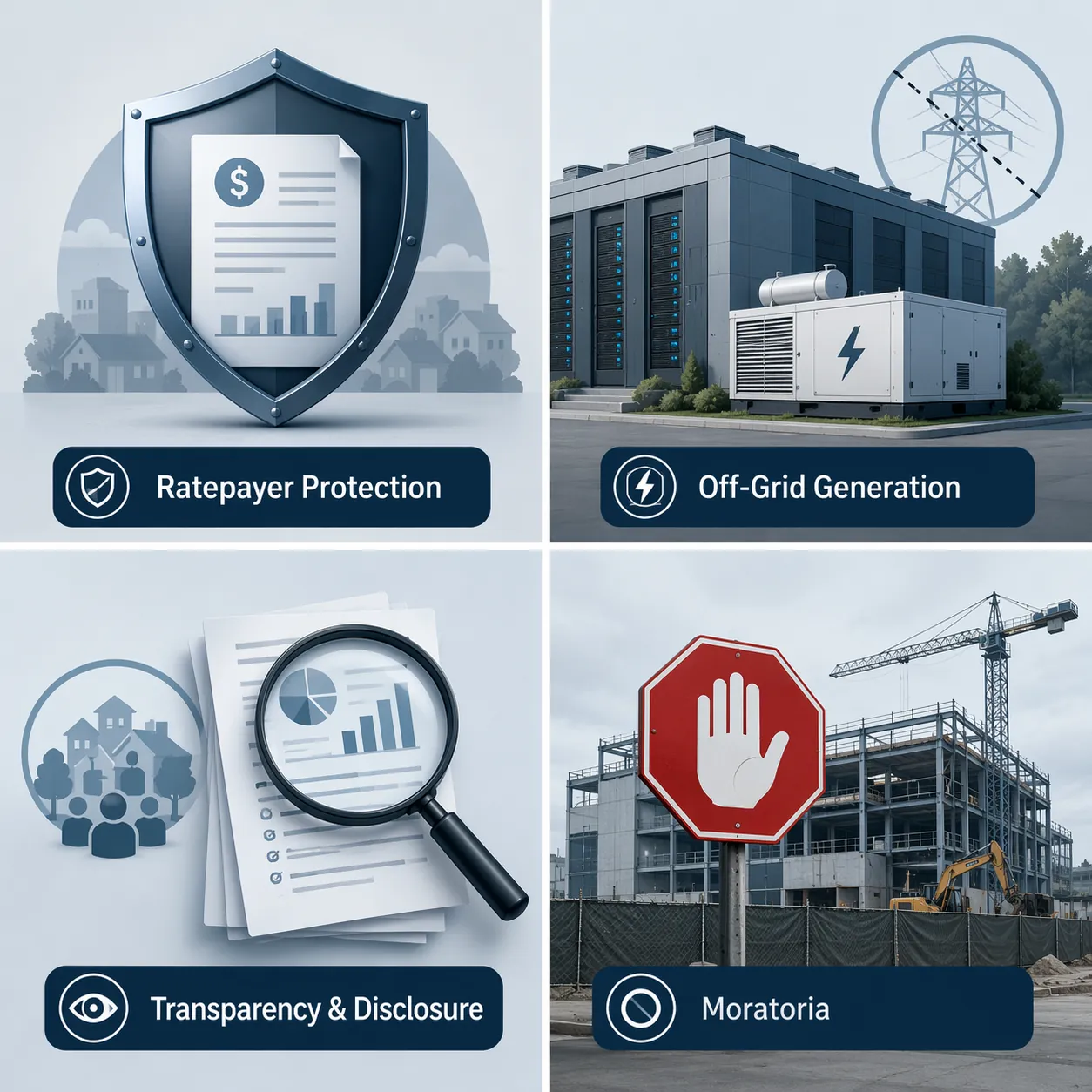
For monitoring purposes, the bills are easier to understand by obligation type than by political label. A utility lawyer, a data center developer, a municipal attorney, and an in-house disclosure team would not read the same bill the same way. The operative exposure depends on what the bill would make someone do.
Ratepayer Protection And Cost Allocation
The Ratepayer Protection Act, the PRICE Act, and the No Harm Data Center Act sit closest to the cost-allocation problem. Their shared concern is not simply that data centers use large amounts of electricity. It is that grid upgrades, generation commitments, transmission investments, or negotiated service arrangements could leave ordinary customers bearing costs associated with new high-load users.[1][2]
H.R. 6529 is the bill to watch first in this category because it is the only identified measure to have advanced beyond introduction. CNBC reported that the House Energy and Commerce subpanel marked it up on June 24, 2026, making it the first data center energy bill in this group to move past introduction in the 119th Congress.[2]
If a ratepayer-protection bill advanced, the monitorable events would likely appear in places that already matter to energy counsel: utility tariffs, large-load service agreements, rate cases, infrastructure cost-recovery proposals, and public statements about who pays for new capacity. That is why the issue reaches beyond hyperscalers. A utility may be the regulated entity making the filing, a data center may be the load driving the need, and residential or commercial ratepayers may be the political constituency named in the bill.
The No Harm Data Center Act is more pointed on secrecy. Thompson Coburn describes H.R. 8033 as requiring data centers to finance the full cost of their energy-infrastructure needs and prohibiting non-disclosure agreements with municipal officials.[1] If that approach moved, legal review would not stop at the power contract. It would reach municipal-side confidentiality terms, public-records posture, and the paper trail around economic-development negotiations.
Off-Grid Generation And Grid Separation
The GRID Act is the most operationally specific of the pending restriction-style bills identified in the research materials. Thompson Coburn describes S. 3852 as requiring new data centers with demand of at least 20 MW to obtain power from sources separate from the grid, while giving existing facilities a 10-year off-ramp.[1]
That 20 MW threshold matters because it gives counsel something concrete to map against a project pipeline. A facility below the threshold would present a different monitoring profile than a new campus designed above it. Existing facilities would raise a separate question: what counts as existing, what changes would preserve or disturb that status, and how the 10-year off-ramp would be measured if the bill text advanced in its current form.
The GRID Act also stands out because it is described as including a mandatory public-disclosure mechanism for utility service agreements.[1] That is not the same kind of obligation as an off-grid power requirement. It would make private contracting arrangements visible, potentially before the parties have resolved siting, cost allocation, or community-relations strategy. For operators and utilities, that disclosure feature may be as important as the grid-separation concept.
The DATA Act points in the other direction. Rather than imposing an off-grid mandate, Thompson Coburn describes S. 3585 as allowing qualifying high-energy-use operations to develop fully off-grid electricity systems subject to fewer federal requirements.[1] It is therefore not just another AI energy restriction. It is the deregulatory counterpoint in the federal set: a proposal that treats off-grid development as a route to reduced federal friction rather than as a compulsory separation from the grid.
Transparency, Environmental Disclosure, And Community Impact
The Data Center Transparency Act and the Data Center Community Impact Act belong in the disclosure bucket. The available descriptions are less detailed than the GRID Act’s 20 MW trigger or the No Harm Data Center Act’s municipal NDA provision, so the safer reading is narrow: these bills would make data center energy, environmental, or community-impact information more visible if they advanced, but the precise reporting cadence, covered entities, and reviewing authority should be checked against bill text as it becomes available.[1]
Disclosure bills change the legal work even before they create penalties. They can affect diligence questions, board reporting, local-government communications, and claims made in public-facing sustainability materials. A proposed disclosure obligation is not an enforcement program, but it identifies the information Congress may later decide should be collected, compared, and made public.
Moratoria
The AI Data Center Moratorium Act is the bluntest proposal in the set. Thompson Coburn describes S. 4214 as a federal pause on new data center construction, and the available materials do not report advancement beyond introduction.[1]
For a project team, a moratorium bill is easy to overread and dangerous to ignore. It does not stop construction today. If it moved, however, the immediate questions would be timing, grandfathering, definitions of new construction, and whether expansions of existing facilities are treated differently from greenfield projects.
What Is Not In Place Yet
The current federal record does not support a statement that Congress has regulated AI data center energy consumption. It supports a narrower statement: members of Congress have introduced multiple bills that would regulate or otherwise reshape energy arrangements for AI and data center load, and one of those bills has received subcommittee markup.[1][2]
The same record also does not support treating the subject as dormant. A bill that has not passed can still affect diligence, lobbying strategy, public-utility-commission positioning, municipal negotiations, and contract drafting if it identifies a policy direction that may become live after the next procedural step.
Two gaps matter most for enforceability. First, none of the identified bills is federal law. Second, the available materials do not identify a private right of action or an agency enforcement mechanism in any of them.[1] Those gaps should be stated plainly in any client alert or partner briefing. They are the difference between a legislative risk and a compliance deadline.
Parallel Tracks: FERC And The States
Congress is not the only place where large-load energy issues are moving. Brookings notes that FERC issued a June 2026 order on grid interconnection for large loads, creating a regulatory track outside the pending federal bills.[3] That is a separate monitoring lane: it can matter to interconnection and grid planning even if none of the eight congressional bills becomes law this quarter.
State activity is the other lane. Thompson Coburn and Troutman Pepper Locke both report that 27 states are advancing their own data center or related energy legislation, while also describing federal policymaking as constrained by election-year caution.[1][4] The state count should not be folded into the federal bill count, but it does explain why a purely federal tracker will miss part of the risk picture.
For now, the defensible posture is not to announce a federal AI data center energy statute that does not exist, and not to wait for one before tracking the details. Through the 2026 midterms, the useful work is bill by bill and jurisdiction by jurisdiction: H.R. 6529 for markup movement, S. 3852 for operational specificity, H.R. 8033 for cost and municipal-confidentiality provisions, S. 3585 for the deregulatory off-grid counterpoint, and the remaining disclosure and moratorium bills for signs that their broad concepts are being converted into enforceable text.
References
- Congress Struggles With Data Center Policy, Thompson Coburn, June 16, 2026.
- AI data centers tech companies Congress energy costs, CNBC, June 24, 2026.
- Global energy demands within the AI regulatory landscape, Brookings.
- Federal and State Policymakers Target AI Data Centers as Electricity Costs and Grid Reliability Concerns Mount, Troutman Pepper Locke.
Operationalizing workflow
No workflow has been explicitly linked to this obligation yet. See Workflows generally.
Illustrative cases
No illustrative case is currently tracked for this obligation. See Risk Digest for documented incidents generally.
← Back to RegulationReport a correction or tip
Spotted an outdated figure, a misstated fact, or a ruling this regulation entry should reflect? Public comments are disabled for this content given the professional cost of a misreported case outcome, penalty amount, or rule text — use the structured correction channel instead.
Report a correction or tip for this record →