
The legal risk behind AI data center overinvestment
- Authority
- U.S. Securities and Exchange Commission
- Rule type
- statute
- Jurisdiction scope
- US federal
- Source text
- Read primary rule text ↗
Disclose material off-balance-sheet SPV debt, lease commitments, and residual value guarantees in capital-raising and periodic filings.
The first legal question in AI data center overinvestment is no longer whether the market will someday decide that too many megawatts, GPUs, leases, and buildings were ordered at once. Courts are now being asked a narrower question: when companies raised capital during the buildout, did their filings let investors see the commitments that would still be there if the revenue curve arrived late?
Three complaints filed in January and February 2026 mark the opening securities-litigation map. The Oracle shareholder class action was filed on February 5, 2026, in the District of Delaware, with a June 12 to December 16, 2025 class period and claims under Sections 10(b) and 20(a). The Oracle bondholder suit, Ohio Carpenters’ Pension Plan v. Oracle, was filed on January 14, 2026, in New York Supreme Court and targets Oracle’s September 2025 bond offering. Masaitis v. CoreWeave was filed on January 12, 2026, in the District of New Jersey, No. 26-cv-00355.[1][2]
| Case | Court and filing date | What the complaint puts at issue | Current posture to keep in view |
|---|---|---|---|
| Oracle shareholder class action | District of Delaware; February 5, 2026 | FY2026 capex projection, negative free cash flow, and alleged statements to equity investors | Pleading stage; D&O Diary cautions it reads more like a mismanagement case |
| Ohio Carpenters’ Pension Plan v. Oracle | New York Supreme Court; January 14, 2026 | September 2025 bond offering documents, debt load, lease commitments, and credit-watch context | Pleading stage; offering-document theory |
| Masaitis v. CoreWeave | District of New Jersey; January 12, 2026 | Early AI infrastructure securities filing identified in the same wave | At or before motion-to-dismiss stage on the available record |
That posture matters. These are complaints, not findings. They do not establish that the AI data center buildout is irrational, that Oracle or CoreWeave is liable, or that any particular off-balance-sheet structure is unlawful. They do show that plaintiffs have found a disclosure theory that is different from the usual “AI-washing” complaint. The alleged problem is not that a company exaggerated a model’s intelligence or the magic of automation. It is that investors allegedly could not see enough of the cost, timing, financing, or contingent obligations attached to the infrastructure being built to supply AI demand.

The Oracle equity complaint starts with capex and cash flow
The Oracle shareholder action is the easier one to overread, and also the one that should be handled with the most discipline. The complaint alleges that Oracle projected FY2026 capital expenditures of $50 billion, compared with a September 2025 projection of $35 billion, and that the company reported negative free cash flow exceeding $10 billion in its December 10, 2025 quarter.[1]
Those figures give plaintiffs a clean story: management allegedly knew, or should have told investors more clearly, that the AI infrastructure push was consuming cash faster than revenue could absorb. But a clean story is not the same thing as a securities claim that survives dismissal. D&O Diary’s caveat is useful precisely because it is unsentimental: the Oracle shareholder complaint “reads more like a mismanagement case” and may be premature.[1]
That distinction is not academic. Securities law does not punish a large capital program merely because it later looks aggressive. A complaint has to tie alleged misstatements or omissions to what investors were told, when they were told it, and why the undisclosed facts made those statements misleading. If the allegation collapses into “the company spent too much,” defendants will try to put it back in the box labeled business judgment.
The bondholder case is closer to the filing mechanics
The Oracle bondholder complaint has a different center of gravity. It concerns an $18 billion September 2025 bond sale and alleges that the offering documents were materially false and misleading. Quinn Emanuel’s account of the complaint says Oracle’s total debt exceeded $130 billion, that it had $248 billion in new lease commitments, and that S&P and Moody’s placed Oracle on negative credit watch.[2]
For disclosure lawyers, the offering date is the hinge. A purchaser of newly issued debt is not just reacting to a market narrative about AI infrastructure. The investor is buying a security under a specific set of offering materials, with debt service, lease commitments, liquidity, and credit ratings all bearing directly on the risk being underwritten. The question becomes less atmospheric: what did those bond documents say about the company’s obligations at the moment investors lent the money?
That is why the bondholder suit is likely to be watched beyond Oracle. Equity plaintiffs often have to fight over optimism, loss causation, and whether bad spending decisions were recast as fraud after the fact. Offering-document cases can be more mechanical. If a plaintiff can point to a liability, commitment, contingent exposure, ratings fact, or omitted concentration that should have appeared differently in a debt offering, the argument begins closer to the document itself.
The structure plaintiffs will keep returning to: SPVs, leases, guarantees
The more important legal development is not any single complaint. It is the financing architecture around the AI data center buildout. Quinn Emanuel reported on March 13, 2026, that hyperscalers moved more than $120 billion of data center spending off balance sheets in roughly 18 months through bankruptcy-remote special-purpose vehicles.[2]
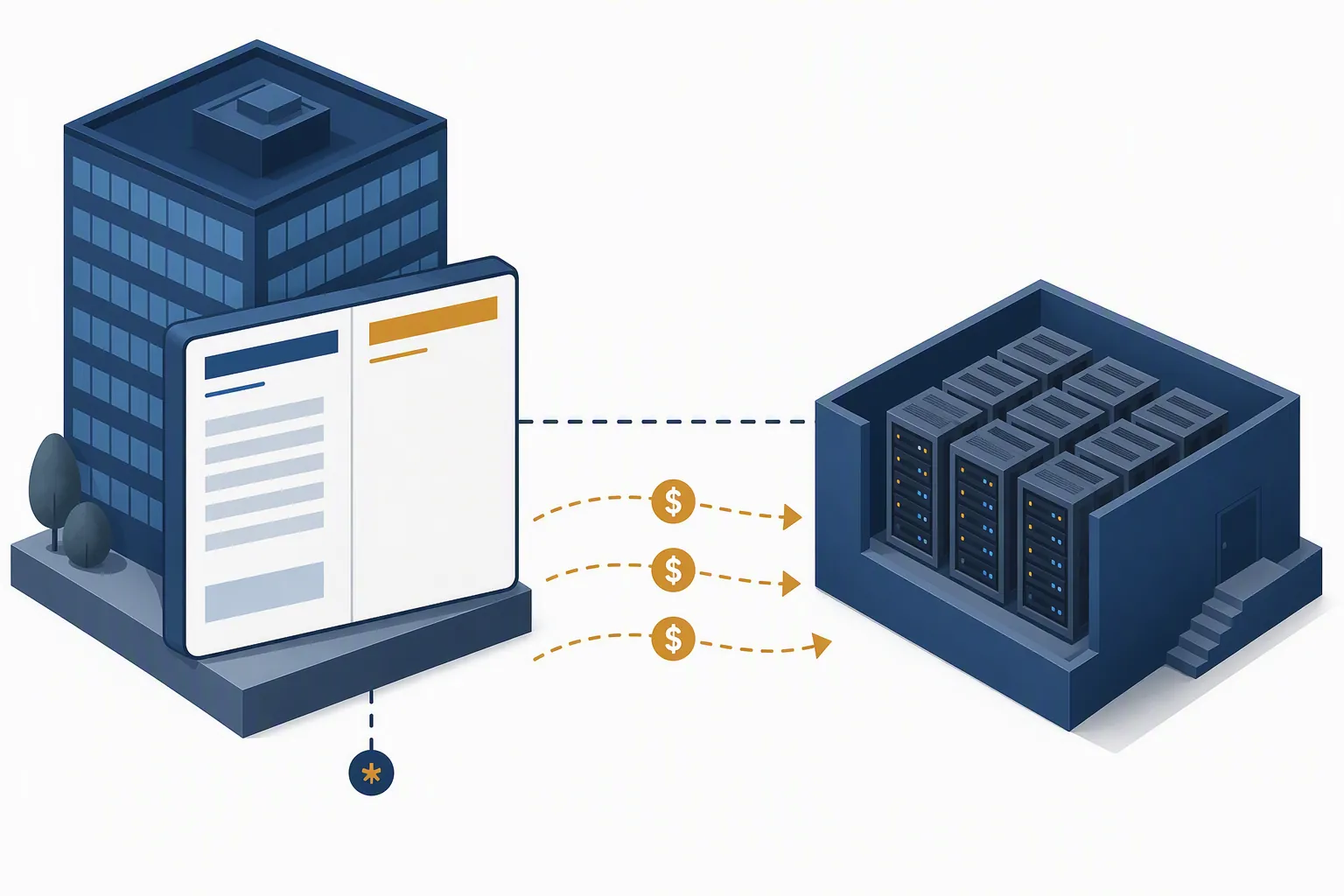
The point of such a structure is not mysterious. A corporate parent can support a massive facility through contracts, leases, purchase commitments, or guarantees while the project debt sits at an SPV. Bankruptcy remoteness and non-recourse finance may be commercially rational. They also produce the exact disclosure problem that future complaints will exploit: the economic exposure may matter to investors even when the accounting presentation does not put the full amount on the parent’s balance sheet.
Meta’s Beignet Investor SPV is the clearest example in the available record. According to Quinn Emanuel, Beignet Investor raised $30 billion for the Hyperion facility, with about $27 billion in loans not appearing as Meta liabilities. Meta’s residual value guarantee of up to $28 billion appears only in footnotes and does not appear as a balance-sheet liability.[2]
That footnote is where the legal risk becomes concrete. A residual value guarantee is not the same thing as ordinary capex, and it is not the same thing as recognized debt. It is a promise that can become economically important if the underlying asset is worth less than expected at the relevant time. In an AI data center, that risk is not fanciful: the asset depends on power availability, tenant demand, chip cycles, utilization, cooling design, and the durability of AI workloads. None of that means the guarantee will be triggered. It means a plaintiff will ask why such a large contingent obligation was not made more prominent when investors assessed leverage and liquidity.
The plaintiffs’ bar does not need the phrase “AI bubble” to make that allegation work. It needs a mismatch. On one side: public statements about capacity, demand, or financing flexibility. On the other: lease obligations, SPV support, residual value guarantees, or purchase commitments that allegedly make those statements incomplete. The larger and more footnote-dependent the obligation, the easier it is for a complaint to tell that story.
Why a footnote-only guarantee invites a different reading
Footnote disclosure can be legally adequate. The securities laws do not require every risk to be printed in red on the first page of a filing. But materiality litigation is rarely kind to the argument that sophisticated investors should have assembled a company’s true exposure by triangulating a balance sheet, lease note, related-party section, risk factor, and project-finance footnote while management described the same buildout in cleaner operational terms.
That is why the legal implications deserve more attention than the word “overinvestment” itself. The issue may arise before the economics are settled. A company can believe, reasonably, that long-term AI demand will fill the capacity. It can also face a disclosure challenge if its filings make the downside path hard to reconstruct.
Credit analysts are already adjusting the lens
The securities complaints are not developing in isolation. Moody’s announced a plan to adjust credit ratings for understated lease liabilities in the data center sector.[3] That is not a judicial finding and not a plaintiff victory. It is still significant because ratings methodology can validate the practical concern behind the complaints: obligations may be economically debt-like even when they are not presented as headline balance-sheet debt.
Once a ratings agency changes how it treats lease liabilities, defendants lose some room to argue that only litigators care about the presentation. Credit analysts care because lease-adjusted leverage changes the answer to ordinary underwriting questions. How much fixed payment capacity is already spoken for? How much debt-like exposure sits outside the debt line? How much cash has to arrive from AI workloads before the structure feels conservative rather than stretched?
For D&O officers and disclosure committees, the lesson is not to ban SPVs or guarantees. It is to test whether a reader can understand the company’s real exposure without performing a forensic consolidation exercise. If the business depends on a structure being respected for accounting purposes, the risk disclosure should still explain what happens economically if demand, residual values, refinancing markets, or tenant utilization disappoint.
CoreWeave is an early marker, not yet a detailed template
Masaitis v. CoreWeave belongs in the map because it was filed in the same January 2026 window, in the District of New Jersey, and Quinn Emanuel identifies it as part of the emerging AI infrastructure litigation wave.[2] On the source record available here, it should not be made to carry more than that.
That restraint is useful. A litigation trend is not stronger because every filing is forced into the same template. The Oracle complaints currently provide the richer detail on capex, free cash flow, debt issuance, lease commitments, and credit-watch context. CoreWeave’s role, for now, is to show that plaintiffs were not looking only at one issuer. They were looking at AI infrastructure companies and the financing pressure around their growth stories.
This is not just AI-washing
AI-washing cases usually challenge what a company said about its AI capabilities, adoption, product sophistication, or revenue impact. The data center cases point elsewhere. They ask whether the company understated the obligations incurred to build the physical substrate for AI: campuses, power, servers, cooling, leases, SPVs, guarantees, and debt.
That shift matters for pleading. Capability claims often turn on whether the company’s product did what executives implied it could do. Infrastructure-risk claims can turn on documents: offering memoranda, lease tables, commitments and contingencies notes, cash-flow statements, risk factors, and ratings disclosures. The relevant actor is not only the executive who praised demand on an earnings call. It is also the team that decided where a guarantee appeared and whether the offering document made the burden legible.
The theory will still face the usual defenses. Companies will argue that risks were disclosed, that investors knew AI infrastructure required extraordinary spending, that forward-looking statements were protected, that the alleged omissions were immaterial, and that market losses reflected changing expectations rather than fraud. Those arguments may succeed. The present point is narrower: plaintiffs have found a filing-based route into the AI buildout.
The market backdrop explains why plaintiffs are looking here
The macro numbers are large enough to attract complaint drafting, but they should not be mistaken for proof. Quinn Emanuel cites about $400 billion in projected AI infrastructure capex versus roughly $60 billion in AI revenue in 2025.[2] It also cites $5.2 trillion in projected infrastructure investment by the end of the decade.[2] Other projections in the market differ: McKinsey, as reported through Chamberlain and The New York Times, has cited $7 trillion by 2030, while Bloomberg/EnergyNow has cited $3 trillion.[2]
Those gaps and ranges do two things. They give plaintiffs a narrative of possible overbuild, and they give defendants a narrative of a still-forming supercycle. KKR and other institutional investors have argued that long-term AI infrastructure demand can justify the present activity. That view is not a litigation footnote; it is part of the reason courts should be careful before treating aggressive buildout as inherently suspect.
A court does not have to decide the supercycle debate to decide a disclosure motion. It can ask whether the complaint pleads a misleading statement or omission with the required specificity. That is the discipline missing from much of the public “bubble” discussion. The securities-law question is not whether the capital cycle feels excessive. It is whether investors were told enough about the commitments that would make excess painful if the cycle turned.
The broader securities docket supplies the incentive. Dechert reported that 2025 securities class action aggregate investor losses reached a record $694 billion, and that AI-related filings rose from 15 to 16 cases, with AI-washing claims growing in sophistication.[4] Skadden, citing Cornerstone Research, reported 161 new securities class actions filed through September 30, 2025, and described AI-related securities claims as outpacing other categories.[5]
Old analogies, limited uses
The available analogies are serious but not predictive. Quinn Emanuel points to post-2008 RMBS putback litigation recovering more than $36 billion, Moody’s $864 million DOJ settlement, and Enron-era SPV recharacterization and veil-piercing theories as precedent context for how structured obligations can become litigation targets in distress.[2]
Those examples should be used carefully. RMBS litigation involved different assets, contracts, representations, and market failures. Enron is too often invoked as a shortcut for any off-balance-sheet structure someone dislikes. The better use of those precedents is modest: they show that when investors later believe risk was housed in entities or instruments they did not adequately understand, litigation often tries to pull those structures back into the issuer’s story.
That is enough to matter for disclosure practice. If a bankruptcy-remote entity owns the facility, if a parent’s obligation appears as a guarantee rather than debt, or if a lease commitment expands faster than recognized revenue, the filing has to do more than satisfy a classification rule. It has to survive the later reader: the bondholder holding the offering memorandum after a downgrade, the equity plaintiff comparing capex guidance to free cash flow, the credit analyst reconstructing adjusted leverage.
Where the exposure is forming now
For companies financing AI data centers, the immediate legal exposure is forming in a few predictable places:
- Capex guidance that changes materially while management continues to describe demand or backlog in confident terms.
- Negative free cash flow that makes the timing gap between infrastructure spending and AI revenue visible.
- Debt offerings where lease commitments, ratings pressure, liquidity, or contingent support obligations are central to repayment risk.
- SPV arrangements that remove project debt from the parent’s balance sheet while leaving the parent economically exposed through leases, guarantees, or support agreements.
- Residual value guarantees that appear in footnotes but may be large enough to alter how investors assess leverage, downside exposure, or asset-risk transfer.
None of these items is automatically a securities violation. Each becomes dangerous when the disclosure gives investors a fragmented picture: one section shows manageable debt, another contains large lease commitments, a footnote holds the guarantee, and the business discussion emphasizes demand without explaining what happens if that demand is delayed or repriced.
The discipline for 2026 filings is therefore practical. If the company’s AI infrastructure exposure would look different after consolidating SPV debt, lease commitments, and residual value guarantees for credit-analysis purposes, the disclosure should not require investors to discover that difference by accident. If the business case depends on long-duration demand, the risk factor should identify the obligations that mature, persist, or become burdensome before that demand is fully monetized.
The Oracle and CoreWeave complaints do not prove AI data center overinvestment. They do not prove liability. At the present stage, they are a roadmap of plaintiff theories around capex, leases, SPVs, offering documents, and footnote-only guarantees. That is already enough to change how the next filing should be read.
References
- Oracle Shareholder Suit Over AI Data Center Spending, D&O Diary, February 2026.
- AI Data Centers and the Coming Litigation Wave, Quinn Emanuel, March 13, 2026.
- Moody’s plan to adjust credit ratings for understated lease liabilities in the data center sector, Moody’s, January 16, 2026.
- 2025 Securities Class Action Aggregate Investor Losses and AI-Related Filings, Dechert, March 25, 2026.
- 2026 Insights: AI-Related Securities Claims and Cornerstone Research Filing Data, Skadden, 2026.
Operationalizing workflow
No workflow has been explicitly linked to this obligation yet. See Workflows generally.
Illustrative cases
No illustrative case is currently tracked for this obligation. See Risk Digest for documented incidents generally.
← Back to RegulationReport a correction or tip
Spotted an outdated figure, a misstated fact, or a ruling this regulation entry should reflect? Public comments are disabled for this content given the professional cost of a misreported case outcome, penalty amount, or rule text — use the structured correction channel instead.
Report a correction or tip for this record →