
AI Literacy in Schools Becomes a Legal Requirement
- Authority
- State legislatures
- Rule type
- statute
- Jurisdiction scope
- US state
- Source text
- Read primary rule text ↗
Adopt board AI policy, designate coordinator, integrate AI literacy into curriculum, implement human-review rules, restrict procurement, and provide parent notice.
For school districts, the legal question around AI literacy in schools is no longer whether a superintendent wants a pilot, a teacher wants a chatbot policy, or a curriculum director wants a digital citizenship unit. As of Q3 2026, the compliance calendar is filling with state requirements: board-approved AI policies, named coordinators, standards revisions, human-review rules, procurement constraints, parent-facing rights, and, in Tennessee, private litigation exposure tied to AI mental-health screening tools.
This is a Regulation & Ethics obligations tracker, not legal advice. It is limited to the sources identified below and to state K-12 AI-literacy and school-AI policy materials available as of July 25, 2026. The most important distinction is between legislative activity and enforceable law. MultiState counted 134 AI-in-education bills across 31 states as of April 2026; FutureEd separately tracked 77 instruction-focused AI-in-education bills in 27 states; Novo Innovative Pathways reported 27 states with active K-12 AI bills and five signed into law by mid-2026.[1][2][3] Those counts show velocity. District counsel still have to ask the narrower question: which duty is enacted, who owns it locally, and when must evidence of compliance exist?
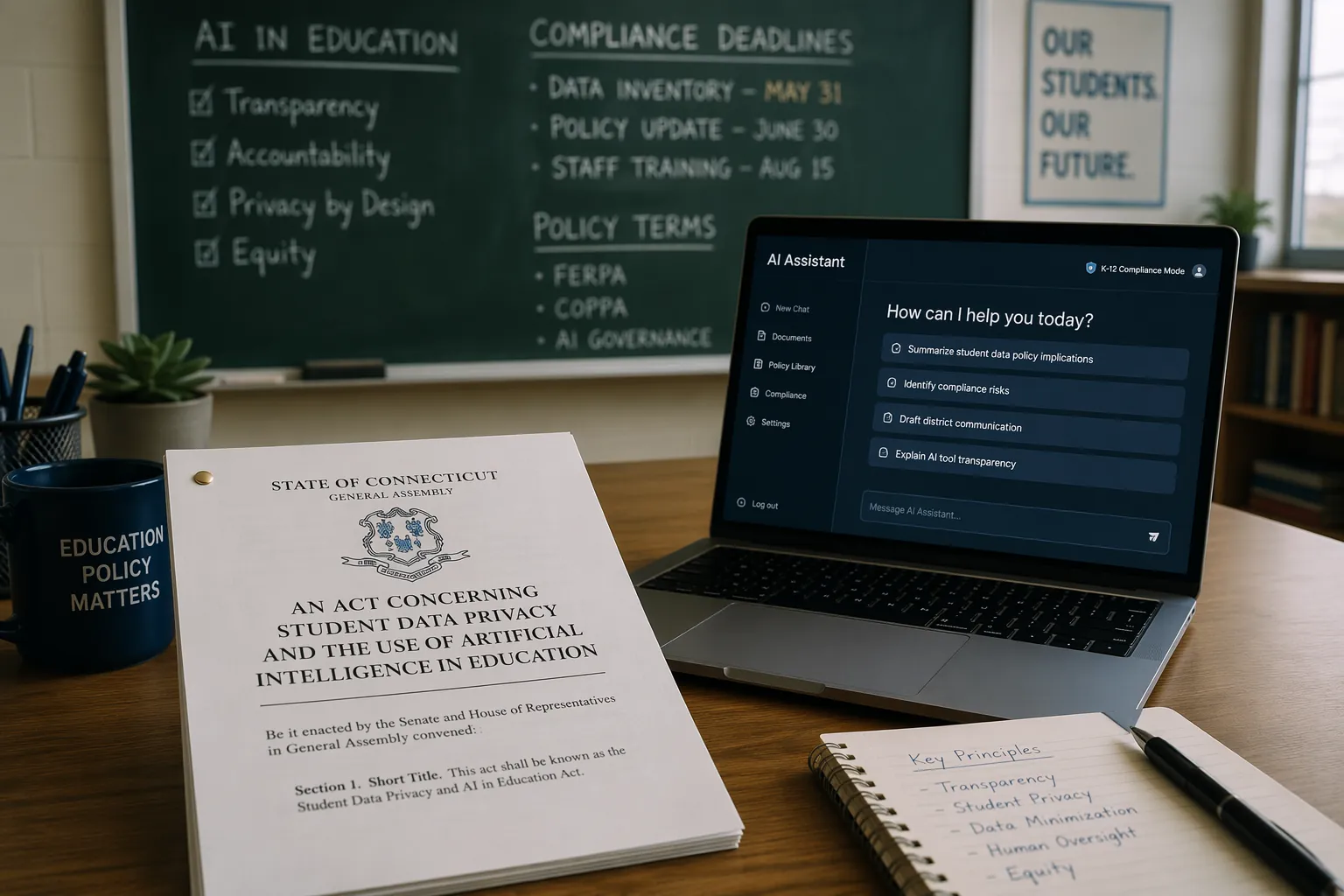
State obligations now on the district calendar
The enacted measures do not all use the same mechanism. Some move through curriculum standards. Some require local board policy. Some assign a state or district governance role. Some regulate a specific class of AI tool. That matters because the implementation file will sit in different places: board agenda management, curriculum adoption, technology procurement, student services, parent communications, or litigation hold procedures.
| Jurisdiction | Current posture | District-facing obligation | Date, actor, or legal hook | Primary source |
|---|---|---|---|---|
| National tracker universe | Active legislative field | AI-in-education bills include instruction, governance, procurement, student safety, and school policy measures | 134 bills across 31 states as of April 2026; 77 instruction-focused bills in 27 states in FutureEd’s tracker | [1][2] |
| Idaho | Enacted law identified in trackers | AI framework, data privacy, and AI literacy standards | Implementation requires alignment among curriculum, privacy, and technology review functions | [2][3] |
| Oklahoma | Enacted law identified in trackers | Responsible Technology in Schools Act obligations, including human-in-the-loop concepts, limits on AI high-stakes decisions, and district AI policies | District policies required by the 2027-28 school year | [2][3] |
| Maryland | Enacted law identified in trackers | AI coordinator mandate, statewide collaborative, and AI literacy in standards | AI literacy standards deadline by June 2027 | [2][3] |
| Ohio | Enacted budget/policy requirement identified by state school-board coverage | Board-approved AI policy requirement for public school districts | Applies across more than 600 districts | [4] |
| Utah | Enacted law identified in trackers | AI literacy inserted into grade 7/8 digital skills instruction | Curriculum and instructional materials review rather than a stand-alone AI course mandate | [2][3] |
| Tennessee | Enacted law identified in trackers | Private right of action connected to AI mental-health screening tools | Liability-facing provision; requires counsel review before procurement or deployment | [2][3] |
| Colorado | Removed backstop | Repeal of the Colorado AI Act changed the state-law risk landscape for school AI deployments | May 2026 repeal noted as a boundary condition for districts that had treated the act as an external governance floor | [1][2] |
The table is deliberately conservative. It does not treat every introduced bill as a district duty, and it does not treat every AI-in-education statute as an AI-literacy statute. For a district office, that distinction is not academic. A bill may justify monitoring. An enacted board-policy requirement changes the agenda calendar. A private right of action changes the risk memo before a tool is purchased.
The policy duty arrives before the instructional year
The easiest date to underestimate is Oklahoma’s 2027-28 district policy obligation. A requirement that takes effect in a school year is not a summer drafting project. A board-approved AI policy usually has to pass through cabinet review, counsel review, technology and curriculum input, bargaining or meet-and-confer considerations where applicable, public agenda posting, board readings, administrative regulation drafting, and staff training.
Ohio presents the same problem at scale. Education Week identifies Ohio among the states requiring school AI policies, and state school-board coverage has described the requirement as reaching more than 600 districts.[4] The legal work is not just writing a model policy. Each district must decide who may approve AI tools, whether employees may enter student information into public systems, how students receive notice of permitted and prohibited use, how suspected misuse affects discipline or academic integrity, and what records must be preserved when a parent challenges an AI-assisted decision.
A defensible policy file should show more than adoption. It should show the district considered student data, accessibility, discrimination risk, academic integrity, employee use, procurement approval, parent communications, and complaint routing. If the policy is later challenged, the district will not want the only exhibit to be a one-page generative AI statement copied into the student handbook.
Coordinator mandates and standards deadlines create institutional handoffs
Maryland’s approach is important because it assigns governance work before the classroom materials are fully settled. The law identified in the legislative trackers includes an AI coordinator mandate, a statewide collaborative, and AI literacy in standards by June 2027.[2][3] That combination creates several handoffs: state standard-setting to local curriculum offices, coordinator guidance to district technology teams, and district implementation back to board oversight.
The word “coordinator” can make the requirement sound light. It is not light if the role carries responsibility for tool inventories, staff guidance, parent notices, vendor review, incident escalation, and documentation. Districts that place the role inside instructional technology may gain classroom fluency but lose legal review. Districts that place it in compliance may gain control but lose adoption intelligence. The more durable answer is usually a named owner with an interdepartmental workflow, not an honorific title added to an already full job description.

Idaho’s framework, privacy, and literacy mix points in the same direction. Once AI literacy is linked to data privacy, the implementation file no longer belongs only to curriculum. The district has to connect classroom use with student-data governance, vendor terms, retention practices, and restrictions on inputting personally identifiable information into systems that were never reviewed as education records vendors.
Human-in-the-loop rules are only useful if someone knows who the human is
Oklahoma’s Responsible Technology in Schools Act is the clearest example of a familiar statutory phrase becoming an operational problem. Human-in-the-loop rules and limits on AI high-stakes decisions sound sensible on paper.[2][3] In practice, a district has to define the covered decisions, the reviewer’s authority, the documentation trail, and the point at which AI output becomes part of the student record.
A high-stakes decision is not limited to final expulsion, graduation, or placement decisions if the AI tool meaningfully shapes the path to that outcome. A risk flag, plagiarism score, behavioral alert, mental-health screen, special education recommendation, or automated translation used in a disciplinary investigation can become legally significant even if an employee later signs the form. A human-in-the-loop provision should therefore answer four questions before the first complaint arrives: who reviews the AI output, what source material they can inspect, what discretion they retain, and how the district records disagreement with the tool.
The same issue appears in AI-literacy instruction. Utah’s grade 7/8 digital skills insertion gives districts a curricular hook for teaching students how AI systems work and where their limits are.[2][3] But if the district’s own discipline, assessment, or monitoring systems use AI in ways teachers cannot explain, the instructional message and the governance file will diverge quickly.
Procurement is where uneven capacity becomes a legal risk
ExcelinEd’s May 2026 analysis makes one of the more practical points in the policy debate: state AI requirements can widen the burden between districts that have procurement, privacy, and technology staff and districts that do not.[5] The statute may apply evenly. The ability to vet tools, negotiate vendor terms, train staff, and monitor compliance does not.
That disparity matters because school AI tools do not enter districts only through formal enterprise contracts. They enter through free teacher accounts, browser extensions, curriculum supplements, assessment platforms, student-support products, and vendor features added to systems the district already uses. A district can adopt an AI policy and still have unreviewed AI functions operating in classrooms, counseling workflows, transportation communications, or student information exports.
The Ohio School Boards Association has framed “shadow AI” as a legal risk for schools, including pathways tied to employee use of tools outside approved systems.[6] That risk is not cured by an AI-literacy curriculum. It is controlled, if at all, through an inventory requirement, purchasing rules, staff training, contract review, and a reporting path for tools already in use.
| Compliance function | District question | Evidence to preserve |
|---|---|---|
| Board policy | Has the board adopted a policy that covers student use, employee use, approved tools, prohibited inputs, and complaint routing? | Agenda packet, adopted policy, administrative regulations, legal review notes |
| AI coordinator or owner | Who is responsible for implementation, inventory, training, escalation, and state reporting where required? | Designation memo, role description, committee minutes, implementation calendar |
| Curriculum and standards | Where is AI literacy taught, and how is it aligned to state digital skills or academic standards? | Curriculum maps, lesson adoption records, training materials |
| Human review | Which AI-assisted decisions require human review, and what authority does the reviewer retain? | Decision protocols, review forms, audit logs, appeal records |
| Procurement and privacy | Can a vendor receive student data, train models on district inputs, change features, or retain records after contract termination? | Vendor terms, data privacy agreements, security review, approved-tool list |
| Parent and student rights | Do parents or students receive notice, opt-out rights where present, or a route to challenge an AI-assisted action? | Notices, consent or opt-out forms, complaint records, translations |
| Training | Have employees and students been trained on permitted uses and prohibited disclosures? | Attendance records, modules, acknowledgments, refresher schedule |
Training deserves its own line in the file because adoption and understanding are different things. The MIT Teaching Systems Lab guide, cited through WINSS Solutions, reports that fewer than half of students and teachers had received AI training.[7] A district that permits AI tools but cannot show training will be poorly positioned when a teacher uploads protected student information, a student relies on a hallucinated source, or a parent asks why an AI-generated alert followed a child through multiple interventions.
Tennessee changes the liability conversation, but not every AI dispute becomes a Tennessee claim
Tennessee SB 1580 is the sharpest liability marker in the current set because it creates a private right of action connected to AI mental-health screening tools, identified by the cited trackers as the first such provision nationally.[2][3] For district counsel, that moves the issue from policy compliance into claims exposure. A procurement review for any mental-health, wellness, threat-assessment, or student-support platform should ask whether AI screening is present, whether the tool makes or supports recommendations, what notices are provided, and how a parent or student can challenge an output.
The Tennessee provision should not be overread. It does not mean every AI-literacy law creates a private right of action, and it does not prove that AI education mandates themselves generate constitutional liability. It does mean at least one state has moved beyond guidance, reporting, and administrative compliance into a plaintiff-facing remedy. That is enough to change board briefings and vendor diligence.
Colorado’s May 2026 repeal of the Colorado AI Act is the opposite kind of marker. It removed a state-law backstop that some institutions had treated as part of the external governance environment. For districts, the lesson is not that AI regulation is receding. It is that a compliance tracker must show repeals and sunsets as carefully as new mandates. A procurement clause or board presentation that relies on a repealed framework can create its own governance problem.
The mandates do not absorb adjacent litigation risk
AI-literacy compliance will not, by itself, resolve the legal disputes forming around school technology. The Kansas Gaggle Fourth Amendment litigation is best understood as a parallel constitutional challenge to AI surveillance in schools, not as proof that AI-literacy statutes create Fourth Amendment liability. The point for districts is narrower and more useful: policies about AI instruction and policies about AI monitoring may sit in different binders, but parents and plaintiffs will experience them as one institutional system.
The same boundary applies to FERPA and privacy claims, discrimination or assessment disputes, and challenges to AI detection tools. A district may comply with a state AI-literacy mandate and still face a claim that an education record was disclosed improperly, an AI-generated score had disparate impact, a plagiarism detector was used unfairly, or a vendor retained data beyond the contract. AI literacy is becoming a required governance function; it is not a universal defense.
That is why the implementation record should connect mandates to incident response. If a district prohibits unapproved AI tools, it needs a method to learn about them. If it promises human review, it needs reviewers trained before the contested decision. If it offers parent notice or opt-out rights where required, it needs translations, timelines, and a record of the response. If it relies on vendor assurances, it needs a contract file that says what the vendor actually agreed to do.
A workable district tracker
Districts do not need a philosophical AI plan before they start a legal tracker. They need a live document that separates enacted law from introduced bills, assigns each duty to an owner, and records the evidence that would matter in an audit, board challenge, parent complaint, or lawsuit.
- Jurisdiction and source status: enacted law, active bill, guidance, repeal, or tracker item.
- Duty type: board policy, coordinator, curriculum standard, procurement rule, privacy requirement, human review, opt-out or notice, or private remedy.
- Deadline: statutory date, school-year trigger, board adoption date, training deadline, or vendor renewal date.
- Local owner: board secretary, superintendent, general counsel, curriculum lead, technology director, privacy officer, student services, or procurement.
- Proof of compliance: policy, agenda item, contract, training record, approved-tool inventory, parent notice, review log, or incident file.
- Litigation watch: surveillance, FERPA/privacy, discrimination, assessment, AI detection, and student-support tool disputes.
This is also where legal publishing has work to do. The known dispute categories around Instructure/Canvas FERPA claims, Yale/GPTZero Title VI allegations, Google school privacy litigation, and Kansas Gaggle Fourth Amendment claims need separate Risk Digest treatment so regulation pages can cross-link statutory mandates to actual disputes. Without that second layer, districts see only the front end of compliance and not the claims environment forming around it.
The practical conclusion is limited but immediate. AI literacy in schools is now source-traceable, jurisdiction-specific, and enforceable enough to belong on the district governance calendar. The districts that wait until the effective school year will not merely be late to a curriculum conversation. They will be late to policy adoption, role assignment, procurement review, staff training, parent communication, and litigation monitoring.
References
- AI in Education Legislation: 2026 State Policy Trends, MultiState, April 2026.
- Legislative Tracker: 2026 State AI in Education Bills, FutureEd.
- K-12 AI State Legislation Tracker 2026, Novo Innovative Pathways, mid-2026.
- Which States Require Schools to Have AI Policies?, Education Week, September 2025.
- K-12 AI Policy in Education (2026 Trends), ExcelinEd, May 26, 2026.
- Shadow AI poses legal risks for schools, Ohio School Boards Association.
- Policy for AI in Schools, A 10-Step 2025–2026 Implementation Guide, WINSS Solutions.
Operationalizing workflow
No workflow has been explicitly linked to this obligation yet. See Workflows generally.
Illustrative cases
No illustrative case is currently tracked for this obligation. See Risk Digest for documented incidents generally.
← Back to RegulationReport a correction or tip
Spotted an outdated figure, a misstated fact, or a ruling this regulation entry should reflect? Public comments are disabled for this content given the professional cost of a misreported case outcome, penalty amount, or rule text — use the structured correction channel instead.
Report a correction or tip for this record →