
AIPAC endorsements and AI PACs meet in campaign finance law
- Authority
- Federal Election Commission (FEC)
- Rule type
- regulation
- Jurisdiction scope
- US federal; state AI-ad laws noted
- Source text
- Read primary rule text ↗
Independent-expenditure committees must avoid coordination with campaigns and screen for foreign-national participation, source restrictions, and applicable state AI-ad disclosure rules.
Last verified: August 3, 2026. Jurisdiction: U.S. federal campaign-finance law, with state AI-ad rules noted where they alter ad-disclosure obligations. This article is legal-background analysis, not legal advice. Source basis: FEC committee records, FEC guidance, Federal Register materials, and cited press reports where figures are either FEC-processed or expressly attributed to the reporting outlet or group-provided claims.
“AIPAC” and “AI PACs” are no longer just a search-engine ambiguity. They describe the same campaign-finance architecture showing up in different political markets: endorsement-adjacent networks, independent-expenditure-only committees, large donor checks, delayed donor visibility, and a legal firewall that matters more than the size of the buy.
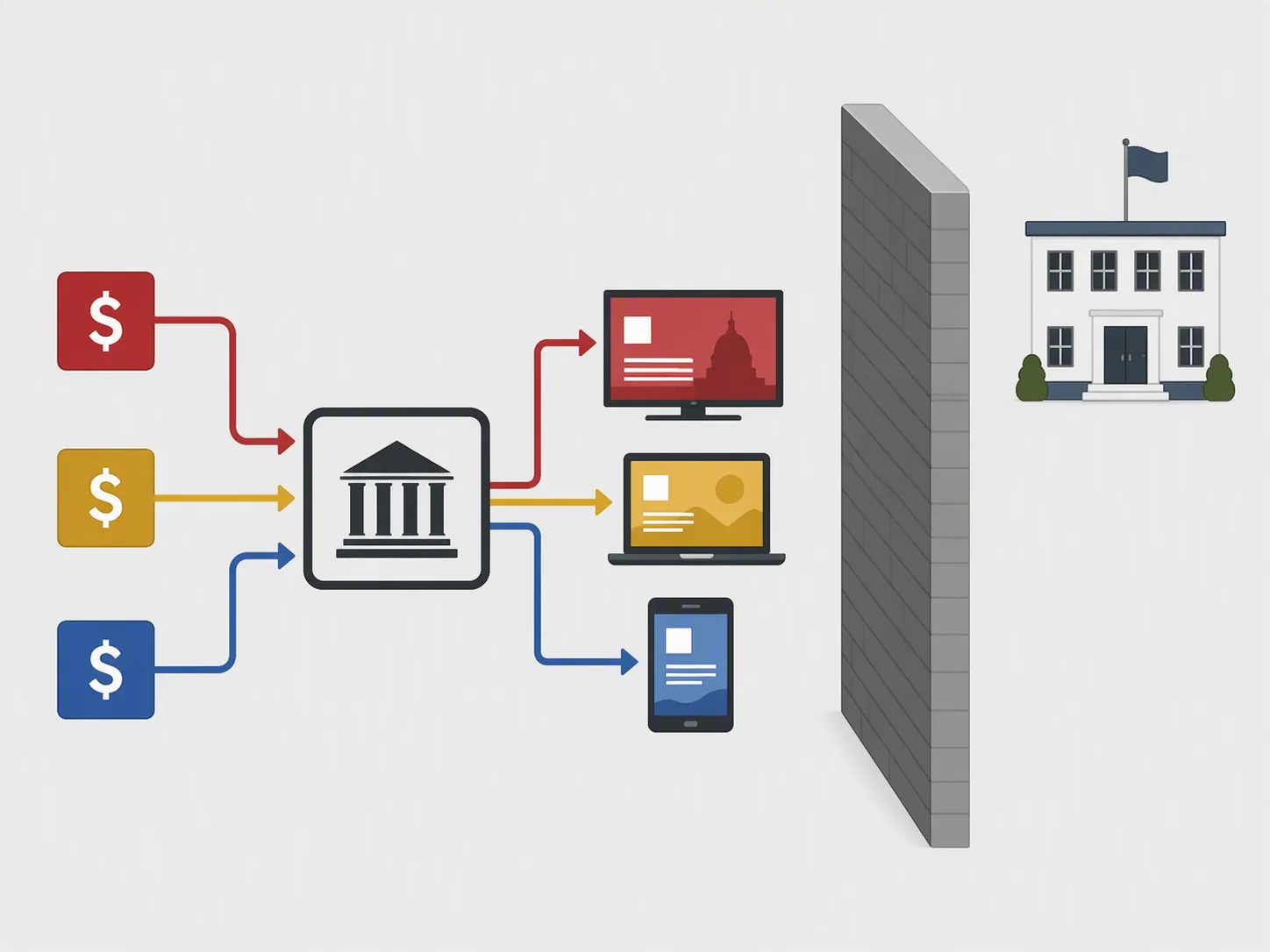
The first legal correction is simple. Endorsements are speech. Large independent expenditures are not unlawful because they are large. The federal prohibition that does the real work is coordination: an outside spender may advocate for or against candidates, including candidates it publicly praises or opposes, but it cannot make those expenditures in cooperation, consultation, or concert with a campaign under the FEC’s coordination framework.
That distinction is why the 2026 convergence number matters without becoming the legal test. The Nation, using FEC-processed independent-expenditure data, reported that crypto, AI, and AIPAC-aligned super PACs had combined to spend more than $180 million in the 2026 cycle, with AI networks alone exceeding $52.8 million in House and Senate races.[1]

The shared structure: endorsements outside, campaign coordination barred
The useful comparison is not that AIPAC, crypto, and AI funders want the same policy outcomes. They do not need to. The comparison is that their outside-spending vehicles use the same lawful federal campaign-finance lane: independent expenditures that expressly advocate for or against federal candidates while remaining independent of the candidates’ campaigns.
FEC guidance defines independent expenditures as communications that expressly advocate the election or defeat of a clearly identified federal candidate and are not made in cooperation, consultation, or concert with, or at the request or suggestion of, the candidate, campaign, party committee, or their agents. The same FEC guidance routes coordination analysis through the payment, content, and conduct standards, with special attention to republication of campaign materials, common vendors, former employees, and substantial discussions.[2]
That is the campaign-finance grammar behind the 2026 spending stories. An endorsement by a candidate-screening organization, an outside group’s voter guide, and a super PAC’s attack ad are not the same act. The legal risk rises when the money and strategy move across the firewall: ad scripts previewed for a campaign, targeting decisions shaped through campaign conversations, vendor information reused in a way that satisfies the conduct standard, or campaign material republished as the outside group’s own paid communication.
AIPAC’s federal records give the cleanest starting point because they are committee-level, not press-release level. United Democracy Project, committee ID C00799031, is the AIPAC-aligned independent-expenditure committee. Its FEC page reported $103,988,109.27 in receipts, $27,928,913.21 in independent expenditures, and $80,255,176.92 cash on hand for the Jan. 1, 2025 through June 30, 2026 coverage period.[3] AIPAC PAC, committee ID C00797670, separately reported $47,521,820.85 in receipts on its FEC committee page.[4]
Those two pages are more useful than the generic label “AIPAC money.” One committee is the super PAC vehicle making independent expenditures. The other is AIPAC’s PAC. Different committee IDs, different filing records, different legal functions. Collapsing them into one dramatic noun may make for a sharper headline, but it is a poor way to assess FECA exposure.
AI PACs did not invent the model; they entered it
The AI network is newer, and some of its headline fundraising numbers are less settled because they come from the groups or their backers rather than fully caught-up FEC receipts. CNBC reported that AI-linked groups described more than $200 million in combined election spending plans, including Leading the Future figures first described around $125 million and later around $140 million, and Public First Action at $80 million; those figures should be treated as group-provided until filings verify the money path.[5]
The anatomy still matters. Reporting identified Leading the Future and affiliates including Think Big and the Republican-arm American Mission, while Public First Action operates Jobs and Democracy PAC; Meta also fields political committees in the broader AI-election environment.[1][5] Election Law Blog separately flagged Leading the Future’s leadership and funding as part of the emerging AI campaign-finance buildout.[6]
New York’s 12th Congressional District shows the scale without resolving every legal question. The Nation reported roughly $13.2 million spent for Alex Bores and more than $8 million against him in that race as part of the AI-spending wave.[1] The legal point is not that those numbers are too high for federal law to tolerate. The point is that, if the spending is independent, the size of the buy does not by itself supply the violation.
| Network | Principal outside-spending architecture described in the record | What the law cares about first |
|---|---|---|
| AIPAC-aligned | United Democracy Project as IE-only super PAC; AIPAC PAC as separate PAC record | Whether outside spending remains independent; what donors and transfers are disclosed, and when |
| Crypto | Fairshake-style super PAC spending in federal races | Same IE-only independence rules; donor disclosure and coordination firewall |
| AI | Leading the Future / Think Big / American Mission; Public First Action / Jobs and Democracy PAC; other tech-linked PAC activity | Independence, source restrictions, foreign-national participation, 501(c)(4) flows, and AI-ad disclosure overlays |
Delayed disclosure is often lawful, and still politically consequential
The part that offends voters is not always the part that violates federal law. Donor disclosure can arrive after the moment when primary voters most need it. That is not a loophole in the theatrical sense; it is a reporting-calendar consequence. If a committee’s receipt reporting date falls after primary day, voters may see the ads before they can see the donors behind the vehicle that paid for them.
Illinois is the cleaner example of the mechanics. Al Jazeera reported that Chicago Progressive Partnership was funded solely by Elect Chicago Women, which had raised more than $4 million from United Democracy Project plus $1 million from a top UDP donor, with donor information disclosed only after the March primaries.[7] One can call that concealment in ordinary political language. In a legal analysis, the better first question is narrower: which committee received which money, from whom, during which reporting period, and when did the receipt become reportable?
The Nation also reported that combined independent expenditures from UDP, DMFI, and three Illinois-linked PACs had already reached $57.6 million, exceeding the 2024 full-cycle total it used for comparison.[1] That figure is useful because it is tied back to FEC data. It does not prove coordination, and it does not need to. It proves that the outside-spending system can place extraordinary sums into a primary electorate before the electorate has a full donor map.
Michigan belongs in this discussion only to the extent it shows how many disclosure issues can sit near one another without being the same issue. The bundling-gap question tied to AO 2022-03 and Democracy Engine is already treated in Lex Machina Review’s separate record, How AIPAC evades FEC bundling disclosure in Michigan’s primary. This article is concerned with the network-level IE structure: how the same outside-spending machinery is now available to AI entrants.
Where AI entrants should expect the legal tripwires
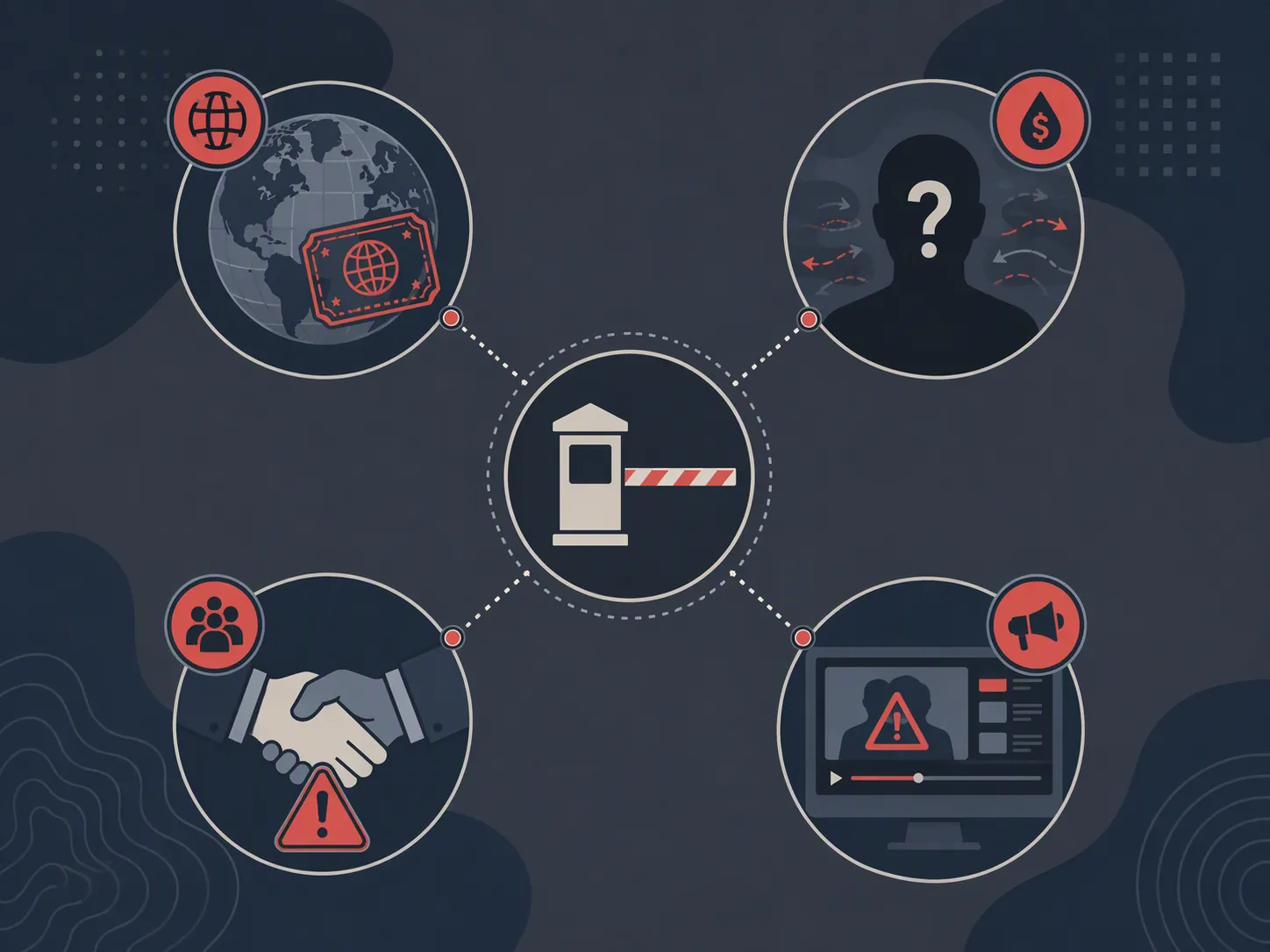
The compliance memo for an AI founder, model company, venture fund, or policy nonprofit should not start with “too much political spending.” It should start with source, control, disclosure, coordination, and ad content. AI companies copying the AIPAC playbook inherit the benefits of the super PAC lane, but they also bring facts that AIPAC-style political committees do not always bring: foreign-connected owners, multinational cap tables, overseas engineers and executives, affiliated 501(c)(4)s, synthetic media, and policy teams that talk to campaigns in ordinary commercial and legislative contexts.
Foreign-national participation is the practical problem, not a law-school hypothetical
Federal law bars foreign nationals from making contributions, donations, expenditures, independent expenditures, and disbursements in connection with U.S. elections. FEC guidance also states that foreign nationals may not participate in decisions involving election-related spending by corporations, labor organizations, political committees, or other persons, and may not provide substantial assistance in connection with a contribution, donation, expenditure, independent expenditure, or disbursement.[8]
That is where AI companies require more discipline than a conventional domestic donor network. A U.S. subsidiary with foreign parentage, a venture fund with foreign limited partners, an executive committee including non-U.S. persons, or an internal policy team with foreign-national employees does not automatically make every U.S. political expenditure unlawful. But the contribution decision, expenditure decision, messaging approval, and strategic assistance have to be isolated from foreign-national direction or participation. The factual record that later matters will be board minutes, approval chains, Slack messages, vendor scopes, and who had authority over the political budget.
Corporate and LLC money needs source review before it becomes a PAC receipt
The corporate-money rules are not reducible to “companies cannot participate.” FEC guidance distinguishes who may and may not contribute to candidates and committees, including rules for corporations, LLCs, partnerships, and other entities.[9] Super PACs may receive unlimited contributions from permissible sources for independent expenditures, but that does not eliminate source restrictions, foreign-national restrictions, or the need to determine how an LLC is taxed and who is behind the funds where the facts require it.
For AI investors, the pre-check question is mundane and important: what entity is writing the check, what funds are being used, who controls the decision, and whether any foreign national has directed, approved, or substantially assisted the election-related spending. It is easier to build that record before the wire than to explain it after an enforcement complaint attaches the cap table.
501(c)(4) flows change the disclosure record
A 501(c)(4) can be the place where the public record thins. The campaign-finance issue is not solved by calling it dark money, and it is not erased by avoiding that phrase. If a social-welfare organization gives to an IE-only committee, the super PAC filing may disclose the organization while not disclosing all upstream donors to that organization. If the same policy donors also fund research, lobbying, trade-association work, and campaign ads, counsel should assume reporters and complainants will try to stitch those channels together, even where FECA treats them differently.
The compliance consequence is document separation. Political spending approvals, charitable or social-welfare grants, lobbying strategy, model-policy advocacy, and candidate-facing conversations should not be allowed to blur into one “AI policy” workflow. The more a record suggests that a nonprofit grant was routed to support a particular candidate expenditure while hiding the real source, the less helpful the formal committee label becomes.
Coordination allegations are built from workflow evidence
The coordination rules are operational rules. They ask who paid, what the communication said, and what conduct connected the spender to the campaign.[2] That makes them uncomfortable for companies used to treating public-policy conversations as ordinary stakeholder management. A meeting about AI procurement, a campaign’s questionnaire, a candidate’s public position paper, and an outside group’s ad buy can coexist lawfully. The risk comes when the campaign and outside spender share nonpublic strategic information, request or suggest the expenditure, use common vendors in ways that transmit protected information, or republish campaign materials.
For AI entrants, the same people may know the policy merits, the regulatory threat model, the candidate landscape, and the ad strategy. That is efficient inside a company and dangerous inside a political file. A usable firewall is not a slogan; it is a restricted attendee list, separated vendors, written no-coordination instructions, screened data access, and a record showing that the IE team made its own spending decisions.
AI-ad law is thin federally and much sharper in the states
Federal campaign-finance law has not become a comprehensive AI-ad code. On Sept. 19, 2024, the FEC declined to open an AI-specific rulemaking and approved an interpretive rule treating the fraudulent-misrepresentation ban in 52 U.S.C. § 30124 as technology-neutral.[10] The Federal Register notice documented that disposition and interpretive approach.[11]
That federal move matters, but mostly because it shows the ceiling is low. If an AI-generated ad fraudulently misrepresents campaign authority or impersonates a candidate or party in a covered way, existing federal law may matter. Routine synthetic editing, voice generation, or generative-image use is more likely to raise disclaimer, platform, state-law, or deception questions than a standalone federal AI-ad violation.
The more active overlay is the state patchwork. WashU Law’s political-media statutes and litigation tracker collects state AI political-advertising laws and challenges, including California AB 2839 being preliminarily enjoined in October 2024 and AB 2655 being struck down in August 2025 under Section 230.[12] Any national AI super PAC plan that clears federal IE rules still needs a state-by-state review before synthetic media runs in a primary.
What endorsements do, and do not, change
The practical question combines AIPAC endorsements, campaign finance law, and regulations. The clean answer is that the endorsement itself is not the regulated expenditure. AIPAC may endorse candidates. AI policy leaders may praise or condemn candidates. Crypto executives may announce a preferred slate. The regulated conduct begins when money is contributed, spent, reported, routed, or coordinated.
Endorsements can still matter legally as context. If an endorsement operation and an IE operation share vendors, staff, data, scripts, or campaign communications, the endorsement record may become part of a coordination inquiry. If a candidate’s campaign treats an outside spender as an allied arm rather than an independent speaker, the public endorsement may be less important than the private conduct behind it. But federal law does not convert a super PAC ad into an unlawful contribution merely because it supports an endorsed candidate.
That is why a campaign’s complaint about being outspent is analytically weak unless it identifies the prohibited path. The better complaint may be democratic rather than legal: primary voters can be saturated with ads before donor disclosures catch up. That is a serious problem for voter information. It is just not the same problem as illegal coordination.
The usable compliance distinction
The AIPAC playbook has become available to AI PACs because federal campaign-finance law permits IE-only scale and permits disclosure schedules that may leave donor identities unclear until after a primary. Crypto networks used the same lane. AI networks are now using it too. That structural convergence is the important 2026 fact.
The risk profile changes when AI entrants bring foreign-connected corporate actors, 501(c)(4) money flows, synthetic-media ads, or campaign-facing strategy conversations into the same workflow. Those facts move the analysis away from outrage over influence and toward the places FECA and state law actually look: source, disclosure, coordination, foreign-national participation, and specific deceptive-ad rules.
References
- Crypto, AI, and AIPAC Super PACs Are Spending in Lockstep Against Progressives, The Nation, July 21, 2026.
- Making independent expenditures, Federal Election Commission.
- United Democracy Project committee page, Federal Election Commission.
- AIPAC PAC committee page, Federal Election Commission.
- What AI companies want for the millions they're spending on elections, CNBC, July 9, 2026.
- Leading the Future leadership/funding, Election Law Blog.
- How AIPAC channels millions through shell PACs ahead of US midterms, Al Jazeera, May 20, 2026.
- Foreign nationals, Federal Election Commission.
- Who can and can't contribute, Federal Election Commission.
- Commission approves notification of disposition, interpretive rule on artificial intelligence in campaign ads, Federal Election Commission, September 19, 2024.
- Artificial Intelligence in Campaign Ads, Federal Register, September 26, 2024.
- Political Advertising: AI Policy and Regulation Resources, WashU Law.
Operationalizing workflow
No workflow has been explicitly linked to this obligation yet. See Workflows generally.
Illustrative cases
No illustrative case is currently tracked for this obligation. See Risk Digest for documented incidents generally.
← Back to RegulationReport a correction or tip
Spotted an outdated figure, a misstated fact, or a ruling this regulation entry should reflect? Public comments are disabled for this content given the professional cost of a misreported case outcome, penalty amount, or rule text — use the structured correction channel instead.
Report a correction or tip for this record →