
Removed From an Alaska Airlines Flight? Know Your Rights
- Authority
- U.S. Congress
- Rule type
- statute
- Jurisdiction scope
- US federal
- Source text
- Read primary rule text ↗
Air carriers may refuse to transport a passenger the carrier decides is or might be inimical to safety; removed passengers may file a DOT discrimination complaint and seek refunds or credit.
If you were removed from an Alaska Airlines flight and then told you could not fly the airline again, the first legal answer is narrower than the viral version. This is not legal advice, and as of August 1, 2026, there is no identified lawsuit or court order adjudicating the Whitney Lynn incident. The public record is still made of videos, Alaska’s statement, and press accounts.
On those reported facts, Lynn’s strongest-sounding argument is probably the wrong one: a First Amendment claim against Alaska Airlines likely fails before the court ever reaches religion or viewpoint. Alaska is a private carrier, not the government. The useful questions are instead whether the airline had a safety-based basis to remove her, whether it applied its authority in a discriminatory way, and what remedies remain after a passenger has been removed and banned.
| Question | Likely legal frame | What it means for a removed passenger |
|---|---|---|
| Was this a First Amendment violation? | State action threshold | Usually no, because a private airline is not the government. |
| Could the airline remove a boarded passenger? | 49 U.S.C. § 44902(b) and DOT safety/security/health/unlawful-conduct framing | Yes, if the carrier decided the passenger was or might be inimical to safety. |
| Could the airline ban future travel? | Contract of Carriage and private-carrier discretion, limited by anti-discrimination law | Often yes, though the process may be opaque and fact-dependent. |
| What can the passenger actually do? | DOT discrimination complaint, refund or credit request, narrow state-law claims | Practical remedies exist, but they are much smaller than a viral constitutional claim. |
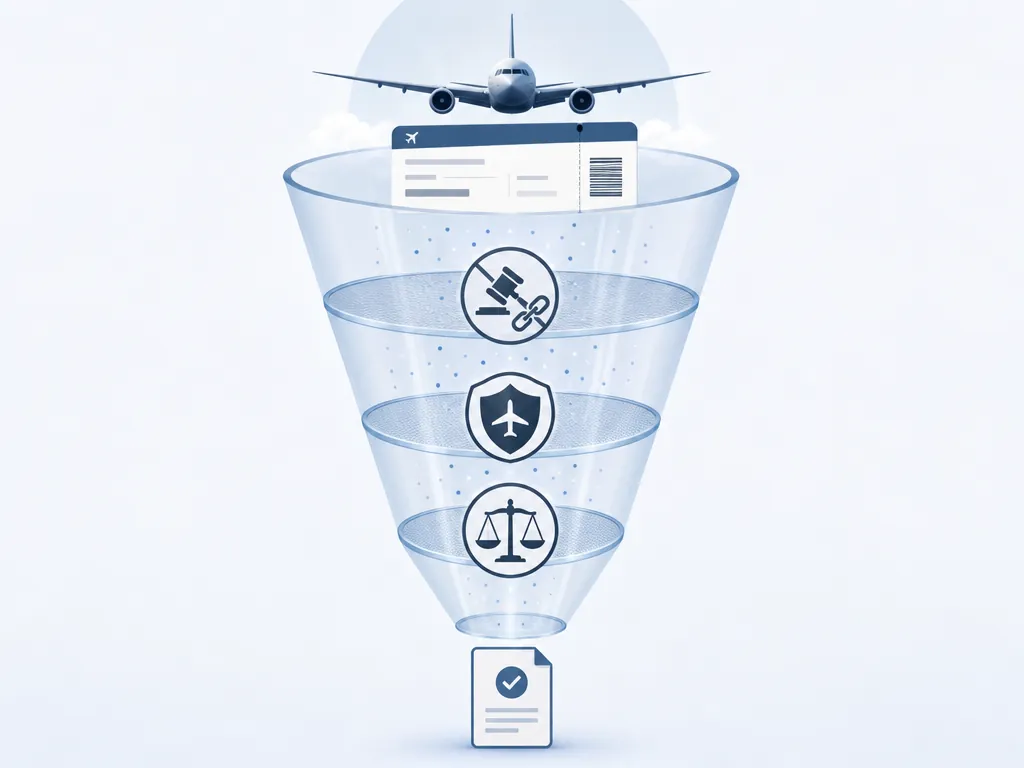
What is actually reported about the Alaska Airlines incident
The reported passenger was Whitney Lynn, a 40-year-old Orlando resident, on an Alaska Airlines flight from Orlando to San Diego on July 30, 2026. Press accounts describe her preaching in the aisle during a delay before takeoff, being asked to deplane, and later saying she viewed the aircraft as a “captive audience” whose passengers “have no choice but to hear the truth.” Alaska told The Washington Post: “The passenger was asked to deplane the aircraft for safety reasons. For the foreseeable future, the guest will not be permitted to travel on our flights.” The same reporting says she received an email placing travel holds on Alaska, Hawaiian, and Horizon travel. [1][2]
That is not a finding of fact. It is the public incident record. The distinction matters because the legal rights analysis changes if a passenger was quietly praying in a seat, standing in the aisle during boarding or delay, refusing crew instructions, or arguing with flight attendants. Viral clips compress those differences. Airlines, regulators, and courts usually do not.
The First Amendment is the wrong door
The search phrase “evangelist removed from Alaska Airlines flight legal rights” points to the obvious public anxiety: can an airline remove someone for religious speech? But constitutional free-speech analysis starts with state action. A passenger can have a serious religious-liberty grievance and still not have a First Amendment claim against a private airline.
That threshold point does a lot of work here. Alaska Airlines is not a city council, a public university, a police department, or a courtroom. If a crew member tells a passenger to stop speaking in the aisle and return to a seat, the case does not automatically become a constitutional speech case because the content is religious. The first practical question becomes whether the passenger’s conduct gave the carrier a permissible safety reason to refuse transport.
The reported phrase “captive audience” is legally more important than it may first appear. It is not because passengers have a general right to be free from hearing religious speech in public. It is because an aircraft cabin before departure is not a park or sidewalk. Passengers are seated, crew are preparing a safety-sensitive operation, and an aisle is not a pulpit. Once the dispute is about standing, delay, crew instructions, and a confrontation before takeoff, the airline has a much easier time describing the event as onboard conduct rather than viewpoint suppression.
The carrier’s safety authority is broad, but not magic
Federal law gives an air carrier substantial discretion to refuse transportation. Under 49 U.S.C. § 44902(b), a carrier “may refuse to transport a passenger or property the carrier decides is, or might be, inimical to safety.” [3]
That phrase is deliberately practical. A captain and crew are not required to conduct a mini-trial at the aircraft door. They have to decide whether the flight can depart safely and whether a passenger who is already creating a conflict will comply once airborne. In a cabin confrontation, the risk is not limited to violence. Delay, aisle obstruction, refusal to follow instructions, escalation, and distraction from required duties can all matter.
DOT’s Fly Rights page, which DOT marks as archived, frames post-boarding deplaning more narrowly than general customer-service dissatisfaction: once a passenger has boarded, an airline may require the passenger to leave for safety, security, health, or unlawful-behavior reasons. The same DOT page separately discusses denied-boarding rules for oversales, which is why bumping compensation is a poor fit for a safety removal. [4]
Alaska’s Contract of Carriage is the private agreement that governs transportation on the airline. Before relying on a specific rule number in a complaint or pleading, a passenger should verify the live contract text because airline contract pages and PDFs can change. For present purposes, the important point is ordinary: the contract structure gives the carrier refusal-to-transport authority, and refusing crew instructions is the kind of conduct airlines commonly treat as disqualifying. [5]
That is why the reported argument with crew matters more than the sermon’s theology. A seated passenger reading Scripture quietly presents one kind of record. A passenger reportedly preaching from the aisle during a delay, then disputing crew direction, presents another. If Alaska’s safety explanation is accurate, the removal sits in the part of aviation law where courts tend to give operational personnel room to act.
Where religion discrimination still fits
None of this means an airline can remove a passenger because she is Christian, Muslim, Jewish, atheist, or anything else. Federal aviation law separately prohibits an air carrier or foreign air carrier from discriminating against a person in air transportation on the basis of race, color, national origin, religion, sex, or ancestry. [6]
That is the anti-discrimination lane, not the First Amendment lane. A passenger who can plausibly allege that similarly situated passengers were treated differently because of religion, or that the airline’s stated safety reason was a pretext for religious discrimination, can file a complaint with DOT’s Office of Aviation Consumer Protection. DOT says it reviews every discrimination complaint it receives; its process includes a 30-day acknowledgment and a substantive response from the airline generally due within 60 days. [7]
On the reported Lynn record, though, the discrimination theory looks factually weak. Alaska’s public explanation was safety. The reported conduct included aisle preaching during a delay and a dispute with crew. Lynn’s own reported “captive audience” framing gives the airline a content-neutral way to describe what it was addressing: a passenger using the cabin environment in a way that other passengers could not realistically avoid and that crew had to manage before departure. [1][2]
A discrimination complaint does not require the passenger to win the case before filing it. But it does require more than the proposition that the removed speech was religious. The harder factual work is showing that religion, rather than conduct and crew noncompliance, drove the airline’s decision.
Why crews are primed to treat cabin confrontation seriously
The legal environment around passenger conduct has become less forgiving since the pandemic-era surge in unruly-passenger incidents. Federal regulations prohibit a person from assaulting, threatening, intimidating, or interfering with a crew member performing duties aboard an aircraft. [8] A related federal criminal statute addresses interference with flight crew members and attendants. [9]
The FAA says it has maintained a zero-tolerance policy for unruly passengers since January 13, 2021, can propose civil penalties of up to $43,658 per violation, and recorded more than 1,240 airline-reported unruly-passenger cases in 2024. The agency also cautions that its public figures understate the full universe because they count only incidents reported to the FAA by crew members. [10]
The FAA has also referred more than 310 unruly-passenger cases to the FBI since late 2021. [11] That does not mean Lynn committed a crime; the public record does not establish that. It does explain the institutional reflex. When a passenger turns a crew instruction into a conscience-based confrontation, the person who bears the immediate operational risk is not the passenger with the camera. It is the crew member who must decide whether the aircraft is safe to push back.
The ban is a separate problem from the removal
Being removed from one flight is embarrassing and disruptive. Being told that future travel is blocked is more serious. Alaska reportedly told Lynn she would not be permitted to travel on its flights “for the foreseeable future,” and press accounts say the travel holds extended to Alaska, Hawaiian, and Horizon. [1]
Private airline ban processes are often opaque. The ACLU has criticized proposals for broader airline no-fly lists partly because private bans may lack clear notice, standards, and meaningful appeal procedures. [12] That critique is not a ruling that every airline ban is unlawful. It is a reminder that a passenger may face a very real consequence without the sort of formal process people associate with government punishment.
For a banned passenger, the practical step is to separate three requests that often get blurred together: written confirmation of the ban’s scope, reconsideration or reinstatement, and a refund or credit for unused transportation. Airlines do not have to treat those as the same issue. A carrier may maintain a refusal-to-transport decision while still owing money back under its contract or customer-service rules.
What remedies are realistic
The most useful remedies for a removed-and-banned passenger are administrative and contract-based, not constitutional.
- DOT OACP discrimination complaint: Use this if the passenger can plausibly allege discrimination based on religion or another protected category under 49 U.S.C. § 40127. The complaint should identify the protected category, the conduct of airline personnel, comparator facts if any, and why the safety explanation is allegedly pretextual.
- Refund or credit request: Ask for reimbursement for unused transportation and related contract benefits. Do not frame this as denied-boarding compensation unless the case is actually an oversales bumping case; DOT’s denied-boarding rules are aimed at involuntary bumping, not safety removals. [4]
- Written reconsideration of the ban: Ask the airline to state the ban’s duration, covered carriers, review process, and conditions for reinstatement. A short, non-performative letter is more useful than relitigating the cabin dispute.
- Small-claims or state-law theories: Depending on the facts and forum, a passenger may consider breach of contract or tort theories. These claims are constrained by federal aviation law, preemption issues, and the deferential treatment often given to crew safety decisions.
The state-law piece is where litigation predictions become unstable. Courts have not applied one uniform standard when reviewing refusals to transport under § 44902(b). The Ninth Circuit’s decision in Eid v. Alaska Airlines used a reasonableness-under-the-circumstances approach, while the First Circuit’s Cerqueira v. American Airlines applied a more deferential arbitrary-and-capricious standard. Commentary on the split treats it as unresolved, and no controlling published Eleventh Circuit precedent is identified here for a passenger from Florida. [13]
That split is not academic decoration. Under a reasonableness standard, a passenger has more room to argue that the airline overreacted to the facts known at the time. Under an arbitrary-and-capricious standard, the airline has a wider safety margin. Either way, the court usually looks at what the crew reasonably perceived before departure, not the passenger’s later description of spiritual motive.
Applying that stack to Lynn
If the reported facts are accurate, Alaska’s position is strong. The First Amendment theory likely fails because the airline is private. The safety rationale has factual support in the reported aisle preaching during a delay, the “captive audience” framing, and the confrontation with crew. Section 44902(b) gives the carrier broad discretion when it decides a passenger is or might be inimical to safety. DOT’s own post-boarding framework points to safety and security as the relevant removal grounds.
The religion-discrimination claim remains legally possible in the abstract. It is just not made strong by saying the speech was religious. The passenger would need facts suggesting Alaska acted because of religion rather than because of cabin conduct and crew noncompliance. On the current public record, Alaska’s safety explanation is the cleaner fit.
The ban is harder to evaluate because the public record does not show Alaska’s internal review, exact contract provision, or reinstatement process. But private carriers commonly retain broad refusal-to-transport authority, and the absence of a formal public appeal process does not by itself make the ban unlawful.
So the narrow answer is this: if Lynn was removed and banned for the conduct now being reported, the removal and ban were likely lawful. “Likely” matters. There is no adjudication, and the § 44902(b) review standard is not uniform across circuits. For a removed passenger, the practical path is a DOT discrimination complaint if there are real discrimination facts, a refund or credit request for unused travel, and carefully scoped state-law claims—not viral certainty that a private airline violated the First Amendment.
References
- Airline removes evangelist after onboard preaching session, The Washington Post, July 31, 2026
- Watch: Alaska Airlines removes passenger for preaching in aisle; evangelist calls it spiritual warfare, The Economic Times
- 49 U.S. Code § 44902 - Refusal to transport passengers and property, Legal Information Institute
- Fly Rights, U.S. Department of Transportation
- Contract of Carriage, Alaska Airlines
- 49 U.S. Code § 40127 - Prohibitions on discrimination, Legal Information Institute
- Non-Discrimination in Air Travel, U.S. Department of Transportation
- 14 CFR § 121.580 - Prohibition on interference with crewmembers, Electronic Code of Federal Regulations
- 49 U.S. Code § 46504 - Interference with flight crew members and attendants, Legal Information Institute
- Unruly Passengers, Federal Aviation Administration
- FAA Refers More Unruly Passenger Cases to FBI, Federal Aviation Administration
- Airlines Want the Government to Create a New Passenger No-Fly List, American Civil Liberties Union
- Standard of Care for Airlines to Remove or Refuse to Board Passengers, Kreindler & Kreindler
Operationalizing workflow
No workflow has been explicitly linked to this obligation yet. See Workflows generally.
Illustrative cases
No illustrative case is currently tracked for this obligation. See Risk Digest for documented incidents generally.
← Back to RegulationReport a correction or tip
Spotted an outdated figure, a misstated fact, or a ruling this regulation entry should reflect? Public comments are disabled for this content given the professional cost of a misreported case outcome, penalty amount, or rule text — use the structured correction channel instead.
Report a correction or tip for this record →