
Sam Altman's 'Gentle Singularity' Changes AI Regulation—Here's How
- Authority
- Sam Altman
- Rule type
- policy proposal
- Jurisdiction scope
- US federal, international
- Source text
- Read primary rule text ↗
“Gentle singularity” is a useful phrase because it does two jobs at once. It keeps the grandeur of a world-changing AI transition, while softening the regulatory implication that usually follows from existential-risk language. When Sam Altman published “The Gentle Singularity” in June 2025, the phrase arrived after public anxiety had already been primed by displacement warnings from Anthropic CEO Dario Amodei and polling cited by AEI showing that only 17% of Americans viewed AI positively.[1][2] The move was not simply semantic. It helped recast the central policy question from “who can stop a dangerous system?” to “who can guide a transition that is already under way?”

That distinction matters for lawyers, procurement committees, and regulators because the meaning of “gentle singularity” is not exhausted by whether Altman is right about the future. Its practical significance is what kind of oversight it makes seem proportionate. Catastrophic-risk framing invites licensing, pre-deployment review, incident reporting, and external control points. Gentle-transition framing invites standards, forums, coordination, and public-private planning. Those can be legitimate tools. They are not the same burden.
The question, then, is not whether Altman has become optimistic or cautious. It is whether the governance structure attached to the “gentle” frame gives anyone outside the company a right to verify compliance.
The Policy Meaning Of “Gentle”
Altman’s June 2025 essay presents the singularity less as a cliff edge than as an accelerating social process: powerful systems become normal, society adapts, and the transition feels less violent than the term historically suggested.[1] Nieman Journalism Lab noted the rhetorical novelty in the word “gentle” itself, because earlier singularity discourse tended to emphasize rupture, loss of control, or sudden discontinuity.[3]
There is nothing inherently evasive about a calmer account of technological change. A regulator can overreact to speculative risk just as easily as a company can understate it. But a calming frame becomes legally important when it changes the acceptable form of supervision. If the transition is dangerous but manageable, then standards and coordination begin to sound more sensible than licensing or pre-approval. If the transition is inevitable, then delaying deployment begins to sound like denying public benefit. If the transition is broadly beneficial, then the burden shifts to skeptics to explain why intervention should occur before harm is visible.
For a legal reader, the first red flag is not optimism. It is the absence of an inspection right. A standard without a mechanism for access, records, audit, and consequence is closer to a representation than a control.
The Timeline Is The Argument
Altman’s public posture on AI oversight did not move in a vacuum. In 2023, he co-signed the Center for AI Safety statement warning that mitigating the risk of extinction from AI should be a global priority, and he testified in favor of federal licensing for advanced AI systems.[4] By June 2025, he had supplied a more domesticated vocabulary for the same frontier: the “gentle singularity.”[1] By May 2026, reporting on his congressional testimony described him as opposing government model pre-approval requirements.[5] In June 2026, he appeared alongside G7 leaders at Evian, and in July 2026, secondary reporting described his call for a US-led international AI forum modeled partly on the IAEA, together with a proposal for the US government to take a 5% equity stake in OpenAI.[6][7]
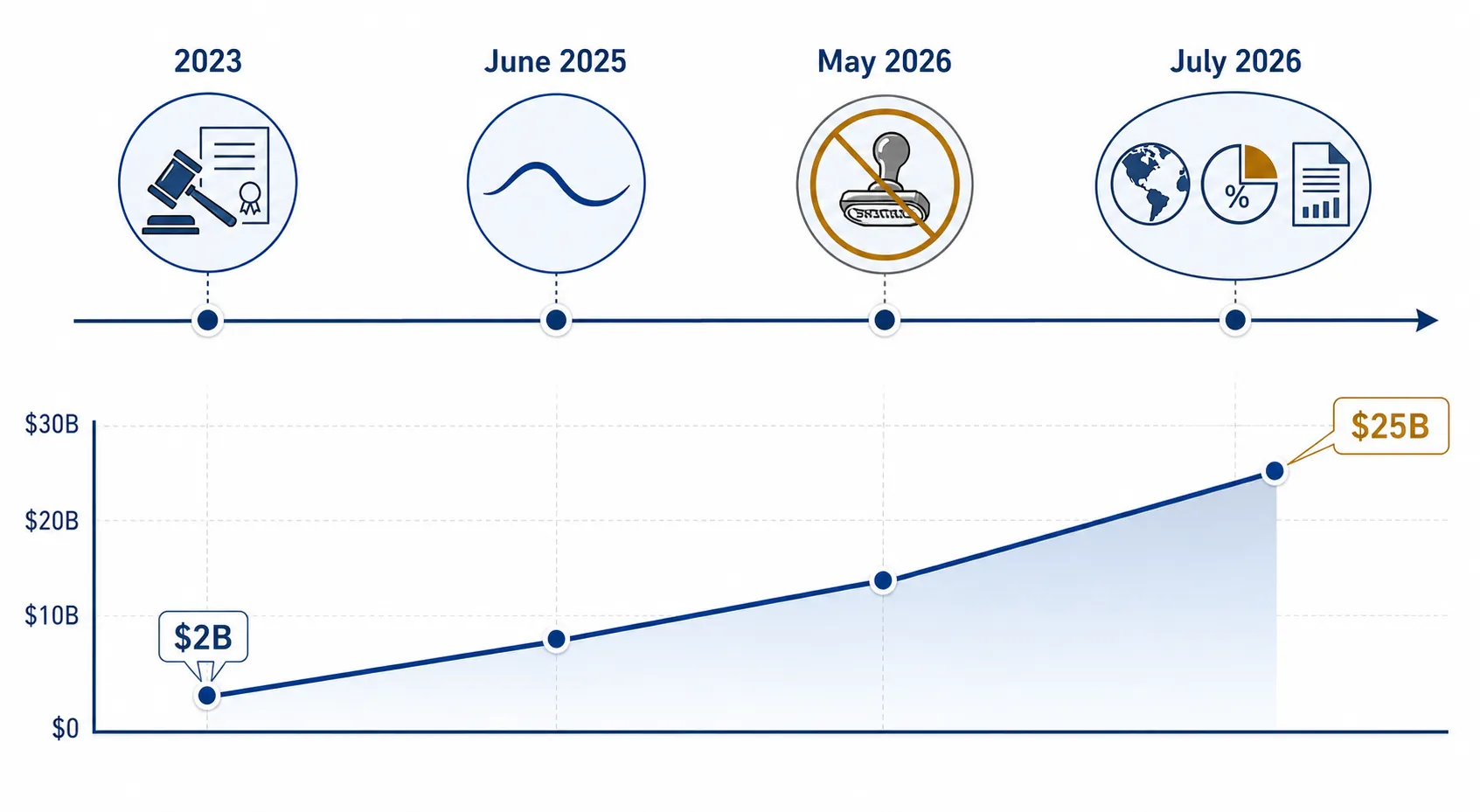
That sequence deserves more weight than any single quote. The shift is from licensing-friendly testimony when frontier AI governance was still being publicly constituted, to standards-and-forum governance once OpenAI had become a far larger commercial actor. StartupHub.ai’s synthesis reports OpenAI annual recurring revenue rising from about $2 billion in 2023 to about $25 billion by March 2026, while also summarizing reporting that OpenAI’s superalignment compute commitment fell well short of the 20% pledge.[4] Those figures should be verified against the original Reuters, PYMNTS, and New Yorker materials before publication-grade reliance, but as reported they make the incentive picture hard to ignore.
| Period | Public Position Or Proposal | Regulatory Consequence |
|---|---|---|
| 2023 | Extinction-risk statement and Senate testimony supporting federal licensing for advanced AI systems | Accepts the idea that some models may require prior public authorization |
| June 2025 | “The Gentle Singularity” reframes rapid AI change as a manageable transition | Makes coordination and adaptation sound more natural than emergency restraint |
| May 2026 | Congressional testimony reported as opposing model pre-approval | Moves away from ex ante permissioning as the central control |
| July 2026 | International forum, US equity stake, and industrial-policy proposals | Broadens the package from safety governance into political economy |
The superalignment point is especially concrete. OpenAI had announced that it would dedicate 20% of compute to superalignment work; StartupHub.ai, synthesizing The New Yorker’s April 2026 investigation, reports delivery at roughly 1.5% and notes that the dedicated superalignment team dissolved after its co-leads departed in May 2024.[4] A safety promise that depends on compute is not just a philosophy. It is a budget line, a capacity allocation, and eventually a document request.
This is where procurement and litigation instincts converge. If a vendor tells a law firm that it has a serious safety program, the useful follow-up is not whether the vendor believes in safety. It is who can inspect the allocation, what records are retained, whether the commitment survives commercial pressure, and what remedy exists if the representation proves thin. The same logic applies at international scale.
From Safety Oversight To Political Economy
The 2026 package, as reported, does not stop at safety standards. Forbes reported that Altman proposed a US-led global AI referee and floated a 5% US government equity stake in OpenAI, described as worth about $42.6 billion at an $852 billion valuation.[6] Fortune separately reported on OpenAI’s 13-page “Industrial Policy for the Intelligence Age,” including ideas such as public wealth funds and shorter workweeks.[8]
That expansion is revealing. Once the frame is a managed transition to abundance, regulatory design starts to absorb distributional politics: who owns upside, how workers are cushioned, whether the state participates as shareholder, and whether AI gains fund public benefits. Those are not side issues, but they are different issues. A public wealth fund is not a model audit. A four-day-workweek proposal is not an incident-response obligation. A government equity stake may align some national interests, but it can also complicate independence if the same government must regulate a company in which it has a financial interest.
For the ownership question, the constitutional and administrative-law difficulties belong in a separate analysis of AI nationalization plans. For the income-distribution proposals, the better cross-reference is the legal treatment of AI universal basic income proposals. The point here is narrower: broad political-economy packaging can make a regulatory proposal appear more public-regarding while leaving the inspection problem untouched.
The IAEA Analogy Breaks At Inspection
The IAEA analogy has obvious appeal. It signals international seriousness, technical expertise, and a world in which dangerous capabilities are monitored rather than wished away. SiliconANGLE and Forbes both reported Altman’s call for an international AI standards forum modeled in part on the nuclear oversight structure.[6][7] But the analogy gets weaker exactly where lawyers need it to be strongest: verification.

Nuclear inspection depends on physical realities. Inspectors can examine facilities, seals, equipment, inventories, samples, and material flows. Fissile material has a supply chain and a footprint. There are still evasion risks, but the regime is built around things that can be seen, measured, and compared against declared records.
Frontier-model governance has a different evidentiary posture. Training can occur inside data centers controlled by the developer or its infrastructure partners. The relevant facts include training runs, model weights, datasets, eval results, fine-tuning, post-training modifications, deployment pathways, and access controls. Some of those facts can be logged. Some can be audited. None are automatically available to an international standards body just because standards exist.
The Anthropic Fable and Mythos export-control episode illustrates the problem. Brookings discussed the Commerce Department’s June 2026 order restricting two Anthropic models in the context of enforceability and model modification, while arguing that standards must account for how frontier models can be altered after release.[9] The lesson is not that one company’s episode proves general noncompliance. It is that a regulator’s theory must reach the model as modified, deployed, transferred, or repurposed—not merely the model as described in a policy paper.
Brookings’ July 2026 intervention is useful because it does not simply reject the forum idea. It argues that the G7 should accept the standards offer only if modified to include government and civil-society participation and enforceability.[9] That is the missing element. A forum may convene. A standards body may publish. A company may attest. Oversight begins when someone with authority can compel evidence and impose consequences.
Standards Body Or FAA-Style Regulation?
The industry split is not merely stylistic. Altman’s reported preference leans toward an international standards forum; Amodei has been associated with a more prescriptive, FAA-style model of regulation.[2][9] For lawyers, those models produce different compliance questions.
| Governance Model | What It Typically Emphasizes | Legal Due-Diligence Question |
|---|---|---|
| Standards-body approach | Consensus benchmarks, shared norms, voluntary or semi-voluntary technical criteria | Who can verify adherence, and what happens if the vendor fails? |
| Prescriptive approval model | Ex ante rules, permissioning, required demonstrations, regulator-defined thresholds | What evidence must be produced before deployment or scaling? |
| Public equity or industrial-policy approach | State participation in upside, social cushioning, national competitiveness | Does ownership strengthen accountability or create regulatory conflict? |
A standards body can move faster than legislation and may attract technical expertise that agencies lack. It may also become the place where regulated entities define the test they later claim to have passed. That is not a reason to dismiss standards. It is a reason to ask whether the standard is incorporated into procurement terms, regulatory duties, audit rights, reporting obligations, and remedies.
Law-firm buyers already know this pattern from vendor diligence. A model provider’s safety statement may be relevant, but it does not answer whether client data is exposed, whether privilege claims are preserved, or whether the firm can obtain meaningful incident information. Altman’s statement that ChatGPT conversations lack legal privilege has already become part of the legal record firms must evaluate; courts and vendors will not treat public statements as decorative when risk allocation is contested. See the related analysis of ChatGPT privilege rulings for that narrower issue.
What Legal Professionals Should Treat As Unresolved
The “gentle singularity” frame should be tracked as a live policy proposal, not waved away as branding. It is politically effective because it offers public reassurance without denying transformative change. It also gives policymakers a menu: international standards, government partnership, industrial benefits, and less emphasis on pre-approval. That menu may become part of agency design, procurement language, G7 coordination, or congressional hearings.
But enforceable oversight requires details the current framing does not supply. A legal review should separate participation from authority. It should ask whether governments, independent researchers, civil-society representatives, affected industries, and end users have formal roles or merely consultation windows. It should ask whether the body can inspect training records, evals, model-card claims, compute usage, security controls, incident logs, and post-deployment modifications. It should ask whether source verification exists: not only whether a company reports compliance, but whether an outside actor can test that report against primary evidence.
- Participation: who sits in the forum, who votes, and who can object?
- Inspection authority: who can compel access to facilities, logs, evals, and model artifacts?
- Audit access: are auditors independent, technically capable, and protected from vendor retaliation?
- Source verification: can representations be checked against primary records rather than summaries?
- Consequences: what happens when a company withholds evidence, misses a safety commitment, or deploys outside the standard?
Those questions are not anti-AI. They are the minimum difference between governance and cover. If a firm is relying on OpenAI or another frontier provider for legal work, the same discipline belongs in vendor review: documented controls, breach history, contractual audit rights, data-use limits, and remedies. The related analysis of OpenAI breach and safe-harbor claims addresses that procurement layer.
The Narrow Legal Judgment
For AI regulation, Altman’s “gentle singularity” is best understood as a burden-shifting device. It does not deny risk; it rearranges the kind of burden that appears reasonable. It makes cooperative standards more attractive than model approval, industrial policy more visible than inspection design, and managed transition more politically marketable than emergency governance.
That framework may still produce useful institutions. It should not be treated as enforceable oversight unless the proposal specifies participation, inspection authority, audit access, source verification, and consequences for noncompliance. Until then, it remains a sophisticated governance narrative attached to a verification gap.
Source note: the July 2026 Financial Times op-ed claims are reconstructed through Forbes, SiliconANGLE, and Brookings reporting because the original op-ed was not directly available for verification. The OpenAI industrial-policy paper, revenue figures, and superalignment compute figures should be confirmed against primary documents or original publishers before use in formal legal memoranda. Last verified: 2026-07-27 UTC. This article belongs in regulation-ethics as analysis of obligations and governance credibility, not legal advice.
References
- The Gentle Singularity, Sam Altman, June 2025.
- Sam Altman’s Gentle Singularity Message to an Anxious Public, American Enterprise Institute.
- Has the gentle singularity already begun? And when did the singularity become gentle?, Nieman Journalism Lab, June 2025.
- Figure: Sam Altman Public Position Evolution 2026-06-13, StartupHub.ai, June 13, 2026.
- OpenAI’s Altman to urge US lawmakers not to require AI model approvals, Reuters, June 3, 2026.
- Sam Altman Wants a Global Referee for AI. He Also Wants the US Government to Own a Piece of OpenAI, Forbes, July 6, 2026.
- Sam Altman calls for US-led international forum to set global AI standards, SiliconANGLE, July 2, 2026.
- Sam Altman says AI superintelligence is so big that we need a New Deal. Critics say OpenAI’s policy ideas are a cover for regulatory nihilism, Fortune, April 6, 2026.
- G7 should accept AI standards offer, but make it enforceable, Brookings, July 2026.
Operationalizing workflow
No workflow has been explicitly linked to this obligation yet. See Workflows generally.
Illustrative cases
No illustrative case is currently tracked for this obligation. See Risk Digest for documented incidents generally.
← Back to RegulationReport a correction or tip
Spotted an outdated figure, a misstated fact, or a ruling this regulation entry should reflect? Public comments are disabled for this content given the professional cost of a misreported case outcome, penalty amount, or rule text — use the structured correction channel instead.
Report a correction or tip for this record →