
AMBER and Silver Alert legal requirements compared
- Authority
- U.S. Congress; state legislatures and alert agencies
- Rule type
- statute
- Jurisdiction scope
- US federal and state
- Effective date
- Apr 30, 2003
- Source text
- Read primary rule text ↗
AMBER: DOJ criteria plus NCIC Child Abduction entry. Silver: state-specific statute criteria. Adults outside both: Ashanti/MEP check.
US-only Regulation & Ethics obligations record. Last verified at record level: Aug. 3, 2026. This article is an editorial legal-background comparison, not legal advice. Before relying on it for an activation decision, client advisory, newsroom standard, or agency protocol, verify the current statute, agency policy, and alerting procedure in the relevant jurisdiction. Named legal-background reviewer: to be completed in the publication record before release.
The practical answer is asymmetric. AMBER Alert has a federal statutory foundation in the PROTECT Act, signed April 30, 2003, and a federal coordination structure through the national AMBER Alert coordinator housed within the Department of Justice architecture.[1] DOJ also publishes recommended activation criteria, including an NCIC entry with the Child Abduction flag.[2] Silver Alert does not have one enacted federal statute that supplies one national trigger. The operative Silver Alert requirement is the state rule in the state where the alert is being considered.
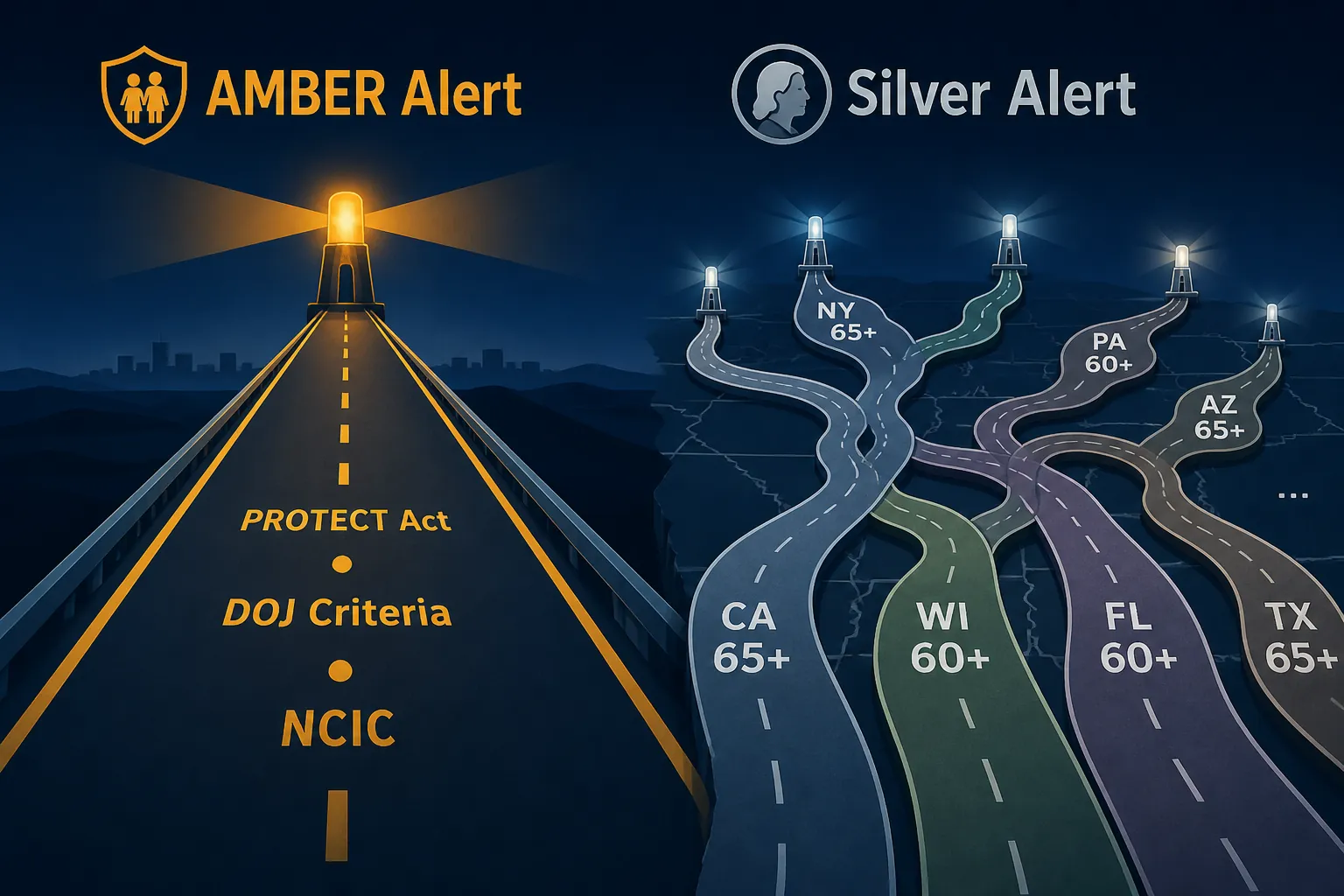
The comparison that matters is source of law
The fastest way to misstate this subject is to treat “alert” as a single public-safety button. It is not. AMBER, Silver, Ashanti, and the FCC’s Missing Endangered Persons code occupy different legal layers. Some tell officials when a program should be activated. Some tell federal agencies how to coordinate. Some give alert originators a communications code. Those are not interchangeable obligations.
| Alert pathway | Controlling source | Trigger or criteria | Operational consequence | Record status |
|---|---|---|---|---|
| AMBER Alert | Federal foundation: PROTECT Act and DOJ AMBER Alert coordination architecture.[1] | DOJ recommends five criteria: reasonable belief of abduction; child 17 or younger; imminent danger of serious bodily injury or death; enough descriptive information; and NCIC entry with the Child Abduction flag.[2] | A case is evaluated against nationally recommended criteria and entered into NCIC in the required manner when the criteria are met. | US federal layer; last verified Aug. 3, 2026. |
| California Silver Alert example | California Government Code § 8594.10 as described by the California Highway Patrol Silver Alert page.[3] | CHP describes the program as covering a missing person who is 65 or older, developmentally disabled, or cognitively impaired, subject to the state criteria.[3] | The relevant question is whether California’s statutory and CHP criteria are satisfied, not whether a national Silver Alert test exists. | State example only; last verified Aug. 3, 2026. |
| Wisconsin Silver Alert example | Wisconsin DOJ Silver Alert Program.[4] | Wisconsin describes eligibility as a missing person age 60 or older who is believed to have a permanent cognitive impairment, with a request made within 72 hours of the person’s disappearance.[4] | The 72-hour request condition matters; it is a state program condition, not a national Silver Alert rule. | State example only; last verified Aug. 3, 2026. |
| Florida Silver Alert example | Florida Department of Law Enforcement Silver Alert criteria page.[5] | The available source record identifies Florida criteria for persons 60 or older, or persons 18 to 59 who lack capacity, subject to FDLE criteria.[5] | Florida should be rechecked directly at the FDLE source before publication or operational reliance because the criteria page was not fully crawled in the research record. | State example with source-check caveat; last verified Aug. 3, 2026. |
| Ashanti Alert | Ashanti Alert Act, Pub. L. 115-401, signed Dec. 31, 2018; BJA program overview.[6] | A voluntary national communications network for missing persons over age 17 who fall outside AMBER Alert and Silver Alert scope.[6] | It does not convert Silver Alert into a federal program; it creates a separate federal gap-filling network. | Federal gap-filling layer; last verified Aug. 3, 2026. |
| Missing Endangered Persons EAS code | FCC Missing Endangered Persons Emergency Alert System code, effective Sept. 8, 2025.[7] | A standardized EAS event code for missing and endangered persons; the FCC ties the rule to cases outside AMBER criteria and to documented gaps in missing-person alerting.[7] | The code changes the communications landscape, but it does not supply one national Silver Alert statute. | Federal communications layer; last verified Aug. 3, 2026. |
A table is useful here only if the jurisdiction labels stay attached. “Silver Alert law requires” is an incomplete sentence unless the next words identify the state and the verification date. California, Wisconsin, and Florida are not being used as a sample from which to infer a national rule. They are being used because they show why no national Silver Alert answer is available.
Why AMBER has a federal legal spine
AMBER Alert’s federal structure begins with the PROTECT Act. DOJ’s AMBER Alert legislation page describes the Act as establishing the national AMBER Alert coordinator role and assigning coordination functions within the federal system.[1] That does not mean every activation decision is made in Washington. It does mean AMBER sits on a federal architecture in a way Silver Alert does not.
The DOJ guidelines are also operational rather than ceremonial. They recommend that AMBER Alerts be issued only when all five criteria are met:[2]
- Law enforcement must have a reasonable belief that an abduction has occurred.
- The child must be 17 years old or younger.
- The child must be in imminent danger of serious bodily injury or death.
- There must be enough descriptive information about the victim and the abduction for the alert to help recover the child.
- The child’s name and other critical data elements must be entered into NCIC, and the case must be flagged as a Child Abduction.
The fifth criterion is often the line that public summaries blur. AMBER is not only a broadcast decision; it is also a data-entry handoff. The DOJ guideline requires entry into the National Crime Information Center system and use of the Child Abduction flag.[2] For counsel, agencies, and newsrooms, that makes the record trail part of the legal and operational analysis. A missing child case may be urgent and still fail the AMBER criteria if the facts do not support abduction, imminent danger, or sufficient descriptive information.
That distinction is not a moral ranking of cases. It is the difference between an official alerting program with defined gates and the broader universe of missing-person reports. The family’s report becomes an official obligation only when the receiving agency can match the report to a program’s authority and required facts.
Silver Alert cannot be answered without a state name
Silver Alert is the legally unstable side of the comparison because there is no enacted federal Silver Alert statute that supplies one national eligibility rule. The phrase usually refers to state programs for missing older adults or missing persons with cognitive impairment, but the age threshold, impairment language, requester requirements, and timing windows are state-specific.
California: 65-plus, developmental disability, or cognitive impairment
California’s CHP Silver Alert page points to Government Code § 8594.10 and describes the program as applying to a missing person who is 65 years of age or older, developmentally disabled, or cognitively impaired, when the state criteria are met.[3] That language already differs from the common shorthand that Silver Alert is simply “for seniors.” In California, age is one path; developmental disability or cognitive impairment is another.
Wisconsin: 60-plus, permanent cognitive impairment, and a 72-hour request window
Wisconsin’s DOJ Silver Alert Program uses different gates. It describes the program as available for a missing person who is 60 or older and believed to have a permanent cognitive impairment. It also states that the request must be made within 72 hours of the person’s disappearance.[4] That timing condition is not decorative. It is precisely the kind of program rule that disappears when a national explainer says only that Silver Alerts are for missing older adults.
Florida: 60-plus, or 18 to 59 and lacking capacity
Florida’s FDLE Silver Alert criteria page identifies a different structure again: persons 60 or older, or persons ages 18 to 59 who lack capacity, subject to Florida’s criteria.[5] This row should be treated as a publication recheck item because the FDLE criteria page was not fully crawled in the research record. The safe compliance posture is to verify the FDLE text directly before stating Florida’s rule in a client memo, agency document, or newsroom guide.
The point is narrow but important: these three states do not prove what Silver Alert means everywhere. They prove the opposite. California’s trigger language, Wisconsin’s 72-hour request window, and Florida’s adult-capacity category require different intake questions. The person at the agency desk cannot solve the problem by knowing that a person is missing and endangered. The desk needs the jurisdiction, the statutory category, the activating authority, and the required facts.
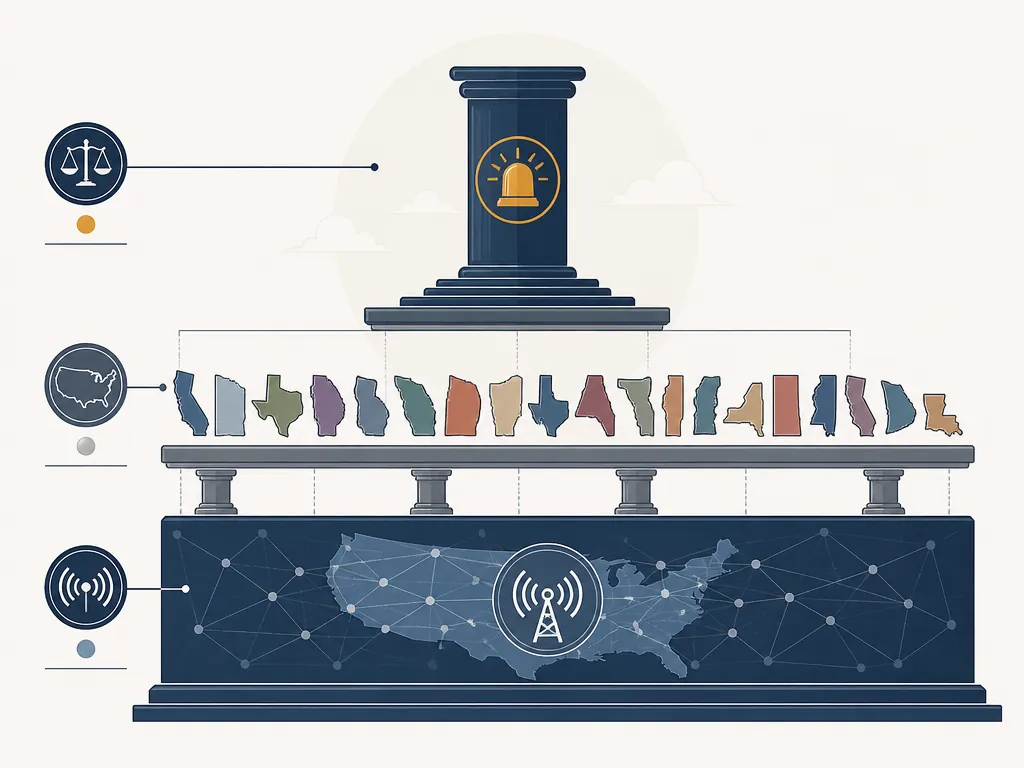
The failed federal Silver Alert history should not be treated as current law
Secondary legislative-history summaries report that a National Silver Alert Act proposal appeared as H.R. 6064 in 2008 and that H.R. 632 passed the House by voice vote on Feb. 11, 2009, but was not enacted.[8] That history helps explain the asymmetry with AMBER, but it should not be made to do more work than it can bear. A failed bill is not controlling law. Before publication, any detailed bill-history claim should be rechecked against the primary congressional record.
Older counts of how many states had Silver-type programs, and older recovery-rate statements, are also point-in-time materials. They may be useful in a policy history article. They are less useful in an obligations record where the live question is whether a particular state’s program can be activated today.
Ashanti Alert fills a federal gap; it is not a federal Silver Alert
The Ashanti Alert Act, signed Dec. 31, 2018, created a voluntary national communications network for missing persons over age 17 who fall outside the scope of AMBER Alert and Silver Alert.[6] That placement matters. Ashanti is not best described as a federal Silver Alert equivalent. It is a separate federal gap-filling framework for missing endangered adults who do not fit the child-abduction model and may not fit a state Silver Alert rule.
For a lawyer or newsroom standards editor, the Ashanti question comes after the AMBER and state Silver questions. If the person is a child and the abduction criteria are satisfied, AMBER is the relevant pathway. If the person fits the state Silver criteria, the state Silver program may be relevant. If the missing person is over 17 and falls outside those systems, Ashanti becomes part of the federal-layer check.
The FCC’s MEP code changed the communications layer in 2025
The newest federal development is the FCC’s Missing Endangered Persons Emergency Alert System event code. The FCC states that the MEP code became effective Sept. 8, 2025.[7] That date matters because the code is no longer a future proposal in this record. Any current comparison of AMBER and Silver Alert requirements should account for it.
The FCC’s stated data gap is substantial. Its MEP page says more than 188,000 people reported missing in 2023 did not meet AMBER Alert criteria, and it notes that Black persons were roughly 35% of missing adults while representing about 12% of the U.S. population.[7] Those numbers do not prove that any specific alert system is effective. They explain why a separate event code for missing endangered persons became legally and operationally significant.
The MEP code should not be confused with a new national Silver Alert statute. It standardizes an Emergency Alert System event code for missing endangered persons. It does not decide whether California, Wisconsin, Florida, or any other state must issue a Silver Alert in a particular case. The state activation rule still has to be checked.
What to check before saying an alert is legally available
- For AMBER: start with the PROTECT Act framework, the DOJ-recommended activation criteria, and the NCIC Child Abduction flag requirement.
- For Silver: start with the state statute or state program criteria. Do not describe Silver Alert as though it has one federal age threshold or one national impairment definition.
- For missing endangered adults outside AMBER and state Silver scope: check the Ashanti Alert framework and the FCC MEP event code.
- For any public-facing explanation: attach the jurisdiction and the verification date. “Silver Alert law requires” is not a complete legal statement without them.
That is the compliance line. AMBER begins with federal statute, DOJ criteria, and NCIC obligations. Silver begins with the state. Missing endangered adults outside both systems require an Ashanti and MEP-code check before anyone treats the gap as legally empty.
References
- Legislation — Office of Justice Programs
- Guidelines for Issuing AMBER Alerts — Office of Justice Programs
- Silver Alert — California Highway Patrol
- Silver Alert Program — Wisconsin Department of Justice
- Silver Alert Criteria — Florida Department of Law Enforcement
- Ashanti Alert Act Overview — Bureau of Justice Assistance
- Missing and Endangered Persons Emergency Alert System Code — Federal Communications Commission
- Silver Alert — Wikipedia
Operationalizing workflow
No workflow has been explicitly linked to this obligation yet. See Workflows generally.
Illustrative cases
No illustrative case is currently tracked for this obligation. See Risk Digest for documented incidents generally.
← Back to RegulationReport a correction or tip
Spotted an outdated figure, a misstated fact, or a ruling this regulation entry should reflect? Public comments are disabled for this content given the professional cost of a misreported case outcome, penalty amount, or rule text — use the structured correction channel instead.
Report a correction or tip for this record →