
How SEC Disclosure Rules Apply to AMC's CEO Compensation
- Authority
- U.S. Securities and Exchange Commission
- Rule type
- regulation
- Jurisdiction scope
- US federal
- Source text
- Read primary rule text ↗
Disclose CEO compensation in Item 402 tables, hold an advisory say-on-pay vote, and comply with exchange clawback-policy requirements under Rule 10D-1.

The first legal distinction in AMC’s CEO-compensation disclosures is the one most likely to get lost in public argument: SEC rules require the company to disclose executive compensation in prescribed places, and the federal proxy rules require a shareholder vote to approve, on an advisory basis, executive compensation as disclosed under Item 402, but that vote does not approve, veto, unwind, or reprice the CEO’s pay.[4] The obligation attaches to disclosure, voting procedure, board accountability, and exchange-listing clawback standards — not to direct shareholder ratification of the compensation decision.[5]
AMC’s FY2025 Form 10-K/A, accepted on EDGAR on April 30, 2026, gives a useful worked example. In the Summary Compensation Table, AMC disclosed CEO Adam Aron’s total compensation as $25,431,961 for 2023, $11,353,972 for 2024, and $14,975,072 for 2025. The same table disclosed stock awards of $17,908,855 for 2023, $5,444,104 for 2024, and $7,381,282 for 2025.[1] Those numbers matter legally because they are not just press-ready totals. They sit inside Regulation S-K Item 402’s architecture, and the stock-award column is calculated under the SEC’s table rules, not by simply asking how much cash changed hands.
Item 402 requires registrants to provide the compensation disclosures specified in the rule, including narrative discussion, tabular compensation data, potential termination payments, pay-ratio disclosure, pay-versus-performance disclosure, clawback-policy disclosure, and award-timing disclosure.[2] The SEC staff’s Item 402 interpretations also make clear that stock awards in the Summary Compensation Table are reported based on grant-date fair value under FASB ASC Topic 718, with related interpretive guidance on how the table operates.[3] That calculation point is easy to miss if the reader enters through the headline total rather than through the filing.
Where the CEO pay disclosure actually lands
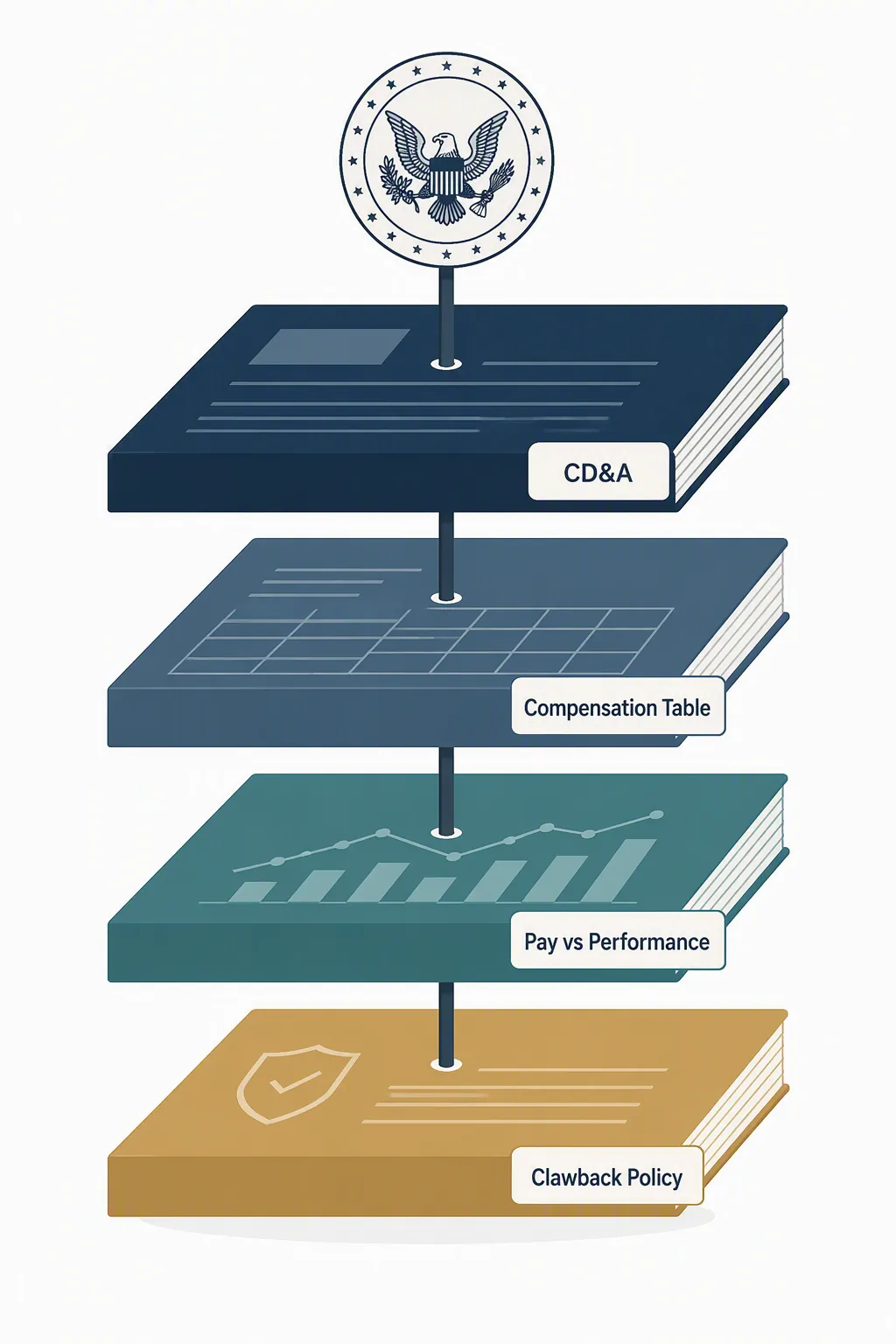
For a public-company reviewer, AMC’s CEO-compensation disclosure is not one item. It is a set of required locations. Some are tables. Some are narrative. Some are triggered by particular transactions or policies. The practical question is therefore not “what was the CEO paid?” in isolation, but “which Item 402 disclosure is carrying which part of the answer?”
| Disclosure area | Rule location | What the rule is doing in the filing |
|---|---|---|
| Compensation Discussion and Analysis | Item 402(b) | Explains the material elements of compensation for named executive officers and the company’s compensation policies and decisions. |
| Summary Compensation Table | Item 402(c) | Presents annual compensation amounts, including salary, bonus, stock awards, option awards, non-equity incentive plan compensation, pension changes and nonqualified deferred compensation earnings, all other compensation, and total compensation. |
| Termination and change-in-control payments | Item 402(j) | Requires disclosure of potential payments and benefits on termination or change in control, subject to the rule’s conditions. |
| Golden parachute compensation | Item 402(t) | Requires specified golden-parachute compensation disclosure in relevant transaction contexts. |
| CEO pay ratio | Item 402(u) | Requires disclosure comparing annual total compensation of the principal executive officer to the median employee, subject to the rule’s methodology. |
| Pay versus performance | Item 402(v) | Requires tabular and related disclosure comparing executive compensation actually paid with specified financial performance measures. |
| Clawback-policy disclosure | Item 402(w) | Requires disclosure tied to recovery of erroneously awarded compensation under the applicable clawback framework. |
| Option and similar award timing | Item 402(x) | Requires disclosure concerning policies and practices on timing certain awards in relation to material nonpublic information. |
That map is the starting point for reading AMC’s filing. The Summary Compensation Table answers one question; the CD&A answers a different one. The pay-versus-performance table is not a duplicate of the Summary Compensation Table. The clawback disclosure is not a substitute for the advisory vote. Treating those items as interchangeable is how a compensation story becomes legally imprecise.
The Summary Compensation Table is a rule calculation, not a moral label
AMC’s disclosed CEO totals for 2023, 2024, and 2025 appear in the Summary Compensation Table in the FY2025 10-K/A.[1] Item 402(c) prescribes the table and its columns.[2] That matters because the table is not designed as a one-line cash ledger. It aggregates specified compensation categories under SEC rules, including equity-award values that are reported on the required accounting basis.
The stock-award entries are a good example. AMC disclosed stock awards for Aron of $17,908,855 for 2023, $5,444,104 for 2024, and $7,381,282 for 2025.[1] Under the SEC staff’s Item 402 interpretations, stock awards reported in the Summary Compensation Table are reported at grant-date fair value under ASC 718.[3] That is not the same thing as saying the executive received that exact amount in cash during the year, or that the ultimate realized value of the equity will equal the disclosed grant-date value.
The legal usefulness of the table depends on that discipline. If a reader wants total compensation as defined for Item 402(c), the Summary Compensation Table is the place to look. If the reader wants realized equity gains, vesting conditions, incentive design, or board rationale, the analysis has to move to the surrounding tables and narrative rather than overloading the total-compensation column.
CD&A explains the decision architecture
Item 402(b) requires Compensation Discussion and Analysis for the named executive officers covered by the rule.[2] CD&A is where the filing moves from the numerical result to the company’s explanation of material compensation elements: what the program is designed to reward, how the compensation committee used performance measures or discretion, and how the elements of compensation fit together.
For AMC, the CD&A is the section a reviewer would read before deciding whether the table’s numbers have been placed in context. The Summary Compensation Table can show that a stock-award value was included. It does not, by itself, explain the compensation committee’s rationale for making the award, the performance conditions attached to it, or the committee’s view of retention and incentive objectives. Those points belong in the narrative disclosure when material under Item 402(b).
The pay-ratio and pay-versus-performance disclosures answer narrower questions
Item 402(u) requires CEO pay-ratio disclosure, a separate comparison between the principal executive officer’s annual total compensation and the median employee’s annual total compensation.[2] AMC’s FY2025 10-K/A includes Item 402(u) pay-ratio disclosure.[1] That disclosure is not a replacement for the Summary Compensation Table. It is a standardized comparison intended to locate CEO pay in relation to the company’s employee population under the rule’s methodology.
Item 402(v), the pay-versus-performance rule, does something else again. It requires a table and related disclosure comparing executive compensation actually paid with specified company performance measures.[2] The phrase “compensation actually paid” in that rule is a term of art. It is not simply the same number as the Summary Compensation Table total, and it should not be read as ordinary-language cash received without checking the rule’s required adjustments.
For AMC, this means a serious compensation review has to keep at least three measurement frames separate: Summary Compensation Table total compensation, CEO pay-ratio compensation, and pay-versus-performance “compensation actually paid.” Those frames may all concern Aron’s compensation, but they do not measure the same thing.
Termination, change-in-control, and golden-parachute disclosure sit outside the annual total
Item 402(j) requires disclosure of potential payments upon termination or change in control, subject to the terms of the rule.[2] This is where a filing addresses what named executive officers may receive if specified future events occur. Those amounts are not the same as annual compensation reported in the Summary Compensation Table, because they are contingent on termination, change-in-control, or related triggering circumstances.
Item 402(t) addresses golden-parachute compensation in relevant transaction settings.[2] It is a transaction-context disclosure, not a standing shareholder veto over annual CEO pay. If the disclosure is required, the company must present the required information in the prescribed context. The existence of the disclosure requirement does not convert annual say-on-pay into legal approval of a merger-related parachute arrangement.
Clawbacks are enforceable through listing standards and policy disclosure, not through say-on-pay
The clawback layer is often mentioned in the same public conversation as executive pay, but it is a different legal mechanism. Rule 10D-1 operates through exchange listing standards requiring listed issuers to adopt and comply with recovery policies for erroneously awarded incentive-based compensation after certain accounting restatements.[5] Item 402(w) then adds compensation-disclosure requirements tied to those clawback policies.[2]
That distinction is important after a negative say-on-pay vote. A failed advisory vote does not itself trigger a Rule 10D-1 recovery. A restatement-driven clawback analysis is not the same event as shareholder dissatisfaction with a compensation program. If recovery is required, it comes from the clawback policy and listing-standard framework; if disclosure is required, it is made under the relevant SEC disclosure rule.
Award timing disclosure is now part of the compensation-control file
Item 402(x) adds another control-oriented disclosure: policies and practices concerning the timing of certain option, stock-appreciation-right, and similar awards in relation to the disclosure of material nonpublic information.[2] It is not aimed at the size of a CEO’s annual pay package as such. It asks whether the company has policies and practices around timing awards near material information events and requires the prescribed disclosure.
In a company file, this disclosure belongs near the compensation controls and equity-grant process. It should not be collapsed into the Summary Compensation Table or treated as a vote outcome. Its relevance is procedural: how awards are timed, what policies exist, and what the company must tell shareholders about those practices.
What a negative say-on-pay vote does — and does not — do

The say-on-pay vote is mandatory to hold under the federal proxy regime, but advisory in legal effect.[4] That means shareholders are asked to vote on executive compensation as disclosed under Item 402, yet the vote does not itself amend an employment agreement, cancel an equity grant, claw back a vested award, or prohibit the board from making future compensation decisions.
The consequence is practical rather than self-executing. A negative vote can intensify scrutiny from proxy advisers, institutional investors, governance analysts, and investor-relations teams. It can create a board-response problem for the compensation committee. It can shape the next proxy statement, because the company may need to explain shareholder engagement, committee deliberations, compensation-program changes, or the reasons it did not make changes. But the vote is not a legal switch that turns a disclosed compensation number into an invalid payment.
That is the correct way to read AMC if shareholders reject or oppose the advisory compensation resolution. The filing still has to contain the required Item 402 disclosure. The company still has to run the required vote. The board still bears governance consequences for the result. What does not follow is automatic unwinding of Aron’s disclosed compensation solely because the advisory vote went against management.
A filing checklist keyed to AMC’s example
For a reviewer using AMC’s FY2025 10-K/A as the worked filing, the useful checklist is short and mechanical:
- Confirm the named executive officers and locate the CD&A required by Item 402(b).
- Read the Summary Compensation Table under Item 402(c), keeping the SEC calculation basis separate from cash received or realized equity value.
- For stock awards, check that the table is being read through the grant-date fair-value framework under ASC 718, as reflected in the SEC staff’s Item 402 interpretations.
- Locate the termination and change-in-control disclosure under Item 402(j), and do not mix contingent future payments into annual total compensation.
- Check whether any Item 402(t) golden-parachute disclosure is required in the relevant transaction context.
- Review the CEO pay-ratio disclosure under Item 402(u) as a separate ratio calculation.
- Review the pay-versus-performance table under Item 402(v), separating “compensation actually paid” from Summary Compensation Table total compensation.
- Confirm clawback-policy disclosure under Item 402(w) and separate that framework from the advisory say-on-pay vote.
- Check award-timing policies and practices under Item 402(x) where applicable.
- Read the say-on-pay result as an advisory vote with governance consequences, not as shareholder approval or disapproval with direct legal effect on the compensation already disclosed.
AMC’s disclosed CEO pay figures are large enough to attract attention, but the legal analysis begins only after the figures are put in their proper filing locations. The Summary Compensation Table gives the Item 402(c) total. The CD&A supplies the company’s material explanation. The pay-ratio and pay-versus-performance disclosures answer their own rule-specific questions. The clawback policy operates through the listing-standard recovery framework and related disclosure. The advisory vote supplies governance pressure, not legal approval power.
References
- AMC Entertainment Holdings, Inc. Form 10-K/A for FY2025, SEC EDGAR, accepted April 30, 2026, https://www.sec.gov/Archives/edgar/data/1411579/000141157926000016/amc-20251231x10k.htm
- 17 CFR 229.402 — Executive compensation, eCFR, https://www.ecfr.gov/current/title-17/chapter-II/part-229/subpart-229.400/section-229.402
- Compliance and Disclosure Interpretations: Regulation S-K, Item 402 and Item 407, SEC Division of Corporation Finance, https://www.sec.gov/divisions/corpfin/guidance/execcomp402interp.htm
- 17 CFR 240.14a-21 — Shareholder approval of executive compensation and golden parachute compensation, eCFR, https://www.ecfr.gov/current/title-17/chapter-II/part-240/section-240.14a-21
- 17 CFR 240.10D-1 — Listing standards relating to recovery of erroneously awarded compensation, eCFR, https://www.ecfr.gov/current/title-17/chapter-II/part-240/section-240.10D-1
Operationalizing workflow
No workflow has been explicitly linked to this obligation yet. See Workflows generally.
Illustrative cases
No illustrative case is currently tracked for this obligation. See Risk Digest for documented incidents generally.
← Back to RegulationReport a correction or tip
Spotted an outdated figure, a misstated fact, or a ruling this regulation entry should reflect? Public comments are disabled for this content given the professional cost of a misreported case outcome, penalty amount, or rule text — use the structured correction channel instead.
Report a correction or tip for this record →