
Arkansas Ten Commandments Monument Appeal Looms in Eighth Circuit
- Authority
- Eighth Circuit
- Rule type
- statute
- Jurisdiction scope
- US federal
- Source text
- Read primary rule text ↗
Current posture: pending appeal, not an Eighth Circuit decision
For anyone searching for an Arkansas Ten Commandments monument appeals court decision, the first correction is the most important one: there is no Eighth Circuit decision yet. As of Q3 2026, the appeal is pending as Eighth Circuit No. 26-1897, and the relevant new event is that Arkansas filed its opening brief on July 22, 2026.[1]
The case comes from the Eastern District of Arkansas, No. 4:18-cv-00342, where the district court issued a 148-page opinion on March 31, 2026, holding that the Capitol-grounds monument violated the Establishment Clause and that Arkansas also violated the Equal Protection Clause by excluding The Satanic Temple from comparable display access. The removal order was stayed, so the monument’s physical status and the appeal’s legal status are not the same thing.[2]
That distinction matters for client alerts and internal risk memos. What changed this week was not controlling law in the Eighth Circuit. It was the appellant’s opening move: Arkansas Attorney General Tim Griffin, represented on appeal with First Liberty Institute, asked the court to reverse and framed the district court’s opinion as one that “tosses aside” Kennedy v. Bremerton, the Supreme Court’s 2022 Establishment Clause decision.[1]
No verified response-brief deadline, amicus deadline, or oral-argument date appeared in the public materials reviewed for this update. Until the Eighth Circuit acts, the safe phrasing is pending appeal, opening brief filed, removal order stayed.
What the district court actually put on appeal
The appeal is not just a referendum on whether a Ten Commandments display is historically familiar. The district court gave the appellants two adverse holdings to attack: an Establishment Clause holding directed at the state-authorized monument itself, and an equal-protection holding tied to the state’s refusal to allow The Satanic Temple to install its own display under comparable terms.[2]
The plaintiff side is unusually broad for a public-display case. Public reporting describes individual Arkansans and religious or nonreligious objectors including a rabbi, a Presbyterian elder, a Wiccan, the Freedom From Religion Foundation, the American Humanist Association, Arkansas Society of Freethinkers, and The Satanic Temple as intervenor.[3]
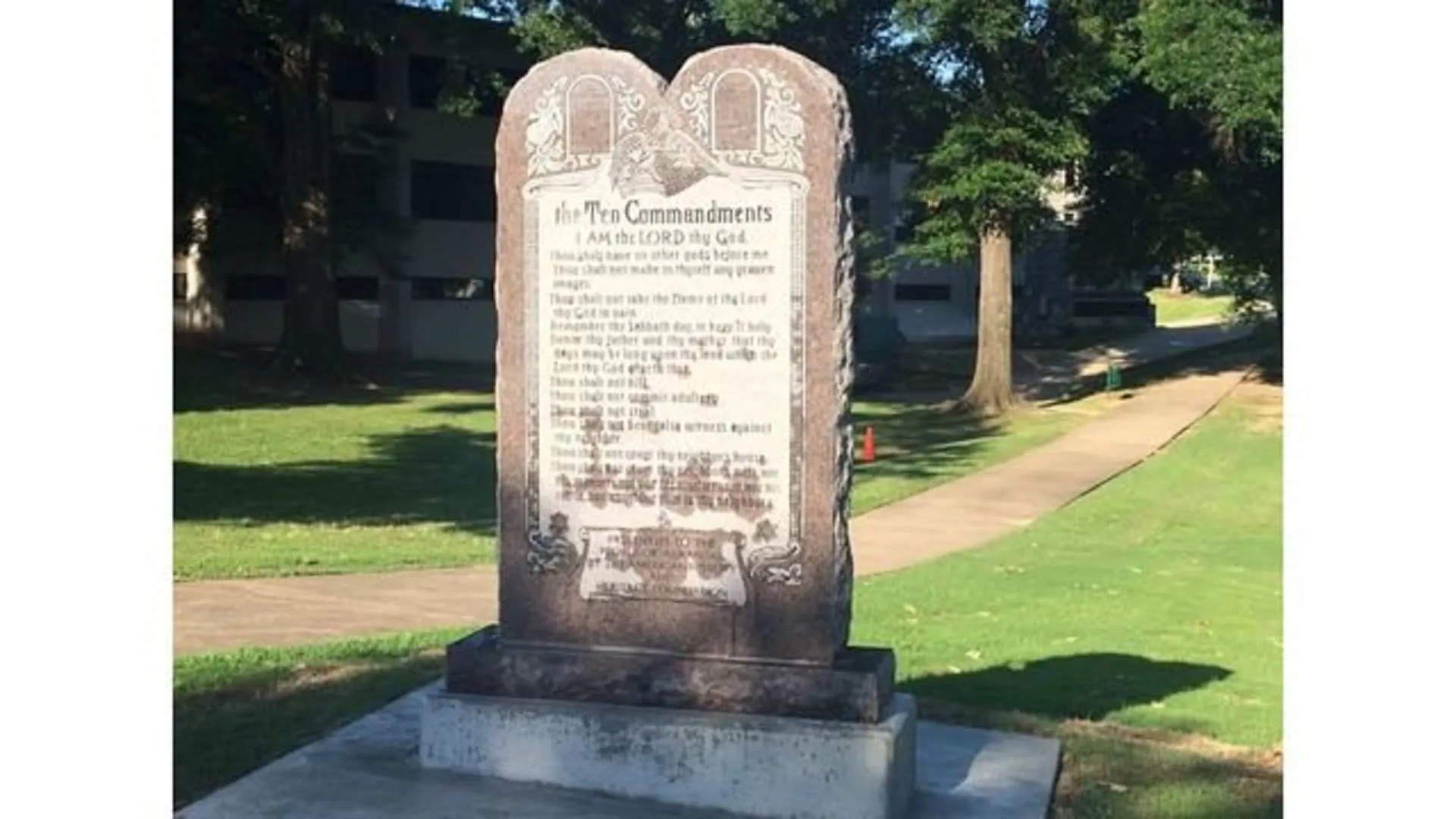
The monument facts are useful chiefly because they keep the case from collapsing into a classroom-display replay. The display is a 6,000-pound granite monument, privately funded and placed on Arkansas Capitol grounds between the State Capitol building and the Arkansas Supreme Court building. The original monument was destroyed by a vehicle on June 27, 2017, the day it was installed; the replacement was installed on April 26, 2018.[4][5]
Those facts do not decide the case. They do, however, give the Eighth Circuit several routes that do not exist in a classroom-only dispute: government speech on Capitol grounds, proximity to state legal institutions, the effect of a replacement after destruction, and the separate question whether Arkansas administered display access evenhandedly once it opened space to one religious text.
Why Stone and Kennedy now occupy the same sentence
The doctrinal problem is compact but not tidy. Stone v. Graham, decided in 1980, struck down a Kentucky law requiring Ten Commandments displays in public-school classrooms under the Lemon framework. Kennedy v. Bremerton, decided in 2022, rejected Lemon and redirected Establishment Clause analysis toward “historical practices and understandings.”[6]
That leaves the question now doing most of the work in Ten Commandments litigation: does Stone survive Kennedy, and if so, how much of Stone remains binding outside the public-school classroom? The Arkansas appellants say Kennedy requires courts to ask whether the Display Act and monument resemble the coercive hallmarks of a religious establishment, and they argue the Arkansas monument fits within a longstanding national tradition of Ten Commandments displays in American public life.[1]
The district court did not accept that framing. Commentary on the ruling describes the district court’s approach as a coercion-plus-endorsement analysis, which the appellants now characterize as incompatible with Kennedy.[7] That is the procedural hinge of the appeal: not whether Lemon is formally gone, but whether a lower court can still treat Stone as controlling when the challenged display is not a classroom posting and the Supreme Court has since changed the Establishment Clause test.
The Eighth Circuit does not have to answer that question as broadly as the parties may want. It could distinguish Stone because this is a monument on Capitol grounds. It could distinguish Nathan because Nathan involved classrooms. It could decide the equal-protection issue without writing the Establishment Clause opinion that cert-stage advocates would prefer. Those narrower routes are exactly why posture matters before predictions harden into talking points.
The circuit map as of Q3 2026
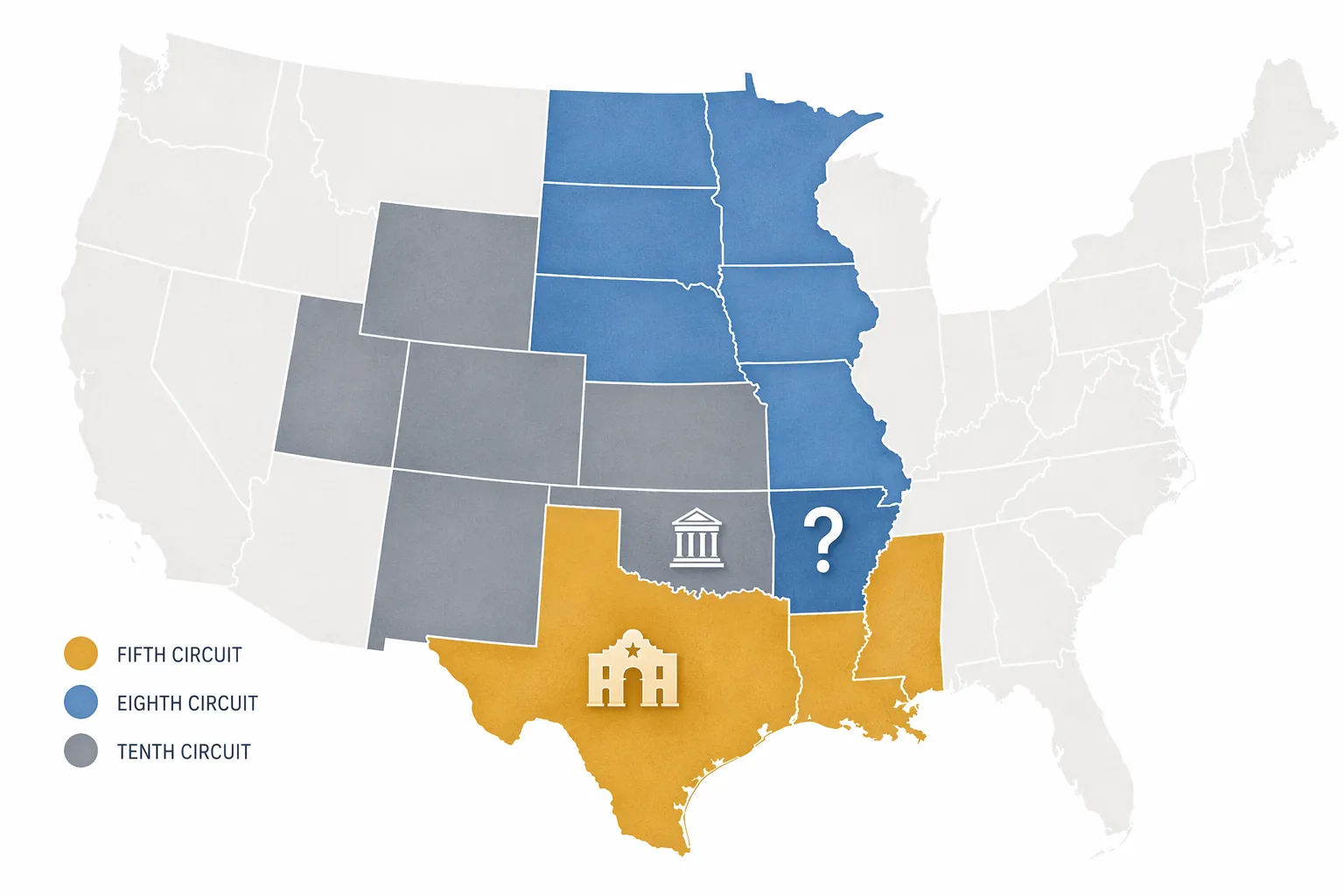
| Circuit | Current Ten Commandments posture | Why it matters |
|---|---|---|
| Fifth Circuit | Nathan v. Alamo Heights ISD, an April 2026 en banc decision, upheld a Texas classroom Ten Commandments display law by a 9-8 vote under Kennedy’s history-and-tradition framework.[6] | This is the post-Kennedy pro-display pole, but it arose in the school-classroom setting. |
| Eighth Circuit | Arkansas Ten Commandments monument appeal, No. 26-1897, pending after the July 22, 2026 opening brief; no Eighth Circuit monument precedent identified in the cited materials.[1][6] | This is the clean-slate circuit now positioned to say how Kennedy applies to a Capitol-grounds monument. |
| Tenth Circuit | The Oklahoma Ten Commandments monument removal ruling predates Kennedy and used a different Establishment Clause analysis.[6] | This remains the older removal-side reference point, but its pre-Kennedy posture limits how directly it maps onto current doctrine. |
The cleanest split would emerge if the Eighth Circuit affirms the Arkansas removal order on Establishment Clause grounds. In that posture, the Fifth Circuit would have a post-Kennedy decision upholding required Ten Commandments displays in classrooms, while the Eighth Circuit would have a post-Kennedy decision requiring removal of a Ten Commandments monument from Capitol grounds.
That would be visible enough for a cert petition, but still not perfectly symmetrical. Nathan is a classroom case. Arkansas is a monument case. The Tenth Circuit’s Oklahoma monument case is closer on physical setting, but older on doctrine. The Supreme Court may care about that mismatch; so should anyone drafting a risk memo today.
If the Eighth Circuit reverses, the national effect is different but still important. A reversal would not create the same removal-versus-display conflict with Nathan. It would instead make the Eighth Circuit another post-Kennedy court reading history and tradition to protect a government Ten Commandments display, while leaving the older Tenth Circuit monument ruling increasingly exposed as pre-Kennedy authority.
Certiorari path: probable, not date-certain
Supreme Court review is probable because the Arkansas appeal puts the unresolved Stone-after-Kennedy question into a relatively clean vehicle. The Eighth Circuit has no identified Ten Commandments monument precedent in the cited materials, the district court opinion is extensive, the removal order is stayed, and the appeal squarely asks the court to choose between a Kennedy-centered historical inquiry and a more endorsement-sensitive approach.
Probable does not mean scheduled. A petition cannot be evaluated as an actual filing until the Eighth Circuit issues a judgment and the losing side decides how to frame the question presented. Any calendar beyond the filed opening brief is still a watch item, not a fact.
Watch points before treating this as national law
- Whether the appellees frame Stone as still binding after Kennedy, or as limited to classroom compulsion.
- Whether amici push the Eighth Circuit toward a broad circuit-split opinion or a narrower monument-specific ruling.
- Whether the panel treats Nathan as persuasive post-Kennedy authority despite the classroom setting.
- Whether the equal-protection ruling involving The Satanic Temple supplies an independent ground that complicates Supreme Court review.
- Whether the stay remains in place while the appeal proceeds.
Where the tracker stands
The Eighth Circuit has not decided the Arkansas Ten Commandments monument appeal. The district court ordered removal but stayed that order. The opening brief filed July 22, 2026, has turned the case into one of the clearest pending vehicles for testing whether Stone v. Graham remains viable after Kennedy v. Bremerton, but the appeal is still a live case, not a completed circuit decision.[1][2]
References
- Court Asked to Reverse Decision Saying Ten Commandments Monument at the Arkansas Capitol Must Come Down — First Liberty Institute.
- Federal Court Strikes Down Ten Commandments Monument at Arkansas State Capitol as Unconstitutional — ACLU of Arkansas.
- Federal judge blocks law requiring Ten Commandments monument at Arkansas Capitol — Arkansas Times, April 1, 2026.
- Ten Commandments Monument (Little Rock, Arkansas) — Wikipedia.
- Arkansas Ten Commandments monument ruled unconstitutional — Baptist News Global.
- The Ten Commandments return to federal court — SCOTUSblog, January 2026.
- Satanic Temple Wins Legal Fight Over 10 Commandments Monument in Arkansas — Reason, April 2, 2026.
Operationalizing workflow
No workflow has been explicitly linked to this obligation yet. See Workflows generally.
Illustrative cases
No illustrative case is currently tracked for this obligation. See Risk Digest for documented incidents generally.
← Back to RegulationReport a correction or tip
Spotted an outdated figure, a misstated fact, or a ruling this regulation entry should reflect? Public comments are disabled for this content given the professional cost of a misreported case outcome, penalty amount, or rule text — use the structured correction channel instead.
Report a correction or tip for this record →