
How the 2026 asylum rule sends 444,000 cases to court
- Authority
- USCIS
- Rule type
- regulation
- Jurisdiction scope
- US federal
- Effective date
- Jul 28, 2026
- Source text
- Read primary rule text ↗
Allows USCIS to refer affirmative asylum cases to immigration court without an interview; over 444,000 pending cases affected.
Last verified: July 29, 2026. This article discusses the July 2026 interim final rule published at 91 FR 47101, not individualized legal advice. The rule was published on July 28, 2026, took immediate effect, and was issued as an interim final rule rather than through advance notice-and-comment rulemaking. USCIS’s own regulatory-impact tables identify 444,724 pending affirmative asylum cases, or 31% of a 1,434,145-case FY2025-end backlog, plus about 132,167 future applicants per year, as cases that may now be referred without the ordinary asylum officer interview step.[1]
What some searches describe as the new asylum deportation rule is, legally, this 2026 interim final rule. Its immediate effect is routing. A written affirmative asylum application can move from USCIS to immigration court without the applicant first sitting for the non-adversarial USCIS interview that has long been the ordinary checkpoint in the affirmative process.
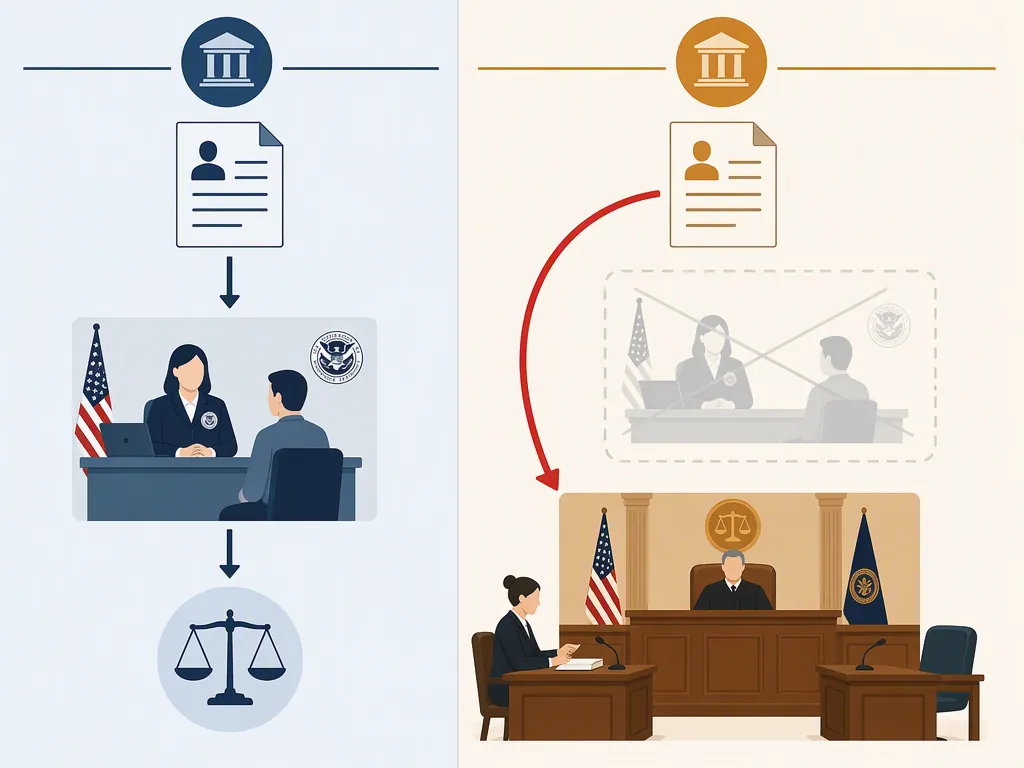
The Before-and-After Is a Change in Forum
Before the rule, the ordinary affirmative asylum path ran through USCIS: the applicant filed Form I-589, waited for an asylum office interview, and appeared before an asylum officer in a non-adversarial setting. That interview was not a statutory entitlement. It was still the practical baseline, and it mattered because it placed the first live test of the claim inside an agency process rather than inside removal court.
After the rule, specified affirmative cases may be referred to EOIR without interview. The applicant does not simply lose a meeting. The applicant is placed into INA §240 removal proceedings, where the case is heard by an immigration judge, ICE counsel appears as the opposing party, and there is no right to appointed counsel for the respondent.[1]
That distinction is the center of the rule. It does not repeal asylum. It does not say an immigration judge may not grant relief. It does, however, move a large class of cases from an affirmative adjudication track into a defensive posture before the government has conducted the interview that used to shape the referral.
| Prior ordinary affirmative path | July 2026 IFR path for covered cases |
|---|---|
| Written asylum application filed with USCIS | Written asylum application filed with USCIS |
| USCIS schedules a non-adversarial asylum officer interview | USCIS may refer without interview in specified categories |
| Referral follows officer processing that ordinarily includes an interview-based record | Referral can occur without a credibility assessment in the referral letter |
| If not granted, case can be referred to EOIR | Case enters INA §240 removal proceedings directly |
| No ICE trial attorney at the USCIS interview | ICE counsel appears in adversarial immigration court |
Which Cases Can Be Sent Without Interview
The rule does not make every affirmative asylum case an automatic court referral. Its practical reach turns on three referral categories: one-year-filing-date issues, mandatory bars, and discretionary referrals. Those categories are where counsel has to look first, because each changes the screening question from “prepare for interview” to “prepare for possible removal proceedings without interview.”[1]
One-year-filing-date issues
The largest identified affected pool is tied to the one-year filing deadline. The Federal Register’s regulatory-impact analysis estimates that 444,724 pending cases fall within the one-year-filing-date referral estimate, representing 31% of the 1,434,145-case affirmative asylum backlog at the end of FY2025.[1]
For a lawyer, that is not a background statistic. It is a triage instruction. Any pending affirmative case with a possible filing-deadline problem now has to be treated as a case that may be diverted before the client has the chance to explain changed circumstances, extraordinary circumstances, date disputes, entry history, or other deadline evidence in the familiar interview setting.
The written submission therefore carries more weight at the routing stage. Declarations, chronology, proof of entry, proof of changed conditions, proof of delayed discovery, medical or trauma evidence, and attorney argument on exceptions are no longer merely preparation for an officer conversation. In covered cases, they may be the only materials USCIS sees before deciding whether to send the applicant to court.
Mandatory bars
The rule also permits referral without interview where a mandatory bar is implicated. The Federal Register identifies mandatory bars as one of the categories that can trigger referral without the ordinary interview step.[1]
This is where imprecision becomes expensive. A criminal-history issue, firm-resettlement question, persecutor-bar concern, terrorism-related inadmissibility issue, or other statutory bar question may now create routing exposure before an officer has tested the applicant’s explanation in person. The rule does not make the bar finding final for all purposes, but it does change who must do the next hard thing. Instead of clarifying the issue first in a USCIS interview, the applicant may have to litigate it defensively before an immigration judge.
Discretionary referrals
The broadest operational verb in the rule is not “shall.” It is the permission to refer. The IFR allows asylum officers to refer certain cases without first deciding statutory eligibility, including on a discretionary basis.[1]
That matters because discretionary referral is not limited to a clean threshold defect. It gives the agency a procedural off-ramp before the interview has done any record-building work. The applicant may still receive de novo review in court, but the case arrives there as a removal case, not as an affirmative interview that failed to produce a grant.
USCIS retains the ability to request additional evidence before referral, so the rule should not be read as requiring immediate transfer in every covered case. The practical problem is that the RFE path is optional agency handling, while the applicant and counsel must prepare as if the written file could be enough to trigger court transfer.[1]
The Referral Letter Now Carries Less
The rule also removes the requirement that referral letters include credibility assessments. AILA’s summary of the IFR highlights the same operational change: officers may refer cases to EOIR without interview, and the rule removes the credibility-assessment requirement from referral letters.[2]
That is not a clerical deletion. A credibility assessment tells the receiving system something about what the officer heard, what the officer accepted, and what the officer thought required further testing. Without an interview, there may be no officer-tested narrative at all. Without a credibility assessment in the referral letter, the immigration court receives less of the agency’s own evaluation and more of a bare procedural transfer.
For counsel, the consequence is predictable. The court record may need to be built almost from scratch while the client is already in removal proceedings. If prior preparation assumed an asylum office interview would surface weaknesses, clarify translation problems, or identify missing corroboration, that assumption is no longer safe for covered cases.
De Novo Review Remains, but the Room Has Changed
The government can fairly say that immigration judges retain authority to review asylum claims de novo. That point should not be brushed aside. A referral without interview is not a merits denial that binds the immigration judge.
But de novo review is not the same thing as equivalent procedure. In immigration court, the applicant is a respondent in removal proceedings. ICE counsel appears for the government. The applicant has the privilege of counsel at no expense to the government, not a guarantee that counsel will be appointed. Filing quality, hearing attendance, witness preparation, interpreter issues, continuance practice, and local court management become merits-adjacent facts because they affect whether the claim is ever presented coherently.
The risk signal from the current court environment is severe, although it should be stated carefully. The Los Angeles Times, relying on data from Mobile Pathways, reported that asylum approval rates fell below 3% in January 2026, down from 18% in January 2025; the same reporting said 20% of asylum seekers nationally missed hearings, 41% of January 2026 decisions were classified as abandoned, and LA County had a 56% no-show rate.[3]
Those figures are not presented in the research materials as official EOIR baseline statistics. They are still material for risk assessment. A rule that accelerates transfer into a forum showing reported collapse in approvals and major hearing non-appearance problems should not be described as mere internal case management.

What Counsel Should Assume About Pending Affirmative Cases
The safest working assumption is that a pending affirmative case with a one-year issue, a possible mandatory bar, or facts that could invite discretionary referral now needs a removal-defense file before USCIS acts. That does not mean every such case will be referred. It means the loss event can occur earlier than many case plans contemplated.
- Audit filing-date exposure first: entry date, filing date, changed-circumstances theory, extraordinary-circumstances theory, and documentary support.
- Treat possible mandatory bars as routing risks, not only final merits risks.
- Update declarations so the written record can carry facts that previously might have been developed orally at interview.
- Prepare clients for the possibility that the next notice is not an interview notice but a referral into INA §240 proceedings.
- Build a court-ready packet early enough that a referral letter without credibility analysis does not leave the defense record underdeveloped.
Risk-management staff should also revisit advice given to clients who filed affirmatively because they expected the asylum office to be the first live adjudication point. That advice may have been accurate under the old procedural baseline. The new rule changes the handoff point, and a changed handoff point changes deadlines, staffing, client counseling, and malpractice exposure.
The Backlog Number Is Not Just Backlog Politics
The 444,724 figure is easy to flatten into a backlog-management talking point. The more precise reading is narrower and more consequential: the agency has identified a defined share of the affirmative backlog that may bypass the interview stage under the new rule. The same regulatory-impact analysis estimates approximately 132,167 future applicants per year may be affected.[1]
That matters because backlog reduction and risk transfer are different things. If a case leaves USCIS inventory by entering immigration court, the agency has reduced one queue by placing the applicant into another legal environment. The legal burden does not disappear. It changes forum, posture, and opposing party.
The 1994 Baseline Was Practice, Not a Statutory Guarantee
The prior interview-centered model should not be romanticized. The affirmative asylum interview was not a guaranteed safe harbor, and the research materials do not support treating it as a statutory right. Since the 1994 asylum rulemaking, however, the government had consciously retained interviews as the ordinary procedural baseline for affirmative adjudication.[1]
That baseline did real work. It gave the applicant a non-adversarial first forum. It let an asylum officer ask questions before the case became a removal case. It created a point at which credibility and eligibility could be tested without an ICE prosecutor at counsel table. Removing that checkpoint is not the same as repealing a statutory right, but it is still a material procedural change.
Forum Conditions Are Part of the Legal Effect
The rule arrives while immigration courts themselves are under pressure. The Los Angeles Times reported, in coverage of the new federal rule, that more than 100 immigration judges had been fired and replaced with military lawyers or former DHS prosecutors, that DOJ removed an immigration-law-experience requirement, and that the Pentagon authorized up to 600 military lawyers.[4]
Those facts do not prove how any individual judge will rule. They do matter to the receiving forum. A direct-referral rule has different practical effects in a stable, fully staffed, high-counsel-representation adjudication system than it has in a system where court staffing, respondent attendance, and approval outcomes are already under strain.
The APA Question Is Still Developing
DHS characterizes the IFR as a procedural rule exempt from notice-and-comment under 5 U.S.C. §553(b)(A), and it also invokes the foreign-affairs exception. Those are likely first-line litigation targets because the rule has large downstream consequences for applicants even if the agency frames the change as internal processing.[1]
As of July 29, 2026, no court challenge to this IFR has been identified in the research materials. That point matters. The APA argument is plausible and expected; it is not yet an outcome. Severability may also become important if challengers attack some referral categories or implementation features but not the entire rule.
The D.C. Circuit’s June 2026 Make the Road New York v. Noem expedited-removal decision is related immigration-procedure context, but it is a distinct development. This IFR stands or falls on its own text, administrative-law posture, and implementation record.
The Rule’s Legal Effect Is a Risk Shift
The July 2026 rule does not formally deny asylum, abolish immigration judge review, or make every affirmative applicant removable without a hearing. Its legal effect is more procedural and more immediate: it permits USCIS to skip the ordinary asylum officer interview for large categories of pending and future affirmative cases, issue a referral without a credibility assessment, and move the applicant into INA §240 proceedings.
That is where risk changes hands. USCIS reduces the need to conduct interviews in covered cases. Applicants and counsel inherit the burden of building a court-ready defensive asylum case earlier, with less agency-developed record, against ICE counsel, in a forum where counsel is not appointed and reported approval and appearance data show serious danger.
References
- Affirmative Asylum Referrals Without Interview, Federal Register, July 28, 2026.
- USCIS Announces IFR Allowing Officers to Refer Asylum Applicants to EOIR Without Interview, AILA.
- Asylum approvals plummet as fearful immigrants skip hearings, Los Angeles Times, March 3, 2026.
- New federal rule sends asylum cases to immigration courts, Los Angeles Times, July 27, 2026.
Operationalizing workflow
No workflow has been explicitly linked to this obligation yet. See Workflows generally.
Illustrative cases
No illustrative case is currently tracked for this obligation. See Risk Digest for documented incidents generally.
← Back to RegulationReport a correction or tip
Spotted an outdated figure, a misstated fact, or a ruling this regulation entry should reflect? Public comments are disabled for this content given the professional cost of a misreported case outcome, penalty amount, or rule text — use the structured correction channel instead.
Report a correction or tip for this record →