
August 2025 Family Visa Bulletin Dates — Verify AI Summaries
- Effective date
- Aug 1, 2025
Last reviewed for this article: July 24, 2026. This is a regulation-and-ethics reference for checking the august 2025 visa bulletin family green card update; it is not legal advice and should not replace review of the cited government and bulletin sources before any filing, client update, or case strategy decision.
For August 2025, USCIS selected the Dates for Filing chart for family-sponsored adjustment applicants and the Final Action Dates chart for employment-based applicants; USCIS listed that August 2025 chart-selection page as last reviewed on July 14, 2025.[1] The official Department of State August 2025 Visa Bulletin page is the underlying source document, but during crawl it returned an authentication-required error, so the family-sponsored dates below are cross-verified against USCIS’s chart-selection page and the bulletin reproductions published by Morgan Lewis, AILA, and Chugh LLP.[1][2][3][4]
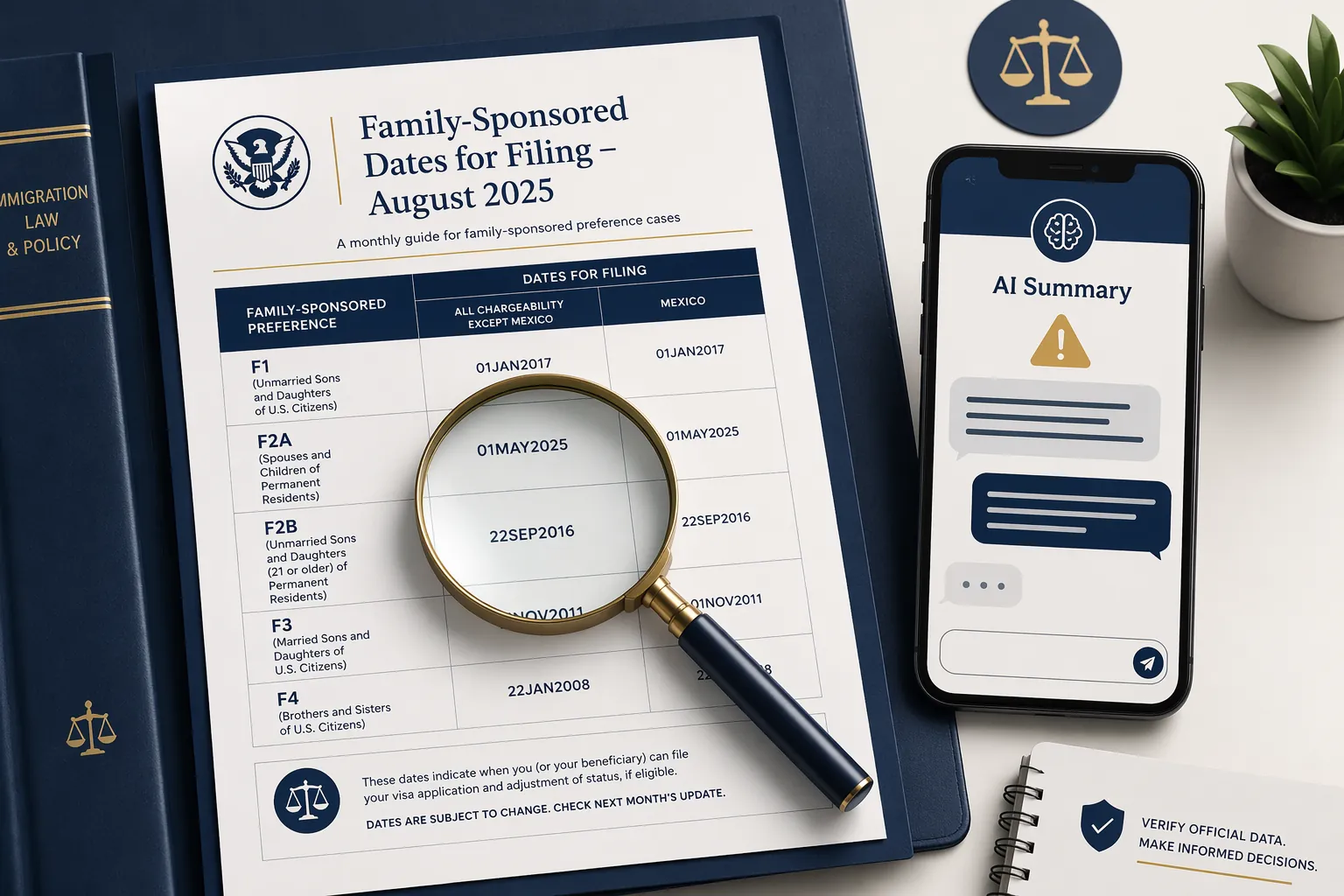
August 2025 Family-Sponsored Dates for Filing
This is the chart that matters for family-sponsored adjustment filing in August 2025. If an AI summary starts from Final Action Dates, mixes in employment-based chart selection, or says simply that “family categories advanced,” it has already missed the first control point.
| Family category | All chargeability areas except listed | China-mainland born | India | Mexico | Philippines |
|---|---|---|---|---|---|
| F1 | September 1, 2017 | September 1, 2017 | September 1, 2017 | April 1, 2005 | April 22, 2015 |
| F2A | April 1, 2025 | April 1, 2025 | April 1, 2025 | April 1, 2025 | April 1, 2025 |
| F2B | January 1, 2017 | January 1, 2017 | January 1, 2017 | January 1, 2006 | October 1, 2013 |
| F3 | July 22, 2012 | July 22, 2012 | July 22, 2012 | June 15, 2001 | May 8, 2004 |
| F4 | January 1, 2009 | January 1, 2009 | December 1, 2006 | April 30, 2001 | January 1, 2008 |
The movement pattern is narrow. F2A advanced one month to April 1, 2025 for all chargeability areas. F4 advanced to January 1, 2009 for Worldwide and China-mainland born. F1, F2B, and F3 showed zero movement across all chargeability areas.[2][3][4]
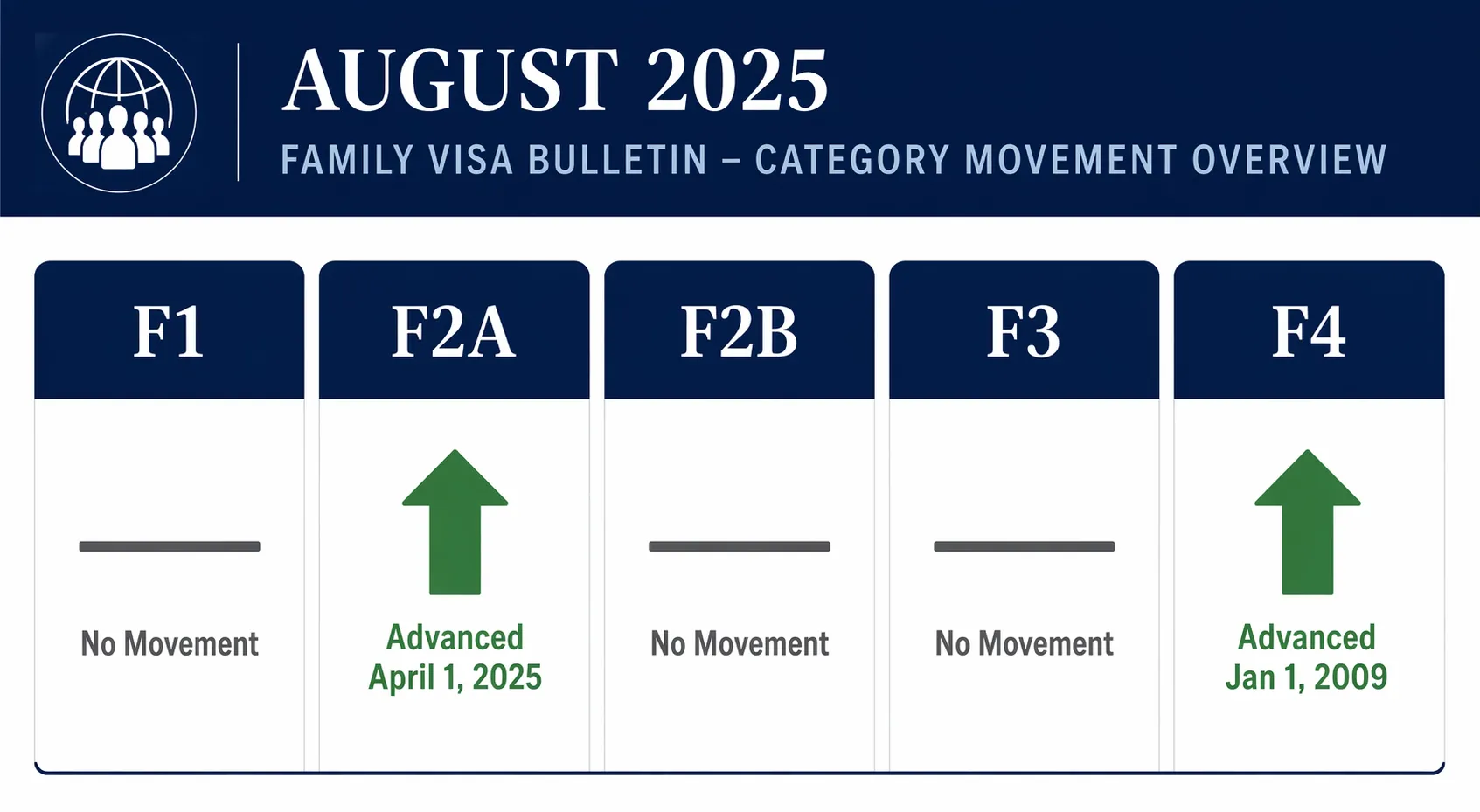
That distinction is the whole point. A summary that says “family-based dates moved forward in August” is not useful enough for practice. It may be directionally pleasant and still operationally wrong for a client in F1, F2B, or F3. It may be correct for one F4 chargeability area and wrong by implication for another. It may give the right date but attach it to the wrong chart.
What Changed, and What Did Not
For fast review, the August 2025 family update can be reduced to two actual advances and three category-wide freezes.
- F2A: advanced one month to April 1, 2025 for all listed chargeability areas.[2][3]
- F4 Worldwide and China-mainland born: advanced to January 1, 2009.[4]
- F1: no movement across all chargeability areas.[2][3][4]
- F2B: no movement across all chargeability areas.[2][3][4]
- F3: no movement across all chargeability areas.[2][3][4]
The fiscal-year context does not change the filing answer. The reproduced August 2025 bulletin text states a family-sponsored preference limit of 226,000 for FY2025, with a per-country limit of 25,620 and a dependent-area limit of 7,320.[4] Those numbers explain the statutory frame, but they do not tell a paralegal which August chart USCIS allowed or whether a particular priority date could be used for filing.
How to Test an AI-Generated August 2025 Summary
The check should be mechanical. Do not ask whether the AI answer “sounds right.” Ask whether it survives the same controls a human preparer would have to satisfy before a client-facing update leaves the office.
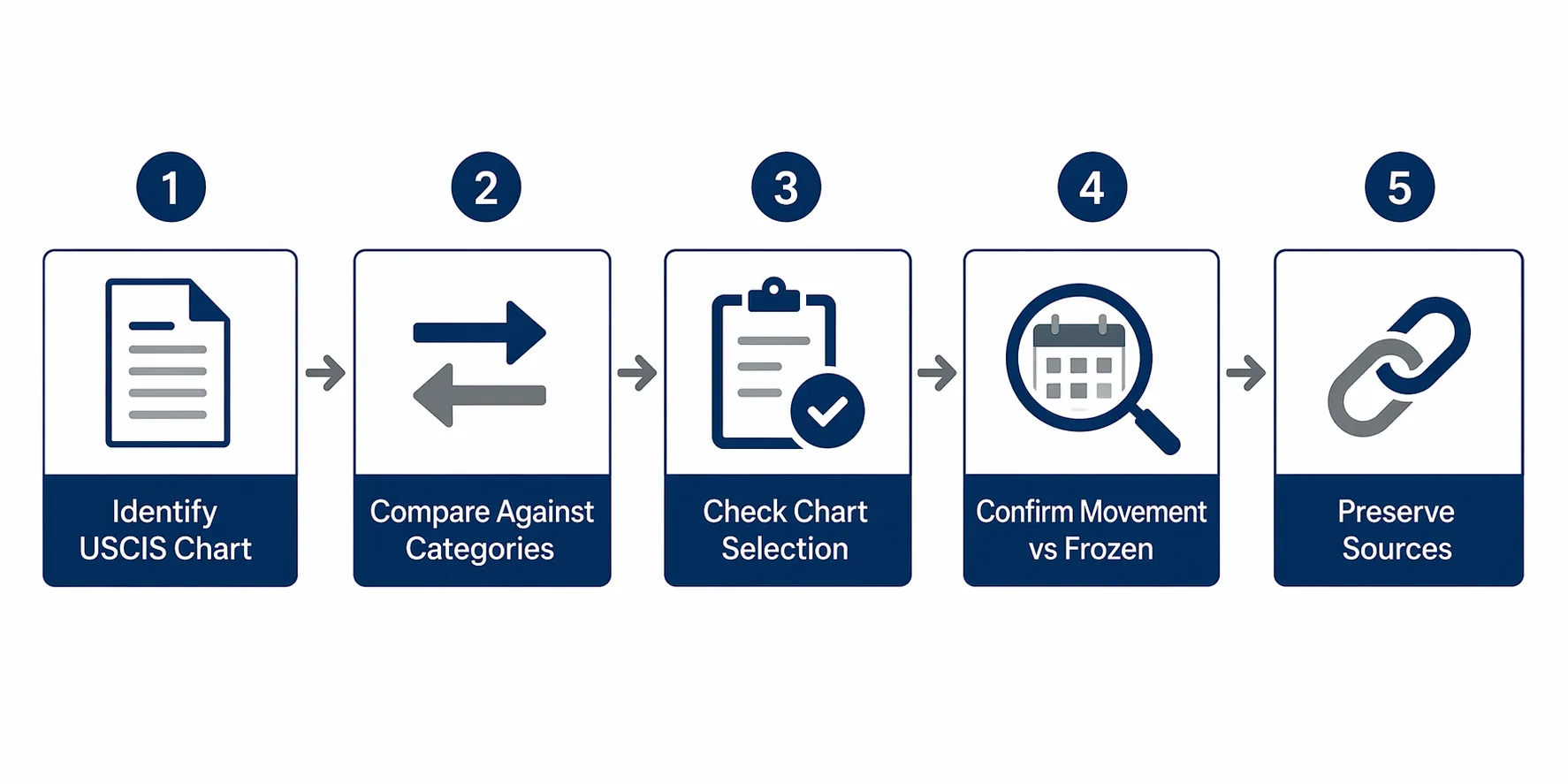
- Confirm the USCIS chart selection for August 2025. For family-sponsored adjustment applicants, the operative chart is Dates for Filing, not Final Action Dates.[1]
- Put the AI answer beside the family-sponsored Dates for Filing table, category by category and chargeability area by chargeability area.
- Look for employment-based contamination. An answer may correctly mention August 2025 USCIS chart selection but wrongly import the employment-based Final Action Dates rule into the family-sponsored analysis.
- Require the movement statement to name the categories. The answer should say F2A advanced, F4 Worldwide and China advanced, and F1, F2B, and F3 did not move.
- Preserve the source trail for the file: USCIS chart-selection page, the cross-checked bulletin reproductions, and a dated copy or screenshot if the client update relies on the table.
A useful answer can be short. It does not need to explain the history of the family preference system. It does need to identify the month, the chart, the family-sponsored table, the category, the chargeability area, and the movement status. If one of those fields is missing, the answer is unfinished.
A simple redline test
Take a sentence like this: “The August 2025 Visa Bulletin advanced family categories, including F2A and F4.” That sentence is not false enough to catch the eye, which is why it is dangerous. Redline it until it says: “For August 2025 family-sponsored adjustment filings, USCIS selected Dates for Filing. F2A advanced to April 1, 2025 for all chargeability areas; F4 advanced to January 1, 2009 for Worldwide and China-mainland born; F1, F2B, and F3 did not move.”
That edit changes the answer from a news-style summary into something a case team can check. It also exposes the most common failure: flattening category-specific movement into a general family-based improvement.
Why This Verification Step Belongs in the File
AI hallucination is not just a research inconvenience in immigration practice. Reuters reported in June 2026 that the Ninth Circuit sanctioned two immigration attorneys with six-month suspensions and $2,500 fines each for filing AI-hallucinated case citations and lack of candor, based on the visible lead paragraphs of the partially paywalled report.[5] That is litigation misconduct, not a visa bulletin error, but it shows the professional setting in which AI-generated legal material is now being judged.
CLINIC’s August 2025 example is closer to day-to-day immigration research. In a controlled test, ChatGPT fabricated an immigration case citation — “Campbell v. Barr,” 956 F.3d 542, 553 (2d Cir. 2020) — and supplied analysis that appeared authoritative.[6] One test is not a prevalence study. It is enough, however, to remind a case team that fluency does not verify a source.
EOIR Policy Memorandum PM 25-40, effective August 2025, also signaled EOIR’s intent to address AI misuse under existing professional conduct rules.[6] A wrong August 2025 family chart in a client email is not the same event as a fabricated court citation, but both failures begin with the same bad habit: letting generated text pass as checked legal work.
What to Save With the August 2025 Client Update
A clean record does not need to be elaborate. It should let another person in the office reconstruct why the update said what it said.
- USCIS August 2025 When-to-File page showing Dates for Filing for family-sponsored applicants and Final Action Dates for employment-based applicants.[1]
- The family-sponsored Dates for Filing table reproduced from cross-checked bulletin sources.[2][3][4]
- A note that the official DOS August 2025 bulletin page could not be directly crawled because it returned an authentication-required error during source collection.
- A short movement note: F2A advanced; F4 Worldwide and China advanced; F1, F2B, and F3 froze.
- If AI assisted the first draft, the original AI output and the corrected version used for the final client-facing communication.
The August 2025 family bulletin is a poor candidate for casual summarizing because the action is limited and uneven. No client-facing filing instruction, eligibility note, or “good news” email should move forward until the USCIS chart selection and the family-sponsored Dates for Filing table have been checked against the cited sources.
References
- When to File Your Adjustment of Status Application for Family-Sponsored or Employment-Based Preference Visas: August 2025, USCIS, July 14, 2025, link
- US Department of State Releases August 2025 Visa Bulletin, Morgan Lewis, July 2025, link
- Visa Bulletin for August 2025, AILA, Doc. No. 25071406, link
- August 2025 Visa Bulletin, Chugh LLP, link
- US appeals court sanctions lawyers over AI hallucinations, lack of candor, Reuters, June 3, 2026, link
- I’m sorry, I just hallucinated: ChatGPT’s apologies won’t protect you, CLINIC, link
Operationalizing workflow
No workflow has been explicitly linked to this obligation yet. See Workflows generally.
Illustrative cases
No illustrative case is currently tracked for this obligation. See Risk Digest for documented incidents generally.
← Back to RegulationReport a correction or tip
Spotted an outdated figure, a misstated fact, or a ruling this regulation entry should reflect? Public comments are disabled for this content given the professional cost of a misreported case outcome, penalty amount, or rule text — use the structured correction channel instead.
Report a correction or tip for this record →