
What International Law Applies to Autonomous Drone Strikes?
- Authority
- United Nations / IHL treaty framework
- Rule type
- treaty and customary international law
- Jurisdiction scope
- International
- Source text
- Read primary rule text ↗
Verify lawful basis for force; apply distinction, proportionality, and precautions; complete Article 36 weapons review.
Last verified: July 31, 2026. This tracker is general legal information, not legal advice.
If an autonomous drone strike is proposed, conducted, or later investigated, the starting point is not a legal vacuum. Existing international law applies. The harder answer is narrower: no current treaty rule prohibits armed drones or autonomous weapon systems outright, so the legality of a particular strike turns on the system, the target, the operating environment, and the evidence that the ordinary rules on distinction, proportionality, and precautions could be satisfied at the time of use. ASIL’s 2025 survey of the issue describes broad agreement in UN and CCW settings that existing international law applies to autonomous weapons systems, while the ICRC’s drone FAQ states the no-per-se-prohibition baseline for armed drones and ties their use to ordinary IHL targeting rules. [1][2]
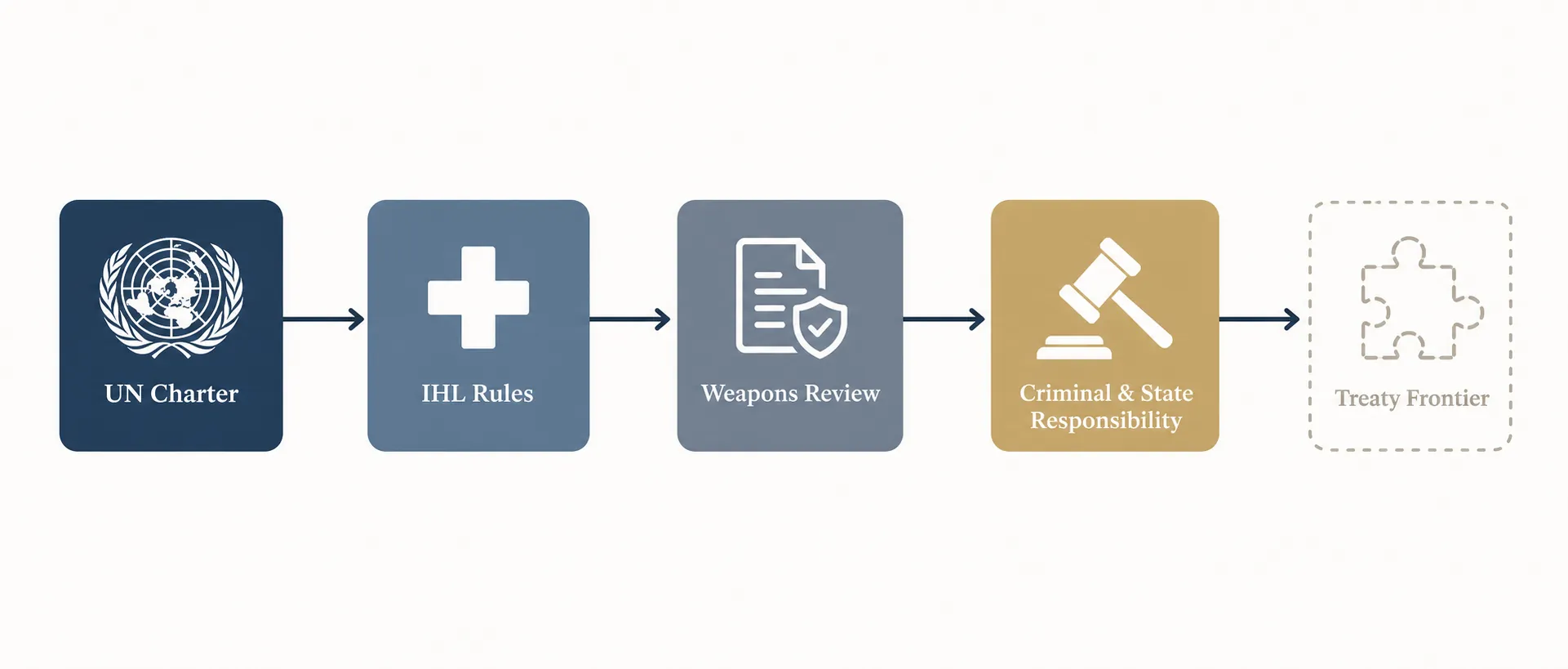
| Decision point | Law that comes into view | What counsel should test |
|---|---|---|
| Before any strike is authorized | UN Charter rules on the use of force | Is there a lawful basis for force at all — consent, Security Council authorization, or self-defense — before the drone’s autonomy level matters? |
| When a target is selected or engaged | International humanitarian law targeting rules | Can the specific system, in this environment, distinguish lawful targets, support a proportionality judgment, and permit feasible precautions? |
| Before a new system is fielded | Weapons-law review, including Article 36 AP I for states bound by it | Has the state reviewed whether the weapon, means, or method of warfare would be prohibited in some or all expected uses? |
| After civilian harm or an allegedly unlawful strike | International criminal law, command responsibility, and state responsibility | Who made the legally relevant decisions, what was foreseeable, what was logged, and whether the state or individuals can be tied to the act? |
| At the policy frontier | UN, CCW, and treaty-process debates | Are existing rules considered sufficient, or should meaningful human control and new prohibitions become binding law? |
First separate the machine from the legal question
The phrase “autonomous drone strike” often compresses three different things. A remote-piloted drone may be legally important, but the target is still selected and engaged by human operators through a communications link. AI-assisted targeting may recommend, rank, or classify objects, while a person still authorizes the use of a weapon. An autonomous weapon system raises the distinct legal problem: after activation, the system selects and applies force to targets without further human intervention. The ICRC uses that basic functional definition for autonomous weapon systems, while also emphasizing that states have not agreed on a single universal definition. [3]
That distinction matters because “drone” is not the prohibited category. “AI” is not the prohibited category either. The legally relevant moment is the selection or engagement of a target and whether the human, machine, and operating constraints together allow the strike to meet the rules that already govern attacks.
A loitering munition used only against radar emissions at sea, an armed quadcopter directed at a person in an urban street, and a remotely piloted aircraft firing after a human review may all be described casually as “drone strikes.” They do not raise the same international-law analysis. Counsel should identify the system’s actual autonomy at the engagement point before moving to the IHL test. For a procurement-focused way to frame that inquiry, see the site’s terminal-autonomy liability workflow.
The UN Charter question comes before the targeting question
An autonomous system does not create its own right to use force. Before the strike is assessed as an attack under IHL, the state still needs a lawful jus ad bellum basis. The ordinary Charter analysis comes first: whether force is barred, justified by self-defense, authorized by the Security Council, or conducted with valid consent. ASIL’s treatment of autonomous weapons places that threshold within the same existing international-law frame rather than treating autonomy as a separate permission structure. [1]
That order matters in investigations. A strike can be operationally precise and still be an unlawful use of force if the state had no lawful basis to act in the territory concerned. The reverse is also true: a lawful basis for force does not excuse a targeting violation once IHL applies. Autonomy changes the evidence and the compliance controls; it does not collapse those two legal inquiries into one.
Where lawfulness usually turns: distinction, proportionality, and precautions
The ICRC’s FAQ states the baseline cleanly: armed drones are not prohibited as such and are legally comparable to weapons launched from manned aircraft, but their use in armed conflict must comply with distinction, proportionality, and precautions in attack. [2]
For an autonomous drone strike, distinction is not satisfied by saying that the system has an object-recognition model. The relevant question is whether the system can be confined to lawful targets in the actual operating environment. A sensor package that performs tolerably in a controlled desert test range may be insufficient in a city, near medical transport, around surrendering persons, or in a setting where civilians and fighters use visually similar vehicles. The legal issue is not whether the system is sophisticated; it is whether it can reliably support the distinction required for the attack being authorized.
Proportionality is still a human legal judgment, even if software contributes to detection, tracking, or timing. The commander or other responsible decision-maker must assess expected incidental civilian harm against the concrete and direct military advantage anticipated. A system that autonomously finds targets across a broad area can make that judgment harder to document because the person authorizing launch may not know which specific object will be engaged later. That does not make proportionality impossible in every use; it does mean the review must ask how the anticipated engagement set, location, time window, munition effects, and abort conditions keep the later machine action within the proportionality judgment actually made.
Precautions are where many paper assurances either become operational controls or fail. The review should identify who verifies the target category, who sets the geographic and temporal boundaries, what civilian-presence assumptions are used, what happens if the communications link fails, whether the system can be recalled or deactivated, and what information would trigger cancellation or suspension. If the system cannot provide enough control or feedback to support feasible precautions in the intended environment, the strike should not be briefed as lawful merely because the weapon class is not banned.
The practical result is conditional legality. A system might be reviewable for a narrow anti-materiel role in a bounded area and still be unlawful or unusable for selecting persons in a civilian-heavy environment. “Autonomous” is not a single legal answer; it is a set of facts that must be tested against the same IHL obligations that govern other attacks.
Article 36 is the compliance gate, not a strike-by-strike absolution
For states bound by Additional Protocol I, Article 36 requires a legal review when a state studies, develops, acquires, or adopts a new weapon, means, or method of warfare. In autonomous-drone analysis, that review is the bridge between abstract legality and a deployable system. It asks whether the weapon’s employment would be prohibited in some or all circumstances under applicable international law. ASIL treats Article 36 reviews as a central existing-law mechanism for autonomous weapons, and the ICRC’s autonomous-weapons position likewise places legal reviews inside the current compliance architecture. [1][3]
A serious review should not stop at the airframe or munition. It should examine the sensors, training and validation data, target-profile logic, failure modes, operator interface, human-supervision design, communications assumptions, cybersecurity exposure, and the environments in which the system is approved for use. The narrower the approved use case, the more plausible the review may be. The broader the target set and operating area, the more the review must explain how distinction, proportionality, and precautions remain achievable.
Nor does an Article 36 review make every later strike lawful. It is a pre-use legality review of the weapon, means, or method. The actual strike still depends on the facts at the time: what the system detected, what civilians were expected to be nearby, what commanders knew or should have known, what constraints were programmed, and whether the attack was cancelled or suspended when the legal assumptions changed. A weapons review can show that the state built a compliance process; it cannot launder a later misuse.
For a related treatment of Article 36 as the compliance ceiling for AI-enabled drones, see the site’s Geneva Conventions compliance tracker for AI drones.
The Kargu-2 Libya report is important, but limited
The most-cited autonomous-strike reference remains the UN Panel of Experts report on Libya. In its March 2021 report, the Panel described STM Kargu-2 loitering munitions as having been programmed to attack targets without requiring data connectivity between operator and munition, using the phrase “fire, forget and find.” [4]
That finding matters because it shows why the debate is no longer only hypothetical. It should not be made to do more than it does. The Panel report is not a judicial finding that the system unlawfully killed anyone. It is not a treaty interpretation holding that autonomy itself is prohibited. It is an evidentiary marker: investigators and lawyers now have a concrete example of a system alleged to have operated with target-selection autonomy in an armed conflict.
Accountability does not vanish, but proof gets harder
Autonomy complicates accountability by spreading legally relevant choices across design, procurement, testing, deployment, authorization, and field operation. That is different from saying no one can be responsible. International criminal law still asks whether individuals committed, ordered, aided, abetted, or otherwise contributed to crimes, and command responsibility still turns on authority, knowledge, and failure to prevent or punish. State responsibility still asks whether conduct is attributable to the state and whether an international obligation was breached. The difficulty is often evidentiary: who knew what, when the risk became foreseeable, and whether the system’s logs can reconstruct the causal chain. [5]
That is why documentation is not administrative housekeeping. It is the record on which later legality and responsibility may turn: the Article 36 review, approved use cases, target-class constraints, commander’s proportionality assessment, operator training, software version, sensor performance, mission logs, override attempts, and post-strike battle damage assessment. If those records are missing, the legal problem may become less about a doctrinal gap than about a proof gap.
This article does not re-litigate the full liability architecture. For the longer accountability workflow, use the site’s terminal-autonomy liability guide.
Meaningful human control is the frontier, not yet the settled rule
The live treaty debate is not whether existing law applies. It is whether existing law is sufficient for weapons that select and apply force without further human intervention. “Meaningful human control” has become the main vocabulary for that concern, but it is not yet a universally defined binding treaty standard. Lieber Institute analysis of the concept emphasizes the difficulty of determining how much control is legally meaningful, at what point in the targeting cycle, and for which categories of systems. [6]
The ICRC’s position is more prescriptive than the current treaty baseline. It calls for new legally binding rules that would prohibit autonomous weapon systems that are unpredictable, prohibit systems designed or used to apply force against persons, and regulate other autonomous weapon systems through limits on target types, duration, geographical scope, scale of use, situations of use, and human supervision. [3]
Other states and commentators take a more sufficiency-oriented view, arguing that existing IHL can regulate autonomous systems without a fixed one-size-fits-all human-judgment rule. ASIL’s 2025 account describes that split and notes the joint call by UN Secretary-General António Guterres and ICRC President Mirjana Spoljaric for states to conclude a legally binding instrument on autonomous weapon systems by the end of 2026. [1]
UN votes show momentum, not a binding ban
The political track is moving. Human Rights Watch reported that UN General Assembly Resolution 79/62 was adopted on December 2, 2024 by a vote of 166-3-15, with Belarus, North Korea, and Russia opposed and China, India, Israel, Türkiye, and Ukraine among the abstentions; it also reported the prior Resolution 78/241 in December 2023 as adopted 152-4-11. The UN Digital Library record confirms Resolution 79/62 as the official UN record. [7][8]
At First Committee, Stop Killer Robots reported a November 2024 vote of 161-3-13 for draft resolution L.77. That figure is useful as a momentum signal, but it comes from an advocacy campaign and should be treated as such. [9]
None of those votes creates a categorical prohibition on autonomous drone strikes today. They do show that the legal-risk environment is not static. A state or contractor briefing only the absence of a present ban, while ignoring the treaty process and human-control debate, would be giving an incomplete risk picture. A state or advocate describing the votes as if they already created a binding ban would be overstating the law.
The briefing answer
The defensible answer to “what international law applies to autonomous drone strikes?” is: all of the ordinary law applies. The UN Charter governs whether force may be used at all. IHL governs the attack through distinction, proportionality, and precautions. Weapons law requires serious pre-use review, especially Article 36 review for states bound by Additional Protocol I. International criminal law and state responsibility remain available after unlawful harm, even if autonomy makes proof and attribution harder.
The strike should not be briefed as unregulated. It also should not be briefed as categorically banned under existing treaty law. The live compliance risk is evidentiary and operational: whether the particular system, in the particular environment, under the particular human-supervision and operational constraints imposed, can meet the targeting rules that already bind it — and whether the record will prove that after the fact.
References
- ASIL Insights, Volume 29, Issue 1 — American Society of International Law
- FAQ: International humanitarian law and drones in armed conflict — International Committee of the Red Cross — Dec. 2025
- ICRC position on autonomous weapon systems — International Committee of the Red Cross — May 2021
- Final report of the Panel of Experts on Libya established pursuant to Security Council resolution 1973 (2011) (S/2021/229) — Security Council Report — Mar. 2021
- Legal Accountability for AI-Driven Autonomous Weapons — Lieber Institute, Articles of War — Mar. 2026
- How Meaningful is Meaningful Human Control in LAWS Regulation? — Lieber Institute, Articles of War — Mar. 2025
- Killer Robots: UN Vote Should Spur Treaty Negotiations — Human Rights Watch — Dec. 5, 2024
- A/RES/79/62 — UN Digital Library — Dec. 2, 2024
- 161 states vote against the machine — Stop Killer Robots — Nov. 2024
Operationalizing workflow
No workflow has been explicitly linked to this obligation yet. See Workflows generally.
Illustrative cases
No illustrative case is currently tracked for this obligation. See Risk Digest for documented incidents generally.
← Back to RegulationReport a correction or tip
Spotted an outdated figure, a misstated fact, or a ruling this regulation entry should reflect? Public comments are disabled for this content given the professional cost of a misreported case outcome, penalty amount, or rule text — use the structured correction channel instead.
Report a correction or tip for this record →