
Explaining the Bakken Ruling on West Point Civilian Professor Speech Rights
- Authority
- U.S. District Court for the Southern District of New York
- Rule type
- preliminary injunction
- Jurisdiction scope
- US federal
- Effective date
- May 26, 2026
- Source text
- Read primary rule text ↗
West Point must not enforce speech pre-approval policies on civilian faculty
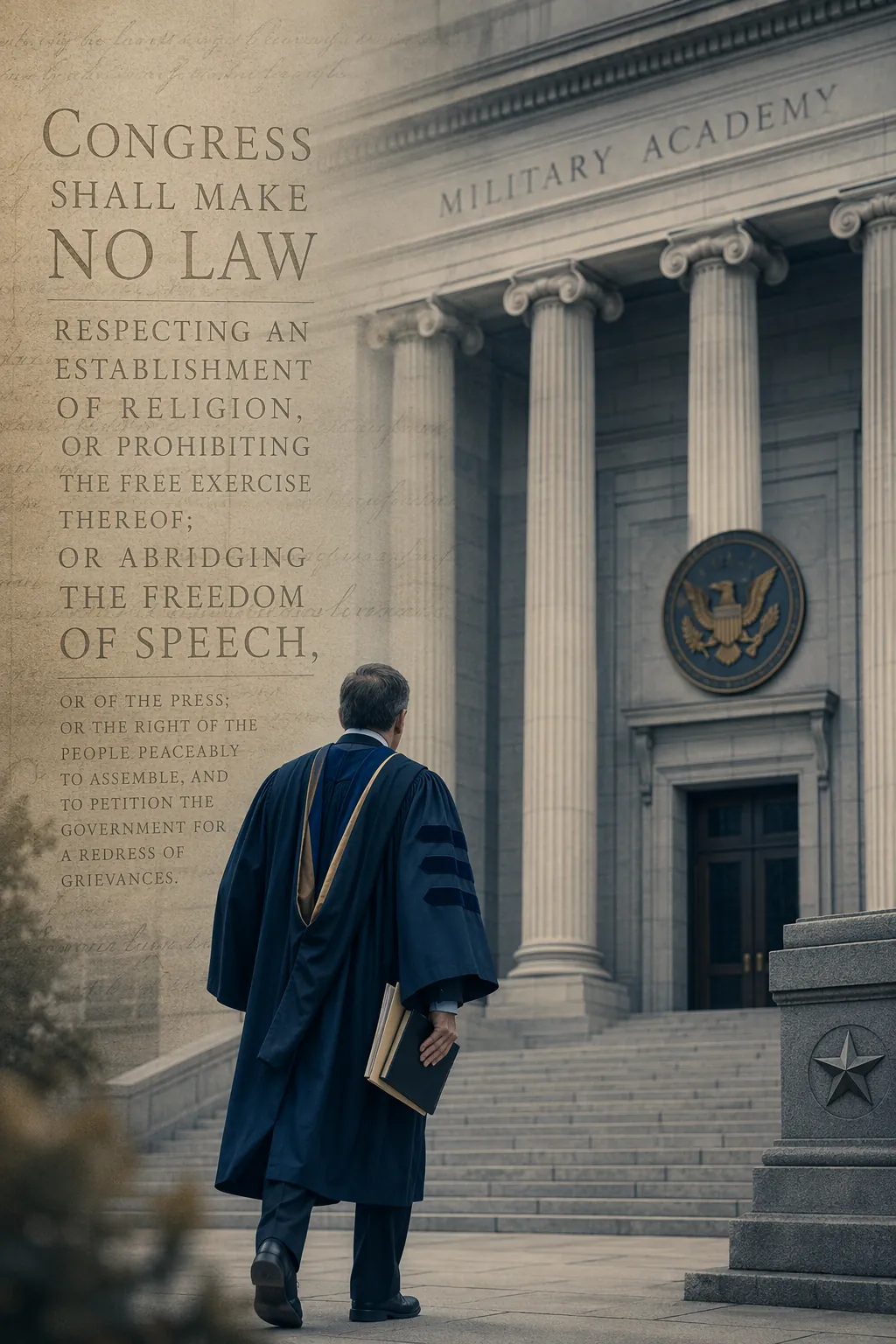
On May 26, 2026, Judge Cathy Seibel of the Southern District of New York granted a preliminary injunction in Bakken v. United States Military Academy, No. 7:25-cv-07826, blocking West Point from enforcing challenged speech policies against civilian faculty while the case proceeds. The injunction does not extend to active-duty faculty, and it is not a final judgment invalidating the policies permanently. It is an interim merits-and-harm ruling: enough to stop enforcement for now, not enough to end the case. [1][2]
That posture matters. A preliminary injunction requires a court to evaluate likelihood of success, irreparable harm, and equitable factors before final discovery and trial. The ruling is therefore a strong signal about how Judge Seibel viewed the First Amendment problem, but it is not the last procedural word. West Point may continue litigating, may seek appellate review, and may still develop arguments that were not persuasive on the preliminary record.
A source note is necessary at the start. The 85-page opinion itself was not available for direct authenticated review. The analysis below relies on consistent reporting and legal commentary describing the opinion’s holdings. Where the language is attributed to Judge Seibel, it is treated as reported language, not as an independent line-by-line reconstruction of the full order.
What West Point was barred from enforcing
The injunction concerns two policies directed at civilian faculty speech. The first was West Point’s February 2025 Academic Engagement Policy, which required civilian faculty to obtain pre-approval before external speaking, publishing, and media engagement. The second was an August 2025 classroom directive requiring pre-approval for classroom discussions and materials. Reporting links both policies to Executive Order 14185, “Restoring America’s Fighting Force,” issued January 27, 2025. [1][3]
| Policy | Speech affected | Why it mattered to the injunction analysis |
|---|---|---|
| February 2025 Academic Engagement Policy | External speaking, publishing, and media engagement by civilian faculty | Required advance approval before faculty could speak or publish outside West Point |
| August 2025 classroom directive | Classroom discussions and teaching materials | Extended pre-approval into instructional content and classroom exchanges |
The paired policies are what give the ruling its force. A university employer may have administrative interests in knowing when faculty members speak in an official capacity, use institutional resources, disclose confidential information, or purport to represent the institution. But these policies, as reported, did not merely ask faculty to clarify affiliation or comply with ordinary security rules. They required permission before speech occurred, and the permission decision depended on review of the speech’s content.
The plaintiff, civilian law professor Col. Graham Bakken, filed the class-action complaint in September 2025. Contemporary reporting described the suit as challenging West Point restrictions on faculty expression under the First Amendment. [4][5]
The prior-restraint problem
The ruling’s first major First Amendment signal is its treatment of the policies as a prior restraint. In practical terms, a prior restraint is a rule that makes a speaker ask for government permission before speaking. That is different from a rule that imposes consequences after speech for specific unlawful conduct, such as disclosure of classified material or harassment. The burden sits in a different place. The speaker must wait; the administrator decides; the speech may never reach its audience.
That machinery is especially consequential for academics. A pre-approval rule for publication can delay an article until the news cycle has passed. A pre-approval rule for media comment can turn a professor’s expertise into a request ticket. A classroom preclearance rule can make an instructor trim discussion before anyone has formally denied anything, because the cost of guessing wrong is borne by the instructor first.
Reported accounts of Judge Seibel’s opinion describe the court as finding the challenged policies likely unconstitutional because they imposed a prior restraint on protected speech. The key point is not that every approval process in a military setting is forbidden. It is that a broad system requiring civilian professors to submit speech for advance approval carries a constitutional presumption against it, and West Point had to justify that system with more than institutional preference. [6]
Why content review changed the level of risk
The second major First Amendment problem was content-based review. A policy can be burdensome because it requires permission; it becomes still more suspect when the official deciding whether to grant permission must inspect what the person wants to say. That is the point at which a review process can sort speech by subject, viewpoint, controversy, institutional comfort, or perceived consistency with command priorities.
The distinction is not cosmetic. A rule requiring a professor to file a travel disclosure before attending a conference is not the same as a rule requiring an administrator to approve the professor’s conference paper before presentation. The former may serve logistics, conflict, or security needs. The latter asks the institution to evaluate expression before it occurs.
The reported holding placed West Point’s policies in the latter category. The approval decision required administrators to review proposed speech and teaching content. That made the restrictions content-based, not merely managerial. Once characterized that way, West Point needed a record showing why the restrictions were necessary and appropriately tailored. The preliminary record, according to accounts of the opinion, did not give Judge Seibel that record. [6][7]
This is the part of the ruling most likely to matter beyond West Point. An institution can write a speech policy in neutral administrative language and still create a content-review regime if approval turns on what the speaker proposes to say. Counsel reviewing comparable rules should therefore look past labels such as “engagement,” “coordination,” “alignment,” or “readiness” and ask who reads the proposed speech, what criteria they apply, whether denial is tied to content, and whether there is a record of actual institutional harm.
The government-employer issue did not erase the civilian faculty claim
Because West Point is a government institution, the case also sits inside public-employee speech doctrine. Government employers have interests that ordinary regulators do not: they can manage workplaces, assign duties, control official messages, protect confidential information, and maintain operational effectiveness. A civilian professor employed by the federal government is not in the same position as a private citizen speaking entirely outside any employment relationship.
But that observation did not end the inquiry. The challenged policies reached speech that looked like scholarship, media comment, academic engagement, and classroom instruction by civilian faculty. The reported analysis did not treat West Point’s status as a military academy as converting all civilian faculty expression into command speech or unprotected employee output. That boundary is central to the injunction: civilian academics retained First Amendment protection even though they worked inside a military service academy. [2][6]
The classroom directive is the harder edge of the case because institutions have more authority over curriculum than over a professor’s outside op-ed or conference paper. Even there, however, the reported policy was not simply an after-the-fact curricular standard or a conventional syllabus requirement. It required pre-approval for discussions and materials. That made the classroom rule part of the same restraint architecture rather than a separate, ordinary exercise of academic administration.
Military deference required evidence, not just invocation
West Point’s strongest institutional argument was predictably military deference. Courts are often reluctant to second-guess professional military judgments, particularly where discipline, readiness, chain of command, or mission effectiveness is genuinely implicated. That reluctance is not ceremonial. It reflects real institutional competence limits: judges do not run academies, command units, or set training doctrine.
Judge Seibel’s reported response was narrower than a broad rejection of deference. The problem was proof. Accounts of the opinion state that she found West Point’s justifications appeared “reverse-engineered” and unsupported by evidence of actual harm to military readiness. She also reportedly described the challenged approach as “radical compliance” with Executive Order 14185 rather than a policy grounded in demonstrated academy-specific injury. [6][7]
That matters because deference is not a substitute record. If the government restricts protected speech, especially through content-based preclearance, it must show why the restriction is needed. A generalized claim that controversial classroom or scholarly expression could affect readiness is not the same as evidence that civilian faculty speech had caused a readiness problem, impaired training, undermined discipline, or otherwise created a concrete institutional harm.
The reported “snowflakes” line captures the court’s skepticism, but the legal work is in the evidentiary point. Judge Seibel reportedly wrote that cadets “are not snowflakes” who need to be shielded from academic debate. That phrasing will draw attention, yet the more durable holding is that an academy cannot simply assume that exposure to contested academic material harms future officers. [6]
Who is protected now, and who is not
The injunction’s scope is limited. It protects civilian faculty from enforcement of the challenged policies. Reporting describes the proposed class as more than 100 civilian faculty members, but class certification has not yet been granted. Active-duty faculty remain outside the injunction and remain subject to the policies. [2]
| Group | Current effect of the May 26 injunction |
|---|---|
| Civilian West Point faculty | Protected from enforcement of the challenged speech policies while the preliminary injunction remains in effect |
| Active-duty faculty | Not covered by the injunction |
| Proposed class of 100+ civilian faculty members | Referenced in reporting and docket summaries, but class certification has not yet been granted |
That civilian-active-duty line should not be blurred. The ruling is significant because it resists treating civilian professors as if they were ordinary military subordinates for speech purposes. It does not decide that uniformed faculty have the same speech rights in the same settings, and it does not disable West Point from regulating military personnel through command structures that were not before the court in the same way.
Procedural posture after the injunction
The procedural history is compact but important. Bakken filed the class-action complaint in September 2025. Judge Seibel denied the government’s motion to dismiss, rejected the Civil Service Reform Act exhaustion argument, and then granted the preliminary injunction on May 26, 2026. Docket summaries identify West Point’s response to the amended complaint as due August 3, 2026, a date that remains subject to docket change. [2][4]
West Point has stated that it is working with Department of Justice attorneys on next steps. An interlocutory appeal to the Second Circuit remains possible, and any appeal would matter not only for the parties but also for institutions attempting to defend speech preclearance rules under military or government-employer rationales. [2]
For now, the operative compliance point is straightforward: West Point may not enforce the enjoined policies against civilian faculty while the injunction remains in place. But lawyers should not treat the ruling as if it were a permanent injunction after trial or a Supreme Court rule governing all service-academy speech disputes. The order is powerful because of its reasoning and record assessment; it is still preliminary because of where the case sits.
Why the ruling will be cited outside West Point
The broader service-academy context explains why Bakken will travel, even if its holding remains bounded. Reporting before the injunction described Executive Order 14185 as affecting other service academies, including a 381-book removal at the Naval Academy, rejection of a symposium paper, a department chair resignation, and a proposed Air Force Academy reduction in civilian faculty share from 37% to 20%. [8]
Those facts do not prove that every academy policy is unconstitutional, and Bakken does not decide disputes at the Naval Academy or Air Force Academy. They do show why institutional counsel will read the opinion as more than a one-campus employment order. If a service academy uses executive-branch policy pressure to build a preclearance system for civilian academic speech, Bakken supplies a litigation roadmap: identify the permission gate, show content review, demand the evidentiary record, and test whether “readiness” is supported by proof or supplied after the fact.
The ruling’s strongest signal is therefore modest but consequential. Civilian faculty at a military academy do not lose First Amendment protection merely because the campus has a military mission. And when the restriction is a content-based prior approval regime, military necessity will not receive automatic deference if the supporting record looks post hoc, generalized, or thin.
References
- US judge halts West Point faculty speech curbs under Trump-era policy — Reuters, May 26, 2026.
- Bakken v. US Military Academy — Duke Campus Speech Database.
- West Point Restriction on Civilian Faculty Speech Overturned — Inside Higher Ed, May 28, 2026.
- Law Professor Files First Amendment Lawsuit Against West Point — Forbes, September 23, 2025.
- West Point violating First Amendment with professor crackdown: Lawsuit — Army Times, September 22, 2025.
- Judge blocks West Point from enforcing faculty speech restrictions — The Hill, May 27, 2026.
- Trump Gets a Lesson in History–and the First Amendment — Harry Litman Substack.
- Academic Freedom Was Already Limited at U.S. Service Academies. Then Came Trump. — Inside Higher Ed, June 23, 2025.
Operationalizing workflow
No workflow has been explicitly linked to this obligation yet. See Workflows generally.
Illustrative cases
No illustrative case is currently tracked for this obligation. See Risk Digest for documented incidents generally.
← Back to RegulationReport a correction or tip
Spotted an outdated figure, a misstated fact, or a ruling this regulation entry should reflect? Public comments are disabled for this content given the professional cost of a misreported case outcome, penalty amount, or rule text — use the structured correction channel instead.
Report a correction or tip for this record →