
Bakken v. West Point First Amendment Lawsuit Details
- Authority
- U.S. District Court for the Southern District of New York
- Rule type
- standing order
- Jurisdiction scope
- US federal
- Effective date
- May 26, 2026
- Source text
- Read primary rule text ↗
Preliminary injunction prohibits enforcement of the pre-approval policy for civilian faculty speech at West Point.
On May 26, 2026, Judge Cathy Seibel of the Southern District of New York preliminarily enjoined West Point from enforcing civilian-faculty speech restrictions that required advance approval before covered academic and public engagement. The practical holding is straightforward: when a military academy makes civilian academics get permission before speaking or publishing in their fields, the policy can be treated as a presumptively unconstitutional prior restraint, even though the institution is West Point and not an ordinary public university. [1]
For readers looking for the Tim Bakken West Point First Amendment lawsuit details, the posture matters. This is Bakken v. United States Military Academy, No. 7:25-cv-07826, in the U.S. District Court for the Southern District of New York. The plaintiff is civilian professor Tim Bakken; the order is a preliminary injunction, not a final merits judgment; Judge Seibel also denied West Point’s motion to dismiss; and the case remains active. [1][2] Last verified: July 28, 2026, UTC. This article is legal-risk analysis, not legal advice.

The narrower question Seibel answered
The case is easy to misread if it is framed as a broad fight over whether the military may regulate speech. That was not the hard question in the injunction ruling. The harder question was what happens when a military academy regulates civilian faculty through a pre-clearance system that reaches articles, conference presentations, media comments, op-eds, social media, and other external engagements tied either to West Point affiliation or to the faculty member’s professional expertise.
That distinction kept the opinion from becoming either a military-deference opinion or an academic-freedom manifesto. West Point’s institutional interests in discipline, order, and mission effectiveness were real. They just did not answer the procedural problem created by a rule that let officials decide whether covered speech could happen before it happened.
| Issue | Where the ruling landed |
|---|---|
| Court and judge | U.S. District Court for the Southern District of New York; Judge Cathy Seibel. [1] |
| Ruling posture | Preliminary injunction; not a final judgment. [1] |
| Policy target | Civilian faculty speech restrictions at West Point, especially the pre-approval system for external academic and public engagement. [1][3] |
| Doctrinal frame | Prior restraint doctrine, including the need for procedural safeguards before officials may license speech in advance. [1][4] |
| Important limitation | The ruling concerns civilian faculty; it does not decide the scope of permissible restrictions on uniformed personnel. [5] |
The approval gate was the constitutional problem
The factual mechanism was West Point’s February 13, 2025 Academic Engagement Policy. As described in reporting on the order and in the Duke Campus Speech Database, the policy required civilian faculty to obtain department-head approval before external engagements, including journal articles, conference participation, media interviews, op-eds, and social media, when the engagement used a West Point affiliation or addressed the faculty member’s disciplinary expertise. Violation could expose faculty to discipline up to termination. [3][6]
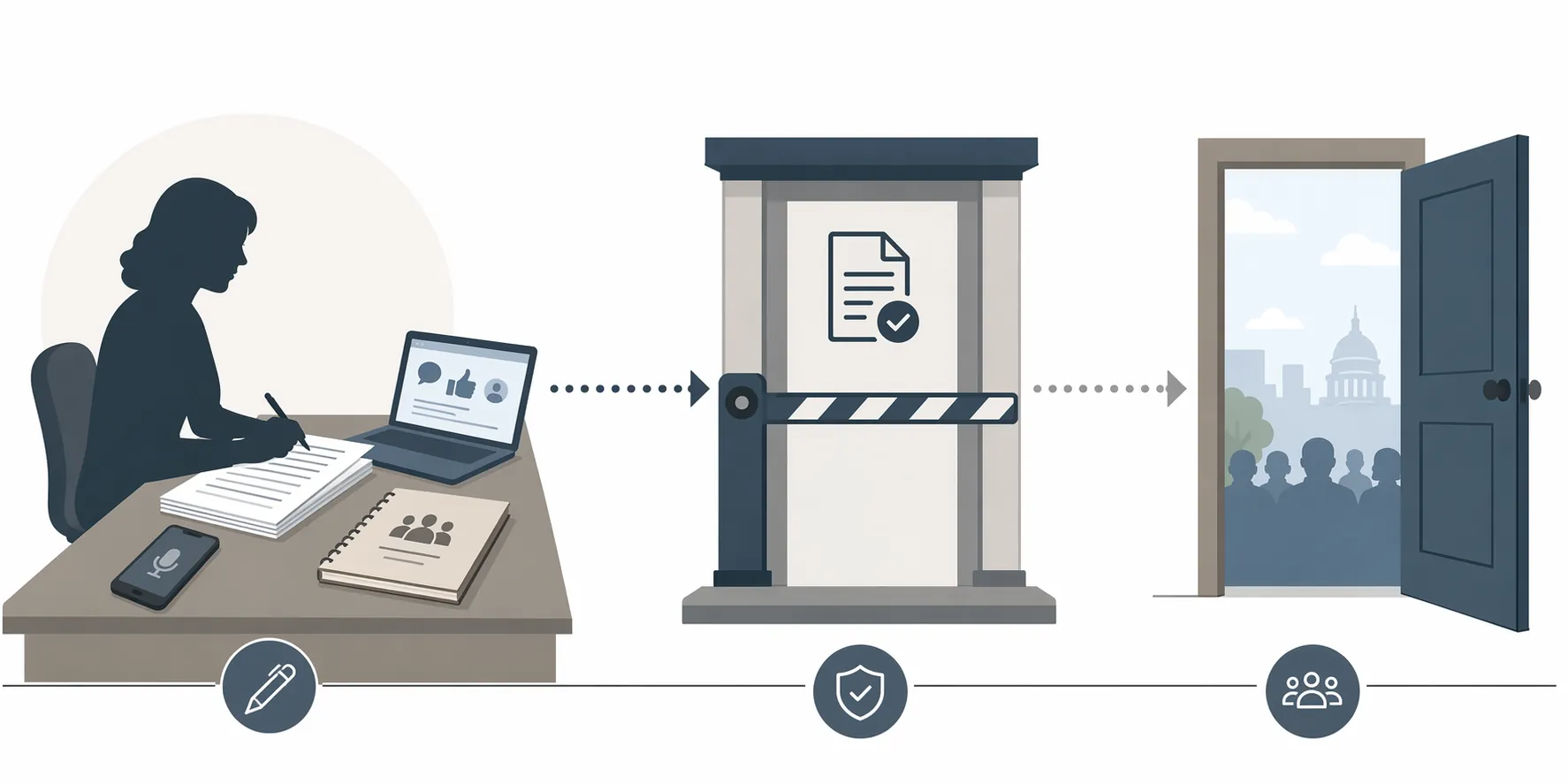
That matters because prior restraint doctrine is concerned with permission systems. A policy that punishes unlawful disclosure after the fact raises one set of questions. A policy that makes a professor wait for approval before publishing, presenting, or commenting raises another. The pre-speech gate changes the incentives: the speaker must decide whether the engagement is worth asking for permission, whether silence is safer, and whether a delayed or unexplained denial can realistically be challenged before the opportunity disappears.
The policy’s breadth made the prior-restraint label more than a formal objection. It was not limited, on the reported facts, to classified information, operational security, cadet privacy, or official institutional statements. It reached professional speech because it was connected to affiliation or expertise. That is a wide trigger for civilian academics, whose jobs often require exactly those forms of engagement: publishing in their discipline, presenting work, answering press questions, and joining public debate in areas they teach or research.
The administrative design then compounded the breadth problem. Bloomberg Law reported that Seibel found the approval regime lacked adequate procedural safeguards: no time limits, no clear standards, and no meaningful appeal process. [4] In a prior-restraint analysis, those omissions are not housekeeping defects. They are the points at which official discretion becomes constitutionally dangerous, because the speaker has no reliable clock, no knowable criteria, and no practical route to a prompt correction.
For a risk officer, this is the feature that travels beyond the individual facts of Bakken. If a government employer wants advance review of civilian academic speech, the rule cannot be written as an open-ended permission slip. The more a policy depends on undefined institutional judgment before speech occurs, the more it starts to look like the kind of licensing scheme First Amendment doctrine already knows how to distrust.
Civilian status did the doctrinal work
Seibel’s civilian-versus-uniformed distinction is the hinge of the ruling. Inside Higher Ed reported that the opinion expressly distinguished between uniformed military personnel, whose speech may be restricted more broadly, and civilian faculty at military academies, who retain academic-freedom protections. [5] That distinction keeps the ruling inside ordinary First Amendment method rather than turning it into a categorical rule against military-academy speech regulation.
West Point is not just another campus. Its educational mission is tied to producing future military officers, and courts have traditionally given military institutions room to preserve command, discipline, and effectiveness. But the speakers covered by the challenged rule were not cadets following orders or uniformed officers speaking within the chain of command. They were civilian academics whose professional role includes teaching, scholarship, and participation in disciplinary debate.
That is why mission language did not end the case. A military academy may have interests that an ordinary public university does not have. The court still required the government to connect those interests to the actual restraint being imposed on the actual class of speakers. Generalized references to discipline and mission effectiveness did not cure a policy that, as reported, reached broad categories of civilian academic speech before publication or public comment.
The record also mattered. Higher Ed Dive reported that Seibel viewed Vice Dean Krista Watts’ affidavit defending the policy as appearing “to be more a reverse-engineered justification for the policy than a serious attempt to explain the true motivations for it.” [7] That is a sharp preliminary-stage assessment, but it should not be inflated into a final finding of bad faith. The safer lesson is procedural: when an institution supplies its rationale after litigation begins, the explanation needs to fit the policy’s text, scope, timing, and actual operation.
The classroom directive shows why informal rules can still chill speech
The injunction analysis was not limited to the written Academic Engagement Policy. The New York Times reported that Dean Shane Reeves gave an August 2025 directive telling faculty not to “advocate for a particular position or ideology” in the classroom, and that Seibel called the directive “nonsensical if the mission is to prepare the nation’s future military officers.” [8]
The significance is not that every classroom-management comment becomes a First Amendment violation. The significance is that an unwritten or informal directive can be reviewable when it would objectively chill protected academic expression. In a classroom, especially one preparing officers to encounter contested legal, ethical, historical, and strategic questions, a ban on “advocat[ing]” a position can become difficult to separate from a ban on teaching through argument, critique, or professional judgment.
That part of the ruling should make institutions careful about oral guidance, slide-deck instructions, dean’s-office emails, and department-level “expectations” that never become formal regulations. A speech restriction does not become legally irrelevant simply because it is delivered informally. If faculty reasonably understand it as a rule backed by authority, the absence of a written policy may make the problem less administrable, not less real.
What the ruling adds to existing First Amendment and academic-freedom doctrine
Bakken is important because it moves a familiar doctrine into a setting where the government’s institutional argument is unusually strong. Prior restraint doctrine developed in contexts far removed from a service academy: licensing, publication, entertainment, protest, and official permission systems. Seibel’s opinion did not have to create a free-floating service-academy academic-freedom exception. It applied the established suspicion of pre-speech approval systems to a civilian-faculty policy at a military academic institution.
That framing is more durable than a broad academic-freedom holding would have been. The vulnerable features were concrete: advance permission, content-linked coverage, broad subject-matter reach, possible discipline up to termination, no clear deadline, no standards, and no meaningful appeal. Those are administrable defects. They allow future courts to ask whether a challenged rule actually needs pre-approval, whether the covered speech is defined narrowly, whether decisionmakers are constrained, and whether a speaker can obtain timely review.
The ruling also gives counsel a way to separate adoption from justification. West Point adopted an approval system in a post-executive-order environment, but the constitutional question was not whether institutional leaders had policy reasons to act. It was whether the chosen mechanism — pre-approval of civilian academic engagement — satisfied the safeguards required when government officials screen speech before it reaches an audience.
For government institutions, the lesson is not that every national-security, confidentiality, operational, or affiliation rule is doomed. A narrower rule targeted at specific protected information, official-capacity speech, or misleading institutional endorsement would present a different case. The problem in Bakken was the combination of breadth and discretion, applied to civilian faculty speech that occupies the ordinary terrain of scholarship and public expertise.
The case context is broader than the injunction, but the injunction is the legal event
Bakken filed the case on September 22, 2025 as a putative class action. The docket identifies the case as No. 7:25-cv-07826 in the Southern District of New York, and Reuters reported that the proposed class covers more than 100 civilian faculty members. [2][3] That number is part of the pleadings and reporting posture, not a court-certified class finding.
The Washington Post later placed the dispute in the context of Bakken’s forthcoming book critical of West Point, scheduled for August 2026, and described the lawsuit as testing the military’s tolerance for internal criticism. [9] That context explains why the case is drawing attention outside First Amendment litigation circles. It does not change the doctrinal center of the injunction ruling, which is the pre-approval system imposed on civilian faculty speech.
Reuters also reported that West Point was consulting with the Department of Justice on next steps after the injunction. [3] That leaves appeal risk and further district-court proceedings squarely on the table. A preliminary injunction reflects the court’s assessment at an early stage, including likelihood of success and equitable factors; it is not the final adjudication of all claims.
What Bakken does not decide
The injunction does not certify a class. It does not finally decide liability. It does not hold that uniformed faculty have the same speech rights as civilian professors. It does not forbid West Point from enforcing properly drawn rules for classified information, operational security, official-capacity statements, time-place-manner limits, or other restrictions that are narrower and procedurally safer than the policy before Seibel.
Nor does it say that “military academy” is irrelevant. The ruling takes West Point’s mission seriously enough to address it, but not so deferentially that mission effectiveness becomes an all-purpose answer to a prior restraint. That is the line future litigants will likely fight over: how much pre-speech control a military-affiliated academic institution can impose on civilian experts before the rule becomes a licensing system with insufficient safeguards.
For now, Bakken supplies a post-executive-order challenge framework rather than a final map of service-academy speech law. A civilian-faculty policy that requires advance approval should be tested for content-based triggers, scope, deadlines, standards, appeal rights, disciplinary consequences, and whether the asserted military interest is tied to the rule as written. That is enough to make the ruling operationally important without pretending it resolves every speech rule a military institution may adopt.
References
- Bakken v. United States Military Academy, Justia
- Bakken v. United States Military Academy, CourtListener
- US judge halts West Point faculty speech curbs under Trump-era policy, Reuters, May 26, 2026
- West Point Faculty Speech Policy Draws Constitutional Challenge, Bloomberg Law
- West Point Restriction on Civilian Faculty Speech Overturned, Inside Higher Ed, May 28, 2026
- Bakken v. U.S. Military Academy, Duke Campus Speech Database
- West Point speech policies paused for civilian faculty by federal judge, Higher Ed Dive
- West Point Trump Free Speech, The New York Times, May 26, 2026
- West Point professors’ lawsuit tests military’s tolerance for internal criticism, The Washington Post, July 26, 2026
Operationalizing workflow
No workflow has been explicitly linked to this obligation yet. See Workflows generally.
Illustrative cases
No illustrative case is currently tracked for this obligation. See Risk Digest for documented incidents generally.
← Back to RegulationReport a correction or tip
Spotted an outdated figure, a misstated fact, or a ruling this regulation entry should reflect? Public comments are disabled for this content given the professional cost of a misreported case outcome, penalty amount, or rule text — use the structured correction channel instead.
Report a correction or tip for this record →