
What Happens to Your Money if a Bank Fails
- Authority
- Federal Deposit Insurance Corporation (FDIC)
- Rule type
- statute
- Jurisdiction scope
- US federal
- Source text
- Read primary rule text ↗
Insured deposits are paid promptly, with an FDIC goal of two business days; uninsured balances become receivership claims paid pro rata by statutory priority.
This is general legal information, not legal advice. Deposit coverage and recovery can depend on the account records, ownership structure, and facts of the bank's failure.
When an FDIC-insured bank fails, the immediate question is not whether the bank was large, familiar, or considered safe. It is how each dollar is classified under federal law. Covered deposits move toward transfer to another bank or direct payment, subject to the FDIC's goal of making insured funds available within two business days. The FDIC says insured depositors have historically usually received access by the next business day, and states that no depositor has lost insured funds since the agency began operating in 1933.[1] Money above the applicable insurance limit is treated differently: it becomes a claim against the failed bank's receivership estate.
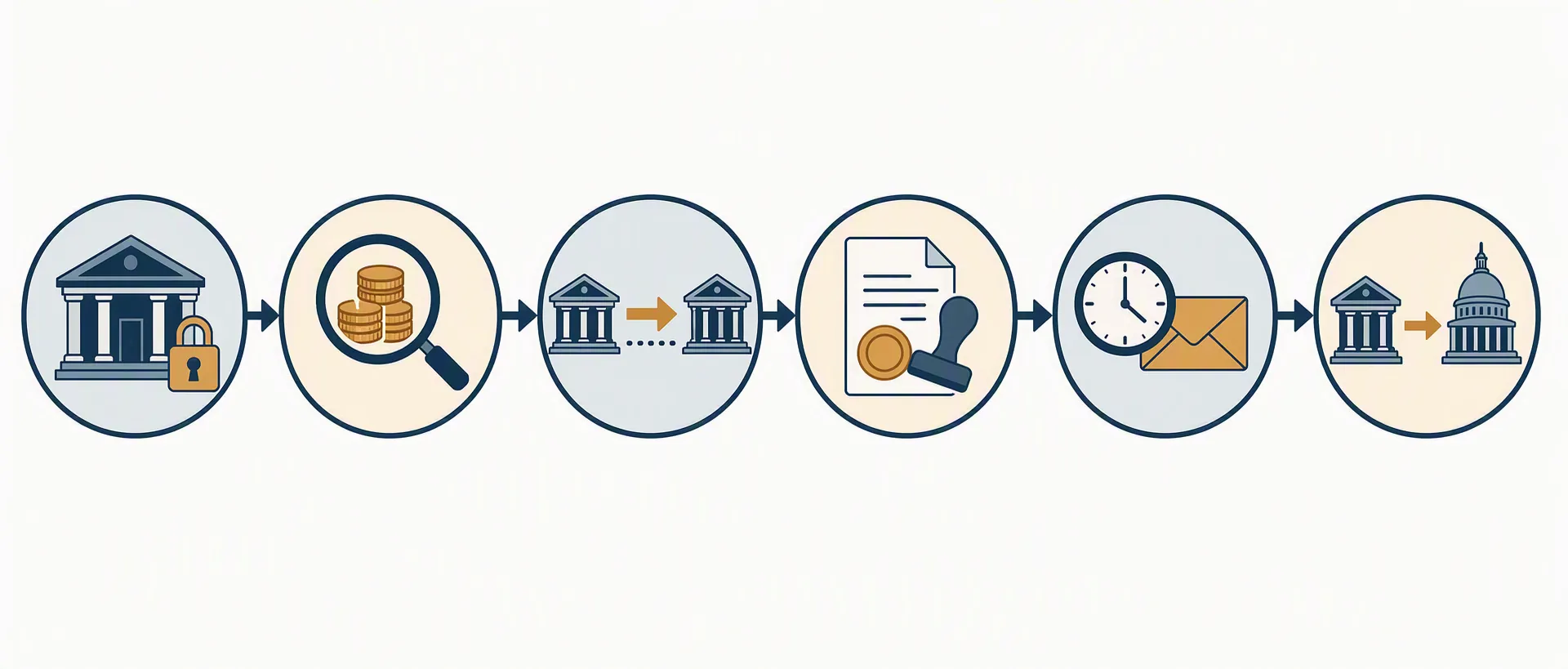
| Stage | What happens | What it means for the depositor |
|---|---|---|
| Failure and coverage review | The FDIC determines the insured amount by depositor, bank, and ownership category, including accrued interest through the failure date.[2] | The $250,000 figure cannot be applied safely by simply adding up account balances. |
| Transfer or payoff | Deposits may be transferred through a purchase-and-assumption transaction or paid directly by the FDIC.[1] | Insured funds are subject to a prompt-payment process; access may occur through an acquiring bank or a payment arrangement. |
| Excess balance | The uninsured portion becomes a receivership claim, generally evidenced by a Receiver's Certificate.[3][4] | Recovery depends on the assets collected by the receiver and is not guaranteed at a particular amount or date. |
| Statutory notices | The FDIC must mail an initial notice within 30 days after initiating payment and a second notice at 15 months.[5] | A depositor who has not claimed funds must keep responding and updating contact information. |
| Unclaimed insured funds | After 18 months, unclaimed insured deposits escheat to the state under the statutory process.[5] | The claim does not simply remain indefinitely with the FDIC. |
Why $250,000 is not a per-account ceiling
The standard insurance limit is $250,000 per depositor, per insured bank, for each ownership category. Those three qualifiers do the legal work. A person may have separate coverage for qualifying individual accounts, joint accounts, certain retirement accounts, trust interests, and other ownership categories, but the applicable calculation depends on the category's rules and the depositor's legal interest.[2]
That means two accounts at the same bank are not automatically covered separately. If they are held in the same ownership category for the same depositor, the balances may be aggregated for insurance purposes. Conversely, accounts that genuinely fall into different ownership categories may receive separate coverage. The bank's brand, asset size, and public reputation do not change that calculation.
The calculation also includes interest accrued through the failure date. A balance that appeared to be below the limit before failure can therefore require a more exact review once accrued interest is added.[2] For a business, the relevant records may include operating accounts, payroll funds, and other accounts held in the company's name. A business owner should not assume that personal and company balances are combined merely because the same person controls both, nor assume that separate account numbers create separate insurance limits.
Some deposits held by an intermediary may receive pass-through coverage if the arrangement, records, and beneficial ownership satisfy the applicable requirements. That is a records-and-structure question, not a label that can be assumed from the fact that a broker, fiduciary, or platform handled the funds.[2][8]
How insured deposits are paid
The FDIC acts first as the deposit insurer. It identifies the insured amount and makes that amount available through one of two principal mechanisms. In the common purchase-and-assumption transaction, an acquiring bank assumes the failed bank's deposits and may provide continuing access. If no acquiring bank takes the deposits, the FDIC can make a direct deposit payoff.[1]
The two-business-day figure is a goal for making insured funds available, not a promise that every account dispute, ownership question, or unusual record will be resolved in that period. The practical result can depend on whether the deposit is readily classified and whether the depositor must provide additional information. The payment target applies to the insured track; it does not convert an uninsured balance into immediately available cash.
The bank's failure also does not erase borrowers' obligations to the bank. Loans generally remain payable, and payments should continue under the loan documents unless the responsible institution gives different instructions. Undrawn credit lines are generally frozen after failure, and a receiver or acquiring institution may examine whether it has a legally available setoff against amounts owed on delinquent loans.[6][7][8] A depositor with both a deposit and a loan should not treat the deposit as automatically available to satisfy the loan, or the loan as automatically canceled by the failure.
What happens to money above the insurance limit
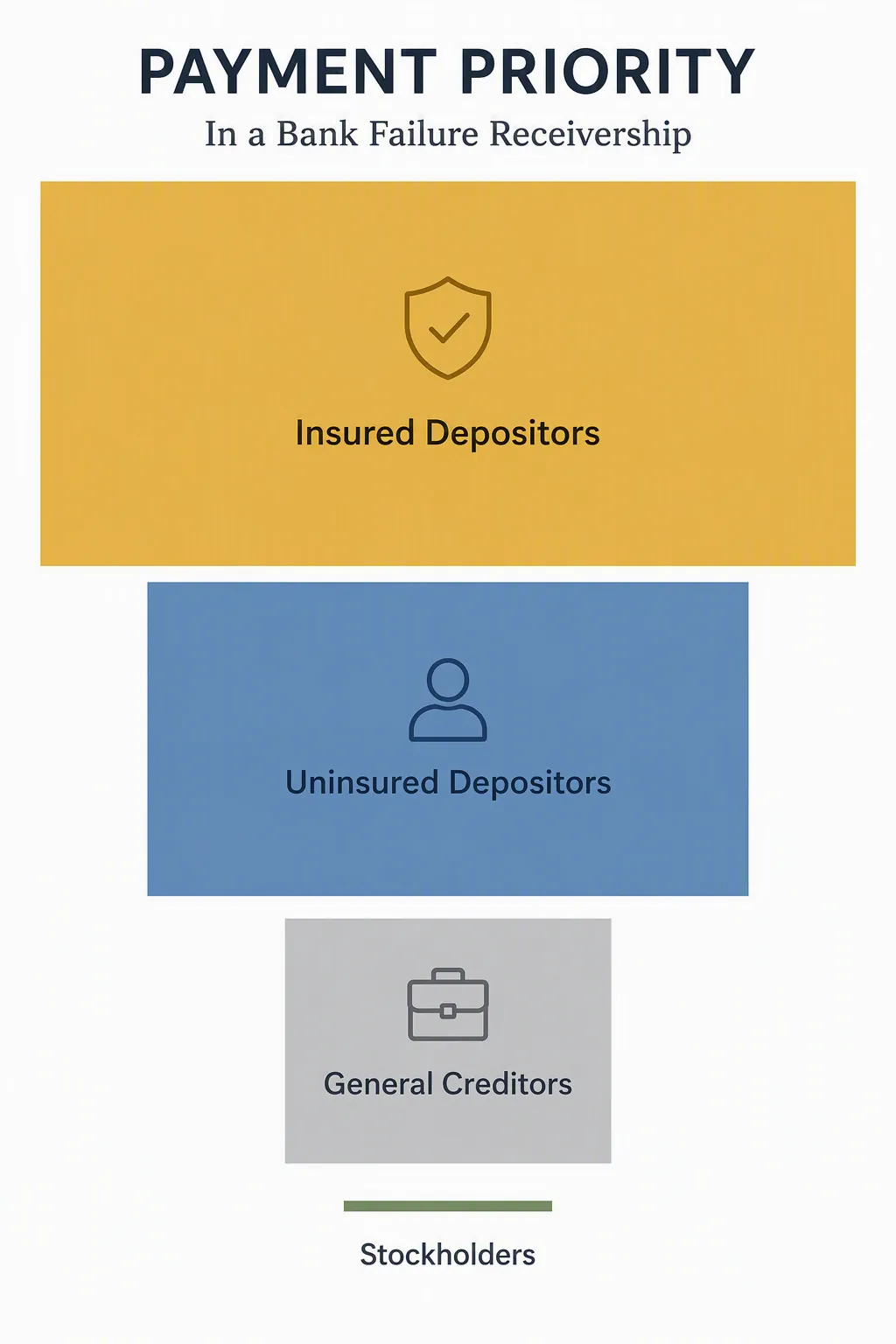
The FDIC then acts in a different legal capacity: as receiver for the failed bank. The uninsured portion is not an ordinary payment waiting behind an administrative delay. It is a claim against the receivership estate, generally represented by a Receiver's Certificate under the FDIC's statutory framework.[3]
For depositor claims, the statutory payment ladder places insured depositors first, followed by uninsured depositors, then general creditors, and finally stockholders.[4] In practical terms, an uninsured depositor has a higher priority than a general unsecured creditor or a shareholder, but that priority does not guarantee full recovery. It determines where the claim stands when the receiver distributes money collected from the failed bank's assets.
As the receiver liquidates or otherwise realizes value from the bank's assets, available funds can be distributed pro rata among claims at the relevant level. The result is often described as cents on the dollar. There is no guaranteed recovery percentage, and there is no universal completion date: both depend on the assets, liabilities, disputes, and other facts of the particular receivership. A historical average or an early distribution in another failure is not a prediction of what a particular depositor will receive.
The distinction is important for a business that needs to meet payroll, pay vendors, or replace a working-capital account. Insured funds are placed on a prompt-payment track. The excess balance may instead require a claim record, correspondence with the receiver, and patience while assets are administered. The legal priority improves the depositor's position relative to lower-ranked claimants; it does not make the receivership estate unlimited.
The notice clock continues after payment begins
Section 12 of the Federal Deposit Insurance Act requires the FDIC to send written notice within 30 days after initiating payment. If an insured deposit remains unclaimed, the FDIC must send a second notice at 15 months. After 18 months, unclaimed insured deposits escheat to the state under the statutory process.[5]
Those deadlines are part of the legal timeline, not merely administrative reminders. A depositor should preserve account statements, ownership records, tax identification information, and communications from the FDIC or acquiring bank. If the account is held through a fiduciary or intermediary, the records needed to establish beneficial ownership may be especially important. The FDIC's notices and the applicable claim instructions control the response required in the specific failure.
The governing question is therefore narrow but consequential: which portion of the deposit qualifies for insurance at that bank and in that ownership category, and which portion must proceed as a receivership claim? Insured money is subject to a prompt-payment regime. Excess money is a claim against a finite estate, paid according to statutory priority as assets are collected. The bank's name does not answer either question.
References
- Payment to Depositors — Federal Deposit Insurance Corporation
- Understanding Deposit Insurance — Federal Deposit Insurance Corporation
- Section 11 — Insurance Funds — Federal Deposit Insurance Corporation
- Priority of Payments and Timing — Federal Deposit Insurance Corporation
- Section 12 — Corporation as Receiver — Federal Deposit Insurance Corporation
- FDIC Bank Receivership Frequently Asked Questions — Morrison Foerster
- When a Bank Fails: What Does It Mean for Depositors? — Manatt
- FAQ About a U.S. Bank Failure — Goodwin
Operationalizing workflow
No workflow has been explicitly linked to this obligation yet. See Workflows generally.
Illustrative cases
No illustrative case is currently tracked for this obligation. See Risk Digest for documented incidents generally.
← Back to RegulationReport a correction or tip
Spotted an outdated figure, a misstated fact, or a ruling this regulation entry should reflect? Public comments are disabled for this content given the professional cost of a misreported case outcome, penalty amount, or rule text — use the structured correction channel instead.
Report a correction or tip for this record →