
Bernie Moreno's Canada Wildfire Sanctions Bill Explained
- Authority
- U.S. Congress
- Rule type
- statute
- Jurisdiction scope
- US federal
- Source text
- Read primary rule text ↗
Automatic sanctions trigger under IEEPA based on AQI threshold
Status first: no sanctions obligation exists today
For a lawyer or legal-ops lead asking whether Bernie Moreno’s Canada wildfire sanctions bill requires action today, the answer in Q3 2026 is no. The CANADA FIRE Act was introduced on July 20, 2026, by Sen. Bernie Moreno, R-Ohio; the reviewed materials did not confirm a final Senate bill number, while a House companion, H.R. 9783, was introduced the same day by Michigan Republicans Jack Bergman, John James, Lisa McClain, and John Moolenaar.[1][2]
There is no enacted sanctions program, no OFAC list change, no current federal-contract certification change, and no present screening obligation solely because a client has Canadian provincial, Crown-linked, embassy, forestry, emergency-response, or contractor contacts. GovTrack’s page for the House companion placed the enactment probability below 1%, which is a useful political-risk signal even if it is not a legal conclusion.[2]
That does not make the bill meaningless. It is a regulation-and-ethics risk item worth recording because it tries to convert air-quality measurements into a mandatory sanctions clock under the International Emergency Economic Powers Act. That is unusual enough to monitor. It is not enough to redesign a compliance program.
This article is general information, not legal advice. Any client-facing answer still depends on the client’s contracts, counterparty profile, financing, immigration exposure, and tolerance for legislative-monitoring risk.
What triggered the bill
The political predicate was the July 16–17, 2026 wildfire-smoke emergency in the Upper Midwest and Great Lakes region. Reported air-quality readings included Duluth at 934 and Marquette at 1,008; those figures should be handled carefully because AQI values above 500 are extrapolated from raw PM2.5 data rather than displayed on the standard EPA AQI scale.[3] Detroit was also reported as the most polluted major city globally during the smoke event, and more than 100 million Americans were under air-quality alerts.[4]
Those numbers explain why a sanctions bill could get attention. They do not, by themselves, answer the legal question. Wildfire smoke already raises employment, event-cancellation, premises-safety, and force-majeure issues; those are separate from whether Congress should direct sanctions against Canadian officials or governmental entities. Readers dealing with operational fallout from smoke events may want the narrower employer and contracting discussions in How Wildfire Smoke Cancellations Expose Force Majeure Gaps and Why Code Orange Wildfire Smoke Obligations Depend on Your State.
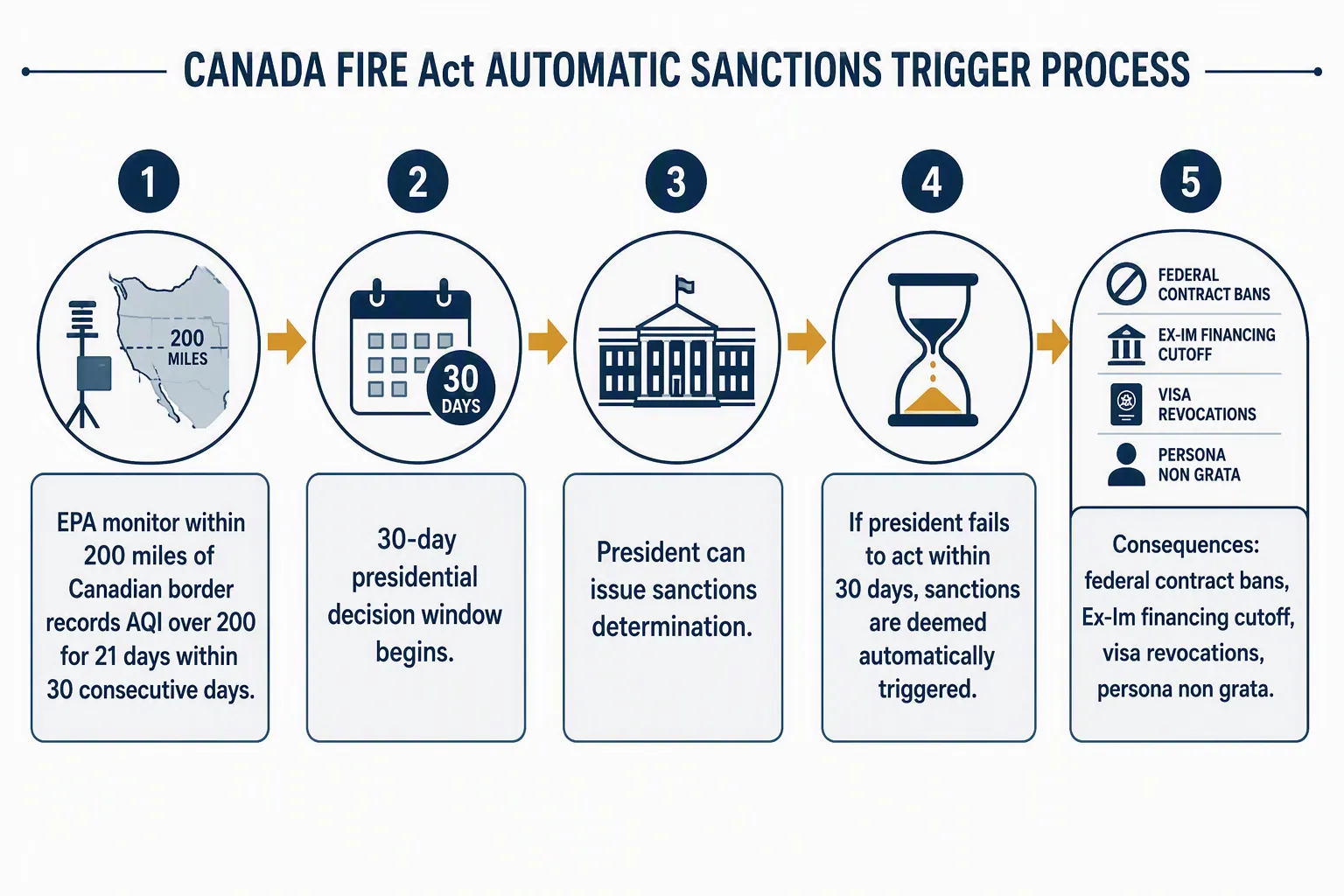
The CANADA FIRE Act takes that smoke event and turns it into a proposed statutory trigger. The central condition is not a single dramatic day. It is a repeated official-monitor condition: an official U.S. EPA monitor within 200 miles of the Canadian border must record AQI above 200 for 21 days within a 30-consecutive-day period.[1][5]
The proposed trigger-to-sanctions workflow
The bill’s most important feature is procedural. It does not merely authorize the president to consider sanctions after transboundary smoke. It tries to force a decision, then treats presidential inaction as an affirmative finding of harm.
| Stage | What the bill would require | Why it matters to counsel |
|---|---|---|
| AQI condition | An official U.S. EPA monitor within 200 miles of the Canadian border records AQI above 200 for 21 days in a 30-day period. | The trigger is tied to official monitoring geography and duration, not a general finding that Canadian policy caused a particular smoke plume. |
| Presidential window | The president has 30 days after the threshold is met to determine whether Canada has caused harm to the United States through wildfire smoke. | The bill would move the issue from environmental conditions into an executive sanctions determination. |
| Deemed affirmative finding | If the president does not make a determination within 30 days, the harm finding is deemed affirmative. | This is the drafting move that creates the unusual regulatory-risk design: silence would not preserve the status quo. |
| Sanctions consequences | Mandatory and discretionary measures would follow if the required finding exists. | The affected relationships would include federal contracting, export financing, property interests, visa status, and diplomatic presence. |
The 21-days-in-30 threshold matters because it filters out a short smoke spike, even a severe one. A one-day AQI shock may move politics; it would not, on the described terms, start the statutory clock unless the official-monitor condition persisted long enough. For cross-border clients, that means the first monitoring question would be factual and geographic: which EPA monitors, within what distance of the border, recorded what values, for how many days.
The presidential-decision window matters more. In ordinary sanctions practice, counsel usually looks for an executive order, OFAC rulemaking, designation, general license, or agency guidance. Here, the bill would insert a 30-day statutory countdown after the environmental threshold. Cleveland.com and Canadian Affairs both described the deemed-finding mechanism: if the president fails to make any determination in that period, the finding is treated as affirmative.[3][6]
That is not a present compliance command. It is, however, the reason this proposal deserves a file note instead of a shrug. A deemed affirmative finding is designed to prevent presidential inaction from blocking the sanctions pathway. Whether that is politically viable is a separate question. As drafted and reported, it is a serious enough mechanism for a practitioner to know where it would bite.
A more granular discussion of the trigger design and sanctions mechanics is available in Analyzing the CANADA FIRE Act’s Novel Sanctions Mechanisms. The point here is the broader risk posture: the bill is not law, but its architecture is more consequential than the usual messaging bill because it tries to automate a legal consequence from environmental measurements.
What sanctions would mean if the bill became operative
The bill invokes IEEPA, a statute sanctions lawyers normally associate with national-emergency economic restrictions rather than air-quality disputes with Canada. The sponsor materials describe mandatory sanctions including a ban on U.S. government contracts with Canada’s government and a cutoff of Export-Import Bank financing.[1] Reporting also described potential blocking of property and asset freezes under the IEEPA sanctions framework.[7]
For a client memo, the practical question would not be “does the client do business in Canada?” It would be narrower: does the client have a U.S. federal contract involving the Government of Canada, a Canadian government counterparty, a Canadian Crown-linked entity, a Canadian provincial or federal agency relationship, Ex-Im Bank-supported financing, or a payment stream that could be touched by a blocking order if a sanctions regime actually came into existence.
The reported bill also includes visa consequences. The affected categories include current or former Canadian Cabinet members and senior Canadian officials involved in forestry, land management, or emergency response.[5] That drafting choice should make immigration and government-relations counsel pay attention, but only as a contingency. A Canadian forestry official is not sanctionable today because a bill has been introduced.
The diplomatic provisions are even more direct. Reporting described persona non grata treatment for the Canadian ambassador and consuls general in Chicago, Detroit, Minneapolis, and New York until AQI remains below 100 for 90 consecutive days.[6][7] That provision is politically attention-grabbing, but for practitioners its main value is diagnostic: the bill is not aimed only at transactions. It would reach diplomatic status, visas, financing, contracting, and property interests.
| Client relationship to identify | Why it could matter only if the regime became law |
|---|---|
| Federal contracts involving Canada’s government | The bill describes mandatory contract restrictions involving U.S. government contracts with Canada’s government. |
| Ex-Im Bank-supported exports or financing | The bill describes a financing cutoff as part of the mandatory consequences. |
| Canadian federal, provincial, forestry, land-management, or emergency-response contacts | Visa and official-status provisions are tied to categories of Canadian officials, not ordinary private Canadian counterparties. |
| Property or payment interests involving covered Canadian governmental actors | IEEPA-style measures could matter if blocking or asset-freeze authorities were actually implemented. |
| Embassy or consular dealings | The persona non grata provisions are directed at named Canadian diplomatic posts and roles. |
The penalty framework would become relevant only if sanctions obligations were enacted or independently created through a valid national-emergency declaration and implementing measures. IEEPA’s reported penalty structure includes criminal penalties for willful violations of up to $1 million and 20 years, and civil penalties of up to $356,579 per violation.[8] Those numbers are not a reason to start screening every Canadian vendor now. They are a reason not to mislabel the bill as harmless theater if it ever moves.
The political and diplomatic signals are poor for enactment
The bill arrived in a crowded and already strained U.S.-Canada context. Canadian Affairs reported that President Trump separately demanded Canada pay damages and raised a Section 338 tariff threat involving Canadian wine, hockey sticks, and cement, while the White House stated that the tariff action was unrelated to wildfires.[6] The same reporting placed the dispute against the backdrop of the CUSMA review passing without renewal on July 1, 2026.[6]
The Senate’s immediate response is easy to overstate and still important. On July 27, a bipartisan Senate majority rejected Trump’s parallel demand for Canada to pay damages; that was not a formal vote on the CANADA FIRE Act itself. Sen. Tammy Duckworth called the demand “ridiculous,” and Sen. Peter Welch said “nobody can control the direction of the wind.”[8] As probability evidence, that matters. As legislative history for the bill, it should not be inflated into a committee defeat or floor rejection.
Existing bilateral arrangements also cut against the idea that Congress had no channel except sanctions. The 1991 Canada-U.S. Air Quality Agreement addresses acid-rain gases rather than PM2.5 wildfire smoke; the 1982 Reciprocal Forest Fire Fighting Arrangement and a 2023 wildland fire cooperation arrangement provide cooperation channels for fire response.[6] None of those frameworks creates the CANADA FIRE Act’s automatic sanctions trigger. They do show that cross-border air and fire issues are not new diplomatic terrain.
Legal theory after the mechanism is understood
The international-law theory is, at minimum, strained. Michael Gerrard of Columbia’s Sabin Center was quoted saying there is “no plausible theory under existing international law” for the approach.[8] Stanford’s Marshall Burke was quoted saying “punishment here would do nothing.”[9] Those are expert assessments, not judicial rulings, but they align with the basic discomfort in the bill: the sanctions target is being tied to windborne smoke rather than a conventional hostile act, expropriation, cyberattack, or military aggression.
The hard legal question would not be whether wildfire smoke can cause cross-border harm. It plainly can. The harder question is whether Congress can or should channel that harm into IEEPA-style sanctions against an ally, and whether an executive national-emergency finding outside the bill could attempt the same result. For present purposes, counsel does not need to resolve that question. Counsel needs to know that the theory exists, that it is contested, and that it has not created a current obligation.
What practitioners should monitor
The right Q3 2026 response is legislative and executive-branch monitoring, not sanctions-screening changes. A short watchlist is enough for most clients unless they are unusually exposed to Canadian government contracting, Ex-Im-supported projects, Canadian official travel, or embassy and consular dealings.
- Confirm whether the Senate bill receives a final number and where it is referred.
- Track whether H.R. 9783 moves beyond introduction or receives committee activity.
- Watch for any attempt to attach the trigger, contract ban, Ex-Im cutoff, visa language, or diplomatic provisions to must-pass legislation.
- Monitor whether the administration advances an IEEPA national-emergency theory outside the bill.
- For highly exposed clients, keep a lightweight inventory of Canadian governmental ties, but do not treat that inventory as a live sanctions-control requirement.
That is the cleanest answer to the compliance question. The CANADA FIRE Act is legally novel enough to record, politically weak enough not to operationalize, and specific enough that cross-border practitioners should monitor it as a regulatory signal rather than build a compliance program around it.
References
- Moreno Introduces CANADA FIRE Act, Moreno Senate Office, July 2026.
- H.R. 9783: CANADA FIRE Act, GovTrack, 2026.
- Article on Sen. Bernie Moreno’s CANADA FIRE Act and wildfire smoke AQI readings, Cleveland.com, July 2026.
- Article on July 2026 Canadian wildfire smoke and U.S. air quality impacts, Yale Climate Connections, July 2026.
- Article on Moreno bill proposing sanctions over Canadian wildfire smoke, The Hill, July 2026.
- Article on Canada wildfire smoke sanctions proposal, tariffs, CUSMA context, and bilateral frameworks, Canadian Affairs, July 2026.
- Article on proposed sanctions and diplomatic measures against Canada over wildfire smoke, The Guardian, July 2026.
- Article on Senate response, IEEPA penalties, and expert criticism of Canada wildfire sanctions proposal, TechTimes, July 2026.
- Article quoting Marshall Burke on wildfire-smoke punishment theory, BBC, July 2026.
Operationalizing workflow
No workflow has been explicitly linked to this obligation yet. See Workflows generally.
Illustrative cases
No illustrative case is currently tracked for this obligation. See Risk Digest for documented incidents generally.
← Back to RegulationReport a correction or tip
Spotted an outdated figure, a misstated fact, or a ruling this regulation entry should reflect? Public comments are disabled for this content given the professional cost of a misreported case outcome, penalty amount, or rule text — use the structured correction channel instead.
Report a correction or tip for this record →