
End Birthright Citizenship for Territories Act, Explained
- Authority
- U.S. House of Representatives
- Rule type
- statute
- Jurisdiction scope
- US federal
- Effective date
- Jan 1, 2027
- Source text
- Read primary rule text ↗
Prospectively ends statutory birthright citizenship for births in Puerto Rico, Guam, U.S. Virgin Islands, Northern Mariana Islands effective Jan 1, 2027; exception language discrepancy unresolved
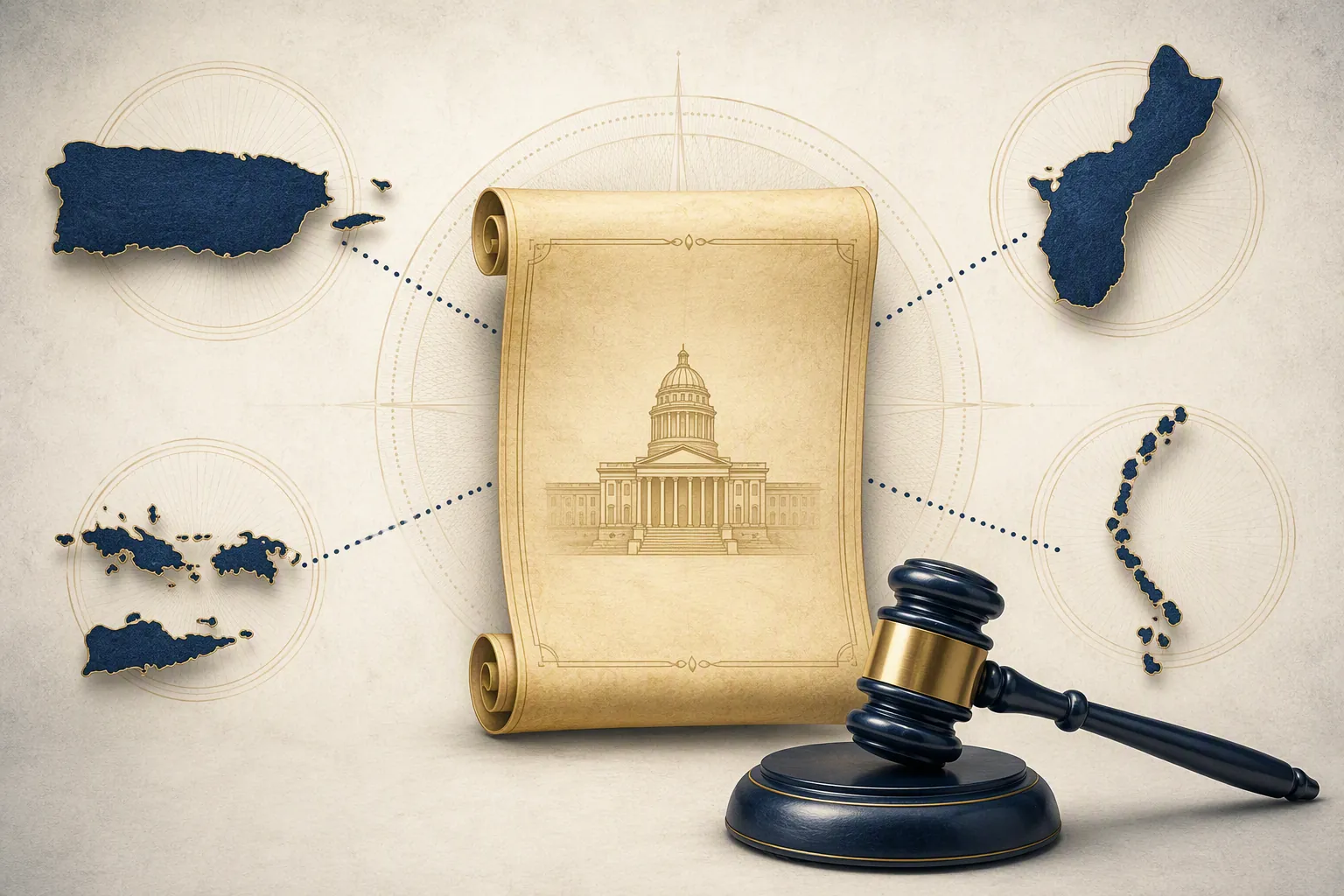
H.R. 9724, the End Birthright Citizenship for Territories Act in the 119th Congress, would end automatic U.S. citizenship for children born in Puerto Rico, Guam, the U.S. Virgin Islands, and the Northern Mariana Islands on or after January 1, 2027, if enacted. The bill is being described as an amendment to the Immigration and Nationality Act and the relevant territorial organic statutes, rather than as a direct amendment to the Fourteenth Amendment itself.[1][2]
That opening caveat matters. As of Q3 2026, the available record does not show H.R. 9724 as enacted law. The materials available for review include Representative Morgan Griffith’s announcement of the bill, third-party analysis of the reported amendment text, public commentary on its legal theory, and statements about its legislative posture. There is no CBO score or committee report in the supplied materials, and no accessible indexed congress.gov bill detail page is available from the research set. The bill-text PDF itself could not be parsed directly, so any responsible explanation has to distinguish what the sponsor says the bill does from what analysts report the operative amendments actually say.
What H.R. 9724 Would Change
Representative Griffith’s press release presents the bill as a response to territorial birthright citizenship. It says the measure would prevent automatic citizenship from attaching solely because a child is born in a U.S. territory, while preserving citizenship for children who have at least one parent who is a U.S. citizen, lawful permanent resident, or active member of the U.S. armed forces.[1]
That is the sponsor’s version of the guardrail. The harder drafting question is whether the actual amendments contain it.
Neil Weare and Right to Democracy report that the amendment text they reviewed does not include the limiting language described in the press release. Their reading is that the bill would repeal or revise existing statutory provisions that confer citizenship based on birth in the named territories, with an effective date of January 1, 2027, but without the parentage, lawful-permanent-resident, or military-service exceptions described by the sponsor.[2]
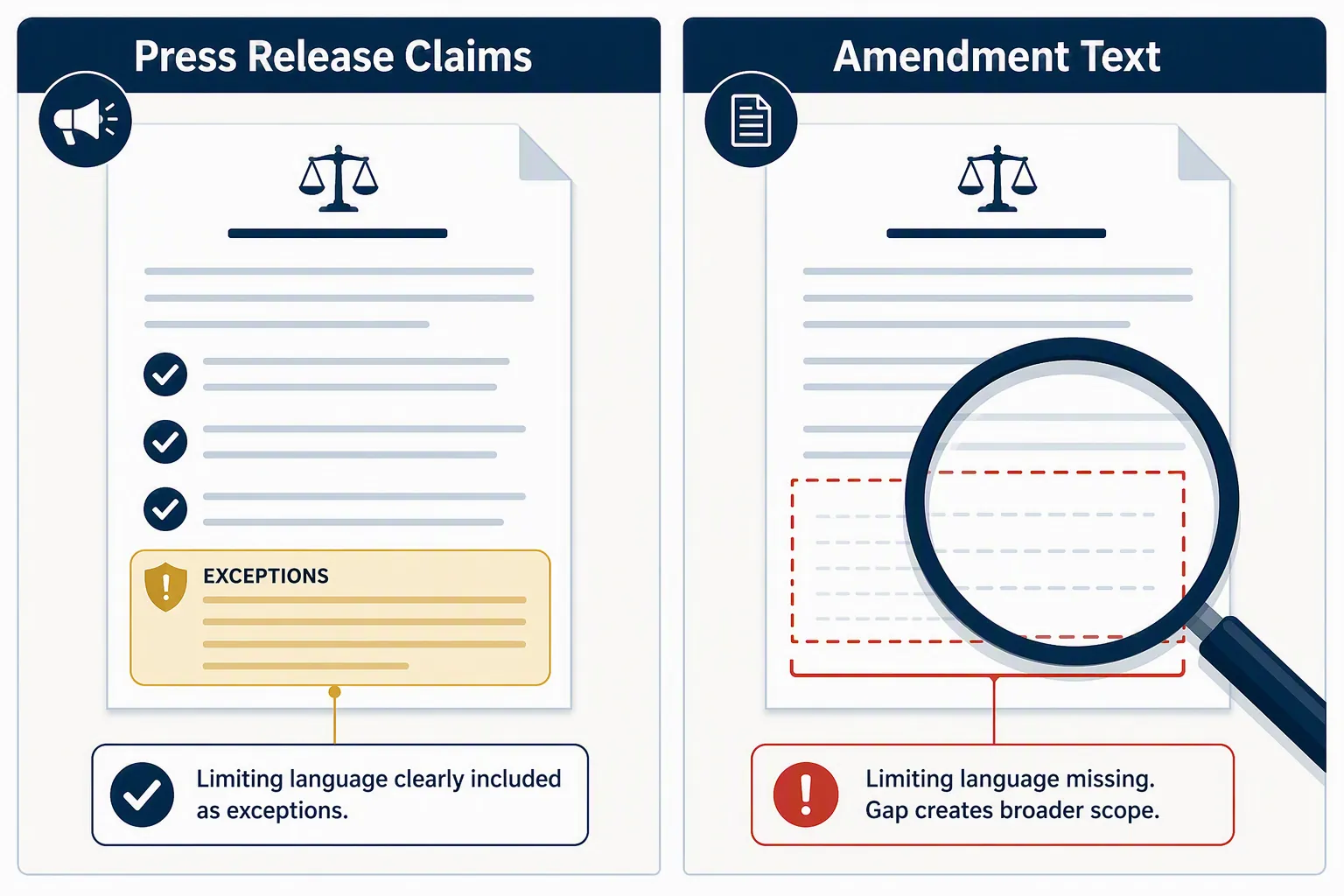
For a legal memo, that discrepancy is not cosmetic. If the exception language is in the operative bill text, then the compliance question turns on parent status and proof. If it is absent, then a child born in one of the covered territories on or after the effective date could fall outside the automatic statutory citizenship rule even where a press-release summary suggested otherwise. The difference affects birth registration advice, benefits eligibility screening, family immigration analysis, and any client-facing explanation that purports to describe the bill’s practical effect.
| Issue | Sponsor announcement | Reported text problem |
|---|---|---|
| Covered places | Puerto Rico, Guam, the U.S. Virgin Islands, and the Northern Mariana Islands | Right to Democracy reads the amendments as targeting the statutory citizenship provisions for those territories. |
| Effective date | Births on or after January 1, 2027 | The same date is central to the reported legal effect. |
| Claimed exceptions | Children with a U.S.-citizen parent, lawful-permanent-resident parent, or active-duty military parent would be protected | Right to Democracy says the amendment text lacks that limiting language. |
| Practical risk | The bill may sound narrower when described through the press release | The operative text, if accurately reported, may be broader than the public-facing summary. |
Why the Statutory Route Matters
The bill’s legal theory depends on a distinction that is familiar in territorial-status law but easy to flatten in public descriptions: citizenship in the states is generally discussed through the Citizenship Clause of the Fourteenth Amendment, while citizenship in the unincorporated territories has historically been treated by Congress and courts as a statutory grant. Lawfare’s analysis explains that the constitutional question turns on whether the Citizenship Clause applies of its own force in U.S. territories, or whether Congress may define territorial citizenship by statute under the territorial framework associated with the Insular Cases.[4]
That is why H.R. 9724 is not drafted as a freestanding declaration that the Fourteenth Amendment excludes territorial births. It instead aims at the statutory machinery: the INA provisions and organic-act provisions through which Congress has conferred citizenship on people born in particular territories. On the materials available, the bill’s premise is that Congress can withdraw or narrow a statutory citizenship rule prospectively because the rule was created by Congress in the first place.[1][2]

The history is territory-specific. Charles Venator-Santiago’s explainer describes Congress’s role in extending citizenship to Puerto Rico, Guam, the U.S. Virgin Islands, and the Northern Mariana Islands through statutes and territorial arrangements rather than through a single across-the-board constitutional rule for all territorial births.[5] For present purposes, the important point is not every chapter of each territory’s status history. It is that H.R. 9724 is operating on provisions that have long been treated as congressional grants.
That does not make the constitutional question disappear. A statutory-citizenship theory gives the bill an argument; it does not pre-adjudicate the challenge that would likely follow if Congress enacted it. The unresolved issue is whether people born in the covered territories have constitutional birthright citizenship independent of the statutes Congress previously enacted.
What Trump v. Barbara Does—and Does Not—Answer
The Supreme Court’s June 30, 2026 decision in Trump v. Barbara is relevant, but it should not be used as shorthand for an answer to H.R. 9724. SCOTUSblog’s coverage reports that the Court struck down President Trump’s effort to end birthright citizenship, while leaving open the distinct question of territorial birthright citizenship.[3]
That posture matters because executive action and congressional amendment are not the same legal object. An executive order purporting to alter citizenship rules faces one set of problems; an act of Congress amending the INA and territorial organic acts would present another. Trump v. Barbara may be an important warning against executive overreach in the citizenship context, but the supplied materials do not support treating it as a holding that children born in Puerto Rico, Guam, the U.S. Virgin Islands, or the Northern Mariana Islands are constitutionally protected from the kind of statutory change H.R. 9724 proposes.
Nor does the open question favor the bill automatically. If enacted, the legislation would likely force courts to confront the constitutional status of territorial birthright citizenship more directly than the Supreme Court did in Trump v. Barbara. The bill rests on the premise that the Insular Cases framework leaves Congress room to legislate in this area; opponents would have room to argue that the Citizenship Clause, later doctrine, or limits on territorial governance foreclose that move.
The Press-Release Problem Is a Drafting Problem
The most operationally important fact in the current record is still the mismatch between the sponsor’s stated exceptions and Right to Democracy’s reading of the amendment language. A press release can explain purpose. It can reassure constituents. It can describe what the sponsor believes the bill should be understood to do. It does not amend the U.S. Code.
For counsel, the safe formulation is therefore narrower than the sponsor’s announcement: H.R. 9724 is represented by its sponsor as preserving certain exceptions, but at least one detailed public analysis reports that those exceptions are not present in the amendment text reviewed.[1][2] Until the bill text is independently accessible and parsed, a client alert should not state the exceptions as operative law without qualification.
That qualification should not be buried. A reader deciding whether to brief HR, benefits, immigration intake, or family-status consequences needs to know whether the operative rule turns on birthplace alone or on birthplace plus a parent-status exception. The difference changes the checklist.
- If the exceptions are operative, advisers would need to verify parent citizenship, lawful permanent residence, or active-duty military status at the time of birth.
- If the exceptions are absent, the bill would be materially broader than the sponsor’s summary suggests.
- If the text remains inaccessible or unparsed, the ambiguity itself should be disclosed in any external-facing explanation.
Where the Bill Stands
The legislative record visible from the supplied materials is limited. Delegate Stacey Plaskett’s July 20, 2026 statement opposed the bill and stated that H.R. 9724 had no cosponsors at that time.[6] Election Law Blog and Puerto Rico Report also covered the bill as a newly introduced measure and placed it in the broader dispute over territorial birthright citizenship, but the research record does not include committee action, a CBO score, or a committee report.[7][8]
That means the bill should be treated as a live legislative proposal, not a current citizenship rule. It would not change the status of children born before its stated effective date on the facts supplied here, and it would not affect any birth unless Congress enacted it. The forward-looking compliance date, January 1, 2027, is still worth flagging because it is close enough to matter for planning if the proposal were to move.
How to Describe H.R. 9724 Without Overstating It
A careful explanation can say that H.R. 9724 would prospectively end automatic statutory citizenship for children born in Puerto Rico, Guam, the U.S. Virgin Islands, and the Northern Mariana Islands on or after January 1, 2027, if enacted. It can also say that the bill relies on the contested but historically significant distinction between statutory territorial citizenship and constitutional birthright citizenship.
It should not say that the Supreme Court has already resolved the territorial question in favor of either side. Trump v. Barbara struck down Trump’s effort and left the territorial issue open.[3] It also should not present the sponsor’s parent-status exceptions as settled operative text unless the cited bill language is available and confirms them. The present record supports a discrepancy, not a clean reconciliation.
The usable bottom line is modest but important: H.R. 9724 is not law, and the available materials show limited legislative movement. But the bill is drafted around a constitutional distinction that remains unresolved, and the reported gap between its press-release description and its amendment text is exactly the kind of issue that should appear in a legal, compliance, or client-facing brief before anyone relies on the summary version.
References
- Griffith Introduces Bill to End Birthright Citizenship in U.S. Territories, Congressman Morgan Griffith.
- Federal Legislation Seeks to End Birthright Citizenship in U.S. Territories, Right to Democracy.
- Supreme Court strikes down Trump’s order ending birthright citizenship, SCOTUSblog, June 2026.
- Constitutional Citizenship in U.S. Territories, Lawfare.
- U.S. Territorial Birthright Citizenship, UConn El Instituto, February 21, 2025.
- Plaskett Statement on Republican Bill to Strip Birthright Citizenship from U.S. Territories, Congresswoman Stacey E. Plaskett, July 20, 2026.
- New Bill Would End Birthright Citizenship in the Territories, Election Law Blog.
- New Bill Would Limit Birthright Citizenship in Puerto Rico, Puerto Rico Report.
Operationalizing workflow
No workflow has been explicitly linked to this obligation yet. See Workflows generally.
Illustrative cases
No illustrative case is currently tracked for this obligation. See Risk Digest for documented incidents generally.
← Back to RegulationReport a correction or tip
Spotted an outdated figure, a misstated fact, or a ruling this regulation entry should reflect? Public comments are disabled for this content given the professional cost of a misreported case outcome, penalty amount, or rule text — use the structured correction channel instead.
Report a correction or tip for this record →