
Blumenthal: Clarity Act's Crypto Loopholes Carry Real Legal Risk
- Authority
- U.S. Congress
- Rule type
- statute
- Jurisdiction scope
- US federal
- Source text
- Read primary rule text ↗
Prohibits federal officials from issuing or sponsoring digital assets; passive holdings, family interests, pre-existing assets, and non-remunerated assets not covered; enforcement limited to DOJ
Regulation & Ethics. Last verified: July 30, 2026, 00:00 UTC. This analysis is not legal advice and should not be treated as a final statutory interpretation. It relies on currently reported descriptions of the CLARITY Act’s 616-page text and ethics title, including Forbes and Paul Hastings summaries, rather than an independent full reading of the bill text itself. [1][2]
The immediate legal question raised by Senator Richard Blumenthal’s cryptocurrency-loophole critique is not whether Trump-branded meme coins make an easy headline. It is whether counsel can responsibly tell a client that the CLARITY Act’s ethics language defines the outer edge of permissible crypto-conflict conduct.
On the materials available now, the safer answer is no. The reported ethics title appears to prohibit some official conduct, but it also leaves several economically meaningful pathways outside the ban. For litigators, in-house counsel, and firm risk teams, that distinction matters: a statute can create prohibitions without creating a clean ethics clearance zone.

What the ethics title reportedly does
The current reported structure is compact enough to state plainly. The CLARITY Act includes a new government-ethics title with a 2029 sunset clause. It bars covered federal officials from issuing or sponsoring digital assets. It reportedly does not prohibit passive holding. Enforcement is vested exclusively in the Department of Justice, with no private right of action and no state attorney general enforcement authority. [1][2]
That is a real ethics provision, not a nullity. A ban on issuance or sponsorship would matter where an official is actively launching, promoting, or structurally backing a token. But the legal risk sits in the distance between that active-conduct prohibition and the broader conflict problem the title is being asked to solve.
Blumenthal put that problem in public view at a July 27–28, 2026 forum, citing $3.8 billion in aggregate investor losses tied to $TRUMP and $MELANIA meme coins and attacking the bill’s crypto-conflict language as inadequate. [3][4] The loss figure does not, by itself, prove that the CLARITY Act’s ethics title is defective. It does explain why small drafting choices carry consequences: investors, counterparties, officials, and compliance teams will all look to the statute for signals about what Congress chose to forbid.
The five loopholes as a working risk map
Transparency International U.S. and Democracy Defenders Action identify five loophole categories in the ethics title: no prohibition on passive holdings or pre-existing stakes, exclusion of family members, grandfathering of existing crypto interests, no disclosure requirements for non-remunerated assets, and DOJ-only enforcement with no private right of action or state attorney general authority. [5]
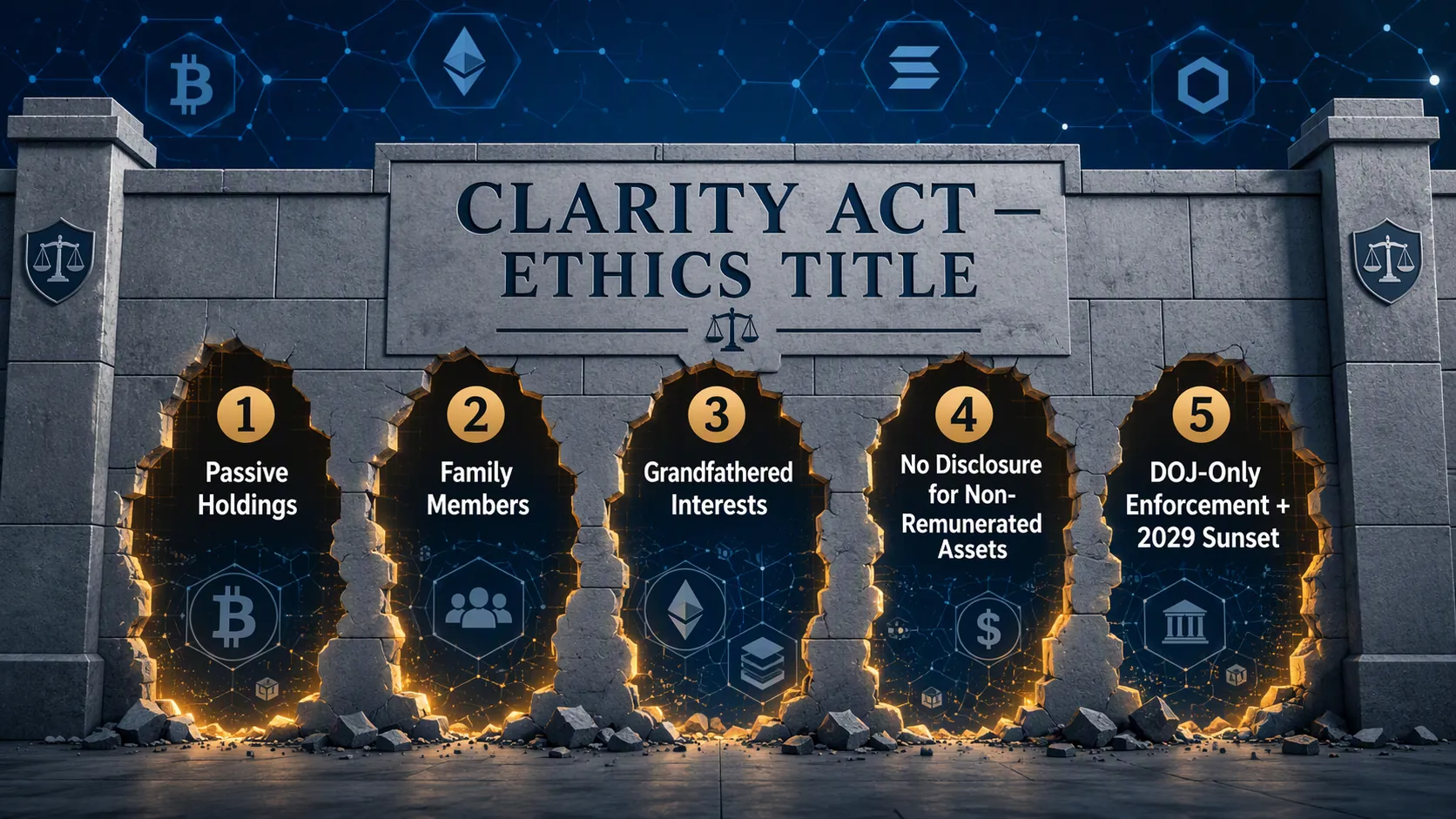
| Reported gap | Why it matters to legal-risk review |
|---|---|
| No passive-holdings ban | A covered person may be barred from issuing or sponsoring a digital asset while still retaining economic exposure to one. |
| Family members excluded | Conflict exposure may move outside the covered-person definition rather than disappear. |
| Existing interests grandfathered | The statute may regulate new conduct while preserving interests acquired before the restriction takes effect. |
| No disclosure for non-remunerated assets | A compliance reviewer may lack a statutory reporting trail for assets that still create appearance or incentive concerns. |
| DOJ-only enforcement and 2029 sunset | The enforcement path narrows, and the ethics restriction is not permanent under the reported text. |
This map should not be read as a judicial holding or a complete conflicts treatise. It is a practical issue list. Each category asks the same legal-structural question: after the ethics title is enacted, who can still hold value, who can still act, who must disclose, who can sue, and when does the rule expire?
Ownership and family gaps: the ban may miss where value sits
The most important drafting choice is the reported distinction between active participation and passive ownership. A prohibition on issuing or sponsoring a digital asset targets visible official conduct. It does not necessarily reach the quieter situation in which an official, or someone outside the covered-person definition, continues to benefit from token appreciation, liquidity events, market attention, or policy shifts that affect a digital asset’s value.
That is why the passive-holdings issue is not a technical complaint. If the statute leaves passive holdings outside the ban, then counsel evaluating a crypto-adjacent conflict cannot stop at the question, “Did the official issue or sponsor the asset?” The next questions are harder: who still owns an interest, when was it acquired, whether it was transferred, whether the transfer changed the economics, and whether the statute requires any disclosure of the retained exposure.
The family-member exclusion sharpens the same problem. The watchdog critique is not merely that family members present a public-relations vulnerability; it is that excluding them from the ethics restriction can leave a path for economically connected interests to remain outside the statutory prohibition. [5] A compliance memo that treats the covered official as the only relevant actor may therefore be too narrow for board-level or regulator-facing use.
The grandfathering concern works differently. It does not depend on transferring value to someone else. It depends on time. If existing crypto interests are preserved, then the law may stop future issuance or sponsorship while allowing pre-enactment interests to remain in place. [5] For a lawyer, that creates a chronology problem: the risk analysis has to distinguish new activity from old exposure, and the absence of a statutory prohibition on the old exposure should not be converted too quickly into an ethics blessing.
Those ownership issues also affect litigation posture. A plaintiff, counterparty, or investigative body trying to show conflict-related harm may face a statutory text that condemns one form of participation while leaving other forms outside the express ban. Defense counsel will notice that. So will boards deciding whether to approve a transaction with a politically exposed crypto connection.
Disclosure is where “not paid” can still leave a blind spot
The reported disclosure gap is narrower but still important. Transparency International U.S. and Democracy Defenders Action say the ethics title lacks disclosure requirements for non-remunerated assets. [5] That is not the same as saying every undisclosed asset is unlawful. It means the statute may fail to create the reporting record that lawyers often need when reconstructing incentives after a transaction, enforcement action, policy decision, or market-moving statement.
For in-house teams, the missing disclosure pathway creates a documentation problem. A company may have no statutory filing to review, no mandatory asset schedule to request, and no simple answer when a board asks whether the relevant official or connected person had crypto exposure. The absence of a disclosure duty can reduce visibility without reducing the underlying reputational or conflicts risk.
Enforcement and sunset: gaps become safer when fewer actors can test them
The enforcement structure is the point most likely to change how lawyers behave. Under the reported ethics title, DOJ has exclusive enforcement authority, with no private right of action and no state attorney general authority. [1][2] The watchdog groups identify the same DOJ-only design as one of the core loopholes. [5]
That does not mean DOJ would never act. It means the number of actors who can force a court to test the boundary is smaller. Private plaintiffs cannot use the ethics title as their own cause of action if the reported no-private-right structure holds. State attorneys general cannot independently enforce the ethics title if the reported state-AG exclusion holds. A compliance team assessing exposure will therefore look not only at what is prohibited, but at who has authority to make the prohibition matter.
This is where a statutory gap can start to resemble a safe harbor in practice, even if Congress never uses that phrase. A client does not need a formal safe-harbor provision to argue that conduct outside the express ban, outside required disclosure, outside private enforcement, and outside state enforcement was left to DOJ discretion. That argument may or may not persuade a court, regulator, board, or counterparty. But it is foreseeable enough that counsel should plan for it.
The 2029 sunset compounds the problem. A time-limited ethics restriction does not create a permanent conflict-of-interest barrier. [1][2] It also gives transactional lawyers and risk committees another date to track: not just the effective date of the prohibition, but the date on which the reported restriction expires unless Congress extends or replaces it.
For firm risk teams, the sunset should be treated as a live file-control issue. Engagement letters, diligence templates, and partner briefings should avoid language suggesting that the ethics title settles the conflict question indefinitely. If the statutory restriction expires in 2029 under the current reported text, then any memo relying on it needs a revision trigger before that date.
State enforcement is a separate federalism problem
New York Attorney General Letitia James has raised a related but distinct concern: state-law preemption. In written testimony reported by Benzinga, James opposed preemption and argued that the federal framework would weaken existing state enforcement regimes. [6]
That objection should not be collapsed into the DOJ-only ethics-title critique, even though the two point in the same direction. DOJ-only enforcement addresses who can enforce the federal ethics restriction. Preemption addresses whether federal law may displace or narrow state tools that already exist. If both features remain, a lawyer may be looking at a framework that simultaneously limits federal enforcement channels and constrains state enforcement capacity.
The available materials do not support a full state-law survey here. They do support a more modest warning: practitioners should not analyze the ethics title in isolation from preemption language. A federal crypto bill can change litigation risk not only by adding federal rules, but also by altering who is left with authority to bring a case.
What lawyers should do with the uncertainty now
The practical mistake would be to convert “not expressly prohibited by the reported ethics title” into “safe.” That move may be attractive in a short client email, but it is hard to defend if the omitted conduct falls into one of the identified categories: passive holdings, family-member interests, grandfathered assets, non-disclosed non-remunerated assets, or conduct reachable only if DOJ chooses to act.
A litigation team should preserve the distinction between statutory violation and conflict evidence. Even if a fact pattern does not fit the reported issuance-or-sponsorship ban, the same facts may still matter to scienter, motive, fiduciary-duty theories, disclosure arguments, administrative-record challenges, or reputational-risk analysis. The ethics title may narrow one route without closing every other legal theory.
In-house counsel should make the same distinction in board materials. A board does not need a conclusion that the CLARITY Act has been violated in order to care about an official’s retained crypto exposure, a family-linked asset, or a grandfathered interest. The relevant governance question is often whether the company can explain why it proceeded despite a known conflict pathway.
Knowledge-management and risk teams should keep dated versions of their guidance. The bill text may change quickly. Any internal note should identify the date reviewed, the sources relied on, the fact that the full bill has not been read for this analysis, and the open questions that would change the advice if amended.
- Do not describe the reported ethics title as a comprehensive crypto-conflicts code.
- Separate active issuance or sponsorship from passive economic exposure.
- Ask whether family-member interests or pre-existing stakes remain outside the covered prohibition.
- Check whether the relevant asset would be disclosed at all under the reported framework.
- Treat DOJ-only enforcement and the absence of private or state-AG enforcement as material to exposure, not as a merits conclusion.
- Calendar the 2029 sunset before relying on the restriction in any durable compliance document.
Nothing in the current source set proves that the CLARITY Act will pass, that the ethics title will remain unchanged, or that a court would treat the identified gaps as lawful safe harbors. The narrower and more useful conclusion is that practitioners should not treat the current reported ethics title as a clean compliance boundary. It leaves unresolved conflict pathways and narrows enforcement in ways that materially affect legal-risk assessment.
The defensible file note is simple: statutory non-prohibition is not ethics clearance. Document the uncertainty, watch for amendments before relying on the text, and keep the crypto regulation-ethics analysis open for revision as the bill changes.
References
- Mixed Reactions To New Crypto CLARITY Act Text & Ethics Clause — Forbes, July 24, 2026
- Senate Releases Updated CLARITY Act Text; SEC Commissioner Addresses Crypto Vaults; and SEC and CFTC Advance 24-Hour Trading — Paul Hastings
- VIDEO: Blumenthal Delivers Opening Statement at Public Forum on Trump’s Crypto Corruption — Office of U.S. Senator Richard Blumenthal
- Blumenthal Blasts Trump’s Crypto Corruption, Calls For Clearer Clarity Act — New Haven Independent, July 27, 2026
- Lawmakers Must Close the Crypto Conflict of Interest Loopholes — or Scrap the CLARITY Act — Transparency International U.S.
- Blumenthal Trump Crypto Loopholes Family Digital Assets — Benzinga
Operationalizing workflow
No workflow has been explicitly linked to this obligation yet. See Workflows generally.
Illustrative cases
No illustrative case is currently tracked for this obligation. See Risk Digest for documented incidents generally.
← Back to RegulationReport a correction or tip
Spotted an outdated figure, a misstated fact, or a ruling this regulation entry should reflect? Public comments are disabled for this content given the professional cost of a misreported case outcome, penalty amount, or rule text — use the structured correction channel instead.
Report a correction or tip for this record →