
BMW's job cuts show there's no 2027 voluntary redundancy law
- Authority
- German Bundestag
- Rule type
- proposed statute
- Jurisdiction scope
- EU
- Effective date
- Jan 1, 2027
- Source text
- Read primary rule text ↗
High earners above ~€180k may face court dissolution with capped severance if proposed law passes.
There is no enacted German “voluntary redundancy law 2027” governing BMW’s job cuts. The phrase conflates two separate tracks: BMW’s announced voluntary separation program, which is planned to operate under existing German employment law, and a proposed 2027 employment-law package that still requires legislation.
The reform track comes from coalition committee resolutions reached in the July 1–2, 2026 window. The law-firm summaries available as of Q3 2026 treat the package as proposed, not enacted, with Bundestag passage still pending and details capable of changing before any statute takes effect.[1][6]
The BMW track is different. BMW’s program was reported on July 29, 2026 as a voluntary program scheduled to run from October 2026 through December 2027, with media reports describing up to about 8,000 job reductions and individual offers to a large share of German non-production staff.[2] BMW did not officially confirm every precise figure reported in the press, including the exact number of affected jobs and offers, so those numbers should be treated as reported parameters rather than published legal terms.[3]
| Track | Current status in Q3 2026 | Why it matters |
|---|---|---|
| BMW voluntary program | Confirmed in broad shape; exact figures remain media-reported | Scheduled to run from October 2026 to December 2027 under existing German law |
| 2027 employment-law package | Proposed, not enacted | Would matter only if passed in relevant form, especially because the proposed January 1, 2027 date falls inside BMW’s program window |
| “Voluntary redundancy law 2027” | No single enacted law by that name | Useful only as a search phrase, not as a legal category |

BMW’s program does not need a new law to operate
A German Freiwilligenprogramm is not a statutory entitlement to severance. It is a company program built around voluntary termination agreements, usually Aufhebungsverträge, with the employer offering terms and employees deciding whether to accept. That is why BMW can run the program before 2027 without waiting for a new statute.
The broad contours reported for BMW fit that model: no compulsory redundancies, production workers excluded, and offers directed primarily at German non-production employees. DW reported about 40,000 individual offers among roughly 84,000 German employees, while other coverage used a nearby 85,000 figure for the German workforce.[2][3]
The legal point is the “double voluntary” structure. The employer does not have to offer a termination agreement to everyone, and the employee does not have to sign. If both sides sign, the employment relationship usually ends on the agreed date and on the agreed commercial terms. If the employee refuses, the program itself does not automatically terminate the contract.
Works-council involvement is also part of the current-law picture, not evidence of a special 2027 law. In German restructurings, a Betriebsänderung can trigger works-council rights, including a reconciliation of interests under BetrVG §111. Voluntary programs can sit inside that framework, especially where the employer is trying to reduce headcount without compulsory dismissals.[4]
There is also a procedural trap that gets lost when the program is described only as “voluntary.” For collective-redundancy notification purposes under KSchG §17, a termination agreement concluded at the employer’s initiative can count as a dismissal. CMS’s voluntary-program FAQ highlights the practical consequence: in an establishment with more than 500 employees, the threshold is 30 dismissals, and the notification analysis can become relevant even where the separation documents are consensual.[4]
That is one reason HR teams should not present an Aufhebungsvertrag as a paperwork shortcut with no employment-law consequences. For the employee, signing can also affect unemployment benefits. German sources discussing BMW’s program have pointed to the risk of a Sperrzeit under §159 SGB III, commonly described as a 12-week blocking period, and a possible Ruhenszeit under §158 SGB III where severance and notice-period issues interact.[7]
Those consequences are fact-specific. The practical lesson is narrower and safer: BMW’s voluntary program is real, but it is not a self-contained legal regime. It sits on ordinary termination-agreement mechanics, ordinary works-council mechanics, ordinary collective-redundancy notification rules, and ordinary social-security consequences.
The overlap begins only because the dates line up
BMW’s business context explains why the company is acting, but it does not change the legal status of the program. Electrive reported BMW’s first-half 2026 figures as revenue down 8% to €62.27 billion, pre-tax profit down 29.4% to €4.05 billion, and an EBT margin of 6.5%, with management pointing to weak demand in China as part of the pressure.[5]
The more important legal date is not BMW’s earnings date. It is the program window. BMW’s voluntary program was reported to run from October 2026 to December 2027, while the employment-law package is being discussed with a proposed January 1, 2027 effective date for several items.[1][2]
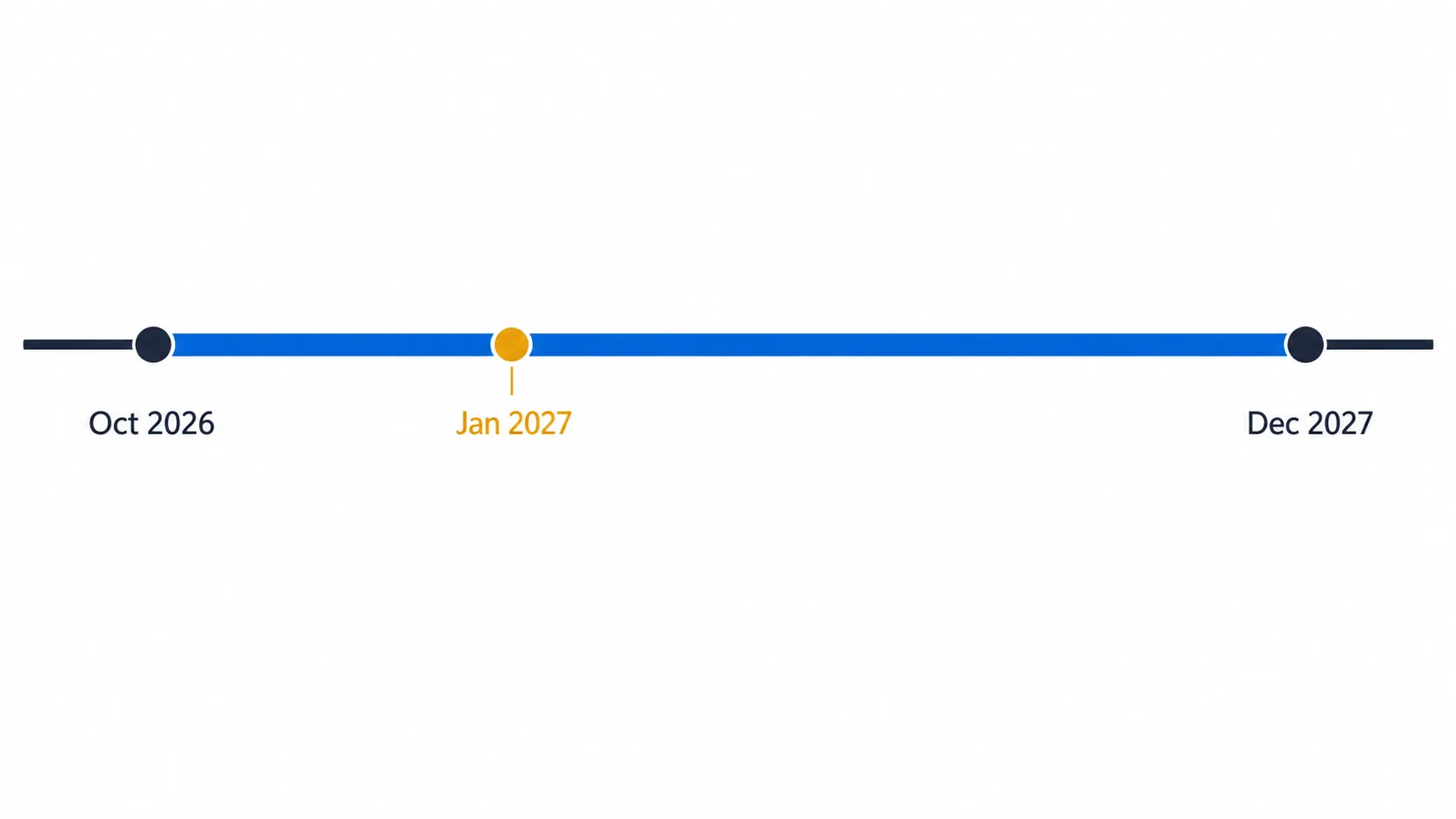
If the reform package fails, changes materially, or starts later than proposed, BMW’s program remains a voluntary program under existing law. If the high-earner severance proposal passes in relevant form with a January 1, 2027 start, then one category of employee would need to reassess the bargaining position while the program is still open.
The proposed high-earner severance option is the real 2027 issue
The proposed rule receiving the most attention from employment lawyers is not a general voluntary redundancy statute. It is a high-earner dismissal and severance mechanism modeled on the financial-sector risk-taker rule in KWG §25a(1) no. 5a. As summarized by Baker McKenzie and DLA Piper, it would allow court dissolution of the employment relationship under KSchG §§9–10 for employees above a specified earnings threshold, even where a dismissal is found socially unjustified.[1][6]
| Feature | Proposed rule |
|---|---|
| Status | Proposed, not enacted |
| Target group | Employees earning more than 1.75 times the pension contribution assessment ceiling |
| Illustrative 2026 threshold | 2026 BBG of €101,400 implies about €177,450; sources expect the 2027 threshold to exceed €180,000 |
| Court mechanism | Dissolution under KSchG §§9–10 even if dismissal is socially unjustified |
| Severance cap | Generally 12 months’ earnings |
| Higher caps | 15 months for employees aged 50+ with at least 15 years’ service; 18 months for employees aged 55+ with at least 20 years’ service |
| Proposed start | January 1, 2027 |
For a high earner inside BMW’s German non-production population, the timing question is concrete. A 2026 voluntary offer is negotiated against the existing background: the employee may accept the Aufhebungsvertrag, reject it, or continue employment unless the employer pursues another lawful route. If the proposed 2027 rule is enacted in the form summarized above, the employer may have an additional court route for employees above the earnings threshold during the remaining 2027 part of BMW’s program window.
That does not mean a high earner should automatically reject or accept a 2026 offer. It means the reservation price, litigation risk, and timing analysis could change. A voluntary package that looks unattractive in October 2026 may look different if, by January 2027, the employer can seek a capped court dissolution rather than negotiating only under the old leverage structure.
The unresolved questions matter. The current summaries do not settle whether the rule would reach existing contracts or only new employment relationships, how variable compensation would be counted in annual income, or what happens to pending disputes if legislation is passed while a restructuring is already underway.[6]
Reported payout models are not BMW terms
The BMW severance formula has not been published as an official term sheet. Merkur.de discussed possible model calculations using factors such as 0.5, 1.0, or 1.5 months’ salary per year of service, but those were scenarios for estimating possible severance ranges, not confirmed BMW offer terms.[8]
That distinction is not cosmetic. A severance model can omit the parts that decide whether a real employee should sign: release periods, bonus treatment, equity vesting, pension effects, non-competes, tax timing, reference language, repayment clauses, unemployment-benefit consequences, and whether the employee has a realistic alternative to agreement.
For internal communications, it is safer to say “reported scenarios” or “illustrative models” unless the company has issued a confirmed formula to the employee population. For employees, the same caution runs in the other direction: do not treat a newspaper severance estimate as an entitlement.
The rest of the 2027 package is background here
The proposed employment-law package contains other items, but they do not turn BMW’s program into a 2027 voluntary redundancy law. They are surrounding proposals and should be labeled that way.
- Proposed severance tax benefits tied to prompt re-employment, with greater benefit the faster the employee takes a new job.[1]
- Proposed expansion of fixed-term contracts without objective grounds to as much as 48 months with up to six extensions, through December 2030.[1]
- Proposed abolition of the written-form requirement for fixed-term contracts from January 1, 2027.[1]
- Proposed changes to sick-note rules, including abolition of telephone sick notes and a day-one sick-certificate obligation.[1][6]
Each of those items may matter for German HR operations if enacted. None is the legal basis for BMW’s current voluntary termination-agreement program.
Practical status position as of Q3 2026
Last verified: August 3, 2026. This article is a legal-status record for general information, not legal advice.
- Confirmed: BMW has announced a voluntary separation program in Germany, reported to operate from October 2026 through December 2027.
- Confirmed in law: German employers can use voluntary termination agreements under existing employment-law rules, with works-council, collective-redundancy notification, and social-security issues to manage.
- Not enacted: the 2027 employment-law package, including the high-earner severance option, remains a proposal awaiting legislation.
- Relevant if enacted: the high-earner rule could affect bargaining behavior for employees above the earnings threshold while BMW’s program is still open in 2027.
- Still unresolved: whether the high-earner rule would apply to existing contracts, how variable pay would be counted, and how pending disputes would be handled.
So the clean answer to “bmw job cuts germany voluntary redundancy law 2027” is this: BMW’s program is real, but it is governed by existing law. The 2027 reform is not law. Only if the high-earner severance proposal passes in relevant form does it become a live factor for certain employees before BMW’s December 2027 program close.
References
- Germany: Planned Significant Changes to German Employment Law — Baker McKenzie
- BMW to cut up to 8,000 jobs — DW
- BMW will weltweit 8.000 Stellen abbauen – viele davon in Deutschland — ZEIT
- FAQ on voluntary redundancy programmes — CMS
- BMW to cut 8000 office jobs primarily in Germany — electrive
- German reform package: Employment law implications — DLA Piper
- BMW Stellenabbau 2026/2027: Abfindung, Aufhebungsvertrag und Sperrzeit – wichtige Tipps für BMW Mitarbeiter — anwalt.de
- Beim Stellenabbau bekommen BMW-Mitarbeiter Abfindung? So viel könnten Mitarbeiter bekommen — merkur.de
Operationalizing workflow
No workflow has been explicitly linked to this obligation yet. See Workflows generally.
Illustrative cases
No illustrative case is currently tracked for this obligation. See Risk Digest for documented incidents generally.
← Back to RegulationReport a correction or tip
Spotted an outdated figure, a misstated fact, or a ruling this regulation entry should reflect? Public comments are disabled for this content given the professional cost of a misreported case outcome, penalty amount, or rule text — use the structured correction channel instead.
Report a correction or tip for this record →