
Byrd Rule Blocks the SAVE America Act in Reconciliation
- Authority
- U.S. Senate Parliamentarian
- Rule type
- statute
- Jurisdiction scope
- US federal
- Source text
- Read primary rule text ↗
Reconciliation provisions must have budgetary effects that are not merely incidental to policy change.
The immediate procedural answer is already unfavorable to the SAVE America Act: the core election-policy provisions have been ruled noncompliant with the Byrd Rule, and the proposed $10 billion grant-conditioning workaround is vulnerable to the same objection rather than exempt from it. Any SAVE America Act reconciliation analysis therefore does not begin with whether Congress may regulate federal elections, or whether voter ID is good policy. It begins with whether the Senate can honestly treat nationwide documentary proof of citizenship, voter-ID mandates, federal preemption of state registration rules, DHS database use, and election-official penalties as budget provisions.
On the available record, that is the hard part for proponents. Roll Call and Legislative Procedure both describe the SAVE America Act provisions as running into the Byrd Rule’s bar on reconciliation provisions whose budgetary effects are only incidental to nonbudgetary policy change.[1][2] Later reporting likewise describes Parliamentarian Elizabeth MacDonough as having ruled the SAVE America Act provisions noncompliant with the Byrd Rule.[3][4]
One limitation matters at the outset. The Congress.gov text for H.R. 7296 was not available in the sources consulted here. The discussion of specific provisions therefore relies on secondary descriptions from congressional-procedure reporting and legal-policy explainers, not on an independent section-by-section parsing of bill text.

The provisions at issue are election rules with budget effects attached
The described SAVE America Act package would require documentary proof of citizenship for voter registration, impose voter-identification requirements, alter the relationship between federal standards and state registration systems, require use of the Department of Homeland Security’s SAVE database for verification, and expose election officials to penalties for noncompliance.[4] Those are not minor administrative riders. They alter who can register, what documents must be accepted, which systems state and local officials must use, and what consequences attach if election administrators do not comply.
That does not mean the provisions have no budget consequences. A registration mandate can cost money. A federal grant program can move federal funds. A database requirement can impose federal and state administrative burdens. But the Byrd Rule does not ask whether Congress can identify some fiscal trace. It asks whether the fiscal component is doing the legislative work, or whether it is an incidental consequence of a policy decision being moved through a budget vehicle.
The Byrd Rule gate the bill must pass
Budget reconciliation avoids the Senate filibuster only for measures that fit within reconciliation’s budget function. The Byrd Rule is the enforcement mechanism. In practical terms, a senator may raise a point of order against “extraneous” matter, and the parliamentarian’s advice determines whether the provision stays in the bill absent a successful waiver or override.
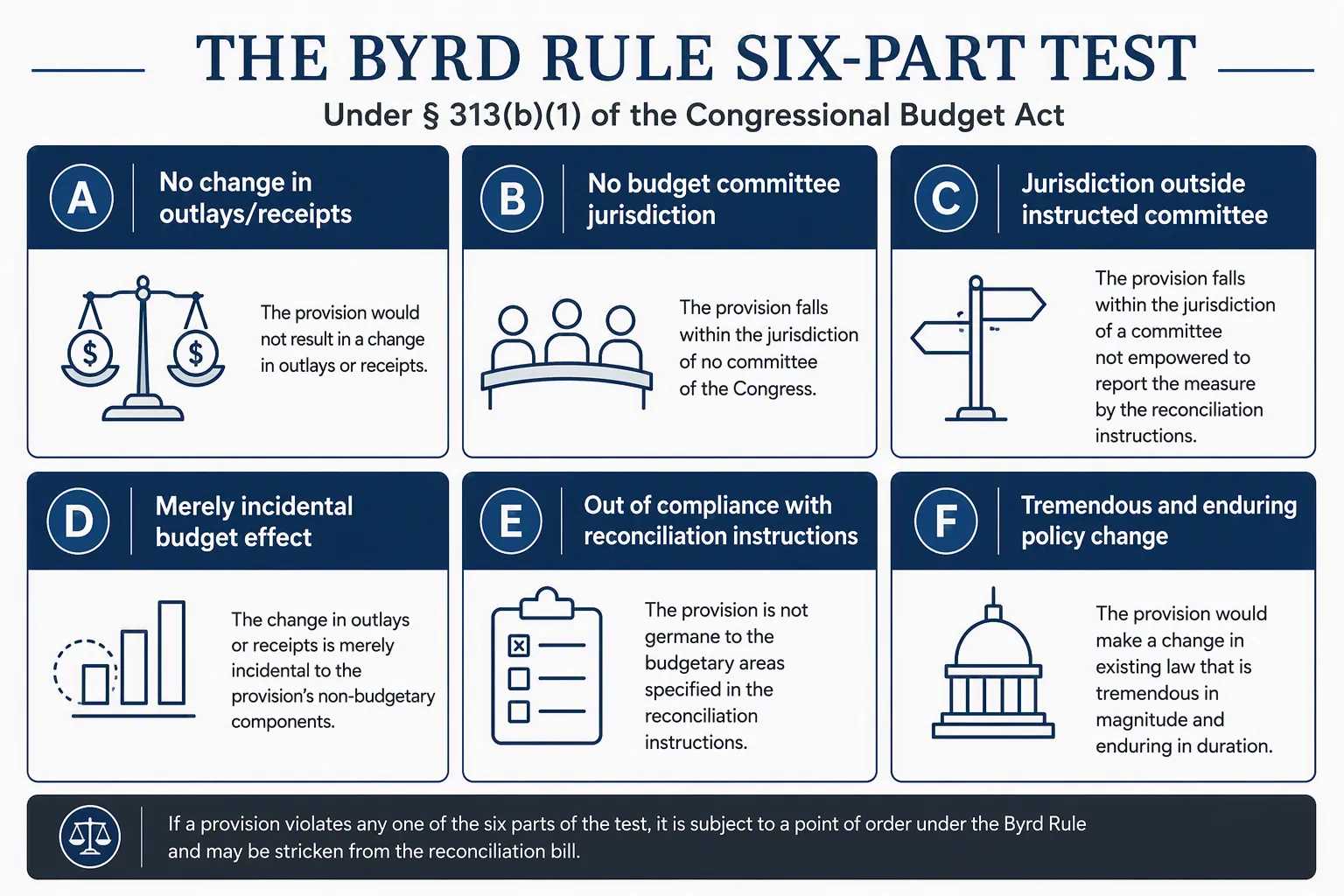
The operative checks discussed in the SAVE America Act materials include whether a provision changes outlays or revenues, whether it complies with the reconciliation instructions, whether it falls within the jurisdiction of the committee receiving those instructions, and whether its budgetary effects are merely incidental to the nonbudgetary policy change.[1][2] In this dispute, the load-bearing inquiry is the “merely incidental” test.
| Byrd Rule check | Why it matters for the SAVE America Act |
|---|---|
| No real outlay or revenue change | A provision that principally changes election eligibility or registration standards cannot survive just because compliance has administrative costs. |
| Failure to comply with reconciliation instructions | If the instructed committee does not produce the required budgetary result, the provision is vulnerable on that ground as well. |
| Outside the instructed committee’s jurisdiction | A grant program handled through Senate Rules and Administration may not carry every DHS, criminal-liability, or state-registration mandate proponents want to attach. |
| Budgetary effect merely incidental to policy change | This is the central problem: the policy change appears to dominate the fiscal effect. |
| Long-window deficit effects | A provision that increases deficits outside the budget window can trigger a Byrd Rule point of order, though this is not the principal issue in the current materials. |
| Social Security | Not central here, but part of the statutory structure of reconciliation limits. |
The 2021 precedents make the SAVE America Act’s problem concrete. In the minimum-wage dispute, MacDonough ruled that a $15 minimum wage was “a substantial and far-reaching policy change whose size in dollar terms does not mean it is primarily a budgetary matter.”[1] The lesson is not that dollar amounts are irrelevant. It is that a large fiscal estimate does not automatically transform a regulatory labor rule into a budget rule.
The immigration precedent points the same way. Legislative Procedure describes MacDonough’s 2021 ruling on immigration provisions as finding “a tremendous and enduring policy change that dwarfs its budgetary impact.”[2] That language is especially damaging to the SAVE America Act reconciliation theory because the election provisions are not naturally budgetary in subject matter. They regulate voter eligibility documentation, identity verification, state systems, and enforcement.
Why the original election provisions fail the ordinary reconciliation analysis
The original version’s first problem is that its budget hook is thin compared with the policy displacement it attempts. Requiring documentary proof of citizenship is a rule about voter eligibility administration. Requiring voter ID is a rule about ballot access and election administration. Mandating use of a federal database is a rule about verification architecture. Penalizing election officials is an enforcement choice. Each may generate public costs, but the costs follow from the policy design.
That distinction is exactly what the “merely incidental” inquiry is built to police. If Congress could place any regulatory overhaul into reconciliation by pointing to compliance expenses, the Byrd Rule would lose much of its function. The question is not whether the SAVE America Act has any budgetary consequences; it is whether the budget consequences are more than incidental to the election-law changes. The existing ruling and the 2021 precedents answer that question against the bill under ordinary procedure.[1][2]
Criminal or civil enforcement mechanisms do not solve the problem. Penalties can produce revenue, and enforcement can cost money, but a penalty provision whose purpose is to compel election officials to follow new federal registration rules still looks like election regulation first. The fiscal effect is not the measure’s center of gravity.
Nor does the presence of federal systems, including DHS verification infrastructure, by itself make the package budgetary. A federal database requirement may require appropriations, administrative capacity, or intergovernmental coordination. But the policy choice is the mandated verification regime. Under the minimum-wage and immigration precedents, the Senate does not stop at the budget line and ignore the regulatory object.
The $10 billion grant-conditioning workaround is a better argument, but not a cure
The grant version deserves more careful treatment than “they renamed the bill.” The reported workaround would create a $10 billion SAVE America Election Grant Program and frame documentary proof-of-citizenship and voter-ID requirements as terms and conditions on federal election assistance.[2] Grants are spending. Grant conditions can have real budgetary content. If the bill simply appropriated money for election administration, the reconciliation analysis would look different.
The problem is that grant form does not end the Byrd Rule inquiry. A condition attached to federal money can still be a nonbudgetary policy command for reconciliation purposes. The Senate still asks whether the condition is within the jurisdiction of the instructed committee and whether the condition’s budgetary effects are merely incidental to the policy change.
Jurisdiction is the first pressure point. Available sources identify Senate Rules and Administration as the committee receiving the relevant reconciliation instructions, but the workaround reportedly reaches into matters involving DHS database use, federal standards for state registration systems, documentary proof requirements, and liability for election officials.[2] Some election-administration spending may sit comfortably with Rules and Administration. It does not follow that every attached verification, immigration-data, or enforcement mandate is within that committee’s reconciliation jurisdiction.
That matters in a Byrd bath. If a grant condition is found outside the instructed committee’s jurisdiction, or if the condition is found to have a merely incidental budget effect, the condition can be stripped even if the underlying grant appropriation remains. The $10 billion figure may strengthen the argument that the bill has a spending component, but the 2021 minimum-wage precedent is a warning against treating size in dollar terms as dispositive.[1]
| Feature of the workaround | Procedural effect |
|---|---|
| $10 billion election grant program | Creates a real spending vehicle and gives proponents a more serious reconciliation hook. |
| DPOC and voter-ID as grant conditions | Still subject to the “merely incidental” inquiry if the conditions mainly impose national election rules. |
| DHS SAVE database requirements | Raises jurisdictional questions if the instructed committee is Senate Rules and Administration rather than a committee with DHS jurisdiction. |
| Election-official liability | Looks like enforcement policy rather than a budget term unless proponents can tie it tightly to grant administration. |
| Byrd bath review | Could preserve spending while removing policy conditions if the parliamentarian treats the conditions as extraneous. |
There is also an instruction-compliance problem in the available reporting. Roll Call reports that the House budget framework lacked spending offsets, creating an additional procedural vulnerability under reconciliation’s instruction requirements.[1] That is not the same objection as “merely incidental,” but it travels in the same direction: the more the bill functions as an election-policy package with spending attached, the harder it is to defend as a reconciliation measure.
The uncertainty should be stated cleanly. The grant-conditioning theory is not frivolous simply because it is aggressive. Prior reconciliation bills have included terms and conditions on spending, and the existence of a grant program gives proponents something more substantial to argue from than incidental administrative costs. But the current record does not identify precedent for using reconciliation to impose election-eligibility and documentation requirements of this scale through grant terms. On this record, the burden remains with proponents to show why the conditions are budgetary in substance, not merely in packaging.
Political escape hatches exist, but they are not the ordinary legal route
It would be too strong to say the bill is procedurally impossible in every imaginable Senate. The Senate can waive Byrd Rule points of order with sufficient votes, and a majority could attempt a more drastic institutional move by firing or replacing the parliamentarian. Those routes would change the analysis because they would change or bypass the enforcement mechanism.
That is why President Trump’s demand that Senate Majority Leader John Thune fire MacDonough is procedurally relevant, even though it is not a Byrd Rule argument.[3] The current reported posture cuts the other way: Thune has rejected the demand.[3][6] Without a waiver, replacement, or successful override, MacDonough’s application of the Byrd Rule remains the operative gate.
The “nuclear option” framing can also obscure the narrower point. Replacing a parliamentarian would not make the SAVE America Act budgetary; it would make the Senate willing to proceed despite, or with a different view of, the procedural objection. That distinction matters for anyone evaluating legal risk, institutional precedent, or the likelihood that a reconciliation strategy survives in the Senate as it presently operates.
The calendar makes a theoretical survival path less useful for 2026
Even if a narrowed grant provision survived, the calendar is hostile to any claim that the SAVE America Act can meaningfully govern the November 2026 midterms. The House budget framework was approved 216-214 on July 22, 2026; the House then recessed from July 23 through late August, the Senate recess was scheduled from August 7 through September 14, and Congress faces campaign-season compression after September.[5][6] A Byrd bath itself takes multiple legislating days.[3]
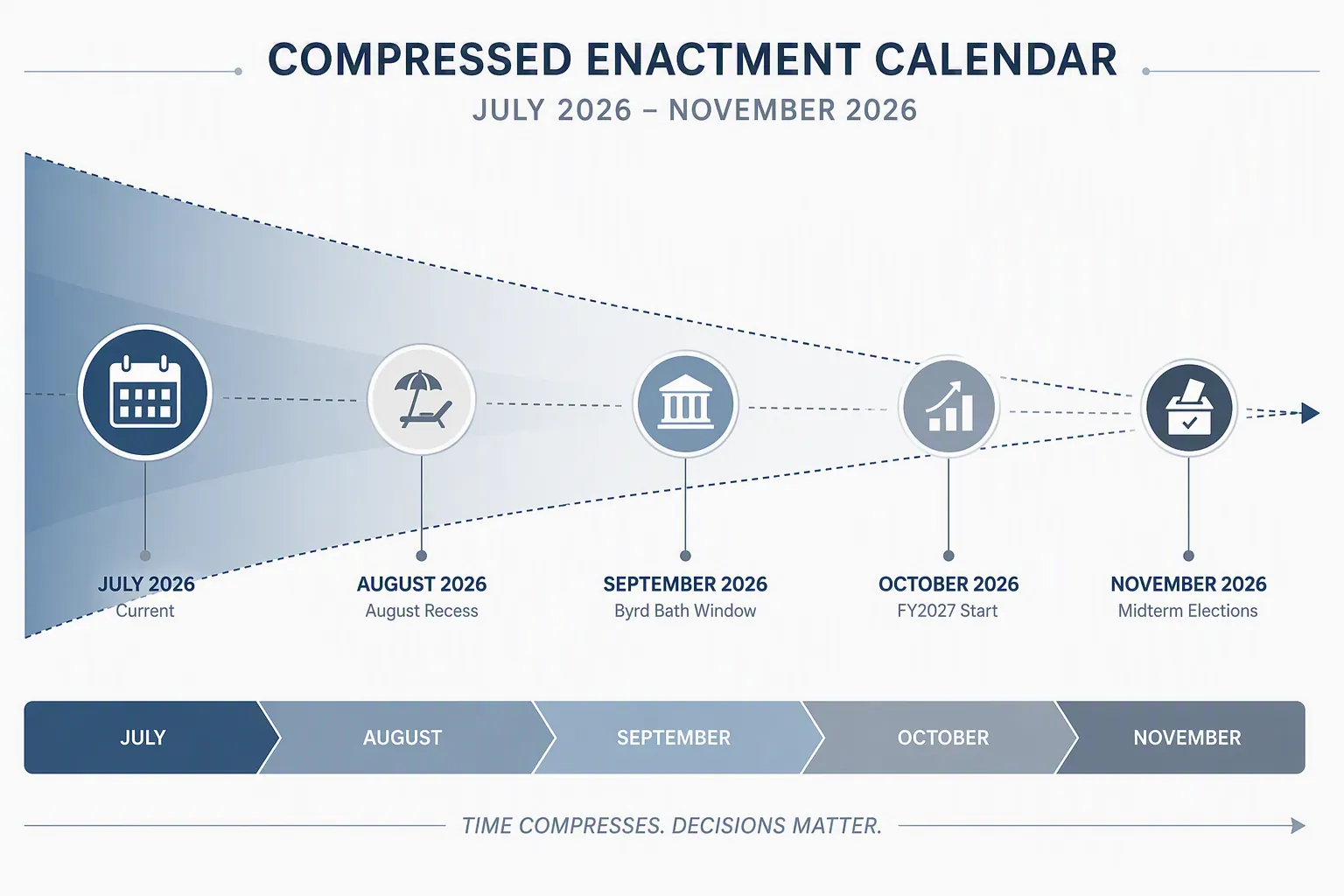
Fiscal-year timing adds another practical complication. Available sources identify FY2027 as beginning October 1, 2026, leaving little room for enactment, agency setup, grant administration, state acceptance, system changes, training, public notice, and litigation before Election Day.[5] Reconciliation can accelerate Senate passage relative to ordinary legislation, but it cannot make state and local election systems reconfigure themselves instantly.
Sen. Thom Tillis’s implementation point is important for that reason. Democracy Docket and NBC News report his view that even if the measure had passed the prior year, it could not have been implemented in time because more than 10,000 election jurisdictions would need to overhaul systems.[5][4] That is not a merits judgment about voter ID. It is a timing judgment about operational capacity.
For litigation and compliance planning, that distinction is useful. A provision can be politically salient even if it cannot be operationalized for the next election. Conversely, a provision can be procedurally vulnerable even if it would impose large administrative costs if enacted. The SAVE America Act faces both problems: the ordinary Byrd Rule analysis blocks the main election-policy provisions, and the remaining 2026 calendar leaves little practical runway for a surviving grant structure.
Where the reconciliation analysis lands
Under ordinary Senate rules, the SAVE America Act’s core election-policy provisions cannot ride budget reconciliation to timely enactment before the 2026 midterms. The original provisions fail because their budgetary effects are incidental to a sweeping election-law project. The $10 billion grant workaround improves the form of the argument, but it does not eliminate the Byrd Rule questions over committee jurisdiction and merely incidental policy conditions. The political escape hatch remains real in theory, but current reporting does not show the votes, leadership position, or personnel change needed to make it available.
References
- Byrd rule poses challenge for voter ID bill in reconciliation, Roll Call, March 25, 2026.
- Can Reconciliation Save the SAVE America Act?, Legislative Procedure, March 24, 2026.
- Trump calls on Thune to fire Senate parliamentarian to pass SAVE America Act, The Hill, July 2026.
- What to know about the SAVE America Act, NBC News, July 2026.
- House Republicans relaunch SAVE America Act push in new reconciliation package, Democracy Docket, July 23, 2026.
- Trump demands Senate cancel August break, PBS News, July 2026.
Operationalizing workflow
No workflow has been explicitly linked to this obligation yet. See Workflows generally.
Illustrative cases
No illustrative case is currently tracked for this obligation. See Risk Digest for documented incidents generally.
← Back to RegulationReport a correction or tip
Spotted an outdated figure, a misstated fact, or a ruling this regulation entry should reflect? Public comments are disabled for this content given the professional cost of a misreported case outcome, penalty amount, or rule text — use the structured correction channel instead.
Report a correction or tip for this record →