
California Mail Ballot Rejection: 2024 Primary Data and Legal Risks
- Authority
- California Secretary of State
- Rule type
- regulation
- Jurisdiction scope
- US state
- Effective date
- Jul 24, 2026
- Source text
- Read primary rule text ↗
Counties must follow signature verification and cure procedures; late ballots require postal infrastructure review.
California rejected 108,982 mail ballots in the 2024 primary, a 1.56% rejection rate. By the 2026 primary, the number had risen to 148,241, or 1.73% of mail ballots cast.[1] Those two numbers are the necessary starting point for any analysis of California's 2024 primary mail ballot rejection reasons, but they are not the whole legal story. The more important change is categorical: late-arriving ballots, not signature mismatch, now appear to be the dominant rejection reason.
The 2026 primary figure includes 93,479 ballots rejected for lateness, about 63% of all rejected mail ballots, compared with roughly 76,000 late rejections in the 2024 primary.[1] Signature mismatch remained substantial, at about 44,000 rejections in the 2026 primary, and ballots with no signature accounted for about 8,300 more.[1] The source trail matters: the 2024 and 2026 primary totals are reported by AP from Secretary of State documents that were not available as directly reviewed PDFs, while the Secretary of State separately maintains statewide 2024 vote-by-mail rejection-reason report pages.[1][2]
That distinction changes the exposure analysis. A signature mismatch, a missing signature, a rejected comparison, and a late scan do not fail at the same point in the system. They do not trigger the same county duties. They do not leave the same evidentiary record. And they do not produce the same defense when a rejected voter, campaign, or civil-rights plaintiff asks whether the failure was legally preventable.
The Rejection Rate Is Only the First Filter
An aggregate rejection rate can be useful for triage, but it is a blunt instrument. A county with a high mismatch rate presents one kind of record: training, signature-comparison standards, reviewer notes, cure notices, deadlines, and whether two officials agreed before rejection. A county with a high late-arrival rate presents another: postmark practices, distance from processing hubs, voter instructions, USPS routing, receipt timestamps, and whether the ballot ever entered a curable posture.
The 2024 general election data point reinforces why the category matters. California elections officials rejected 122,480 mail ballots in that election, and signature mismatch accounted for 59% of those rejections, according to a California Voter Foundation account citing USC Center for Inclusive Democracy analysis.[3] That is a different risk profile from the 2026 primary, where lateness accounted for nearly two-thirds of rejected mail ballots.[1] One set of facts points toward voter-verification and cure procedure; the other points toward receipt deadlines and postal infrastructure.
| Election | Rejected mail ballots | Rejection rate or share | Risk signal |
|---|---|---|---|
| 2024 primary | 108,982 | 1.56% | Baseline primary figure; lateness already substantial |
| 2024 general | 122,480 | Signature mismatch was 59% of rejections | Verification and cure process remained central |
| 2026 primary | 148,241 | 1.73%; lateness was 63% of rejections | Late arrival became the dominant category |
Layer One: Statutory Compliance Still Starts With the Ballot Envelope
California’s statutory framework is not casual about rejected vote-by-mail ballots. Elections Code § 3019 governs comparison of the voter’s signature and the return envelope signature, and it is also where the notice-and-cure architecture now sits. Elections Code § 15377 governs processing and counting of vote-by-mail ballots. Elections Code § 3020 supplies the receipt rule: a vote-by-mail ballot is timely if it is cast by Election Day and received by the elections official no later than seven days after Election Day, subject to the statutory postmark and related timing requirements.
The signature provisions became constitutionally loaded after La Follette v. Padilla. The ACLU’s 2017 challenge attacked California’s then-existing practice of rejecting mail ballots for perceived signature mismatch without giving voters notice and an opportunity to cure; the litigation led to the cure-notice framework now reflected in § 3019(d) and § 3019(e).[4] For county counsel, that history matters because notice is not merely customer service. It is part of the constitutional footing for rejecting a ballot based on voter identity verification.
The Secretary of State’s emergency regulations further narrow county discretion in signature review. They state a presumption of validity, require signature comparison to be liberally construed in favor of the voter, and require two elections officials to unanimously find that signatures do not compare before a ballot may be rejected on that ground. The regulations also require counties to send cure forms within 24 hours after determining that a signature is missing or does not compare.[5]
Those requirements do not make litigation disappear. They change what litigation is about. The useful questions are no longer whether California has a cure process in the abstract, but whether a particular county can show that the process happened when and how the law required: who made the mismatch determination, whether the required concurrence existed, when the cure notice went out, what address or contact channel was used, and whether the voter had a realistic opportunity to respond before certification pressure closed the window.
Layer Two: County Variation Is Where the Record Becomes Uneven
County variation is not automatically unlawful. California counties differ in size, voter population, ballot volume, staffing, language needs, and local mail conditions. But large differences in rejection rates are not legally inert either. California Voter Foundation reported county rejection-rate extremes of 3.52% in Tulare County and 0.17% in Amador County.[3] That spread is too large to treat as background noise without asking which rejection reasons drove it.
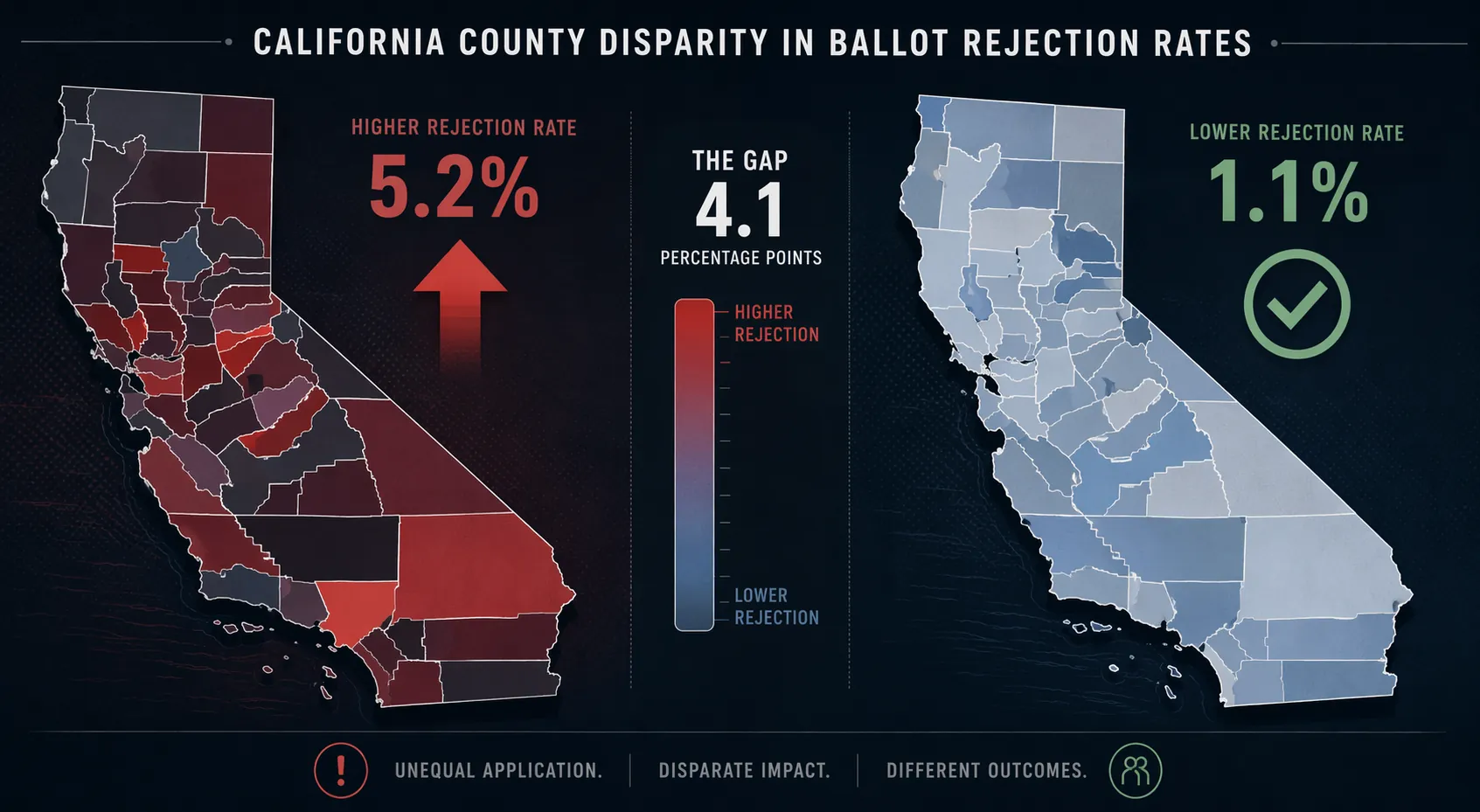
For signature mismatch, the county record should be reviewed at the decision point. Were reviewers trained on the Secretary of State standard? Did they treat natural signature variation as expected, especially for elderly voters, voters with disabilities, or voters whose registration signature is old? Did the county document the two-official unanimous rejection requirement? Did cure forms go out within the regulatory timeline? A mismatch challenge is usually won or lost in the administrative trail, not in a statewide debate over whether signature verification is a good idea.
For missing signatures, the record is different. There is less subjective comparison, but there is still a notice-and-cure obligation. The 2026 primary’s roughly 8,300 no-signature rejections are a smaller category than late ballots or mismatches, but they remain legally sensitive because the voter’s defect is identifiable and often curable if the notice arrives in time.[1] A county that can show prompt cure outreach is in a different position from a county that cannot reconstruct when notice was generated, mailed, emailed, or otherwise transmitted.
Demographic disparity claims require care. The available record does not include published county-level signature-mismatch rejection data by race, age, or other demographic group from the Secretary of State’s rejection-reason reports. Older ACLU allegations and secondary reporting may help frame risk, but they should not be overstated as current county-level proof. For litigation planning, that means counsel should separate a plausible disparate-impact theory from the evidence actually available in the county’s own files.
Layer Three: Lateness Is the Awkward Category
Late-arriving ballots are now the harder problem because they sit partly outside the machinery California built to protect voters. A mismatched signature can be reviewed again. A missing signature can be cured. A late ballot, if it misses the statutory timing rule, is usually not waiting for better county outreach; it is waiting for a time machine.
That is why the 93,479 late rejections in the 2026 primary deserve more attention than another generic argument about signature matching.[1] If lateness is the dominant rejection reason, the operative risk moves away from whether the county gave a voter enough procedural protection after identifying a curable defect. It moves toward whether the voter had a fair and administrable path to satisfy the postmark and receipt rules in the first place.

The postal evidence is not as clean as a Federal Register record in the available sources, so it should be stated as operational risk rather than as a fully primary-sourced federal administrative finding. Still, the reported facts are substantial. LA Times reporting described a December 2024 USPS consolidation from roughly 200 local facilities to 60 regional processing hubs and found that counties more than 50 miles from California’s six USPS processing hubs saw late-ballot rejection rates quadruple, from 2 per 1,000 in 2024 to 9.3 per 1,000 in a 2025 special election. Counties within the 50-mile radius saw a smaller increase, from 2.5 per 1,000 to 5.6 per 1,000.[6]
Merced County reportedly saw a sevenfold increase in late-ballot rejections.[6] That kind of jump does not, by itself, prove a statutory violation by a county. It does, however, change what discovery and risk assessment should look like. The relevant documents may include USPS routing communications, ballot envelope instructions, county receipt logs, drop-box availability, voter education materials, postmark rejection coding, and any warnings given to voters about mailing time.
The Secretary of State and Attorney General reportedly warned in October 2025 about the 50-mile USPS hub radius and advised voters to mail ballots at least one week early.[7] That advice is operationally sensible, but it is also legally revealing. When the safe practice becomes mailing a ballot a week before Election Day, the statutory right to cast a vote-by-mail ballot by Election Day begins to depend heavily on whether the voter uses a drop box, appears in person, or has access to reliable postal processing.
Watson Preserved the Grace Period, Not Every Ballot in the Mailstream
Watson v. Republican National Committee is important, but it should not be made to do more work than it did. The Supreme Court held 5-4 that federal Election Day statutes do not require mail ballots to be received by Election Day, preserving state laws like California’s seven-day receipt grace period.[8] The Justia docket identifies the decision as Watson v. Republican National Committee, 609 U.S. ___ (2026).[9]
For California, that holding protects the legal architecture of Elections Code § 3020. It does not eliminate the postmark and delivery-timing problem. A ballot can still fail because the postmark is missing, late, illegible, or treated as insufficient under the governing rule. A ballot can still arrive outside the statutory window. Watson answers the federal Election Day challenge to grace-period receipt rules; it does not convert postal delay into a curable defect.
Federal Attention Is Real, but It Is Not the Same Issue Everywhere
Federal scrutiny of ballot-counting operations remains relevant, particularly for large jurisdictions such as Los Angeles County, but it should not be allowed to flatten the statewide rejection-reason trend. A county under federal attention for ballot-counting practices faces document-preservation, chain-of-custody, observer-access, and procedural-consistency questions. Those questions overlap with vote-by-mail processing, but they are not identical to the late-arrival problem now visible in the statewide rejection data.
The litigation tracks therefore need to be kept separate. A La Follette-style theory asks whether the voter was deprived of notice and cure before a signature-based rejection. A Watson-style dispute asks whether the state may count ballots received after Election Day under a valid grace period. A postal-delay theory asks whether voters, counties, or both were placed in a timing regime that the statutory cure process cannot repair. Combining those theories may be possible in a complaint, but combining them too early in the analysis obscures causation.
AB 2604 Helps the Cure Problem, Not the Postal One
AB 2604 would require a statewide electronic ballot-curing system using text-message-based notice, and it remained in committee as of July 2026.[10] If enacted and properly implemented, that kind of system could reduce county-to-county variation in cure outreach. It could also improve the evidentiary record by creating more standardized notice timing and contact logs.
But AB 2604 addresses only part of the current risk map. It may help a voter whose signature is missing or questioned. It does not cure a ballot that arrives too late. It does not by itself fix postmark ambiguity, hub routing, or distance-based delivery delay. Treating electronic cure as the main response to the 2026 primary data would mistake the mechanism that California already knows how to improve for the rejection category that is now hardest to remediate.
How Counsel Should Read the Rejection File
The practical review should begin with rejection reason, not rejection total. A county with an elevated signature-mismatch share should be reviewed against § 3019, the Secretary of State regulations, training records, reviewer concurrence, and cure timing. A county with elevated no-signature rejections should be reviewed for envelope design, voter instructions, cure dispatch, and cure-return handling. A county with elevated late rejections should be reviewed against receipt logs, postmark treatment, voter-facing mailing guidance, drop-box alternatives, and any USPS-related correspondence.
- For signature mismatch, ask who made the comparison, what standard they applied, whether two officials unanimously agreed, and when the cure notice was sent.
- For missing signatures, ask whether the county can prove prompt notice and whether the voter had a meaningful return path before the deadline.
- For late ballots, ask whether the record separates voter delay from USPS delay, postmark defects, routing changes, and county receipt practices.
- For county disparities, ask whether the gap is driven by one rejection category or by a broader processing pattern.
- For statewide claims, ask whether the evidence is primary county data, Secretary of State reporting, secondary reporting, or an inference from operational conditions.
California has a comparatively developed cure regime for signature-related defects. That remains true. It is also not enough to answer the current data. When lateness overtakes mismatch, the county’s strongest compliance file may still leave voters outside the count for reasons the county did not fully control and the voter could not realistically cure. The legal exposure now sits at the intersection of documented statutory compliance, county-specific verification and cure practice, and postal delivery evidence. The aggregate rejection rate is a starting exhibit, not the risk measure.
References
- Nearly 150,000 mail ballots rejected in California's June primary — AP News, July 23, 2026.
- Vote-By-Mail Ballot Rejection Reason Reports — Statewide Elections, 2024 — CA Secretary of State.
- California elections officials rejected 122,000 ballots in 2024 election. Here's why — California Voter Foundation.
- ACLU Challenges California's Voter Signature-Matching Law — ACLU.
- Signature Verification, Ballot Processing, and Ballot Counting (Emergency Regulations) — CA Secretary of State.
- California election experts sound alarm as rate of rejected ballots quadruples — LA Times, April 4, 2026.
- Quadruple increase in rejected California mail-in ballots signals problems with Trump meddling in future elections — Democracy Docket.
- Supreme Court allows states to accept mail ballots after Election Day, rejecting Republican challenge to voting access — Votebeat, June 29, 2026.
- Watson v. Republican National Committee — 609 U.S. ___ (2026).
- AB 2604: Elections: ballot curing — CalMatters Digital Democracy.
Operationalizing workflow
No workflow has been explicitly linked to this obligation yet. See Workflows generally.
Illustrative cases
No illustrative case is currently tracked for this obligation. See Risk Digest for documented incidents generally.
← Back to RegulationReport a correction or tip
Spotted an outdated figure, a misstated fact, or a ruling this regulation entry should reflect? Public comments are disabled for this content given the professional cost of a misreported case outcome, penalty amount, or rule text — use the structured correction channel instead.
Report a correction or tip for this record →