
Three converging pressures on California mail ballot rejection in 2026
- Authority
- California Secretary of State
- Rule type
- regulation
- Jurisdiction scope
- US state
- Source text
- Read primary rule text ↗
Mail ballots must be postmarked on or before Election Day; signature verification must follow SB 3 notice and cure procedures.
A quick scope note: this piece addresses California election-law risk for practitioners. Lex Machina Review usually covers AI-in-litigation risk, but the same discipline applies here: separate what the record supports from what a client may want the record to prove.
The June 2026 primary gave California campaigns, county counsel, and voter-assistance groups a more urgent version of a familiar problem. As reported by AP from a California Secretary of State PDF, 148,241 mail ballots were rejected in the primary, a 1.73% rejection rate, up from 1.56% in the 2024 primary. The same report attributed 93,479 rejections to lateness alone and roughly 44,000 to signature mismatch. Those figures should be used with source transparency: AP is reporting from the official state PDF, but practitioners relying on the numbers in demands, board presentations, or litigation-risk memos should pull and preserve the underlying state file before treating them as record evidence.[1]
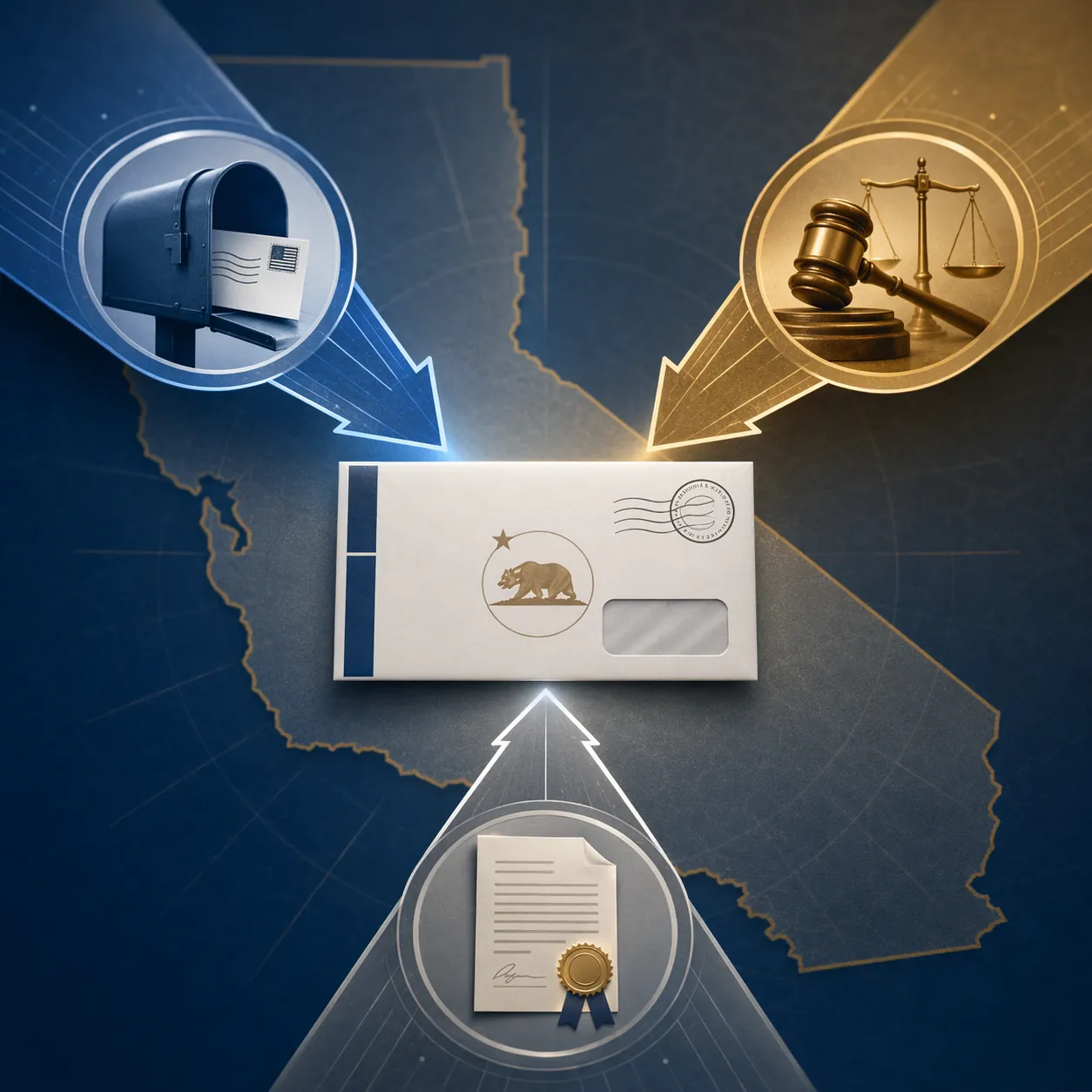
The temptation is to make the spike answer one clean question: did a legal rule change, did a court save the rule, or did counties mishandle signatures? That framing is too blunt for November planning. A late ballot, a mismatched-signature ballot, and a ballot for which cure notice was defective create different facts, different remedies, and different communications risk. A hotline volunteer, campaign lawyer, or county registrar cannot triage them as one undifferentiated rejection category without increasing the chance of giving the wrong instruction to the voter or the wrong theory to the client.
The postmark problem is operational, but it lands as legal exposure
The most important operational change sits outside the Election Code. In December 2025, USPS collection procedures changed so that postmarks reflect the processing-center date rather than the voter’s drop-off date. Los Angeles Times reporting tied that change to a quadruple increase in late-arriving ballots in the November 2025 special election: 8 per 1,000 ballots, compared with 2 per 1,000 in 2024. The same reporting identified heavier impacts in rural counties, including Tulare at 3.52% and Alpine and Merced at 3.36%.[2]
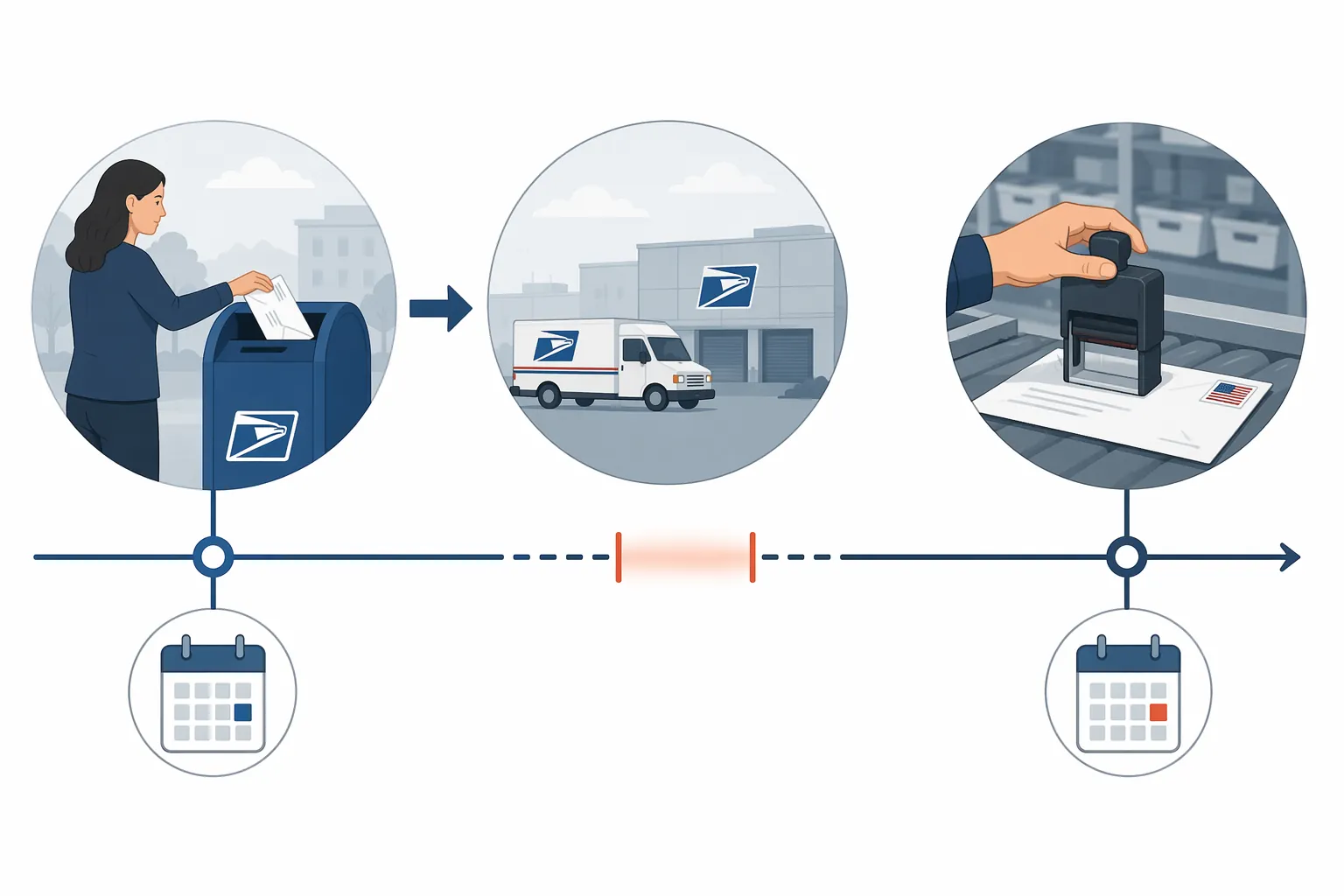
That mechanism matters because California’s grace period depends on a postmark doing a particular evidentiary job. A ballot can be received after Election Day and still count if the statutory conditions are satisfied. But when the postmark reflects processing-center handling rather than voter drop-off, the date on the envelope may no longer cleanly answer the question election officials are trying to resolve: was this ballot mailed on time?
This is where “operational, not legal” stops being a useful endpoint. A voter may have used a mailbox before the deadline. USPS may not have processed the piece until later. The county may then receive an envelope whose postmark does not support timely mailing under the grace-period framework. No one in that chain needs to be acting in bad faith for the ballot to become legally vulnerable.
For counsel, the first cut should therefore be categorical. Lateness rejections tied to postmark evidence require a different factual inquiry than signature mismatch rejections tied to comparison procedure. A pre-litigation letter that treats all June rejections as notice failures will miss the strongest postal-timing issue. A voter-education script that says “mail it by Election Day” without explaining the postmark dependency may be technically familiar and still practically incomplete.
Watson preserved the grace period; it did not repair the timing gap
Watson v. Republican National Committee should be treated as a narrowing clarification, not as a fix. On June 29, 2026, the Supreme Court ruled 5-4 that federal Election Day statutes do not require mail ballots to be received by Election Day, preserving state rules such as California’s seven-day grace period for timely mailed ballots.[3]
That result changed the federal preemption threat, not the envelope-level evidence problem. If a ballot arrives during the seven-day window but carries a postmark that appears too late because of processing-center dating, Watson does not tell the county how to treat that envelope. It leaves California’s grace period standing, but the voter still needs the ballot to qualify under the proof structure the state uses.
The downstream litigation posture reflected that narrowing effect. Issa v. Weber, the challenge to California’s post-Election Day receipt rule, was voluntarily dismissed on July 3, 2026, after Watson.[4] For November advice, that dismissal is significant because it reduces one major attack on the grace period. It is not significant because it solves the USPS postmark change.
The practical mistake would be to tell clients that Watson “saved” California mail voting and therefore cured the June risk. It saved a legal architecture. It did not make a processing-center postmark equivalent to a voter drop-off timestamp, and it did not convert every late-arriving ballot into a countable ballot.
SB 3 moves the signature fight to implementation
SB 3 sits beside the lateness issue rather than inside it. Effective in October 2025, the law changed the compliance terrain for signature verification. The CalMatters Digital Democracy summary identifies several practitioner-relevant features: prohibited consideration of gender, name, address, or time spent when verifying signatures; a 24-hour cure-notification requirement; standardized cure forms; expanded observer rights; and authorization for nongovernmental entities to assist with cure efforts.[5]
| Issue | What SB 3 adds | What it does not settle |
|---|---|---|
| Signature comparison | Bars specified factors from consideration during verification | Does not turn every mismatch into a countable ballot |
| Cure notice | Requires faster notification and standardized cure forms | Does not guarantee uniform county implementation by itself |
| Observers and assistance | Expands observer rights and permits nongovernmental cure assistance | Does not eliminate disputes over access, scripts, or voter contact practices |
| Underlying standard | Creates new procedural obligations around verification and cure | Does not change the existing liberal-construction framework or the basic cure window |
The last row is the one most likely to be lost in campaign-season shorthand. California’s existing signature-verification regulations already include a liberal-construction standard and a two-reviewer unanimous-rejection rule. The research materials do not support describing SB 3 as having replaced those rules or extended the underlying cure window.[6]
What SB 3 does do is create clearer benchmarks for evaluating county conduct after a possible mismatch. If notice goes out too late, if the cure form departs from the standardized form, if reviewers appear to rely on prohibited factors, or if observers are denied access inconsistent with the new rules, the issue is no longer merely whether the original signature call was reasonable. The county’s remedial process becomes part of the exposure.
That is a different problem from USPS timing. A late-postmarked ballot may fail before cure procedures matter. A signature-mismatch ballot may be salvageable if the voter receives timely notice and submits a valid cure. Mixing those categories in public-facing advice can create false reassurance in one direction and unnecessary panic in the other.
Why signature verification remains litigation-sensitive
Signature verification has a longer litigation tail than the 2026 postmark change. Reported 2024 rejection patterns showed county-level disparity, including Imperial County at 2.5% and Amador County at 0.17%, and young voters ages 18 to 24 with rejection rates above 3%. The UCLA Voting Rights Project material is also identified in the research record for evidence of racial bias in signature matching, but it should be handled cautiously unless independently retrieved and preserved, because the underlying page was not fully re-confirmed during research collection.[7][8]
Those figures do not prove that any particular June 2026 county rejection was unlawful. They do explain why a campaign or nonprofit will ask for county-by-county comparisons, age breakdowns, and cure-outcome data rather than accepting a statewide mismatch total as administratively neutral.
La Follette v. Padilla, filed in 2017, remains part of that background because it challenges ballot rejection without adequate notice. SB 3’s 24-hour notice requirement may reduce some of the notice-based vulnerability that animated the case, but uneven implementation would keep the theory alive in practice.[9]
For administrators, that means documentation matters as much as intent. The file should show who reviewed the signature, what standard was applied, when notice was sent, what cure form was used, and how the county tracked voter response. For voter-rights counsel, the same records determine whether the case is about a bad signature call, a deficient cure process, or a data pattern that warrants broader inquiry.
The DOJ investigations add pressure without proving the cause
The federal enforcement climate is part of the risk picture, but it should not be asked to carry more than the sources support. POLITICO reported in June 2026 that the U.S. Attorney’s office opened multiple election-fraud investigations into California elections and that an assistant U.S. attorney was sent to observe Los Angeles ballot processing.[10]
That is a communications and enforcement risk vector. It is not evidence, on the present record, that the June rejection spike was caused by fraud, unlawful signature verification, or county-level ballot processing misconduct. Practitioners advising public agencies should assume records requests, observer disputes, and federal-state correspondence may intensify. Practitioners advising campaigns should avoid converting an investigation headline into a factual claim about why a voter’s ballot was rejected.
November planning has to separate the rejection paths
The immediate work before November is not to pick one headline and build all advice around it. It is to map the rejection path a ballot can enter and assign the right remedial step to each path.
- For lateness risk, review voter-facing materials for claims about mailing deadlines, postmarks, drop boxes, vote centers, and USPS processing uncertainty.
- For signature-mismatch risk, audit county procedures against SB 3 notice, form, observer, and prohibited-factor requirements.
- For cure operations, confirm who sends notice, when the 24-hour clock is triggered, how cure submissions are logged, and how nongovernmental assistance is documented.
- For litigation positioning, preserve the underlying Secretary of State rejection files, county canvass records, USPS-related materials, and cure-notice records before relying on secondary summaries.
- For public messaging, distinguish “mail early,” “use official drop-off options,” and “watch for cure notice” rather than presenting one instruction as a complete protection.
A county clerk will be judged on uniform application and documentation. A campaign lawyer will be judged on whether voter education avoided false assurances. A nonprofit hotline will be judged, at least by the voters who call it, on whether it can tell the difference between a ballot that is too late to fix and a signature issue that may still be curable.
The legal issue in 2026 is therefore not simply “California mail ballot rejection” in the abstract. It is the convergence of a postal evidence problem, a preserved but still evidence-dependent grace period, and a more demanding signature-cure regime. Treating any one of those as the whole story will produce bad advice before it produces a good claim.
References
- California primary rejected mail ballots voting, AP, apnews.com/article/california-primary-rejected-mail-ballots-voting-2291684fe4544cab2301f8965abc8f79
- California election experts sound alarm as rejected ballots quadruple, Los Angeles Times, April 4, 2026, latimes.com/california/story/2026-04-04/california-election-experts-sound-alarm-as-rejected-ballots-quadruple
- Watson v. Republican National Committee, SCOTUSblog, scotusblog.com/cases/watson-v-republican-national-committee/
- Issa v. Weber, League of Women Voters, lwv.org/legal-center/issa-v-weber
- SB 3, CalMatters Digital Democracy, calmatters.digitaldemocracy.org/bills/ca_202520260sb3
- Signature Verification, Ballot Processing, and Ballot Counting Emergency Regulations, California Secretary of State, sos.ca.gov/administration/regulations/current-regulations/elections/signature-verification-ballot-processing-and-ballot-counting-emergency-regulations
- Partisanship and Racial Bias in Signature Matching: Explaining the Ballot Rejection Gap in California, UCLA Voting Rights Project, vrp.ucla.edu/partisanship-and-racial-bias-in-signature-matching-explaining-the-ballot-rejection-gap-in-california/
- California elections officials rejected 122,000 ballots in the 2024 election. Here’s why, Calvoter, calvoter.org/content/california-elections-officials-rejected-122000-ballots-2024-election-heres-why
- La Follette v. Padilla, ACLU, aclu.org/cases/la-follette-v-padilla
- California clashes with Trump DOJ over election fraud probe, POLITICO, June 5, 2026, politico.com/news/2026/06/05/california-clashes-with-trump-doj-over-election-fraud-probe-00952336
Operationalizing workflow
No workflow has been explicitly linked to this obligation yet. See Workflows generally.
Illustrative cases
No illustrative case is currently tracked for this obligation. See Risk Digest for documented incidents generally.
← Back to RegulationReport a correction or tip
Spotted an outdated figure, a misstated fact, or a ruling this regulation entry should reflect? Public comments are disabled for this content given the professional cost of a misreported case outcome, penalty amount, or rule text — use the structured correction channel instead.
Report a correction or tip for this record →