
California Mail Ballot Rejection: Legal Rules and Cure Procedures
- Authority
- California Secretary of State
- Rule type
- regulation
- Jurisdiction scope
- US state
- Source text
- Read primary rule text ↗
Cure signature defects within 24-hour notice and postage-paid return; verify late arrival evidence under Elections Code § 3020.
Verification frame: regulation-ethics; current as of Q3 2026; not legal advice; primary-source links should be checked before use in a filing, client alert, training deck, or voter-contact protocol. The June 2026 primary number used here—148,241 rejected California mail ballots, or 1.73%, reported as the state’s highest rejection rate since 2014—is attributed to AP reporting on California Secretary of State data unless counsel independently obtains and reviews the underlying state data file before publication or reliance. [1]
For counsel, the useful starting point is not “vote by mail” as a political category. It is the point at which a ballot envelope moves from voter conduct into county processing: Was it timely under Elections Code § 3020? Was the envelope unsigned or flagged for signature mismatch under Elections Code § 3019(d) or (e)? Did the county apply the signature-verification regulation in California Code of Regulations, title 2, § 20960? Those questions decide whether counsel is dealing with a noncurable timing problem, a curable signature problem, or a smaller defect category that needs county-level verification.
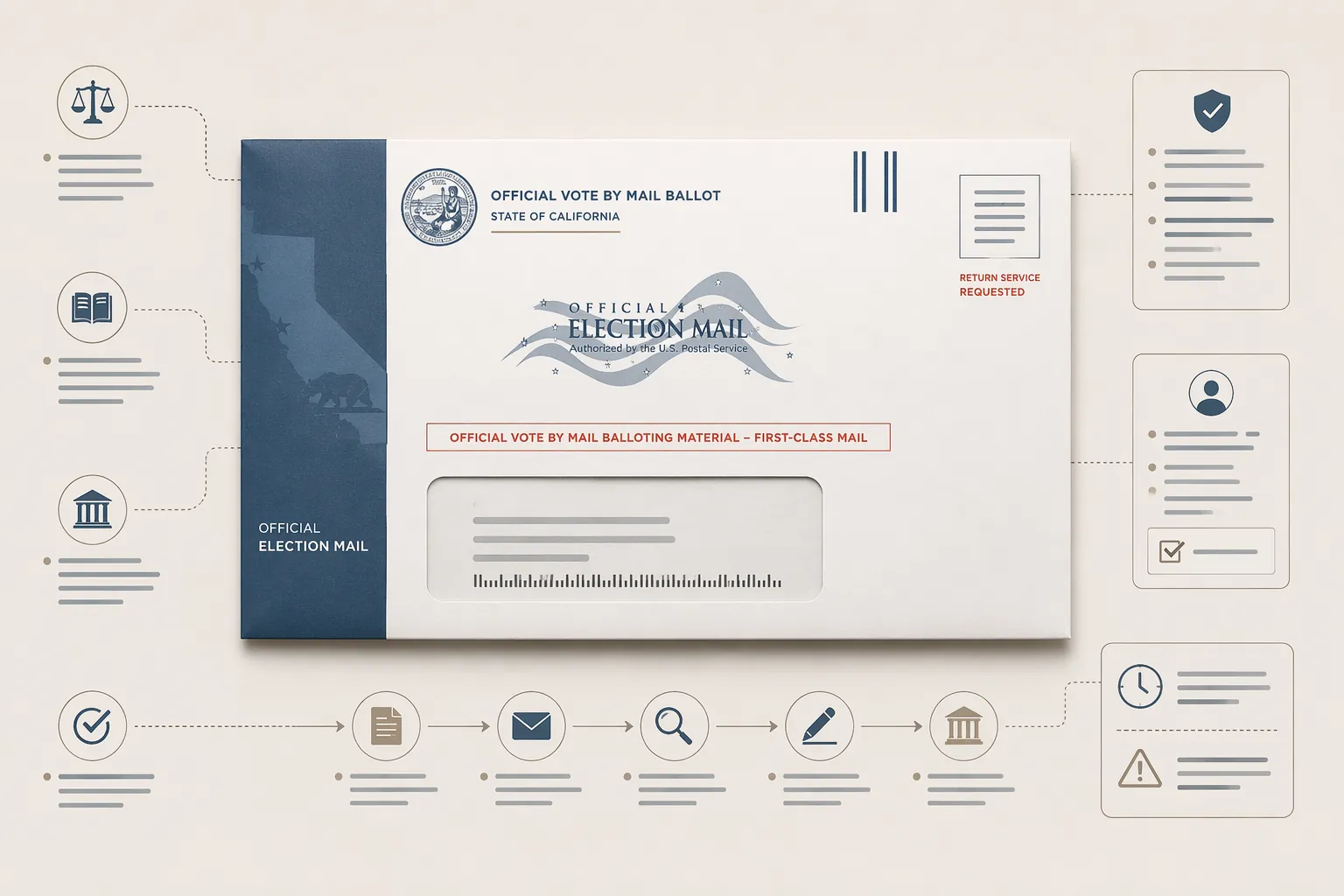
The rejection map counsel actually needs
The June 2026 data gives the legal analysis a clear center of gravity. Late-arriving ballots accounted for 93,479 rejections, or roughly 63% of all rejected mail ballots. Signature-related defects—mismatch and missing signature—accounted for 52,290 rejections, or 35.3%, and those were eligible for cure under the signature provisions. Together, those two categories explain nearly the whole rejection problem counsel is likely to confront in post-election triage. [1]
| Rejection ground | Primary legal hook | June 2026 data point | Cure posture for counsel |
|---|---|---|---|
| Late arrival | Elections Code § 3020 | 93,479 ballots; about 63% of all rejections [1] | Treat first as a timing and evidence issue: postmark, receipt, and any county record of when the ballot entered election-office custody. The cited sources do not identify a cure procedure for a ballot that fails the § 3020 timing rule. |
| Signature mismatch | Elections Code § 3019(d); Cal. Code Regs., tit. 2, § 20960 | Part of 52,290 signature-related rejections, combined with missing-signature ballots [1] | Curable. Review notice timing, return method, language access, deadline, and whether the county applied the voter-protective verification standard. |
| No signature | Elections Code § 3019(e) | Part of 52,290 signature-related rejections, combined with mismatch ballots [1] | Curable. The workflow differs from mismatch review because the problem is absence of a voter signature rather than disagreement with a reference signature. |
| Multiple ballots per envelope or missing ballot | Verify specific statutory and county authority before advising | 743 ballots combined in the cited sources | Do not assume the signature-cure rules apply. These are small-count categories, but the legal consequence for an affected voter can still be final. |
That map leaves little room for generalized advice. A voter whose ballot was rejected because it arrived late is in a different legal posture from a voter whose envelope was timely but flagged for mismatch. A nonprofit reviewing thousands of county notices should therefore sort first by rejection code, not by county, party, or the date the voter calls. County practice matters, but the first branch is statutory.
Late arrival under § 3020
Late arrival carried the June 2026 rejection load. The 93,479 late-arriving ballots reported after the primary were not a rounding error or a background administrative category; they were the majority of rejected mail ballots. [1]
For legal advice, “late” should be unpacked. Section 3020 is not merely a reminder that voters should mail earlier. It directs attention to the ballot’s timing evidence: what date appears on the postmark, when the ballot was received, and whether the county’s records support the rejection code. If a client organization is preparing a cure or outreach operation, this category should be separated from signature notices immediately because the ordinary signature-cure workflow will not solve a failed receipt or postmark requirement.
The fresh complication is postal. AP reported that the late-arrival pattern was driven in part by a December 2024 USPS policy change that decoupled postmark dates from collection dates. [1] That matters because many voting-rights scripts and even some lawyer-facing checklists still speak as if the key fact is when the voter placed the ballot in the mail. After that policy change, the evidence that counts may be less intuitive to the voter: collection, postmarking, and receipt can diverge in ways that affect the § 3020 analysis.
Counsel reviewing a late-arrival rejection should therefore resist two shortcuts. The first is to treat every late rejection as voter error. The second is to treat the postmark rule as if it automatically saves every ballot a voter says was mailed on time. The legally useful question is narrower: what does the county file show about the ballot’s postmark and receipt, and does that file satisfy the statutory timing rule the county invoked?
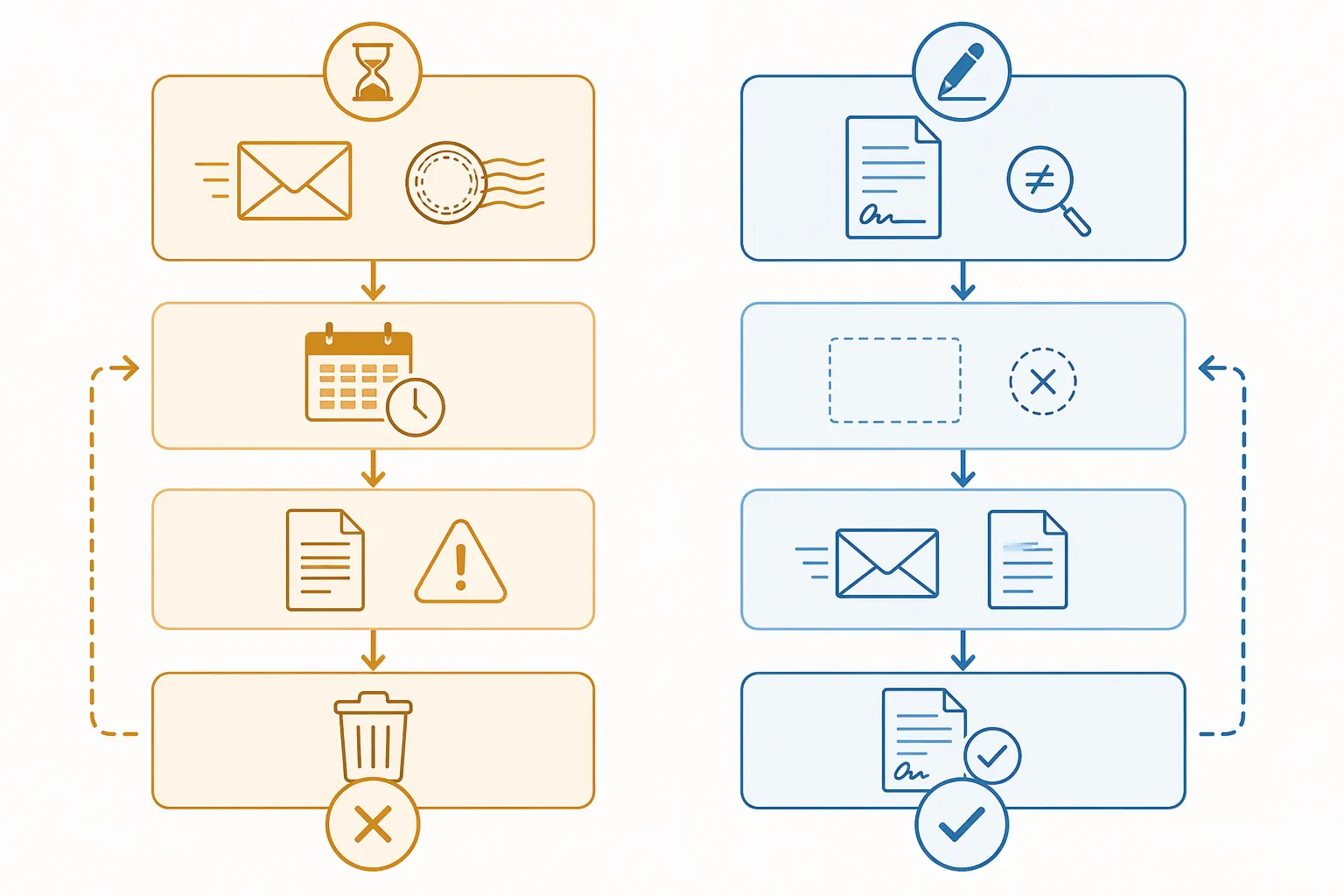
Signature defects: cure rights and the verification standard
Signature problems were the second major category and the main place where voter-facing action can still matter after the county flags a ballot. The June 2026 primary produced 52,290 signature-related rejections, combining mismatch and missing-signature ballots; the cited data identifies that group as eligible for cure under Elections Code § 3019(d) and (e). [1]
The cure workflow is not just a courtesy notice. The cited legal materials identify several operational requirements counsel should check in any county file or voter-contact plan: notice within 24 hours, a postage-paid return envelope, a deadline tied to the election timing and postmark framework, and language-access obligations where Voting Rights Act § 203 applies. Those details matter because a cure right can be lost in practice if the notice is delayed, mailed in a language the voter cannot use, or returned under the wrong deadline assumption.
The verification standard is unusually voter-protective on its face. California’s signature-verification regulation states that a signature is presumed valid, that exact matches are not required, and that comparison must be liberally construed in favor of the voter. It also requires escalation before rejection: two different election officials must unanimously find that the signature differs in “multiple, significant, and obvious” respects, and the regulation uses a beyond-a-reasonable-doubt formulation for that finding. [2]
That standard should change how counsel reads a mismatch rejection. The question is not simply whether two signatures look different to a lay reviewer. The operative question is whether the county’s reviewers applied the regulatory presumption, compared permissible reference signatures, accounted for natural variation, and reached the required unanimous conclusion under the stated threshold. A mismatch notice that gives the voter a cure form is one stage of the process; it does not answer whether the initial rejection was properly made.
Mismatch and missing signature should not be collapsed
A missing-signature ballot presents a cleaner factual problem than a mismatch ballot: the voter did not sign the envelope, or the county processed it as unsigned. A mismatch ballot requires a judgment about handwriting variation. Both are curable in the cited framework, but the legal record counsel requests will differ. For a missing signature, the central issues are notice, form, return deadline, and whether the voter actually supplied the required signature statement. For mismatch, the county’s comparison process and § 20960 compliance are also in play.
This distinction also matters for training volunteers. A script that tells every voter “just sign and return the cure form” may be enough for a missing-signature call, but it is incomplete for a mismatch call where counsel may later need to examine whether the county used the correct standard. The voter-facing instruction can be simple; the legal file should not be.
County variation is an enforcement signal, not proof by itself
Statewide statutes and regulations do not produce perfectly uniform county outcomes. KQED reported county-level variation in the June 2026 primary, including Tulare County at a 3.52% rejection rate while other counties were much lower. [3] That spread is worth tracking, especially for organizations deciding where to request records, deploy language-access support, or monitor cure-notice timing.
The variation does not, on its own, establish motive or illegality. It does justify a county-specific follow-up. A high rejection rate may reflect voter behavior, postal timing, local processing choices, ballot design, outreach gaps, or a mixture of factors. The lawyer’s task is to connect the county’s numbers to the relevant gate: late-arrival evidence, signature-verification practice, cure notice, language access, or another documented rejection category.
The small categories should be treated with similar discipline. Multiple ballots per envelope and missing-ballot cases were reported as 743 ballots combined in the cited sources. That is too small to drive the statewide analysis, but not too small to matter in a close local contest or an individual-rights matter. Because the cited sources do not provide a full statutory cure map for those categories, counsel should verify the governing authority and county records before importing the signature-cure framework.
Litigation and enforcement posture
The statutory framework should be read before the litigation headlines. The pending or recently reported disputes matter because they target the same procedural gates: signature matching, postmark deadlines, observer limits, and county counting practices. But none of those labels is a substitute for the code section, regulation, docket, and order text.
CARA v. Weber is the signature-matching case to verify first if advising on constitutional challenges to California’s review process. Democracy Docket has reported on the challenge as part of broader disputes over California mail-ballot rejection practices, but the cited record does not independently confirm every docket detail, including the precise filing date. [4] Before relying on the case for anything more than issue-spotting, pull the operative complaint, current docket sheet, and any order addressing the signature-verification standard.
Watson v. RNC should be handled with the same caution. The cited record flags it as a postmark-deadline dispute with a reported 5-4 Supreme Court disposition in late June 2026, but also notes that the exact ruling date and opinion text require confirmation from the Supreme Court docket. [4] For a practitioner, that is not a footnote problem. A postmark case can affect advice under § 3020 only to the extent the holding, remedy, timing, and jurisdictional posture are actually established.
Election Integrity Project California v. Padilla remains relevant for federal-court posture around California election-administration challenges. Democracy Docket identifies the matter in the Ninth Circuit context. [4] Counsel should avoid using it as a generic citation for claims about fraud, suppression, or cure-system failure unless the specific Ninth Circuit order supports the proposition being made.
SB 3 is another place where precision matters. Reuters fact-checked claims about the law and reported that the measure, signed May 27, 2026, does not end signature checks for mail ballots. Rather, the fact check describes the law as prohibiting observers from challenging signature-match determinations. [5] That distinction is central: SB 3 may affect who can interfere with or challenge the county’s review, but it does not erase the county’s duty to conduct signature verification under the governing rules.
The reported June 2026 DOJ investigation into Los Angeles County ballot counting should be treated as an unresolved risk item unless and until counsel has the agency letter, subpoena, complaint, or other primary record. It may matter for advice involving county procedures or document preservation, but the existence of a reported investigation is not the same thing as a finding about ballot rejection legality.
Practical advising posture
A workable legal intake for California mail-ballot rejection should ask for four things before analysis begins: the county rejection code or notice, the ballot envelope or cure-notice record if available, the relevant dates shown in the county system, and the voter’s language-access needs. From there, sort the matter into late arrival, mismatch, missing signature, or another category requiring county-specific authority.
For late-arrival matters, focus on § 3020 evidence and the postmark-receipt record. For signature matters, preserve both the voter’s cure path and the county’s verification record under § 20960. For small or unusual categories, do not assume a cure procedure that the statute or county rule does not supply. For litigation-sensitive advice, check the docket the same day the advice is given.
California’s framework is specific enough to advise from, but the June 2026 primary data makes clear where the pressure points are. Late arrival and signature defects are the categories that matter most in volume. Active litigation, the USPS postmark-policy change, and county-level variation make source verification and current county practice part of the legal analysis, not optional follow-up.
References
- Nearly 150,000 mail ballots rejected in California's June primary, AP News, June 2026
- Signature Verification, Ballot Processing, and Ballot Counting Emergency Regulations, California Secretary of State
- California Rejected 150,000 Mail Ballots, Marking Highest Rate Since 2014, KQED
- Pro-Voting Group Says California Rejects Thousands of Lawful Mail-in Ballots Every Election, Democracy Docket
- New California election law does not end signature checks for mail-in ballots, Reuters Fact Check, June 15, 2026
Operationalizing workflow
No workflow has been explicitly linked to this obligation yet. See Workflows generally.
Illustrative cases
No illustrative case is currently tracked for this obligation. See Risk Digest for documented incidents generally.
← Back to RegulationReport a correction or tip
Spotted an outdated figure, a misstated fact, or a ruling this regulation entry should reflect? Public comments are disabled for this content given the professional cost of a misreported case outcome, penalty amount, or rule text — use the structured correction channel instead.
Report a correction or tip for this record →