
Does Carr's 'Speech Police' Denial Survive First Amendment?
- Authority
- U.S. Supreme Court
- Rule type
- judicial opinion
- Jurisdiction scope
- US federal
- Source text
- Read primary rule text ↗
Government officials may not use coercive regulatory pressure to induce private parties to suppress disfavored speech.
Brendan Carr’s July 31 denial — “I don’t view the FCC as the speech police” — is not the end of the First Amendment question. It is the beginning of a narrower one: when is a broadcast regulator enforcing public-interest obligations, and when is it using licensing leverage to pressure editorial judgment before any formal order exists? Carr’s answer rests on the premise that broadcasters occupy licensed spectrum and are therefore “fundamentally different” from cable channels, podcasts, or social media, where he said the FCC has no comparable role.[1][2]
This is a regulation-ethics risk analysis, not legal advice. It is also necessarily provisional. The POLITICO interview is only two days old as of Aug. 2, 2026, and the record should be rechecked for later FCC statements, filings, or court activity before anyone treats this as a litigation memo. The materials doing the work here are Carr’s interview and transcript, the Vullo jawboning analysis, the Kimmel chronology, broadcast-law limits from R Street and RCFP, the civil-society coalition materials, and the post-Slaughter institutional layer.[1][2][3][4][5][6][7][8]
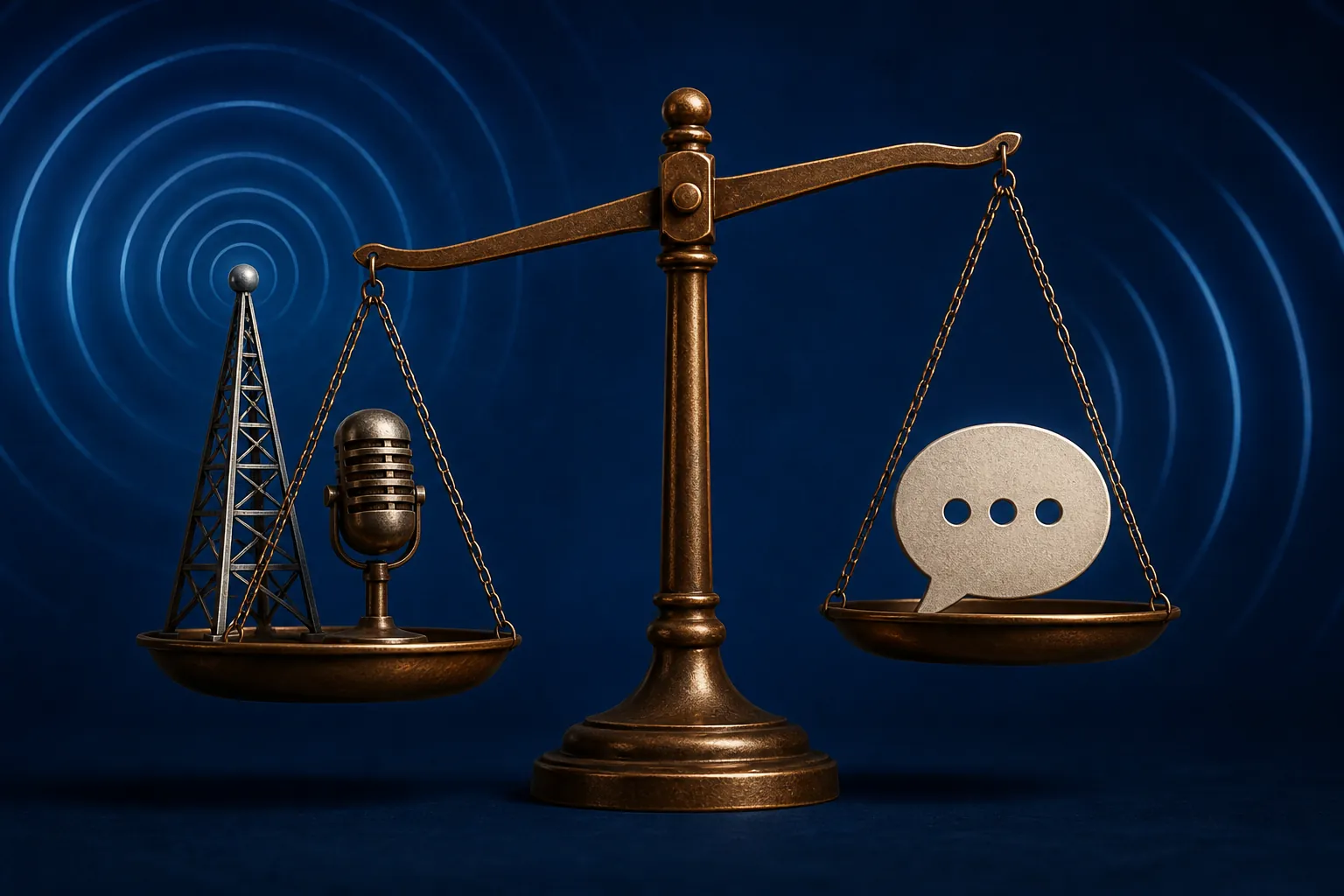
The useful First Amendment analysis is therefore not a broad referendum on whether the FCC may ever supervise broadcast licensees. It plainly may. The harder question is whether Carr’s recent enforcement posture stays inside defined broadcast rules or crosses into the Bantam Books/NRA v. Vullo line: government officials may not coerce private parties to punish or suppress disfavored views.[3]
Carr’s strongest defense is the broadcast distinction
Carr’s best legal ground is not that he dislikes a segment, a network, or a political narrative. It is that broadcast licensees hold government-granted spectrum rights and accept obligations that do not attach to a podcast host, a cable programmer, or a social-media platform. In the POLITICO exchange, he leaned hard on that distinction, describing broadcast as a special category and rejecting any FCC role over social media.[1][2]
That distinction matters. A licensed broadcaster is not just another speaker in the regulatory system. It has renewal obligations, public-file obligations, children’s-programming obligations, political-broadcasting obligations, and exposure to complaint-driven review. Counsel inside a licensee cannot advise management as if the company were simply a website with an audience. If the FCC is enforcing a defined broadcast rule on a developed record, Carr’s “not speech police” position has real doctrinal force.
The stronger examples are the ones Carr and his defenders can frame as rule-bound: equal-time obligations, the broadcast hoax rule, and the news-distortion policy. Even there, the limits are tight. R Street describes the hoax rule as applying to false information about a crime or catastrophe, with knowledge of falsity and likely substantial public harm. It describes the news-distortion policy as requiring deliberate distortion of a significant factual event, not mere inaccuracy, opinion, or aggressive framing.[5]
RCFP’s warning is consistent with that narrowness: the Supreme Court has repeatedly treated FCC authority over licensee journalism as “exceedingly narrow,” and the news-distortion policy is especially vulnerable to improper use because it sits so close to editorial judgment.[6] That does not make the policy unconstitutional in every application. It does mean the FCC’s safest path is boring administrative law: identify the rule, build the record, apply it evenly, explain the remedy, and keep presidential or partisan displeasure out of the decisional chain.
That is also why the license-revocation debate should not do all the work here. Two earlier Lex Machina Review pieces already cover the defense-side verdict: why broadcast-license threats are legally unviable and why viewpoint-based Trump FCC license-revocation threats fail. This article is about a different exposure: coercive pressure that changes programming, affiliate carriage, or renewal strategy before a revocation order ever exists.
The coercion question starts before the FCC issues an order
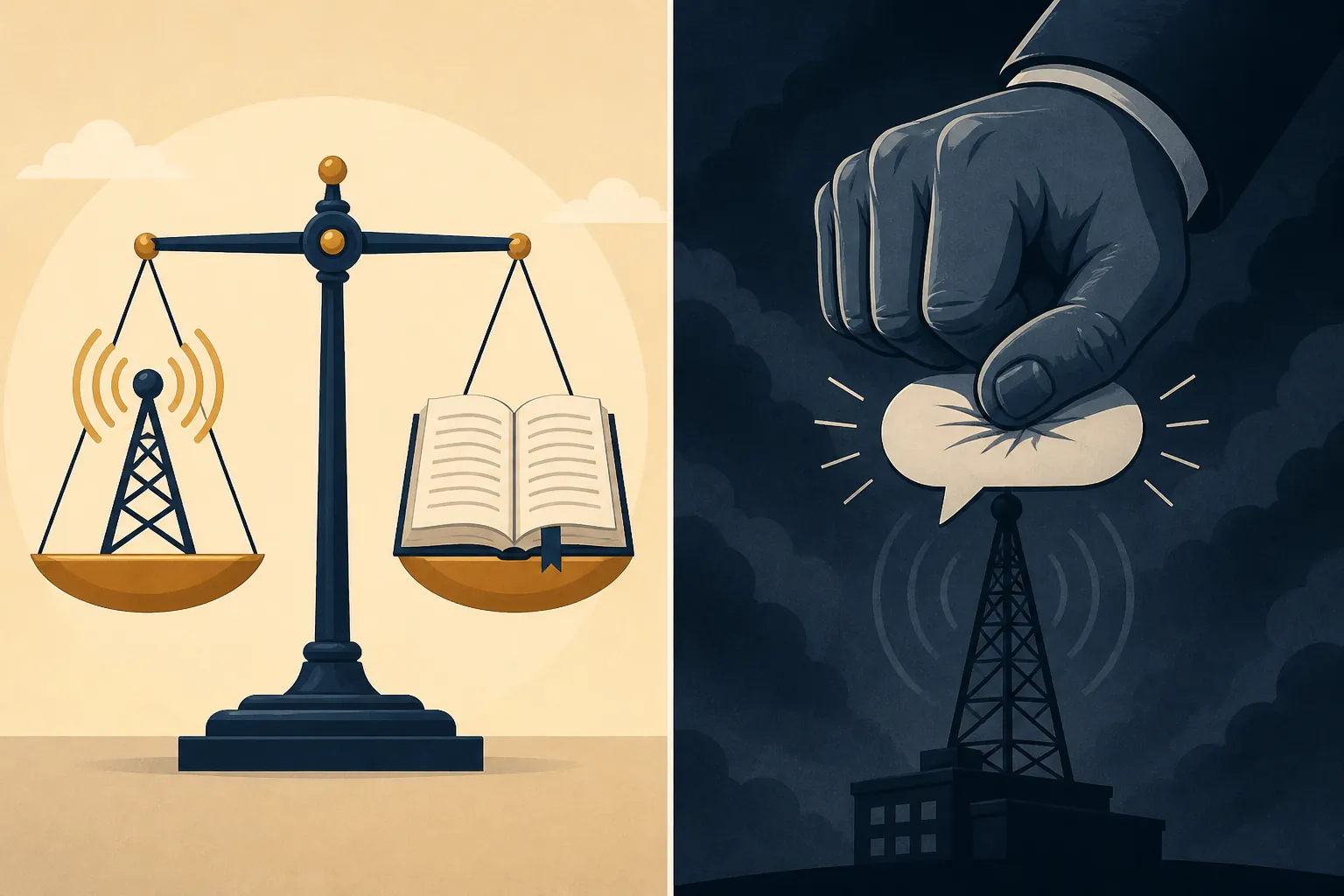
The main risk in the Kimmel episode is not that the FCC immediately revoked a license. It did not. The risk is that a regulator with authority over broadcast licenses spoke in a way that a regulated party could reasonably hear as a threat, and programming decisions followed quickly.
NPR’s Sept. 19, 2025 chronology reports Carr’s warning this way: “We can do this the easy way or the hard way,” followed by “on Kimmel, or there’s going to be additional work for the FCC ahead.” Hours later, ABC suspended Jimmy Kimmel’s show, while Nexstar and Sinclair preempted the program on their stations.[4]
That sequence is why Vullo matters. The Supreme Court’s 2024 jawboning analysis, as applied by Divided Argument’s law-professor commentary, focuses on four factors: word choice and tone, whether the target would perceive a threat, the official’s regulatory authority, and the adverse consequences being signaled.[3] The doctrine does not require a final agency order. It is aimed at the government official who tries to accomplish indirectly, through private intermediaries, what the First Amendment would not allow directly.
| Vullo factor | What counsel would test in the Kimmel record |
|---|---|
| Word choice and tone | Whether “easy way or hard way” sounds like ordinary policy commentary or a demand backed by official consequences.[4] |
| Perception as a threat | Whether ABC, affiliates, or station groups with FCC exposure would reasonably understand the statement as a warning to alter carriage or programming. |
| Regulatory authority | Whether the speaker controlled or influenced licensing, renewal, complaint processing, merger review, or other FCC business affecting the regulated entities.[3] |
| Threatened adverse consequences | Whether “additional work for the FCC ahead” pointed to concrete regulatory burdens rather than public criticism alone.[4] |
The phrase that matters most is not “speech police.” It is “easy way or hard way.” A chair may announce an investigation, identify a rule, invite complaints, and say the agency will review evidence. A chair who sounds as if he is supervising a negotiation between a network and its affiliates creates a different problem. The regulated company’s counsel must then ask whether the company is making an editorial decision, a business decision, or a risk-avoidance decision in response to government pressure. In practice, those categories can collapse in a single afternoon.
Defined rules help Carr; selective leverage hurts him
Carr’s process defense in the POLITICO transcript is that the agency acts on “the facts, the law, and the record.”[2] That is exactly the right vocabulary for the FCC. It is also the vocabulary courts will test against the surrounding facts.
An equal-time case, for example, is not constitutionally equivalent to a demand that a broadcaster stop airing a disfavored comedian. R Street’s March 2026 critique of DA-26-68A1 argues that the FCC’s January 2026 equal-time guidance reinterpreted political-broadcasting obligations in a way that drew a Democratic commissioner’s dissent accusing the agency of seeking to “censor and control speech.”[5] That is a serious allegation, but the legal question still begins with the rule: who was a legally qualified candidate, what use occurred, whether an exemption applied, what comparable opportunity was denied, and whether the agency applied the same theory across partisan lines.
The hoax and news-distortion warnings present the same split. If the FCC has evidence that a licensee knowingly aired false information about a crime or catastrophe likely to cause substantial public harm, the hoax rule supplies a defined channel.[5] If the agency has evidence of deliberate distortion of a significant factual event, the news-distortion policy supplies a narrower but still recognizable channel.[5][6] If instead the agency is using those labels to express dissatisfaction with tone, framing, satire, or political hostility to the administration, the public-interest label does much less work.
That distinction is not formalism. It determines the remedy and the forum. A licensee or affected speaker does not need to prove that revocation is likely tomorrow to seek a declaration that the pressure campaign is unconstitutional. Divided Argument’s analysis treats the likely remedy for a successful jawboning claim as declaratory and possibly injunctive relief, while emphasizing that damages are not the practical center of gravity.[3]
Pending FCC business changes the risk calculation
Counsel for ABC, Disney, Nexstar, Sinclair, or any licensee group does not evaluate a chair’s statement in a vacuum. The company may have renewal exposure, ownership questions, transactions, complaints, rulemaking interests, political-file concerns, or affiliate relationships that can be affected by FCC timing. That is why “no one actually lost a license” is an incomplete answer.
R Street makes the timing point sharply: no broadcast renewal has been denied in decades, and the relevant renewal cycle does not begin until late 2028. On that account, the immediate function of renewal threats is not legal execution but atmosphere — a climate in which broadcasters may self-censor to avoid regulatory trouble.[5]
That is the risk-side answer to the revocation articles. The Communications Act, First Amendment limits, the news-distortion standard, and the renewal calendar may make actual revocation difficult. But a jawboning theory is built for the earlier moment: the phone call not made, the segment not aired, the affiliate preemption imposed, the standards department overruled, the executive told to avoid provoking Washington until a license, merger, or complaint matter clears.
The civil-society coalition materials sharpen this point through due-process and vagueness concerns. The TechFreedom-led March 2026 letter, joined by more than 75 signatories according to the cited materials, asked the FCC to halt unlawful threats to press freedom and pressed the agency to define the public-interest standard through rulemaking rather than ad hoc pressure.[7] The signatory count is less important than the legal demand: tell regulated speakers in advance what rule governs them, and do not let “public interest” become a movable label for disfavored coverage.
The Slaughter layer weakens the process defense
The institutional setting in 2026 makes Carr’s process defense harder to separate from presidential politics. Secondary reporting and business-law analysis describe the June 2026 Supreme Court decision commonly discussed as Trump v. Slaughter as ending the Humphrey’s Executor model of independent agencies and shifting agency behavior toward political control. The precise Supreme Court caption and operative language should be verified before publication, but the risk point does not depend on a slogan: if commissioners are more removable and agencies are more visibly presidential, courts and regulated parties will be less willing to treat process language as insulation from political pressure.[8]
Carr’s own testimony and interview answers add to that exposure. At a December 2025 oversight hearing, Senate materials report Carr saying, “The FCC’s not an independent agency formally speaking.”[9] In the July 31 POLITICO transcript, he declined to state a limiting principle on whether a president may direct FCC probes.[2] Those statements may be defensible as separation-of-powers realism after Slaughter. They are less helpful when the agency needs a court to believe that a contested broadcast action emerged from neutral expertise rather than political direction.
This is where administrative law and First Amendment law meet. A court reviewing an FCC order asks about authority, reasoned decision-making, the record, and remedy. A court reviewing a jawboning claim asks about pressure, leverage, threats, and suppression of disfavored views. The same facts can matter in both inquiries. A hurried investigation, a public warning that precedes any record, a target with pending FCC business, and a remedy untethered to a defined rule all make the agency look less like a public-interest regulator and more like a political intermediary.
What regulated-media counsel should verify
The practical work for a licensee is not to decide whether Carr is a censor in the abstract. It is to preserve the distinction between lawful compliance and coerced editorial change.
- Identify the rule. Is the FCC invoking equal time, hoax, news distortion, renewal standards, ownership review, or a general public-interest concern?
- Demand the record. What complaint, evidence, transcript, broadcast, candidate request, or factual predicate supports the agency’s concern?
- Compare treatment. Has the same theory been applied to similarly situated licensees or speakers across viewpoint and party lines?
- Map pending business. What licenses, transactions, waivers, complaints, or renewals give the FCC leverage over the company at the time of the statement?
- Document causation carefully. If programming changes after official pressure, record who made the decision, what alternatives were considered, and whether the change was tied to fear of FCC consequences.
- Separate public criticism from regulatory threat. Officials may criticize speech. The constitutional risk rises when criticism is coupled with authority and threatened adverse consequences.
That last distinction is the one that will decide most close cases. A chair may say a broadcast was irresponsible, offensive, or beneath the standards expected of a licensee. A chair may not use licensing power to induce a network, affiliate group, or station owner to suppress views the government disfavors. The more the record contains defined rules, even-handed application, and ordinary process, the more Carr’s denial survives. The more it contains selective timing, public threats, presidential alignment, and regulated parties changing programming under pressure, the more the case moves into Vullo territory.
Risk verdict
Carr’s “speech police” denial is legally sustainable only in its disciplined form: the FCC is enforcing defined broadcast rules, on a record, even-handedly, with remedies tied to statutory authority. That version deserves to be taken seriously because broadcast licensees do carry obligations that cable programmers, podcasters, and social-media platforms do not.
The denial is much weaker where FCC action functions as selective, viewpoint-driven pressure on licensees with pending regulatory business. In that setting, public-interest language does not cure the First Amendment problem. It becomes the vocabulary through which the pressure is delivered.
For regulated companies, the central exposure is not damages or immediate license loss. It is chilled speech, emergency litigation, declaratory relief, possible injunctions, and reversibility when political control changes. After Slaughter, the FCC’s claim to neutral institutional distance is thinner. That does not make every Carr enforcement move unconstitutional. It does mean the agency’s safest defense is no longer the chair’s assurance that he is not the speech police. It is a record that proves the agency acted like a regulator.
References
- Brendan Carr: ‘I don’t view the FCC as the speech police’, POLITICO, July 31, 2026
- Full transcript: Chairman of the Federal Communications Commission Brendan Carr, POLITICO, July 31, 2026
- Did Brendan Carr Violate the First Amendment? And Can Anything Be Done?, Divided Argument, Sept. 19, 2025
- FCC Chair Carr's threats over Kimmel raise free speech concerns, NPR, Sept. 19, 2025
- It’s Time for Congress To End the FCC’s Escalating War on Free Speech, R Street Institute, March 18, 2026
- FCC chairman’s testimony raises ‘serious constitutional concerns’, Reporters Committee for Freedom of the Press, Dec. 2025
- Response to FCC Chair Brendan Carr March 2026, TechFreedom, March 20, 2026
- The End of Independent Federal Agencies Will Change Your Business, Harvard Business Review, June 2026
- Klobuchar Questions Carr on Censorship and Free Speech at FCC Oversight Hearing, Office of U.S. Senator Amy Klobuchar, Dec. 2025
Operationalizing workflow
No workflow has been explicitly linked to this obligation yet. See Workflows generally.
Illustrative cases
No illustrative case is currently tracked for this obligation. See Risk Digest for documented incidents generally.
← Back to RegulationReport a correction or tip
Spotted an outdated figure, a misstated fact, or a ruling this regulation entry should reflect? Public comments are disabled for this content given the professional cost of a misreported case outcome, penalty amount, or rule text — use the structured correction channel instead.
Report a correction or tip for this record →