
The Ceuta asylum ruling behind the Morocco border crisis
- Authority
- Spanish Supreme Court
- Rule type
- court ruling
- Jurisdiction scope
- Spain
- Effective date
- Jun 29, 2026
- Source text
- Read primary rule text ↗
Use ordinary devolución procedure with asylum and due-process safeguards for open-water interceptions; do not apply rechazo en frontera.
Verification status and scope
| Field | Record |
|---|---|
| Publication lane | Regulation & Ethics obligations record; not a news liveblog and not legal advice. |
| Last verified | 2026-08-02 UTC. |
| Primary-source note | Before using this analysis for filing, removal, detention, or litigation decisions, verify the official Supreme Court text for STS 814/2026 and any later administrative instructions, court orders, or legislative amendments. The public legal analysis cited here identifies the judgment and holding; the operative text remains the official judgment. |
| Case identified | STS 814/2026, Spanish Supreme Court, Administrative Chamber, Fifth Section, June 29, 2026, ECLI:ES:TS:2026:2965, cassation appeal 3795/2025. The underlying posture concerned Algerian nationals intercepted while swimming toward Ceuta in 2024. [1] |
| Immediate correction | The judgment did not decide the July 2026 mass crossing, did not rule on Spain’s later return operation, and did not say that everyone intercepted near Ceuta or Melilla may remain in Spain. |
| Legal-background review | Required before publication or client reliance; no named reviewer is identified in this record. |
The phrase “Ceuta Morocco border crisis asylum law” now points readers toward one ruling, but the first error is treating that ruling as the legal trigger for everything that followed. STS 814/2026 was decided on June 29, 2026. The mass-crossing and return-operation reporting that made the judgment politically visible came later, in late July and early August, and live reports have not settled the number of arrivals, deaths, or removals with enough consistency to make those figures the center of a legal obligations record. CNN and Euronews both framed the judgment as central to Spain’s immediate dilemma, but the legal question the Supreme Court answered was narrower than the crisis headlines suggest. [2][3]

The Supreme Court did not ban returns at Ceuta and Melilla. It held that the special rejection-at-the-border regime, rechazo en frontera, did not cover swimmers intercepted at sea because open water is not a physical border-containment element. Drones, thermal cameras, and sensors were treated as surveillance tools, not containment elements. That distinction—containment versus surveillance—is the hinge of the judgment. [1]
Once the case is read that way, two bad briefings fall away. One is the reassuring official shorthand that ordinary returns remain available without spelling out the safeguards that make them ordinary. The other is the opposite headline, that exclusion from the special border-rejection regime means Spain cannot return the person at all. The ruling closes one procedural shortcut for one category of interception; it does not erase the devolución route under the Aliens Law.
What the Supreme Court actually took out of the special regime
The special regime at issue is the Tenth Additional Provision governing rejection at the borders of Ceuta and Melilla, inserted into Spain’s immigration-law framework by Organic Law 4/2015. The Court read that regime as tied to attempts to cross physical border-containment elements: the fence, equivalent land-border structures, and, in the Court’s own forward-looking language, potentially physical containment structures placed at sea. It did not read the statute as covering every irregular approach to Spanish territory from Moroccan waters. [1]
That is why the swimmers mattered. They were not alleged to have climbed the fence or crossed through a land-border post. They were intercepted in the water. The government’s argument depended on treating the maritime surveillance environment around Ceuta—drones, cameras, sensors, detection systems—as functionally equivalent to a border barrier. The Court refused that move. Detection is not containment; watching a person swim is not the same legal event as stopping a person at a physical barrier. [1]
That may look technical, but technical is exactly what matters in this file. The wrong procedural label changes who signs the decision, whether the individual file is built, whether a lawyer can intervene before removal, whether an interpreter is required, whether an asylum request suspends execution, and whether custody must go before a judge after the statutory time limit.
| Question | Answer after STS 814/2026 |
|---|---|
| Does rechazo en frontera apply to swimmers intercepted in open water near Ceuta or Melilla? | No, on the Court’s reading of the existing statute, because open water is not a border-containment element. [1] |
| Do surveillance tools convert the sea into a containment element? | No. Drones, thermal cameras, and sensors are surveillance tools, not physical containment structures. [1] |
| Does the ruling prevent Spain from initiating an ordinary return procedure? | No. The ordinary devolución route remains available if its statutory and procedural safeguards are observed. [1] |
| Did the Court decide the legality of the July 2026 mass crossing response? | No. The judgment predates that operational crisis. |
| Did the Court classify Spain’s August 2026 floating barrier at Tarajal? | No. The barrier is the forward-looking classification problem, not an issue decided in the judgment. |
The ordinary devolución route still exists, and it is not a paperwork formality
For practice purposes, the important surviving route is devolución under Article 58(3) of Organic Law 4/2000. That procedure is available for certain irregular entries or attempted entries, but it is not an immediate border rejection by another name. It requires an individual administrative decision by the competent authority, and the person affected retains access to a lawyer and, where needed, an interpreter. [1][4]
The asylum point is equally concrete. If the person requests international protection, the return cannot simply proceed as though nothing happened. The cited procedure materials for Spain describe suspension of the return once international protection is requested, together with access safeguards that are supposed to make the request identifiable in practice rather than theoretical on paper. [5]
Custody also has a hard edge. If the person is detained for the purpose of return and the situation extends beyond 72 hours, judicial authorization is required. That time limit matters at the border precisely because initial processing can be crowded, multilingual, and rushed; the legal file does not improve because the holding room is full. [1][5]
Minors require a separate track. They should not be folded into the adult return channel by administrative convenience or by the speed of a mass event. The materials flag the Supreme Court’s separate July 8, 2026 minors ruling, STS 868/2026, as an objection point in the current legislative debate; that judgment should be checked directly against the official text before it is used as authority in a live matter.
A practical pre-return screen after STS 814/2026 therefore begins before anyone argues about policy. The person handling the file needs to know where the interception occurred, whether a physical containment element was crossed or approached, whether the person expressed fear of return or requested protection, whether age is contested or minority is apparent, whether counsel and interpretation have been provided, and how long the person has been held. That kind of sequence is closer to a verification workflow than to a slogan; the same discipline used in legal fact-checking checklists, such as this site’s verification workflow model, is the right posture for a border-return record.
- Classify the encounter: land-fence containment, authorized border post, open-water interception, or contact with a physical sea barrier.
- Identify the procedure actually being used: rechazo en frontera or ordinary devolución.
- Record the individual decision-maker and the grounds for return.
- Confirm access to counsel and interpretation.
- Ask and record whether international protection is requested; suspend return if the protection request is made.
- Screen for minority and separate the child-protection track from adult return processing.
- Track detention time and obtain judicial authorization if custody exceeds 72 hours.
None of those steps turns the Supreme Court ruling into a permission slip to remain in Ceuta. They are the conditions that make an ordinary return procedure legally different from an immediate rejection at a border structure.
Where Strasbourg fits, and where it does not do the work
The Supreme Court’s ruling sits inside the existing Strasbourg frame created by N.D. and N.T. v. Spain, the Grand Chamber judgment of February 13, 2020. In that case, the European Court of Human Rights addressed immediate returns at the Melilla fence and accepted, on the facts before it, Spain’s position in circumstances involving unauthorized collective entry over the border fence and the availability of legal-entry channels. [6]
STS 814/2026 did not reopen N.D. and N.T. as a broad moral or human-rights referendum on Spanish border policy. The more modest move was statutory: the Supreme Court distinguished fence-crossing from swimming and said the Spanish special regime, as currently written, does not reach the latter merely because the area is watched by maritime-surveillance equipment. Expert commentary by Gemma Pinyol-Jiménez and Daniel Thym makes the same point: the decision is technical, does not collapse all Ceuta and Melilla returns, and does not mean intercepted swimmers may simply stay. [1]
Tarajal is the live classification risk
The most important future-facing part of the judgment is not the holding about swimmers. It is the Court’s obiter about what might happen if Spain placed physical containment structures at sea. The Court did not say that all sea interceptions are forever outside rechazo en frontera. It said the open sea and surveillance tools were not enough under the statute before it. A physical sea barrier could be different. [1]
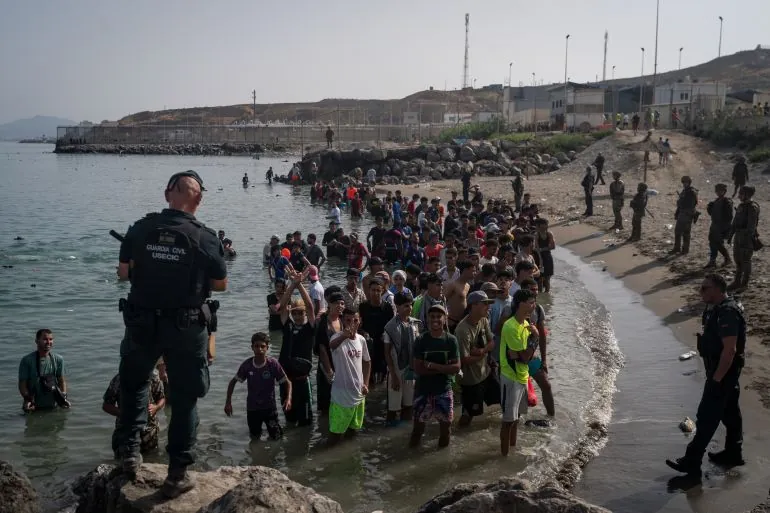
That is why the floating barrier at Tarajal cannot be waved away as a security installation outside the ruling. Spain began installing a roughly 500-meter floating barrier at Tarajal on August 1, 2026, according to live crisis reporting. But STS 814/2026 did not classify that barrier, because it was not the object before the Court. [2][3]
The compliance question is conditional. If the Tarajal barrier is treated as a physical border-containment element, officials may argue that interceptions at or around it fall back within the special rejection regime. If it is treated as a safety, channeling, or surveillance-adjacent device rather than a border-containment element, the argument is weaker. The judgment supplies the distinction; it does not supply the classification.
That leaves practitioners with an uncomfortable but ordinary task: freeze the facts before the law is summarized. What is the barrier’s legal instrument? Where exactly was the person stopped? Was the person touching, crossing, avoiding, or merely near the barrier? Did the encounter happen in Moroccan waters, Spanish waters, the beach zone, or a controlled access point? Which authority acted, and under which written procedure? Those facts will decide whether the Supreme Court’s containment language helps the administration or the person facing return.
Crisis figures are context, not the legal holding
The July and August reporting explains why this judgment became urgent. Reports have described mass arrivals into Ceuta, pressure on reception and return capacity, and a Spanish effort to prepare removals in coordination with Morocco. CNN, Euronews, and El Constitucional all treated the ruling as a central legal constraint on the Spanish response, but they did so amid live figures and operational claims that were still moving as of August 2, 2026. [2][3][4]
That uncertainty should not be cleaned up by pretending the Court settled it. The judgment was earlier than the mass event. It did not count arrivals, approve a Morocco–Spain return operation, decide the legality of the Tarajal barrier, or adjudicate the facts of any later group return. Those questions require current administrative records, bilateral-readmission documents, custody files, asylum-access records, and, where available, court orders.
Legislative watch: the PP bill would move the statutory perimeter
There is also a legislative track. A Popular Party organic-law proposal was admitted by the Congress Bureau on July 23, 2026 and published on July 27, 2026. The bill would extend the special border-rejection regime to irregular entry by land or sea at unauthorized points, a change aimed directly at the gap exposed by STS 814/2026. Because it is framed as an organic-law change, it requires an absolute majority. [4]
That bill should be watched, not treated as enacted law. It faces objections from NGOs and from the minors-protection problem sharpened by the Supreme Court’s July 8, 2026 minors ruling identified in the available materials. Until the bill is enacted, amended, defeated, or replaced, the current compliance analysis still starts with the statute interpreted in STS 814/2026.
The working rule as of 2026-08-02 UTC
For a legal-practice briefing, the safest formulation is this: STS 814/2026 narrows the special rechazo en frontera regime for sea interceptions at Ceuta and Melilla where the person is intercepted in open water and the state relies on surveillance rather than a physical containment element. It does not prohibit ordinary devolución proceedings, and it does not remove the lawyer, interpreter, asylum-suspension, custody, judicial-authorization, and minors safeguards that attach to that route.
The floating barrier at Tarajal is now the live legal classification issue. It may be argued into the Court’s physical-containment category; it may also be contested on facts and function. As of the verification date, that question requires re-verification before anyone turns the June 29 judgment into a return instruction, a litigation theory, or a headline.
References
- The Spanish Supreme Court on Rejection at the Borders of Ceuta and Melilla: What About Human Rights at Sea? – EJIL: Talk!
- The Supreme Court ruling at the center of Spain's Ceuta migrant crisis – CNN, August 1, 2026
- Spain's legal dilemma behind Ceuta's record migrant arrivals – Euronews, July 31, 2026
- The Supreme Court sets the limit for hot returns while Spain prepares returns from Ceuta – El Constitucional
- Access to the territory and push backs – AIDA/ECRE Spain country report
- N.D. and N.T. v. Spain, Grand Chamber judgment of 13 February 2020 – HUDOC
Operationalizing workflow
No workflow has been explicitly linked to this obligation yet. See Workflows generally.
Illustrative cases
No illustrative case is currently tracked for this obligation. See Risk Digest for documented incidents generally.
← Back to RegulationReport a correction or tip
Spotted an outdated figure, a misstated fact, or a ruling this regulation entry should reflect? Public comments are disabled for this content given the professional cost of a misreported case outcome, penalty amount, or rule text — use the structured correction channel instead.
Report a correction or tip for this record →